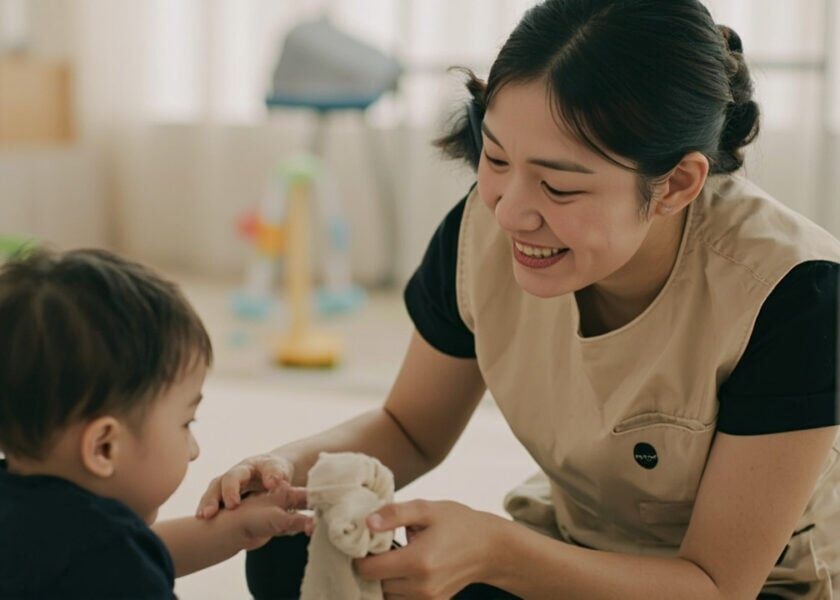
How Singapore Parents Recognize Quality Childcare Over Time
The Quiet Shift: What Singapore Parents Notice After Choosing Childcare
You did the research. You toured the centres. You read the reviews, weighed the options, and asked the questions that mattered. You made a choice — and you made it carefully.
But tonight, I want to talk about what happens after that. Because choosing childcare is not the end of a journey. It is, in many ways, the beginning of one.
There is a quiet shift that happens — sometimes within weeks, sometimes over months — when you begin to notice things you didn’t expect to notice. Subtle things. Small things. Things no brochure captures and no tour can fully reveal.
The different quality of response from a caregiver when your child is tired and out of sorts. The way a morning handoff either feels tense or feels like handing your child to someone who genuinely wants them to have a good day.
These moments do not announce themselves. But they accumulate. And over time, they tell you something that no checklist ever could: whether the care your child is receiving is adequate, or whether it is something more.
If you are beginning to notice these things, this article is for you. What you are sensing is real. And the growing confidence you feel alongside those moments of uncertainty is not naive optimism. It is the beginning of a kind of knowledge that only comes from paying close, loving attention.
What No Tour Can Show You
We talk a great deal about how to choose childcare. What we discuss far less is the sophisticated, observant intelligence that Singapore parents develop once they are inside quality care — the way your instincts sharpen, your capacity to read a room deepens, and you start to notice things about your own child’s wellbeing that you never had to notice before.
Think of the last time you picked your child up at the end of the day. You arrived a little early, maybe. You paused at the door or the gate. And for a moment before your child saw you, you watched.
Not to check up on anyone. Not out of distrust. But because you love your child, and love makes you attentive.
What did you see? Perhaps your child was engaged — not just occupied, but genuinely engaged, their attention held by a caregiver who was sitting at their level, narrating what they were doing, letting the child lead. Or perhaps you noticed something quieter: your child was distressed, and the caregiver was already responding — calmly, warmly, without urgency or exasperation.
They knew your child’s particular brand of a difficult afternoon. They knew that a specific song, or a specific object, or simply a particular tone of voice would help.
That knowledge — that deep, contextual knowledge of a specific child — is not something that can be verified on a tour. It is something that reveals itself over time. And it is something you, as a parent, are already learning to recognise.
The Off-Script Moment: Where Quality Really Shows
There is a particular kind of moment I want to name, because I believe it is one of the most important signals of quality that exists — and one of the least discussed.
I call it the off-script moment. Every childcare environment has its rhythms, its routines, its expected behaviours. The off-script moment is when something unexpected happens — a child falls, a child has a meltdown that is louder and longer than usual, a child is simply having a hard day that defies the usual remedies — and you see how the caregiver responds.
Not the scripted, routine response. The human response. The one that reveals whether this person is genuinely attuned to children, or whether they are executing a set of procedures.
When I think about what separates adequate supervision from genuine, transformative care, I think about off-script moments. I think about the caregiver who, without being prompted, sits down next to a distressed child rather than standing over them. Who matches their own breathing to the child’s, almost unconsciously. Who doesn’t try to fix the feeling quickly but lets the child feel it, and stays.
Who notices, perhaps before the parent does, that a child is not quite themselves today — that something is slightly off, slightly subdued — and adjusts accordingly.
Quality care also has a sound. It sounds like a caregiver speaking to a child in a voice that is warm without being performative, that matches the pace of the child’s own attention. It sounds like children who are comfortable enough to be noisy — to laugh, to argue, to narrate their play loudly and with complete confidence that they will be listened to.
Quality care has a texture. It is felt in the way a caregiver holds a fussy infant — not mechanically, not according to a technique, but in a way that suggests they have learned this particular child’s body language, their preferences, the particular rhythm that calms them. It is felt in the way a toddler’s face changes when their caregiver enters the room — not because of a dramatic reunion, but because there is an immediate, subtle settling. A recognition.
Why Singapore Parents Are More Perceptive Than They Realise
The world we live in does not always trust us to know what we are seeing. It is saturated with information, with metrics, with developmental charts and comparison tools. These things have their place. But they can also crowd out something more valuable: the quiet, embodied knowledge that develops when you watch your child closely over time.
When you know what their baseline looks like on a good day. When you can feel, in your body, the difference between a child who is merely safe and a child who is genuinely flourishing.
Research in attachment theory and early childhood development tells us something remarkably consistent: children who are known, who are responded to as specific individuals with specific temperaments and needs, develop differently. Their stress systems mature differently. Their capacity for curiosity and exploration deepens. Their language emerges earlier and with greater richness.
The first thousand days of a child’s life are not just days. They are the architecture of everything that follows. And the people who shape that architecture are not interchangeable. Their quality matters enormously.
So when I say that Singapore parents are more perceptive than they give themselves credit for, I am not simply being kind. The sensitivity you are developing — the ability to read your child’s state, to sense when something is right or slightly off, to notice the quality of an interaction between your child and their caregiver — is a real and valuable form of knowledge.
One of the most exhausting aspects of parenting is the mental load of wondering. Wondering whether your child is okay. Whether they are eating enough, sleeping enough, feeling secure, feeling seen.
In quality care, that wondering gradually transforms. It softens. It becomes something closer to curiosity — the kind of curiosity that says, I wonder what my child learned today, rather than I wonder if they were safe today.
That shift, from anxious monitoring to confident recognition, is one of the most meaningful gifts that a good childcare environment can give a parent. It is not an accident. It is the result of specific conditions being in place — small ratios, consistent caregivers, transparent communication, relationships that deepen over time.
What Quality Childminding Actually Looks Like: A Practical Guide
If you are currently researching childcare in Singapore, here are the indicators worth watching for — not just during tours, but in the weeks and months after enrolment:
Signs of Genuine Attunement
- The caregiver refers to your child by name frequently and naturally, not just when speaking directly to them
- Your child’s preferences, fears, and favourite activities are mentioned without prompting
- The caregiver notices when your child is slightly off, before a full meltdown occurs
- Comfort is offered in ways that are specific to your child’s needs, not generic
Signs of Responsive Communication
- Updates go beyond “they slept well, ate well” to include specific moments from the day
- The caregiver volunteers information about your child’s emotional state, not just their physical needs
- You receive photos or notes that show your child genuinely engaged, not just posed
- Your questions are answered with specificity, not generalities
Signs of Off-Script Capability
- When something unexpected happens, the caregiver responds with calm, not alarm or irritation
- Transitions between activities are handled with flexibility, not rigid adherence to schedule
- The caregiver sits with distressed children rather than standing over them
- Individual temperaments are accommodated, not managed into uniformity
Common Concerns, Honestly Addressed
“How do I know if my child is just being cared for, or being truly known?”
The difference is in the details. A child who is merely kept will be safe, fed, and entertained. A child who is known will have a caregiver who anticipates their needs, understands their temperament, and responds to them as a specific individual. You will see this in the way your child’s face changes when their caregiver enters the room.
“What if I chose wrong? How would I even know?”
If you are noticing things — subtle changes in your child’s behaviour, the quality of caregiver interactions, the texture of daily communication — you are already paying attention in the way that matters. The small, quiet signs you are picking up — the way your child runs to their caregiver in the morning, the tone of voice the caregiver uses when they speak about your child’s day — these are not coincidences. They are evidence.
“Can I really trust my own observations? I’m not an expert.”
You are your child’s expert. No one else has your accumulated knowledge of who they are, what they need, how they respond to different situations. Quality childcare providers know this. They welcome your insights and share theirs. The relationship should feel like a partnership, not a transaction.
“Is home-based care as good as centre-based care?”
What matters is not the setting but the quality of the relationship and the attunement of the caregiver. The best environments share one thing: caregivers who know children as individuals, not as tasks to be completed.
The EduNanny Approach: Small Ratios, Deep Relationships
EduNanny is part of the ECDA Childminding Pilot, a framework designed to bring quality, affordable infant and childminding care within reach of more Singapore families.
In an EduNanny setting, the ratio of caregivers to children is deliberately small. One to three, at most, in infant care. What this means, practically, is that a caregiver can know your child — not just know their name and their routine.
It means knowing that your child is a little uncertain about loud noises on overcast days. It means knowing that they are currently obsessed with anything that rolls, and that if you give them a cardboard tube, they will be occupied and delighted for a surprisingly long time. It means knowing them well enough that when they are not themselves, it is immediately visible — not because of a monitoring system, but because the relationship is close enough to notice.
Trust, in this context, is not something you extend blindly. It is something that builds in the small moments — in the daily handoff where the caregiver tells you, without being asked, that your child ate well and then napped beautifully, or that they were a bit clingy in the morning and here is what we did that helped.
The Thomas AI Chatbot reflects an understanding that today’s parents want to be present, even when they are apart. That transparency is not optional. That the relationship between a family and their childcare provider should be built on information, on openness, on trust that is confirmed daily, not just promised at the start.
The pilot fee structures, the flexibility of Monday to Friday care blocks, the ability to use the Child Development Account and Baby Bonus — these are the conditions that make it possible for more Singapore families to access this kind of care, to step into this post-decision journey of growing insight and deepening confidence.
Trust What You Are Learning to Notice
There is one more dimension of this journey that deserves attention, because it is almost never spoken about: the way your own relationship with your child deepens when you have a trusted, capable caregiver in your life.
When your child is with someone who is genuinely excellent — someone who supports their development with skill, warmth, and dedication — you are freed, as a parent, in a way that is hard to describe until you experience it. Freed not from concern, but from the exhausting weight of being the only person who can meet your child’s needs.
You become a more present, more patient, more joyful parent — not because someone else is doing your job, but because a good childminder is doing their own job, which is complementary to yours. Together, these two relationships create something richer than either could create alone.
Your child benefits from the richness of having more than one warm, capable adult in their life. And you benefit from the gift of time — time to work, time to rest, time to be your own person, time to return to your child at the end of the day not depleted but replenished, full of the particular attention that only a parent who has had a moment to breathe can give.
If you are a parent who has chosen childcare — and chosen it carefully, and then spent weeks and months afterwards watching, wondering, noticing — what you are doing is significant.
You are not just managing a logistical arrangement. You are engaged in a process of learning — learning to read your child’s inner life, learning to recognise quality when you see it, learning to trust your own instincts even as you gather information and evidence.
This is what it means to be an attentive parent in the modern world. It is hard. It is beautiful. And it is, I believe, one of the most important forms of intelligence a person can develop.
The childcare you have chosen, if it is giving you the space to notice these things — if it is giving you daily evidence that your child is known, safe, growing, and loved in your absence — is doing something extraordinary. It is not just caring for your child. It is creating the conditions in which your own parental insight can flourish.
So trust it. Trust what you are learning to notice. Trust that the small, quiet signs you are picking up are not coincidences. They are evidence. They are the daily, cumulative proof that the choice you made was not just a choice you survived. It was a choice that was right.
EduNanny was built for families who want more than adequate. Who want their child to be not just cared for but genuinely seen. Who want to grow alongside their child’s caregivers, in a relationship that deepens over time into something that feels, more than anything else, like family.
If you are ready to explore what quality care looks like when it is designed around small ratios, deep relationships, and the daily practice of truly knowing your child, we invite you to learn more about the EduNanny programme and what it offers Singapore families.