How Singapore Parents Recognize Excellence in Childcare
The Question Every Singapore Parent Asks After Drop-Off
There is a moment, familiar to every parent who has left their child in care, that arrives with quiet insistence. It comes after the drop-off, after the parting wave, after you have walked back to your car or settled into your desk or allowed yourself, finally, to breathe.
In that moment, a question surfaces. Not loudly. Not with panic. But with the persistent, gentle pressure of something you cannot stop thinking about: Is this working for my child?
It is not a dramatic question. It is simply there, lodged somewhere between your professional responsibilities and your parental instincts, reminding you that you have made a choice you cannot observe in real time. You have trusted someone else with the person you love most in the world, and now you must wait for evidence that this trust was well placed.
Here is what we want you to know: that question is not a sign of doubt. It is a sign of attention. And attention, cultivated and understood, is the very instrument that will reveal to you whether the care your child receives is truly excellent.
Quick Summary: Signs That Quality Care Is Working
- Settling signal: Your child calms within 30 minutes of drop-off and begins engaging with curiosity
- Pick-up ease: Your child recognizes you warmly and shows emotional availability, not flatness or disconnection
- Language emergence: New phrases and emotional vocabulary appear at home that you did not teach
- Communication quality: Your caregiver reports specific observations, asks thoughtful questions, and collaborates with you
- Age-appropriate milestones: Your child shows growing confidence in movement, social interaction, and cognitive curiosity
These are not assumptions. They are observable evidence. Once you learn to read them, the uncertainty you have been carrying was never a symptom of something wrong. It was the beginning of something profound: your growing awareness that you chose well.
The Territory Between Drop-Off and Pick-Up
Let us begin where all of this starts — in the hours when your child is not with you. This is the territory that causes the most quiet anguish for Singapore parents. You have done the research. You have toured the facilities, asked the questions, weighed the options.
And yet, when you are not there to see it, doubt creeps in like morning fog — subtle, diffuse, and impossible to simply wave away.
The question you are asking — Is this working? — is the most honest question a parent can ask. Here is the paradox that too few people will tell you: the parents who ask it most fiercely are often the parents whose children are thriving the most.
Because children in genuinely excellent care do not come home broken or disconnected. They come home changed in ways that are subtle, specific, and deeply meaningful. They come home more themselves than when they left.
Five Signals That Quality Childcare Is Working
Signal One: How Your Child Settles After Drop-Off
The first signal is not the absence of tears. Tears at parting are a normal part of healthy attachment, not a red flag. Every child’s journey through adjustment is different.
The first signal is what happens after. How does your child settle when the caregiver takes over?
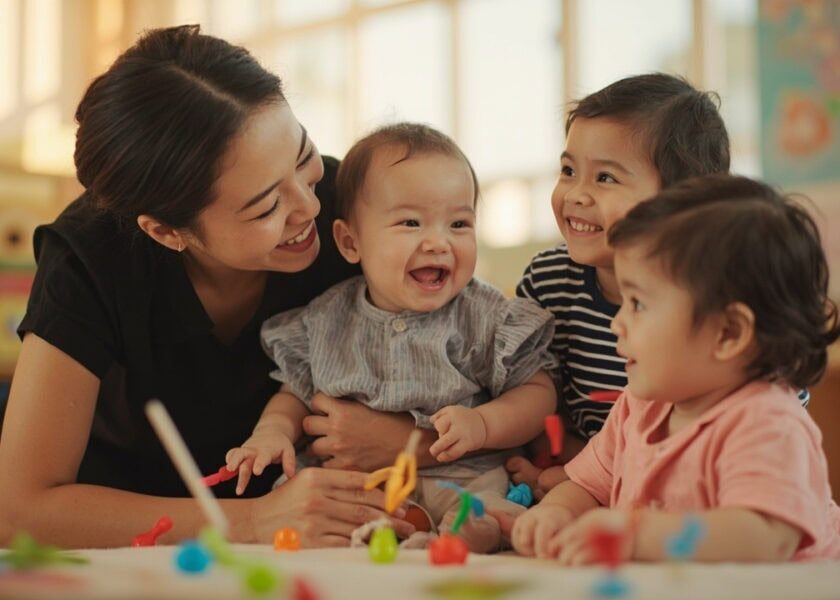
In quality care, there is a window — sometimes minutes, sometimes an afternoon — during which the child recalibrates. They may need a moment of proximity, a word of warmth, a held hand. And then, something shifts. They turn toward an activity. They allow themselves to be curious. They stop holding their tension in their small bodies and begin to breathe and move freely.
When your child settles in under thirty minutes, when they move from guarded to open within a single session, you are watching quality in real time.
You are watching a caregiver who understands that emotional regulation precedes cognitive engagement, and that a child’s trust is built in moments of consistent, warm responsiveness.
Signal Two: What You See at Pick-Up
Watch your child in the minutes after you arrive. Not in the dramatic, outstretched-arms reunion that makes for beautiful photographs — though that too is a signal of attachment and love — but in the moments that follow.
Ask yourself: Does your child look up at you with recognition, with warmth, with the easy certainty of someone who knows exactly who they are and where they belong? Or do they seem oddly disconnected, emotionally flat, unable to settle into your presence even after you have arrived?
Children in quality care come home with something that is hard to name but easy to feel. Call it ease. They have spent their day in an environment attuned to their needs, that has responded to their cues, that has given them the experience of being truly seen.
That experience does not disappear when you arrive. It accompanies them. It makes them more available, not less, to the people they love most.
Signal Three: The Language Your Child Carries Home
At every age, from the earliest coos to the sophisticated sentences of a toddler, language is a window into cognitive and emotional development.
In quality care, children are spoken to — not at, not over, but with. Their actions are narrated. Their feelings are reflected back to them in words.
“I see you are building a tower. That looks like you are feeling proud when it stays up. You are stacking the red block on top — careful, it looks wobbly.”
When your child begins to use phrases at home that you have not taught them, when they describe their emotions with a vocabulary richer than it was last month, when they reference people and activities from their day with specificity and joy — you are watching language emerge in the way it does when a child’s environment is genuinely rich in responsive interaction.
This is not advanced pedagogy or expensive curriculum. It is the simple, profound act of treating a child as though their inner life is worth attending to. It is the caregiver who notices when a child is frustrated and names it. Who celebrates when a child accomplishes something small and makes that celebration feel meaningful.
Signal Four: The Communication Loop Between You and Your Caregiver
Quality reveals itself not only in what your child carries home, but in what the caregiver brings to the relationship with you.
When your caregiver reports on your child’s day, listen for specificity. Listen for details that could only come from genuine observation:
“He showed real interest in the water table today. He kept pouring water from one container to another, and I noticed he was experimenting with different speeds. He didn’t want to stop when we transitioned to lunch.”
In quality partnerships, the caregiver is not simply delivering a report. They are collaborating. They want to know what your child was like at home this morning, what books you have been reading together, whether there have been any changes that might explain a shift in mood or behavior.
You share what you observe at home. Your caregiver shares what they observe in care. Together, you build an increasingly nuanced understanding of who your child is, how they are developing, and what they need.
When this loop is working — when your caregiver is responsive, specific, warm, and genuinely curious — you will find that your doubt begins to quiet. Not because you have been given answers, but because you have been given a partner.
Signal Five: What Quality Looks Like Across Age Groups
For the youngest infants: The signals are primarily physical and emotional. Does your baby arrive at pick-up with relaxed muscle tone — a child who has been held, carried, and responded to throughout the day? Is your baby being talked to, sung to, engaged with face-to-face in those critical windows when neural pathways are forming at their fastest rate?
For older infants and young toddlers: Watch for motor milestones. In quality care, children are given the space and encouragement to move — to crawl, to pull themselves up, to walk with support, to climb and explore in safe, supervised ways. A child who comes home with a scraped knee and a proud expression is a child who has been allowed to test their physical limits under watchful care.
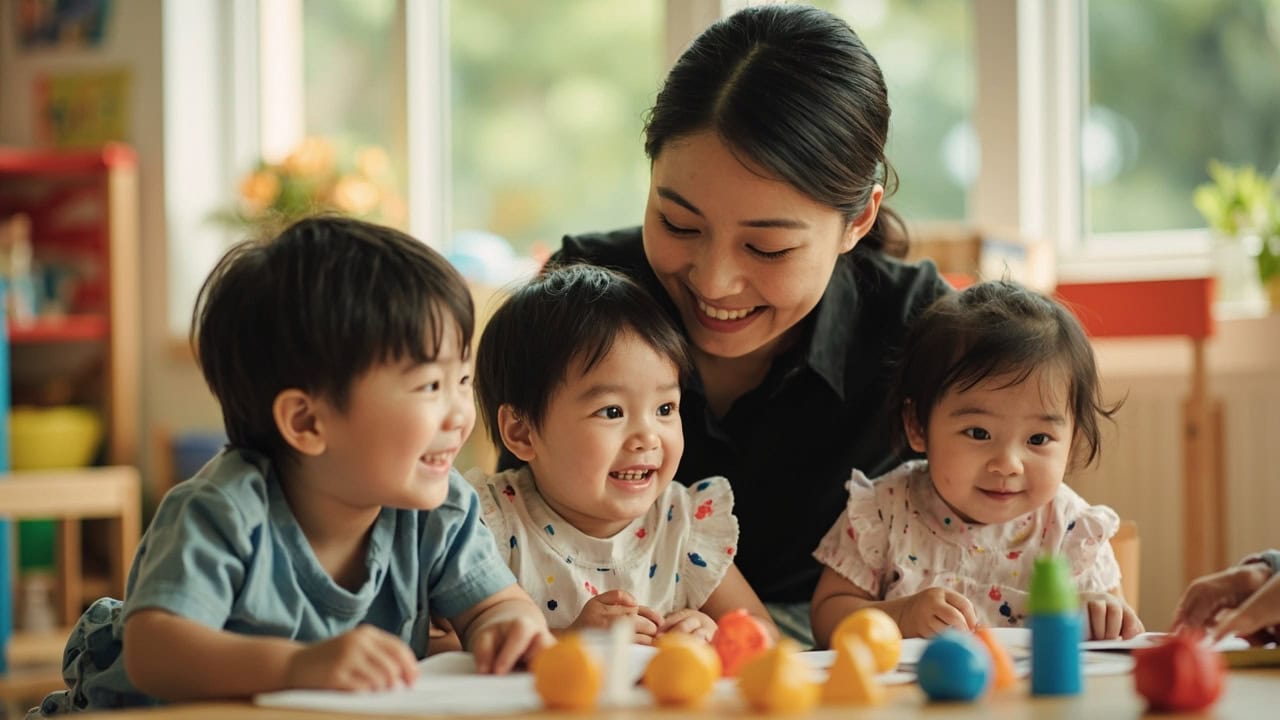
For toddlers and beyond: The signals become social and emotional. Does your child demonstrate the capacity to play alongside others? Can they negotiate, share, express frustration without escalating? Do they show the beginnings of empathy — noticing when another child is upset, attempting comfort?
What you are watching, at every age, is the evidence of a coherent nurturing environment. A place where warmth, responsiveness, developmental support, and respect for the child’s emerging autonomy are consistent across the hours you are not there.
Trusting Your Parental Instincts
There is a question that parents often ask, usually in the form of a confession: How do I know if what I’m seeing is really development, or if I’m just seeing what I want to see?
This question deserves a direct answer: your instincts are not the enemy of clarity. They are its foundation.
Every parent knows their child in a way no caregiver, no matter how excellent, can fully replicate. You know the baseline of your child’s temperament. You know what their fussiness looks like on a bad day versus a good one. You know the difference between their engaged curiosity and their rote performance.
When you combine this intimate knowledge with the framework we are offering — the language for what quality looks like — you become the most accurate assessor of your child’s care that exists.
When you notice your child settling more easily, speaking more fluently, moving with greater confidence, showing more ease in social situations, you are not projecting. You are observing.
We do not want parents who trust blindly. We want parents who trust because they understand. Who recognize quality because they have learned to see it. Who can look at their child’s daily experience and say, with growing confidence: Yes. This is working. I can see it. I can feel it. I know what I am looking at now.
EduNanny: Quality Childcare in Partnership with Families
EduNanny was founded on a conviction that deserves to be stated plainly: Singapore families deserve childcare that is not merely adequate but excellent. Not merely safe but nurturing. Not merely convenient but genuinely supportive of child development in its earliest and most critical years.
Our Approach to Childminding
We are part of the ECDA Childminding Pilot, and we take that designation seriously. The pilot represents a recognition — at the policy level, at the community level — that childminding is not a lesser form of childcare. It is a distinct form with its own strengths, one that deserves investment, innovation, and excellence.
In home-based care, your child receives individualized attention in an environment that is, itself, a home. The ratios are smaller. The relationships are deeper. The continuity is greater.
For families across Singapore — in HDB flats and private residences, in the heart of the city and in the heartlands — this model is not a compromise. It is a choice that, when delivered with excellence, may be the best choice available.
Making Quality Accessible
Monday to Friday care blocks. CDA and Baby Bonus usability. Affordable structures within the pilot framework. These are not peripheral details. They are the practical architecture that makes quality care accessible to families who need it, who deserve it, and who should not have to choose between excellence and affordability.
Our caregivers are trained to communicate not just at pick-up but throughout the day, through the systems and tools that allow you to feel connected even in your absence. Because we know that the parents who trust us most are not the parents who never wonder — they are the parents who wonder and receive answers. Who ask questions and find their caregiver already thinking about the same things. Who realize, over time, that they are not navigating this alone.
Practical Guidance for Choosing Infant Care in Singapore
As you evaluate your options, here are the questions worth asking — and what quality answers sound like:
| Question to Ask | What Quality Looks Like |
|---|---|
| What are your caregiver-to-child ratios? | For infants: 1:3 or better. For toddlers: 1:4 or better. |
| How do you communicate daily progress? | Specific observations, not scripted updates. Questions about the child’s life at home. |
| How do you handle settling after drop-off? | A clear, warm process for helping children transition. Emotional regulation prioritized over immediate activity. |
| What does a typical day look like? | Balance of free play, guided activities, outdoor time, meals, and rest. Not screen time or passive entertainment. |
| How do you support language development? | Responsive interaction, narration of play, naming emotions, rich conversation at every age. |
Your Child Will Show You
The moments that prove your childcare choice was right will not arrive all at once. They will arrive gradually, quietly, in the way your child greets you at the end of a day.
In the words they use that they did not learn from you. In the way they move through the world — curious, confident, secure in the knowledge that they are loved, and that the people caring for them are worthy of that trust.
Quality childcare does not require you to take it on faith. It invites you to observe. It rewards your attention. It leaves evidence that is real, specific, and accumulating.
And if your child is in EduNanny care, we want you to know this: we welcome your attention. We want you watching. We want your questions and your observations and your growing confidence in what you are seeing.
Because we are not producing quality in secret. We are producing quality in partnership with you, in the open, in the daily practice of care that is shaped by warmth and informed by developmental science and delivered by caregivers who love their work.
You chose attention over assumption. That is what good parents do.
And we are honored to be the care that your attention, over time, will confirm was right all along.
Ready to learn how EduNanny can support your family? Schedule a conversation with our team to explore how our ECDA-registered childminding services can give your child the quality care they deserve — and give you the confidence that comes from seeing quality in action, every day.
#SingaporeChildcare #InfantCareSG #ChildmindingSingapore #QualityChildcare #EduNannySG