How Singapore Parents Learn to See Quality Childcare
The Gap Between Looking and Seeing
This is the gap that EduNanny was built to close. Not by replacing your judgment, but by developing it. Not by telling you what to decide, but by teaching you how to see.
There is a difference, and it matters more than most parenting resources acknowledge. Anyone can look at a childcare environment. Looking requires only that your eyes are open. Seeing requires that you understand what you are witnessing.
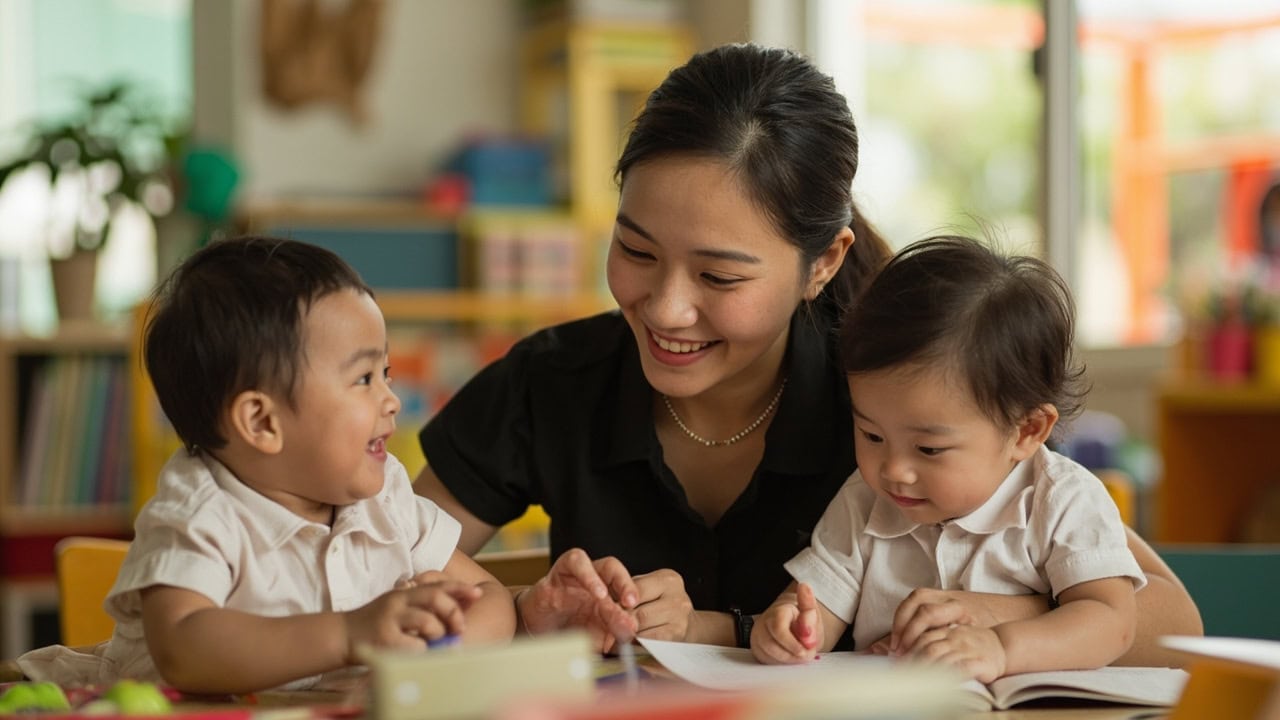
A trained caregiver does not simply watch children play. She notices the micro-moment when a toddler reaches for a puzzle piece and hesitates, and she gives the child a few more seconds to solve the problem independently before stepping in. She notices whether a baby’s cry peaks and subsides naturally, or whether it escalates until the child learns that crying louder is the only way to be heard. She notices the quality of eye contact, the pitch of voice, the pace of movement, and what each signal tells her about the child’s internal state.
These are not instinctual observations. They are learned skills, refined through training and sustained attention. Through our work with families across Singapore, we have come to understand something important: parents can learn them too. Not to the same degree or with the same daily practice, but enough to become meaningful observers of their own child’s experience. Enough to stop relying solely on how a room looks and start understanding how a child feels.
What Quality Caregivers Actually Notice
When you begin to understand what trained eyes look for, the childcare tour transforms from a confusing checklist into something more purposeful. Here is what attentive caregivers observe throughout their day:
Responsiveness to Distress
How quickly does a caregiver respond when a child signals need? A baby who is hungry, tired, or uncomfortable will show it before they can articulate it. The quality of care is revealed not in whether distress occurs, but in how it is met. Does the caregiver observe the early signals of frustration, or only respond when crying escalates? Does the child learn that their communication leads to response, building trust in the world around them?
Independent Problem-Solving
A skilled caregiver walks a careful line. They are present and supportive, but they also know when to step back. When a toddler struggles with a puzzle piece, do they solve it for the child immediately, or do they offer just enough space for the child to experience the satisfaction of working it out? These small moments, repeated across hundreds of interactions, shape a child’s sense of capability and confidence.
The Quality of Language Environment
Children in quality care are spoken to, not at. They are included in conversations, even before they can contribute words. A caregiver who narrates what they are doing, who names objects and emotions, who responds to a baby’s coos as if they are meaningful contributions, creates an environment where language grows naturally. You will not see flashcards or drilling. You will see conversation.
Emotional Regulation Support
Toddlers do not arrive knowing how to manage big feelings. They learn through co-regulation: when a caregiver stays calm during a meltdown, names the emotion the child is feeling, and offers comfort without dismissing their experience. Over time, children in responsive care begin to develop their own capacity to settle. You can see this in how they recover from frustration, how they seek comfort appropriately, and how their emotional vocabulary grows.
How Children Reveal Quality Over Time
Children reveal the quality of their care in ways that are small, specific, and slow. This is what most parents are not prepared for.
We live in an era of instant feedback. We check ratings, read reviews, and expect immediate clarity. But quality childcare does not announce itself on the first visit. It accumulates. It shows up in the gradual softening of a child’s morning goodbye. It appears in the new words that emerge after a few weeks, the songs they hum without being taught, the way they start to walk a little taller into a room they have come to recognize as theirs.
It reveals itself in the way they speak to their caregiver not with fear or mechanical politeness, but with the easy familiarity of someone who has been genuinely heard.
These behavioral signals follow patterns that trained eyes can identify and articulate:
- Increased comfort with separation: A child in responsive, quality care will often show reduced separation anxiety over time, not because they have been told to stop crying, but because they have learned to trust that their caregiver will return.
- Greater emotional regulation: A child in settings where emotional regulation is supported will gradually demonstrate greater capacity to manage frustration without collapsing.
- Accelerated language development: A child who is spoken to with respect and frequency will show language growth, not through flashcard drills, but through the simple accumulation of being included in conversation.
- Growing confidence and independence: Children who are given appropriate challenges and supported through struggle begin to approach new situations with curiosity rather than fear.
The question is not whether these changes are happening. The question is whether you know how to look for them.
Questions That Reveal True Quality
When you begin to see quality in childcare, you also begin to ask better questions. Not the generic questions you find on parenting forums, but questions that emerge from genuine observation of your own child.
When visiting a potential caregiver or childcare setting, consider asking:
- What does my child do when he first arrives? How does he transition from us to your care?
- How does she respond when she is frustrated? What does that look like, and how do you respond?
- What has he been talking about at home? What seems to capture his interest here?
- What surprised you about her today?
- How do you handle moments when a child is struggling emotionally?
- Can you tell me about a time when you gave a child space to solve a problem before stepping in?
These are the questions that reveal whether a caregiver truly knows your child, and whether the care being provided is calibrated to who they are as an individual. They are also the questions that keep the partnership between parent and caregiver alive, because they communicate that you are paying attention, that you are invested, and that you expect your child to be seen as more than a slot in a schedule.
EduNanny: Your Partner in Learning to See
This is where we believe EduNanny serves families most meaningfully. Our caregivers are trained to observe, but we do not keep that knowledge to ourselves. We share it.
We make it a practice to help parents understand what they are seeing when they pick up their child at the end of the day. We talk about the small moments, the incremental progress, the subtle shifts that add up over weeks and months into something parents can recognize and name. We do this because we believe the parent is not a passive recipient of childcare. The parent is the child’s first and most important interpreter, and when we help parents develop their observational capacity, we are not diminishing their role in the family. We are honoring it.
Grounded in Professional Standards
EduNanny’s approach is grounded in the recognition that this kind of attentive care requires structure and support. We operate within the ECDA Childminding Pilot framework, which means our caregivers are trained to standards that meet Singapore’s requirements for professional childminding.
Our ratios are designed to allow genuine responsiveness to each infant and toddler in our care. Not the ratios of a crowded centre, but the ratios that make it possible to notice when a child’s face changes, when their mood shifts, when they need something before they have learned the words to ask for it.
Pathways That Fit Family Life
We offer both home-based and community-based pathways, because families are not uniform in their needs. Some children thrive in the intimacy of a home environment, with familiar faces and a predictable rhythm. Others benefit from the social texture of a centre setting, with peers and structured activities that broaden their world. Whatever the pathway, the principle is the same: the quality of the caregiver’s attention is what matters most.
Transparency as a Foundation of Trust
We believe that transparency builds trust, and trust builds peace of mind. Where our services include communication tools, parents receive regular updates about their child’s day. Where CCTV measures are in place, they are there not as surveillance, but as reassurance. A way of saying to parents: we have nothing to hide, because we are proud of what we offer.
We understand that leaving your infant in someone else’s care is one of the most emotionally complex decisions a parent will make, and we do not take that trust lightly.
You Are Qualified to Judge Quality
You might wonder whether you are qualified to assess professional care. The answer is yes, with the right support. You do not need to become a child development expert. You need to learn to pay closer attention to your own child and to recognize the signals that matter. This is a learnable skill, and it grows naturally when you are partnered with caregivers who can guide your observations.
Uncertainty after a tour is not a failure. It is an honest response to an incomplete picture. Quality reveals itself over time, not in a single visit. We encourage parents to approach the first weeks of care as a continued assessment. Watch how your child responds at pickup. Notice changes in behavior, language, and mood. Ask questions. A good childcare relationship welcomes this ongoing evaluation, because it leads to better care for your child.
Affordability matters. The Childminding Pilot is structured to be accessible to families who need reliable, quality care without facing prohibitive costs. CDA and Baby Bonus funds can be used where applicable, and our Monday to Friday care blocks are designed around the rhythms of working families in Singapore. This is not charity. It is a belief that every child deserves attentive care, and that good intentions must be matched by good access.
A Practical Path Forward for Singapore Parents
If you are researching infant care or childminding in Singapore, here is what we suggest as your next step:
- Visit with curiosity, not judgment. Approach your childcare tours as the beginning of a learning process, not a final exam. You are there to observe, ask questions, and start building your framework for quality.
- Ask specific questions about daily life. Rather than focusing on credentials or curriculum, ask caregivers how a typical day feels for a child. How do they handle transitions? What does rest time look like? How do they support a child who is struggling?
- Observe your child before and after care. Notice how your child responds to arrival and pickup. Watch for subtle changes in mood, language, and behavior over the first weeks. These signals tell you more than any tour checklist.
- Build a relationship with questions. The quality of your ongoing conversations with your caregiver matters. Ask about your child’s day. Share what you notice at home. A good caregiver welcomes this partnership.
- Give yourself permission to learn. You will not feel confident immediately. That is fine. The fact that you are thinking seriously about what your child needs is itself a form of care. That is attention. That is the beginning of seeing.
Begin Your Journey
Some parents arrive already fluent in the language of child development, with strong frameworks for understanding what they see. Others arrive with nothing but love and worry, uncertain whether they are qualified to judge anything at all.
For both, the path is the same: watch closely, ask often, and give yourself permission to learn.
What we are really offering goes beyond practical arrangements. What we are offering is a partnership in which your understanding of your child deepens over time. We want you to leave EduNanny not just with a satisfied feeling that your child was well cared for, but with a genuine growth in your own capacity to read quality, to ask the right questions, to trust your instincts because they have been informed by observation.
We want the childcare tour to be the beginning of your education, not the end of your search.
EduNanny was founded on the belief that raising a child well is not something parents do alone. It takes a village, and in our modern world, the village sometimes needs structure, training, and professional support. But it also takes parents who are present, curious, and willing to grow alongside their children.
We are here to walk that path with you. We are here to be the trained eyes when yours are still developing. We are here to help you recognize quality not because we want you to choose us forever, but because we want you to choose what is best for your child, and to know why.
And if you do choose us, we will earn that trust every day. Not with promises, but with presence. Not with marketing, but with the small, daily acts of noticing your child and helping you notice them too.
Your child is worth watching closely. So are you.
And in learning to see, you will discover something that no childcare tour can teach you in an hour: you already know more than you think. You simply need the right guide to help you trust it.
That is what EduNanny is for.
If you are ready to begin this journey, we invite you to speak with our team about how EduNanny can support your family. Every child deserves attentive care, and every parent deserves to feel confident in their choices.
Learn more about who we are and the standards that guide our work, or explore our full range of services for families across Singapore.