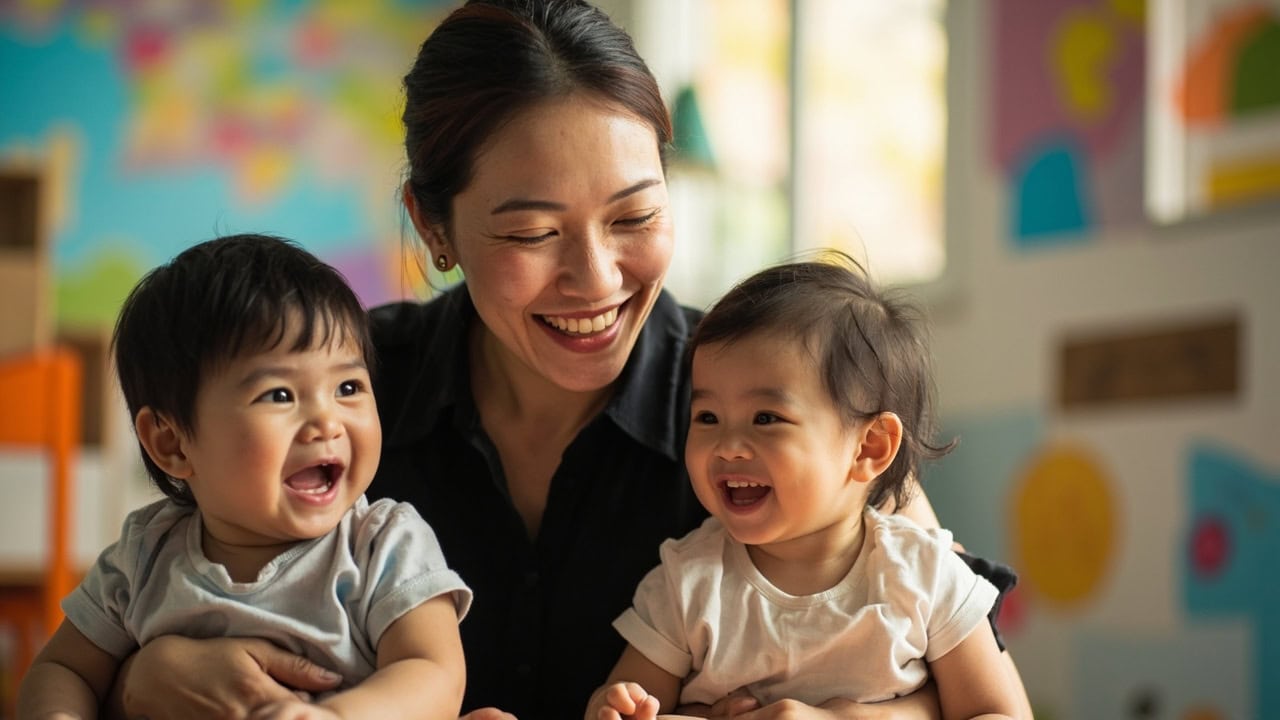
How Singapore Parents Learn to Read Their Child at Pick-Up
What Your Child Is Showing You at Pick-Up
Most parenting content focuses on the decision: how to choose a childcare centre, what to look for, how to know if a caregiver is good. And yes, that matters. But what happens after the decision?
When the bag is packed, the bottle is prepared, the morning handover is done, and you drive or take the bus to work carrying the particular tension of that first separation—then, hours later, you return. What language do you have, in that pick-up moment, to read what your child is showing you? What developmental framework guides your eyes?
For most parents, the honest answer is: not enough. We have opinions about what we want for our children. We have instincts. We have advice from grandparents and friends and the internet. But we often lack the specific, grounded vocabulary to understand what we are actually observing when our child walks out of childcare at five or six o’clock with a particular expression, a particular energy, a particular story written in their body before a single word is spoken.
The pick-up window is not just a transition. It is the most revealing window into your child’s day that exists. And quality childcare, when it is truly quality, does not just care for your child while you are apart. It teaches you how to see them.
The Body Speaks First
Start with the body. Before language arrives, the body speaks. The way a child walks toward you—or hesitates, or runs, or melts into your legs with a grip that says I need a minute—that is information.
A child who moves toward the caregiver for a final wave, who looks back with a wave that feels genuine rather than performed, is a child who has been attached to this place in a real way. A child who cannot wait to leave, who clings to you in a way that feels panicked or urgent—that is information too. Not a verdict, but a signal.
The Face
The face after a day of attuned care often has a particular openness. The child may be tired—that is normal—but there is not the tightness around the eyes, the vigilance, the scanning for the next thing.
A child who has been genuinely seen often comes out more themselves, not less. More silly, or more tender, or more curious, because they have had enough attunement to feel secure enough to expand.
The First Words
What your child chooses to tell you—unprompted, in the first thirty seconds—tells you what mattered to them today. A two-year-old who comes out saying “blue block” or “teacher Mei” or “my friend” is showing you what registered, what stuck, what had emotional weight. This is a window into what your child’s world felt like from the inside.
What Your Child Does Not Say
And then, importantly, what your child does not say. If your three-year-old comes out silent—not because they are tired but because they seem to be holding something—that is worth noticing. If your infant, who usually settles into your arms with a particular ease, is fussy in a way that does not resolve with the usual comfort, that is worth asking about, gently, without alarm.
The Difference Between Being Minded and Being Truly Seen
So we do what we can. We ask: Did you eat? Did you sleep? Did you play? We accept the broad strokes—the diaper was changed, the lunch was finished, there was circle time. We are grateful for the update. We trust, as much as we can, that the day was fine.
But here is the thing: fine is not the ceiling. Fine is the floor. And the space between fine and genuinely thriving—with all its texture, its daily variations, its quiet signals—is a space that quality childcare can help you inhabit with growing confidence.
Any licensed childcare arrangement will ensure your child is fed, changed, supervised, and safe. That is the baseline and it matters. But the developmental difference between being adequately minded and being genuinely seen is the difference between your child surviving the day and your child growing through it.
A caregiver who truly sees your child notices the patterns. Tracks the development. Understands that a toddler who is suddenly refusing snacks may be in a speech leap that makes swallowing feel complicated. Understands that an infant who is extra clingy this week may be working through a developmental phase that will resolve.
That caregiver communicates not just events—what happened—but development—what it means. And that transforms pick-up from a transaction into a tutorial.
Here is what that looks like. Instead of: “She had a good nap, she ate well, we played outside,” a quality caregiver might say:
“She had a good nap, but I noticed something interesting—she was using more complex sentences this afternoon, putting together ideas she hasn’t connected before. She’s been doing that for about a week now. Have you noticed it at home?”
Or:
“He had a harder time settling today, and I think it might be related to the transition we saw last week. Here’s what I tried, and here’s what seemed to help.”
That second kind of update is not just more detailed. It is more useful. It teaches you what to look for. It gives you a lens. And over time, as your caregiver shares these observations week after week, you begin to see your child the way a trained professional sees them—with pattern recognition, with developmental context, with a sense of what is typical and what is emerging and what might need gentle attention.
What Quality Childminding Looks Like in Singapore
In Singapore, the ECDA Childminding Pilot offers a framework that makes this kind of quality genuinely accessible—not as a luxury, but as a standard families can expect.
The Pilot operates within two pathways: home-based and community or centre-based, so that you can choose what fits your family’s rhythm and your infant or toddler’s temperament. In infant care, the ratios are up to one to three—which means your child is not one of fifteen. Your child is one of three, at most. The caregiver can notice. The caregiver can attune. The caregiver can see.
The care runs Monday to Friday, in structured blocks, which means predictability for your child’s developing sense of time and security. And because the Pilot is designed to make quality childcare genuinely accessible, the fees are structured to be affordable within pilot parameters. Your Child Development Account can be used. Baby Bonus provisions apply.
These are not side details. They are the conditions that make the kind of care we have been describing actually possible—the ratios, the attunement, the developmental communication, the trust-building transparency.
Trust Built Through Observation
We do not take lightly that leaving your infant or toddler in someone else’s care requires a particular kind of faith. The reality is that for many parents, the worry does not end at handover. It transforms.
You are not worried that your child will not be fed—you trust that. You are worried about everything you cannot see. Everything that happens in the hours you are not there.
This is why EduNanny Singapore’s approach to communication is designed with exactly this in mind. Where deployed, CCTV measures provide an additional layer of transparency—not surveillance, but openness. Not suspicion, but partnership. Because the truth is that trust is built through visibility, and quality care has nothing to hide.
This kind of quality does not happen automatically just because a service calls itself quality. It has to be designed. It has to be practised. It has to be held as a standard, not just an aspiration. It requires caregivers who are trained not just in safety protocols but in developmental observation. It requires communication structures that prioritise meaning over event, growth over reassurance. It requires a willingness to treat parents as partners in the truest sense—not because it sounds good in a brochure, but because the child’s development genuinely depends on it.
What happens at childcare and what happens at home are not separate worlds. They are one developmental landscape, and when they are connected by skilled observation and honest exchange, something remarkable happens: the child thrives in both.
The Parent You Become
Here is what happens, over weeks and months, when you have a caregiver who communicates development rather than just events. You start to notice things you would have missed before.
You realise that your eighteen-month-old’s insistence on lining up blocks is not just a quirky habit but a cognitive stage that precedes the kind of logical thinking that will matter in primary school. You realise that your three-year-old’s difficulty sharing is not a character flaw but a developmental milestone that requires patience, not punishment. You realise that the clinginess of the past two weeks has a shape, a reason, a trajectory—and that it will pass, because you can see the evidence that your child is still growing through it.
This is what we mean when we say you become a more confident parent—not because you were told you are doing a good job, but because you understand what you are actually seeing. There is a quiet authority that comes from developmental literacy. And it changes the pick-up moment.
Imagine, for a moment, what it would feel like to arrive at pick-up carrying not doubt but curiosity. Not anxiety but a question you are genuinely interested in answering: What will I notice today? What is my child showing me? What does this tell me about how the morning went, how the afternoon went, how they are processing the world right now?
This is not a fantasy. This is what happens when the system around you—your caregiver, your childcare arrangement, your communication with your provider—treats you as a thinking, capable adult who deserves to understand your own child.
You stop worrying that you are missing something important. You stop worrying that your child seems a little off but you cannot articulate why. You stop worrying that you are overreacting or underreacting, that you do not know what you are doing, that somehow other parents have a manual you never received. You start to trust yourself. Because you are learning, through the daily practice of reading the pick-up signals, that you actually do know your child. You are learning to trust the evidence of your own eyes.
What to Look For When Choosing Infant Care in Singapore
If you are researching childcare options right now, here are the questions that actually matter:
- How do updates work? Do caregivers share events—what happened—or development—what it means? The second is harder, and more valuable.
- What can you observe at pick-up? Do children seem loose, open, curious? Or managed, guarded, holding it together? Watch the body before you ask any questions.
- What is the caregiver-to-child ratio? In infant care, lower numbers mean more attunement. This is not a luxury detail—it is a developmental condition.
- How does the caregiver talk about your child? Do they use specific observations—patterns, changes, emerging skills—or general reassurances? Specificity is a sign of genuine attention.
- Can you observe the space? Trust is built through visibility. Quality care has nothing to hide.
You Are Already the Expert on Your Child
You are doing something extraordinarily difficult. Raising a child in Singapore—the logistics, the cost, the pressure, the impossible arithmetic of work and family and guilt and hope—is not for the faint of heart. You are carrying more than most people will ever acknowledge.
The fact that you are here, reading about developmental observation and pick-up windows and quality childcare, tells us something important: you care. Deeply. Intensely. In a way that sometimes feels like it might undo you.
We want you to know that caring is not the problem. Caring is the whole point. And the solution to the particular ache of modern parenting—the not-knowing, the separation, the daily uncertainty that has no perfect answer—is not less caring. It is more skill. More language. More confidence in your own capacity to understand what you are seeing.
That is what quality childcare gives you, when it is truly quality. Not a substitute for your love. Not a band-aid for your absence. A mirror. A lens. A daily invitation to see your child more clearly than you did the day before.
At pick-up. In the small hours of the morning. In the way they ask for water or reach for your hand or tell you, in their imperfect language, about the blue block and the friend and the song. Your child is showing you something every day. The question is: are you ready to see?
EduNanny Singapore operates within the ECDA Childminding Pilot, offering both home-based and centre-based pathways for families who want more than “fine.” Quality care that sees your child—and teaches you to see them too.
You were always the expert on your child. You just needed the right partner to help you see it clearly.
If you would like to learn more about EduNanny’s approach to childminding and childcare in Singapore, or connect with the team, they welcome the conversation.