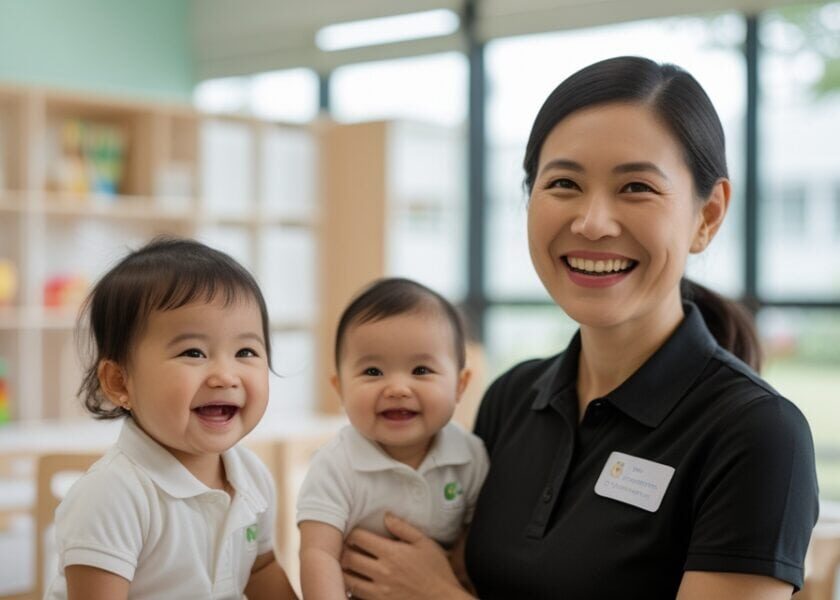
How Singapore Parents Keep the Promise They Made at Birth
The Promise You Made Before You Had Words For It
There is a moment—quiet, private, exhausted—when you first held your child and made a promise you didn’t yet have words for. You were probably terrified. You were almost certainly overwhelmed. The hospital room may have been bright with fluorescent light, or soft with early morning, or humming with the quiet machinery of modern medicine.
And in that moment, before anyone asked you to make decisions about sleep training or screen time or which stroller to buy, you looked at this new person and you decided something. You decided that you would show up. That you would be present. That you would give them every chance.
You made this promise in silence. You didn’t write it down. You may not even remember it consciously now. But it was made, and it was made completely.
Here is what this article is really about: that promise, and what it means to keep it in a city like Singapore, where the architecture of modern life makes keeping promises feel harder than it should.
The Weight Nobody Told You Would Feel Different
The weeks and months that followed tested that first promise in ways no one had prepared you for. There were nights that blurred into days. There were moments when you weren’t sure you were doing any of this right. And then came the decision that every thoughtful parent in Singapore eventually faces: the question of childcare. The question of who else would hold your child while you were building the life you were trying to build for them.
You began to search. You asked friends. You read reviews. You toured centres. You learned more about infant development and developmental ratios and curriculum frameworks than you ever expected to know. You did this, not because you didn’t trust yourself, but because you trusted yourself enough to know that this decision mattered.
But somewhere along the way, the weight of that decision settled differently on your shoulders. The logistics piled up. The mornings became frantic. The goodbyes at the door—which you had prepared for, which you had read about, which you had been assured would get easier—became their own small kind of grief, repeated five days a week.
You started to wonder whether you were doing enough. Whether being the kind of parent who needed childcare meant you were somehow less of one. Whether the hours you spent at work were hours you were stealing from your child’s future.
These thoughts are not weakness. They are evidence of how much you care. They are the cost of loving someone that completely.
Let me say this clearly, because it matters: that feeling is not the truth. That feeling is guilt wearing the costume of love. And guilt, while understandable, is a poor guide for the decisions you actually need to make.
Why the Childcare Conversation Gets It Wrong
This is what the conversation about childcare so often misses. We talk about childcare as if it is a logistical problem to be solved. A matter of convenience, of coverage, of who can watch the child while the parent works.
But for the parents who approach this decision thoughtfully—and if you are reading this article, you are almost certainly one of them—it was never logistical. It was existential. It was about who your child would become. It was about whether you could find, in this city, in this economy, in this particular moment of your life, a place that would honor what you were trying to build.
The Village Question in Modern Singapore
Singapore has changed. The extended family that once surrounded a new parent, the grandmother who lived down the street, the aunt who came every Thursday, the neighbour who knew your child’s name—these networks have thinned. Not because Singaporeans love their families less, but because the architecture of modern life has shifted.
People live far from their parents. Work demands relocation. The rhythms of the city make it hard to build the kind of informal village that previous generations took for granted.
So we have had to find new ways to build village. We have had to professionalize what was once organic. And in doing so, we have had to ask harder questions: What does quality actually mean? What should we expect from caregivers? What do our children deserve?
Parents who ask these questions—who take the time to understand ratios and curriculum and caregiver training and communication practices—are not anxious or overprotective. They are doing exactly what good parents have always done: they are trying to make the best decisions they can with the information available to them.
What Quality Childminding Actually Looks Like
In those fragile, formative days of infant care, quality means ratios that allow for real attention. It means caregivers who are not stretched across too many children, who can notice the small things, who can respond with consistency and warmth. It means knowing that the hours your child spends away from you are hours of growth, of safety, of warmth.
In the toddler years, quality means environments that encourage exploration, that support the massive developmental work of learning to be a person in the world, that build the confidence and curiosity that will carry a child into school and beyond.
What matters most is trust. Not vague, feel-good trust that is asked of parents as a leap of faith, but trust that is built through systems, communication, and visible practice. Trust that comes from knowing:
- There are ratios in place that allow for genuine attention
- Caregivers are trained and verified
- There are protocols for everything from feeding to fever to daily rhythms
- Communication systems give you proof that your child is being seen
Where CCTV and communication measures are in place, they are there not because parents are suspicious, but because parents deserve to feel that the decision they agonized over was a decision they can stand behind with confidence.
The EduNanny Approach: Honoring Intention Over Time
EduNanny Singapore exists because we believe that parents who make this choice need more than a service. They need a partner who shares their commitment. They need transparency when they cannot be present. They need to know that the hours their child spends away from them are hours of the kind of attentive care that would make them proud.
The EduNanny model, operating under the ECDA Childminding Pilot framework, makes this possible in ways that are both thoughtful and accessible:
- Home-based pathways offer the intimacy and consistency that some families need most—the continuity of a single caregiver relationship in the familiar setting of home.
- Centre-based and community pathways offer the rich environment and social learning that others value.
What matters is not which form fits a theoretical ideal, but which form fits your family, your child, your circumstances, and your values. The goal is the same across every pathway: a child who feels safe, who is learning, who is known.
Accessible Pathways for Families
For families navigating the costs of quality care, there are pathways available that make it accessible. Through pilot frameworks and CDA usability and Baby Bonus arrangements, families can make the most of what they have—because quality should not require compromise on financial stability either.
The Promise Kept: Why Your Choice Was Right
Here is what is true. Every parent who chooses quality care for their child is keeping a promise, not breaking one.
The promise you made in that hospital room or in the quiet of your first night home was never about proximity. It was never about being the only person who held your child. It was about showing up in the ways that mattered. It was about giving them the tools to become a person who could thrive—not just survive, but genuinely flourish.
When you searched for childcare that met your standards, when you prioritized quality over convenience, when you asked questions and visited spaces and made a decision that aligned with your values rather than just your schedule—you were keeping your promise. You were doing exactly what you meant to do when you first decided to be a parent.
Childcare is not a substitute for your presence. It is an extension of your intention.
When you choose an infant care programme with a one-to-three ratio—when you choose a place where every caregiver is trained, verified, and committed to the same principles you hold at home—you are not outsourcing your responsibilities. You are investing in a team whose job is to help your child grow in the ways that you, in your most hopeful and ambitious moments as a parent, always intended.
School Readiness and the Long Arc of Development
We talk about children being ready for school—not just academically, but socially, emotionally, in the deep ways that matter for a lifetime. A child who is school-ready is a child who trusts that the world is mostly safe, who knows how to be in relationship with people outside their immediate family, who has the confidence to try things that are hard, to fail, to try again.
Building that kind of readiness is not the work of a single caregiver or a single year. It is the accumulated work of every experience your child has had, every response that taught them they were being heard, every safe exploration that taught them the world was interesting, every consistent warm presence that taught them they were loved.
This is why the choice you made was never just about the first week. It was about investing in that long arc. It was about choosing a partner who would be with you—not just in the enrollment period, but across the years, as your child changed and grew and became more and more of who they are.
What EduNanny Parents Actually Witness
What we have seen, again and again, in the families who have walked this path with EduNanny, is something worth naming clearly.
These parents come to pickup not wondering if their child had a good day. They know. They see it in:
- The way their child runs to greet them
- The language that has suddenly expanded
- The social confidence that has bloomed
- The way their child talks about their caregiver with the easy familiarity of real attachment
- The updates and photos and small notes that fill them in on the ordinary magic of their child’s day
- The school readiness reports that reflect a child who is not just prepared for the next stage but excited about it
They see the promise they made kept—not in the way they imagined, perhaps, but kept nonetheless. Grown. Honored. Made real.
Taking the Next Step
If you are considering childcare in Singapore—whether for the first time or transitioning from one arrangement to another—here is what matters most as you move forward.
Ask the Questions That Matter
You have probably already learned more about ratios and curriculum and caregiver training than you expected to know. Keep asking questions. The right partner will welcome them, not deflect from them.
- What is the caregiver-to-child ratio, and why does it matter at each developmental stage?
- How are caregivers trained, verified, and supported?
- What does communication look like day-to-day?
- How are daily rhythms structured, and how are they adapted for individual children?
- What happens when a child is unwell? When a caregiver is absent?
Look for Alignment, Not Just Fit
Fit is important, but alignment matters more over time. You are not just choosing a place that feels okay today. You are choosing a partner for the long arc of your child’s early development. The right choice feels like an extension of your values, not just a convenient option.
Give the Transition Time
The early days of any new childcare arrangement are hard—for you and for your child. The goodbye at the door that felt manageable in the abstract can feel different when it is real. This is normal. It does get easier. And the evidence that it is working will come: in your child’s growing confidence, in their language, in the way they talk about their day.
The End of Every Day
And at the end of every day, when the childcare day ends and the children come home, there is a moment that we do not talk about enough.
It is the moment when your child runs to you—not because you were there all day, but because you are the person they most want to see. The moment when they show you something they learned, say a word they practiced, tell you about a friend they played with. The moment when you realize that the hours apart did not diminish your relationship.
They enriched it.
They gave your child something they needed—social confidence, cognitive stimulation, the experience of being known by more than just family. And they gave you something too: the chance to come back, at the end of the day, as the parent you meant to be. Present. Warm. Ready.
The promise you made your child was never about being there every moment. It was about being there when it counted. And when you chose quality childcare—when you searched and visited and decided and committed—you made a choice that said: I am going to show up for you in the ways that matter most.
That was not the promise broken. That was the promise kept.
You kept it. Every day you went to work and came home. Every day you asked questions and showed up and loved your child the best you knew how. Every day you made a decision that put their future alongside your present.
That is what keeping a promise looks like in modern parenting. It looks like this. It looks like you.
And that is exactly enough.
If you are researching infant care or childminding in Singapore, EduNanny Singapore is here to have the conversation with you—not just about logistics and availability, but about what you are actually trying to build for your child.
Speak with EduNanny Singapore about your childcare journey →