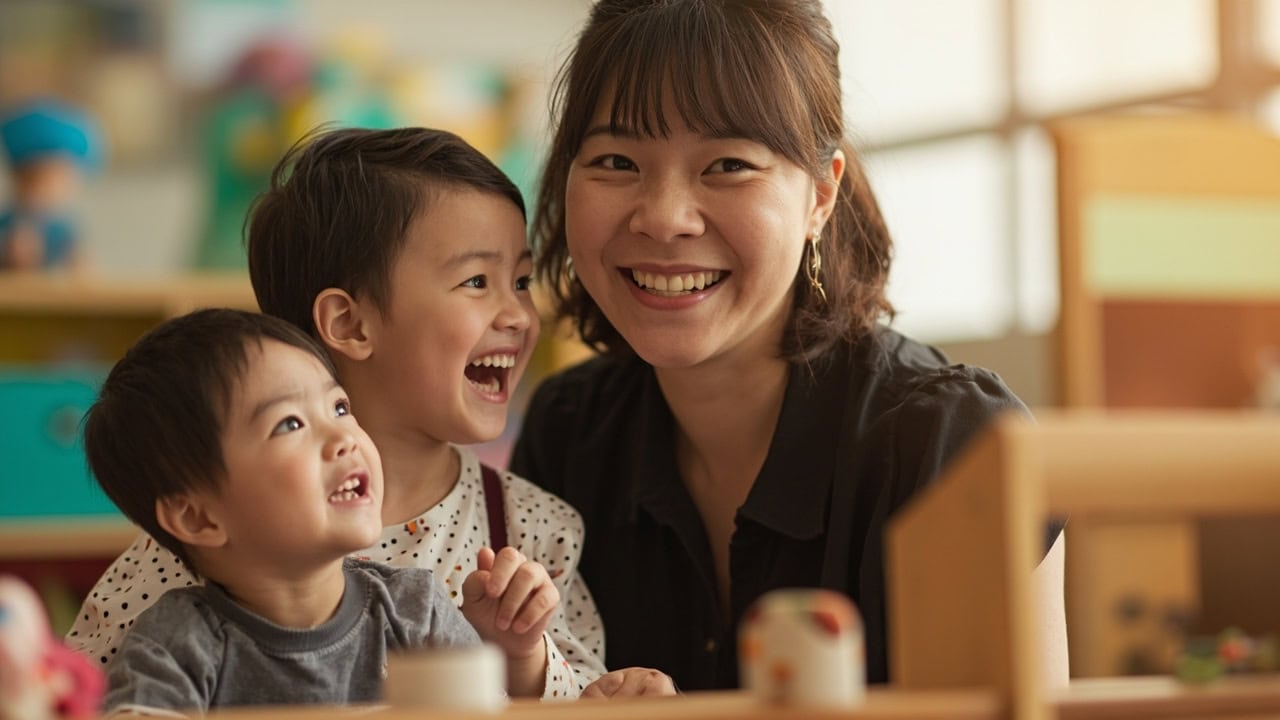
How Singapore Parents Find Quality Childcare Through Careful Observation
Caregiver Stability: What No Tour Can Fully Show
Let us begin with what no tour can fully show you, because it is not visible in the architecture or the curriculum. It lives in the relationships between the people who have stayed.
Caregiver stability is not a soft quality. It is a structural indicator of how a centre operates, and its absence tells you something important before you even know what to ask.
When the same faces greet the children month after month, year after year, something is working—not perfectly, not without challenge, but working in the way that matters: consistently, responsively, with accumulated knowledge about each small person in the room.
Ask yourself what it feels like to walk into a space where the children are genuinely at ease. There is a particular quality to that ease. It is not the forced cheerfulness of a performance or the rigid order of a place where compliance is enforced. It is the ease of children who know their caregivers, who have been met with the same patient attention through enough mornings and afternoons that they trust the rhythm of the day.
That trust takes time. It requires caregivers who stay.
When caregivers remain, they learn the children—not as a category, but as individuals. They notice the small shifts in mood that precede a difficult afternoon. They know which child needs a moment of quiet before joining a group activity. They remember that a particular toddler is working through a developmental leap that has made her clingier in the mornings, and they adjust without being asked.
This knowledge cannot be transferred in a handover note. It lives in the relationship.
When you visit a centre, notice who is in the room. Ask, without apology, how long the caregivers have been there. Not as a test, but as genuine information:
- How long has your team been together?
- What continuity practices do you have when someone is absent?
- How do you support new caregivers joining the team?
A centre that can answer these questions directly, that has thought about them, is a centre that understands why they matter.
Reading the Children Who Already Belong There
Now look at the children who are already there. Not your child. Not a visitor. The children who belong to this space.
In a quality environment, children are not uniformly behaved, but they are recognizably settled. You will see this in:
- The way they move — not rushed or supervised into stillness, but moving with the easy confidence of children who know their environment
- The way they approach caregivers — not with desperate need, but with the casual trust of people who know they will be seen
- The way they play — engaged, sometimes frustrated, sometimes loud, always present
Watch the room when no one new is being performed for. Watch what happens during transitions, the moments when one activity ends and another begins. Watch how caregivers respond to a child who is struggling—not in the polished demonstration of a formal observation, but in the ordinary flow of an afternoon.
Notice whether the warmth you saw in the introduction extends to the moments when it might be easier to let something slide. The quality of the relationships will be visible in the children. That is the most honest indicator you will find.
Here is what many parents do not realize they are doing: they go to a centre visit focused on their own child. They watch how their child responds to the environment, whether they seem interested or anxious, whether they reach for a toy or cling to a parent’s leg.
This is natural. It is also incomplete.
Your child, in that moment, is a visitor. You are both being shown something. What you need to learn cannot be seen through your child’s eyes alone. It must be seen through the eyes of the children who are already enrolled, who have no reason to perform, who simply live in this space as it is.
When you return for a second visit, or when you observe during a less structured moment, shift your attention:
- What are the children doing when they think no one is watching?
- How do they speak to each other?
- What does the room sound like when the door is closed and the tour group has moved on?
- What is the emotional temperature of the place?
This is not about finding a perfect environment. Such a thing does not exist. It is about understanding what this particular environment is really like, beneath the curated presentation, and deciding whether the reality aligns with what you are looking for.
Questions That Reveal Truth
Before you ask another question, understand that the questions themselves reveal something. The way a centre responds to your inquiries tells you how they think about partnership, transparency, and accountability. It tells you what they believe parents are entitled to know.
Some centres will have answers prepared for the questions you think to ask. Others will pause, consider, and respond with something more honest than rehearsed. Some will welcome your curiosity. Others will redirect it.
Notice which kind you are speaking with. Not because one is wrong and the other right, but because you are looking for alignment, and alignment requires honesty on both sides.
When you ask about caregiver qualifications, notice whether the response emphasizes credentials alone or also describes the qualities that make someone a good fit for this work. When you ask about the daily schedule, notice whether the answer feels flexible or rigid, and whether the centre seems comfortable with that flexibility.
The questions that matter most are often the ones that feel uncomfortable to ask. Ask them anyway:
- A centre that cannot discuss turnover honestly cannot be trusted to manage it well.
- A centre that deflects questions about how they handle a child’s difficult transition is telling you something. Listen.
- Ask what you should expect in terms of communication, and notice whether the answer is specific or vague, and whether it reflects genuine confidence or discomfort with the question.
What Quality Actually Looks Like
Beautiful facilities matter. A well-designed environment communicates care, and children respond to spaces that have been thoughtfully prepared. But beauty is not the same as suitability, and impressive architecture does not guarantee that the humans in that space are engaged, warm, and stable.
A room full of expensive toys that are never available is designed for tours. A corner with a few well-chosen materials that children return to again and again is designed for learning. A caregiver kneeling at a child’s level, following the child’s lead, is designed for relationship. A caregiver managing a room full of children with a checklist is doing something different.
The difference is not always visible in a brochure. It is visible in the details, and it is visible in the way the children are living in the space.
What matters is not whether a centre can answer questions well. What matters is whether the reality matches. Ask yourself:
- How long have the caregivers been there?
- Whether the curriculum is genuinely responsive to individual children?
- How does the centre handle the difficult moments that will inevitably come?
These questions cannot be answered by looking at the walls. They can only be answered by watching, listening, and asking.
Quality Indicators at a Glance
| What to Observe | What It Tells You |
|---|---|
| Same caregivers over time | Stability, accumulated knowledge, functioning culture |
| Children move with easy confidence | Sense of security, trust in environment |
| Caregivers follow children’s lead | Relationship-focused, child-centred practice |
| Transitions handled warmly | Consistent care even in difficult moments |
| Direct answers about turnover | Transparency, accountability, honesty |
| Communication philosophy explained clearly | Partnership orientation, parent respect |
| Philosophy reflected in daily practice | Values alignment, authentic culture |
Values Alignment and What You Should Expect
You have values. You came into this decision with them, whether or not you have articulated them. They will shape what you are looking for, and they should.
A quality centre will have values too, and the question is not which set is better, but whether there is enough alignment for a genuine partnership.
Think about what you believe children need in their early years:
- Some parents prioritize cognitive stimulation and early literacy.
- Others prioritize physical development, outdoor time, and gross motor skills.
- Some want their child to learn to navigate social conflict early and build resilience.
- Others want a gentler pace, more individual attention, more space for imagination.
None of these values are wrong. They are yours, and they matter for your child.
Ask the centres you visit about their philosophy—not in the abstract, but in practice:
- What does a typical day look like?
- How much of it is child-directed versus caregiver-directed?
- How do they handle a child who resists group activities?
- How do they think about the balance between structure and free play?
When a centre’s answers resonate with you, you will feel it. When they do not, you will feel that too. Trust both responses. The goal is not to find a centre that tells you what you want to hear, but one whose actual practice aligns with what you believe children need.
Beyond philosophy, there is a practical question that comes before all others. It is not about the curriculum or the facilities. It is about what you will receive, every day, in terms of information about your child’s life.
Different centres have different communication philosophies. Some document extensively, sending daily reports with photographs, developmental notes, and detailed accounts of meals and sleep. Others communicate more verbally, connecting with parents at pickup and trusting that relationship to carry the important information.
Neither approach is inherently superior. What matters is whether it works for you.
Ask directly:
- What will I know about my child’s day?
- How will I be told? How often will I hear from my child’s caregivers directly?
- What happens if I have a concern?
- How quickly can I reach someone?
- What is the protocol for genuine emergencies versus minor worries?
A centre that communicates well will not wait for you to ask these questions. They will have answers prepared, and those answers will reflect a genuine understanding that you are entrusting them with your most precious responsibility. They will welcome your need to know, not manage it.
Understanding the Real Stakes
Let us be clear about something that is often left unsaid in this process. The decision you are making is not merely logistical. It is relational. It is developmental.
It is about entrusting someone else with the care of your child during the years when their brain is developing faster than it ever will again, when their sense of security is being formed, when the patterns of attachment that will influence their relationships for decades are being established.
This is not said to increase your anxiety. It is said because it is true, and because parents who understand this are not more anxious. They are more careful. And careful is exactly what the situation requires.
A quality childcare arrangement is not a backup plan or a logistical convenience. It is an extension of your family during the hours you are apart. It is a place where your child should be safe, known, and nurtured by people who take that responsibility seriously.
Singapore parents face real pressures. The cost of quality care is significant, and the logistics of work, commute, and family life make every choice a negotiation of tradeoffs. You should not be made to feel guilty about these realities. They are the terrain of every working parent in this city.
Quality is not only for those who can afford unlimited options. The clarity you are developing about what matters can be applied to real decisions with real financial and logistical constraints.
Meaningful care options exist that address the practical realities Singapore families face—pathways for both home-based and centre-based care, caregiver-to-child ratios that allow for genuine attention, fee structures designed to be sustainable because quality has real costs, and support for CDA and Baby Bonus funds.
When you find such a place, you will know it not because everything was impressive, but because something felt right. The children were at ease. The caregivers were present. The communication was honest. The values aligned.
That feeling is not irrational. It is the culmination of everything you have been learning to see.
Begin With Clarity
If you are still reading, you have already demonstrated something that this entire framework rests on. You have cared enough to look carefully. You have resisted the temptation to settle. You have done the work of thinking through what quality means, not just for your logistics, but for your child.
That work is not separate from good parenting. It is good parenting.
The decision you are making is significant. It deserves the seriousness you are bringing to it. And when you make it—with clarity rather than anxiety, with discernment rather than desperation—you will make the right choice for your family.
Not the perfect choice, because such a thing does not exist. The right one. The one that reflects your values, meets your needs, and gives your child a place where they will be known.
For families in Singapore seeking thoughtful, development-oriented childcare, EduNanny was built to be a thinking partner through this process—not to hand you a decision, but to help you think through it. Learn more about our approach and what we believe quality childminding can offer your family.
Take the next step when you are ready. The clarity will come. And when it does, you will know.