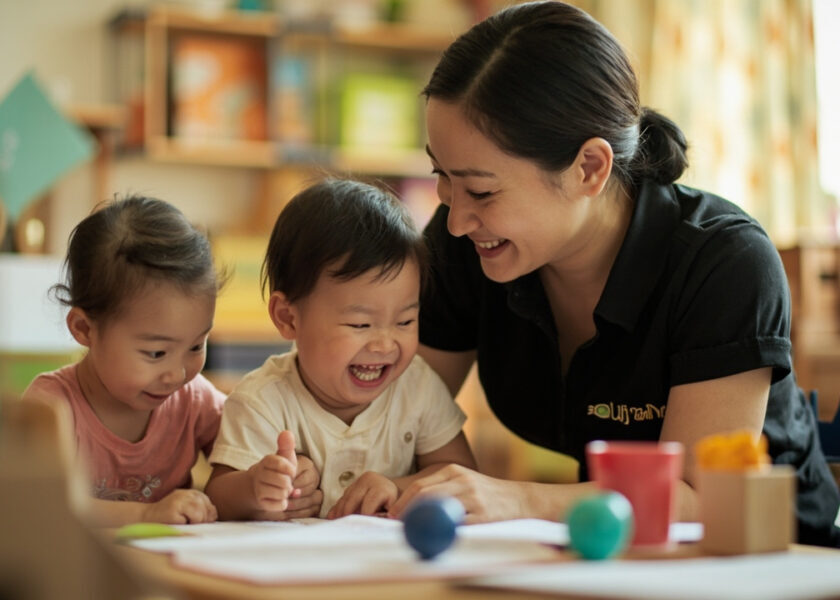
How Singapore Parents Choose Quality Childcare Without Second Guessing
The Moment That Changes Everything: Choosing the Right Person for Your Child
There is a moment—and if you are a parent in Singapore, you probably remember it clearly—when you first leave your child with someone else. It is not dramatic. There is no single turning point, no cinematic instant when everything shifts. But something changes. A threshold is crossed.
In that crossing, a question rises that most childcare marketing would rather you did not ask out loud: have I left my child with the right person?
This is the question this article is built around. Not around the curriculum, not around the facility, not around the philosophy printed beautifully on a brochure or website. Around the person.
Because if you strip everything else away—the bright classrooms, the activity schedules, the carefully worded statements about development—what remains is a human being who will be with your child during the hours that matter most to you. A human being whose warmth, attentiveness, and small daily decisions will shape your child’s experience of the world during these years you will never get back.
Singapore parents deserve to hear this without the softening language that usually surrounds these conversations: the quality of your childcare decision is, at its core, a decision about a person. Not a system. Not a program. A person.
What This Article Covers
- Why the caregiver—not the curriculum—is the decisive factor in quality childcare
- How to evaluate a caregiver’s intentionality beyond warmth and credentials
- What caregiver consistency actually means for your child’s development
- Singapore-specific context: domestic worker care, grandparent care, and centre-based options
- Red flags that signal misalignment versus normal adjustment periods
- How professional childminding through EduNanny addresses these concerns
Why the Person Matters More Than the Program
Most content written for parents in this space dances around a truth while avoiding it. You will be told about curriculum alignment and teacher qualifications and centre accreditation. You will read about the science of attachment and the importance of the first thousand days. All of that is true.
But underneath all of it, sitting quietly in the back of your mind as you tour yet another facility or meet yet another caregiver, is a much simpler, much more personal question: how do I know if this is the right person for my child?
You are not wrong to ask it. You are recognizing something that the best childcare research has known for a long time but that rarely gets communicated clearly: the developmental benefits of quality childcare are not delivered by philosophy statements or activity schedules. They are delivered by human beings, consistently, over time, in moments that no curriculum can predict or plan for.
The way a caregiver responds when your eighteen-month-old is in the middle of a tantrum. The moment they notice your two-year-old is withdrawn and figure out why. The small act of picking up a child who has just fallen and carrying them with genuine comfort rather than polite efficiency. These moments are not in any program. They are in people.
You can have the most sophisticated curriculum in the world. You can have a beautifully designed facility with optimal ratios on paper. But if the human being at the centre of those arrangements is not genuinely engaged, not consistently present, not intentionally attuned to your child, the developmental promise remains unfulfilled. The program sets the stage. The person delivers the performance.
What Families Who Navigate This Well Have in Common
In working with families across Singapore who have made this decision well, a pattern emerges: they do not choose based on glossy materials. They choose based on something harder to quantify but easier to feel.
They pay attention to whether a caregiver can hold their attention while talking about the child. They notice whether the caregiver seems genuinely curious about who this particular child is—not just competent in general, but interested in this specific person. They watch for what the caregiver does when the child is not performing for them, when they are simply present, absorbed in their own play, and the caregiver has to decide how to occupy that space.
What Intentional Caregiving Actually Looks Like
Warmth alone is not sufficient. A caregiver can be warm, genuinely warm, and still not be the right fit for your child. Warmth is necessary but not sufficient.
What you are also looking for is something closer to intentionality—the quality of being not just kind but present, not just responsible but genuinely engaged with your child’s development in the way that you would be.
Signs of Intentional Caregiving
- Curiosity about your specific child: They ask questions about your child’s particular interests, fears, rhythms, and current developmental focus—not just logistical questions but personal ones.
- Reflective practice: They can tell you not just that they respond to crying, but how they think about responding—what they are trying to accomplish in that moment, what they believe children need from caregivers in the hard moments.
- Attunement over time: They notice the small changes—emerging interests, subtle signs of discomfort or joy, the things that matter enormously in the first years of life.
- Engagement beyond the routine: They do what is asked but also go further—not from obligation but from genuine investment in your child’s wellbeing.
This is the difference between someone who does childcare and someone who understands it. And it is visible, if you know what to look for.
When Things Are Difficult
There is a meaningful difference between a childcare service and a caregiving relationship, and that difference lives in what happens when things are hard.
When your child is having a difficult adjustment, when there is a period of separation anxiety or behavioral regression or simply the normal friction of two people learning to be together, a service will manage the situation. A caregiving relationship will work through it.
A caregiver who is genuinely in relationship with your child will not just wait for the difficult period to pass. They will be curious about it, will try to understand what it means, will adjust their approach based on what they learn. This is not about perfection. It is about investment. And investment shows up in how someone handles the moments that are not easy.
How to Evaluate a Caregiver Beyond First Impressions
How do you assess intentionality in a tour, in a meeting, in the brief window when you are deciding? You assess it by paying attention to the questions a caregiver asks—not about logistics, which are easy and everyone asks them, but about your child specifically:
- What does your child love?
- What is your child working through right now?
- What calms your child when they are upset?
Caregivers who are genuinely intentional in their practice are curious about the individual child in front of them, not just about the role they are filling.
You can also pay attention to how they talk about their own practice. Ask them to describe a moment when a child was struggling and how they responded. Listen for whether they have thought about what they do and why—not scripted answers, but the marks of someone who reflects on their work.
Questions Worth Asking
- How do you think about responding when a child is upset?
- Can you tell me about a time you noticed something changing in a child you care for?
- What do you find most meaningful about this work?
- How would you describe your approach when a child is having a difficult day?
The answers you receive—not the polish of the answers, but the substance—will tell you something real about whether this person is engaged in work that matters to them or simply filling a role.
A Framework for Evaluating Quality Childcare
- Observe the questions they ask. Are they curious about your specific child or just the logistics of the arrangement?
- Notice their language about practice. Can they articulate not just what they do but why they do it?
- Watch how they are with children. Not performing for parents, but genuinely present when no one is evaluating.
- Ask about difficult moments. How do they handle separation anxiety, regression, the hard days?
- Trust your observations. You know your child better than anyone. If something feels off, it is worth investigating.
Singapore Parents: Understanding Your Real Options
The pressures on Singapore families are specific, and they shape this decision in ways that content written for other markets does not always capture.
Foreign Domestic Worker Care
Many families in Singapore have experience with foreign domestic workers who have provided childcare. That experience comes with its own set of lessons—about what it means when a caregiver is genuinely committed versus when they are simply doing a job. About the difference between someone who has learned to care for children and someone who has learned to perform care.
Grandparent Care
Others rely on grandparents, and the love in that arrangement is real. But so are its limitations—not limitations of care, but limitations of sustainability, of energy, of the particular developmental support that a dedicated, professionally trained caregiver can offer. Intergenerational care carries deep cultural value. It also carries real constraints that families eventually navigate, often quietly.
Centre-Based Care
Centre-based care has genuine strengths, including structured environments and trained staff. But it also comes with realities that matter for young children: multiple caregivers, larger groups, and the inherent challenge of maintaining the kind of individual relationship that matters most in the early years. When a caregiver is responsible for many children, the depth of attention each child receives is necessarily different.
Comparing Your Options
| Care Arrangement | Strengths | Considerations |
|---|---|---|
| Foreign Domestic Worker | Home-based, familiar environment, potentially long-term consistency | Varies widely by individual; training and investment not guaranteed |
| Grandparent Care | Deep love, family bond, flexibility | Sustainability, energy, professional developmental support |
| Centre-Based Care | Structured environment, qualified staff, socialisation | Multiple caregivers, larger groups, less individual attention |
| Professional Childminding | Individualised attention, consistent caregiver, structured support | Requires finding the right person and arrangement |
Red Flags: When Something Is Not Right
What happens when you have been with a caregiver for months and you realise that something is not right? Not catastrophically wrong, not abusive, not negligent, but not right. Your child is not thriving in the way they should. They are in the care of a warm, well-meaning person who is simply not the right fit.
This happens. It happens more often than childcare providers will admit, because it is easier to blame the child, the adjustment period, or the parents’ anxiety than to name the actual problem: the person at the centre of your child’s care is not the right person.
Signs of Misalignment (Not Normal Adjustment)
- The caregiver seems competent but not curious—professional but not interested
- They do what is asked but do not go further
- Warmth in your presence does not seem to translate into genuine attunement when you are not there
- They talk about your child in generalities rather than specifics
- They cannot tell you a story about your child’s day that reveals they were truly present for it
- Your child shows signs of not being settled even after a reasonable adjustment period
These are not failures of kindness. They are failures of the intentionality that makes quality care possible.
You are allowed to notice these things. You are allowed to pay attention to what is actually happening, to trust your own observations, to ask the questions that feel uncomfortable. You do not need permission from a brochure or a director to evaluate whether the person caring for your child is the right person. That is not being difficult. That is being a parent.
How EduNanny Addresses These Concerns
What EduNanny by BUTLER offers is a different kind of answer to the set of realities Singapore parents navigate. It is part of the ECDA Childminding Pilot, which means it operates within a framework designed to elevate the standard of home-based and community-based care in Singapore.
The pilot structure matters because it means this is not just a service that has decided to call itself quality. It is a service operating within a system that has set specific standards for selection, training, and practice. For parents navigating this decision, that distinction matters. Accreditation and pilot frameworks are not guarantees of perfection, but they are structures designed to ensure that the caregivers you are trusting with your child have been evaluated against more than just an interview and a smile.
What Makes EduNanny Different
The caregiver-to-child ratios in the EduNanny model—up to one to three infants in certain configurations—reflect something important: the number of relationships a caregiver can genuinely maintain is limited, and quality is not optimised by volume.
When a caregiver is responsible for fewer children, they can know each one more deeply. They can notice the small changes, the emerging interests, the subtle signs of discomfort or joy that matter enormously in the first years of life. This is not a soft philosophy. It is a structural recognition that human attention is finite, and that the finite attention your child deserves requires a structure that makes it possible.
What Parents Can Expect
- Communication: Structures that give parents the information they need to feel genuinely connected to what is happening, beyond daily logs into something closer to partnership
- Transparency: Safety measures and open channels that allow parents to feel involved without micromanaging
- Financial accessibility: CDA and Baby Bonus funds can be used, aligning the financial architecture of childcare support with this model
- Predictability: Monday to Friday care blocks that provide the reliability working parents need
In the EduNanny model, caregivers are developed through structured training that goes beyond basic certification. They are supported by an organisation that understands the ECDA Childminding Pilot framework and what it requires. They are retained through conditions that make the work sustainable—clear expectations, professional respect for the role they play.
They are connected to families through communication structures that allow for transparency without surveillance, involvement without micromanagement. This is not a transaction. It is a relationship, supported by an organisation that has decided to take seriously what it means to place a human being in the most important role your child will encounter outside of your own family.
The Decision You Are Actually Making
This is not a small thing. It is one of the most consequential decisions you will make as a parent, and it deserves the same seriousness you would bring to choosing a school, a doctor, a home.
Not because childcare is a commodity to be optimised, but because the person you choose will be with your child in the moments that you are not. They will be there when your child falls and needs comfort. They will be there when your child learns something new and needs someone to notice. They will be there when your child is tired and irritable and needs patience they can only find in someone who truly knows them.
The quality of those moments, accumulated over the months and years of early childhood, will shape who your child becomes in ways that no curriculum can replicate.
Evaluate not just the credentials and the facility and the philosophy, but the human being sitting in front of you. Because the person matters. It has always been the person. And the decision you make about that person is one of the most important decisions you will make in these early years.
EduNanny exists because someone decided that Singapore parents should not have to make this decision in the dark. That you deserve a framework for thinking about what quality looks like, a structure for finding caregivers who meet that standard, and a partnership that treats this decision with the seriousness it deserves.
The caregivers in the EduNanny network are not perfect. No human beings are perfect. But they have been selected and supported and retained with the understanding that what they do matters enormously, and that the child at the centre of this relationship deserves their best.
So if you are ready to choose not just a service but a person—and to trust the structures and support that make choosing well possible—this is where that work begins.
A caregiver who is ready. A family who is ready to trust. And a child in the middle, held by both, growing in the way that children grow when they are genuinely held.
That is what this is about. That is what it has always been about. And that is what EduNanny is here to make possible.
Ready to explore what intentional, quality childminding looks like for your family? Connect with EduNanny to learn more about the ECDA Childminding Pilot and what it means to choose the right person for your child.