How Singapore Parents Can Raise Culturally Rooted Children with Quality Childcare
The Cultural Wealth We Live In
Singapore is one of the most linguistically rich cities in the world. In a single playground, you might hear Tamil and Mandarin, Malay and English, Hokkien and Teochew, Cantonese and Bengali—children switching between languages with an ease that would have taken their parents years to master.
This is not an accident. It is the result of deliberate choices made by families, by communities, and by a society that has long understood: language is not just communication. Language is inheritance. Language is identity. Language is the medium through which culture is transmitted from one generation to the next.
Where the Fear Comes From—and Why It Doesn’t Have to Be Your Reality
There is a quiet anxiety that follows the rise of formal childcare in Singapore. It whispers: if I am not the one teaching my child our language, who will? If my child spends their earliest and most formative years in someone else’s care, will they still absorb the things that make us who we are?
Will they still speak my mother tongue the way I speak it? Will they still understand why the reunion dinner matters, why Hari Raya is a time of forgiveness and feasting, why Deepavali lights illuminate more than just the house?
These are not unreasonable fears. They are a sign of deep parental love and cultural commitment. But they are based on a misunderstanding—one that too many childcare conversations have reinforced without meaning to.
The misunderstanding is this: that cultural transmission is a zero-sum game. That there is only so much culture to go around, and if someone else holds your child for forty hours a week, they are somehow taking something away. That the choice between quality childcare and cultural nurturing is a binary one, a trade-off, a sacrifice.
What if it doesn’t have to be?
What if quality childcare—intentional, thoughtful, premium childcare—could be a second cultural home for your child? Not a replacement for what you do, but an extension of it. Not a dilution of your family’s cultural work, but a reinforcement of it.
This is not wishful thinking. This is what decades of research on early childhood development has quietly affirmed, and it is what every parent who has watched their child return from a day of care reciting a Mandarin rhyme or singing a Malay action song already knows in their heart.
How Children Really Learn Culture and Language
Language does not develop in a vacuum. It develops in relationship. It develops through consistent, meaningful, emotionally rich exposure.
A child does not learn to love a language simply because they hear it. They learn to love it because they hear it from people who love them, in contexts that feel safe and warm, through songs and stories and small daily rituals that make the language come alive.
From the moment they are born, children are taking in the world with all their senses, building the neural pathways that will later support language, cultural understanding, and social belonging. The first thousand days of life—from conception to roughly age two—are not just about physical growth. They are about the architecture of identity. They are about laying the foundations for who this person will become, what languages they will feel at home in, what cultural rhythms will feel natural to them.
This is why the environment in which a child spends their early years matters so profoundly. It is not about replacing the family. It is about complementing, extending, and enriching what the family does.
Consider the difference: a child who hears Mandarin only at home may develop a passive understanding of the language. A child who hears Mandarin at home and then enters a childcare environment where Mandarin is spoken with warmth and intention, where songs and stories and everyday interactions are conducted in the language, where they are gently corrected and encouraged and celebrated for using it—that child is building something deeper. They are building fluency. They are building confidence. They are building a cultural identity that has roots in the family but also branches into the wider world.
And this begins earlier than many parents realize. From the moment a baby is held, spoken to, and sung to, they are building the neural foundations for language and cultural attunement. A six-month-old who is regularly exposed to a heritage language is not simply hearing sounds—they are developing the phonetic map that will later allow them to distinguish between tones, to reproduce sounds accurately, to feel at home in a particular linguistic landscape.
The child who enters a quality infant care environment at nine months and spends their day in a Mandarin-rich setting is not losing their home language. They are gaining a second one. And the earlier they begin, the more natural and effortless this process becomes.
What Quality Childcare That Nurtures Culture Looks Like
Let me be concrete, because this is not an abstract idea. It is something you can see, hear, and feel when it is done well.
Think about what happens in a day at a childcare setting that takes language and culture seriously:
- In the morning, the caregiver greets the child in the language the family has chosen as primary—not as a formality, but as a genuine invitation into relationship
- During breakfast or snack time, there are songs in the heritage language, little ones learning the words to familiar tunes, their accents shaped not by textbooks but by the natural rhythm of a caregiver’s voice
- Throughout the day, there are stories—perhaps a picture book in Tamil, perhaps a nursery rhyme in Cantonese, perhaps a counting game in Malay
- These are not lessons. They are moments. But they are moments that accumulate, that layer upon each other, that slowly build a child’s sense of belonging to a language and a culture
Rituals matter too. In Singapore’s multicultural landscape, they are the markers of identity, the moments when culture becomes tangible and alive.
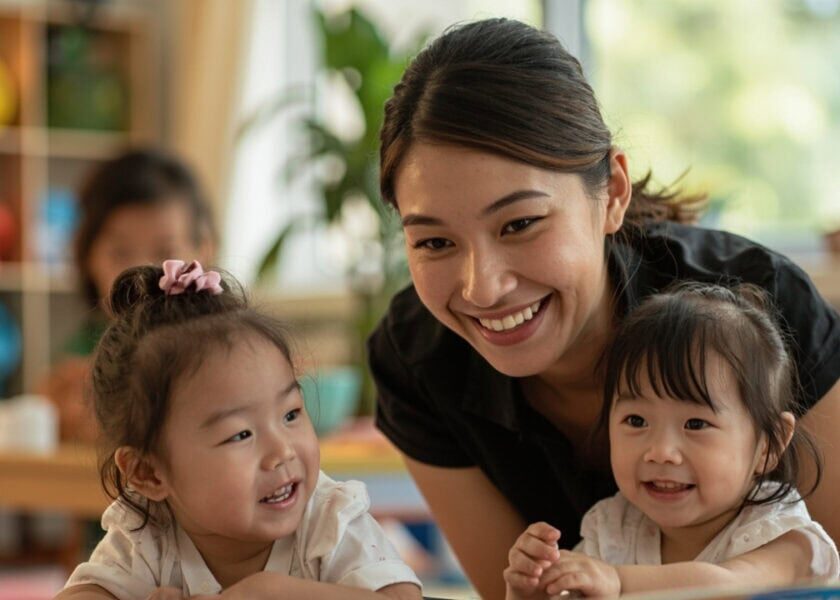
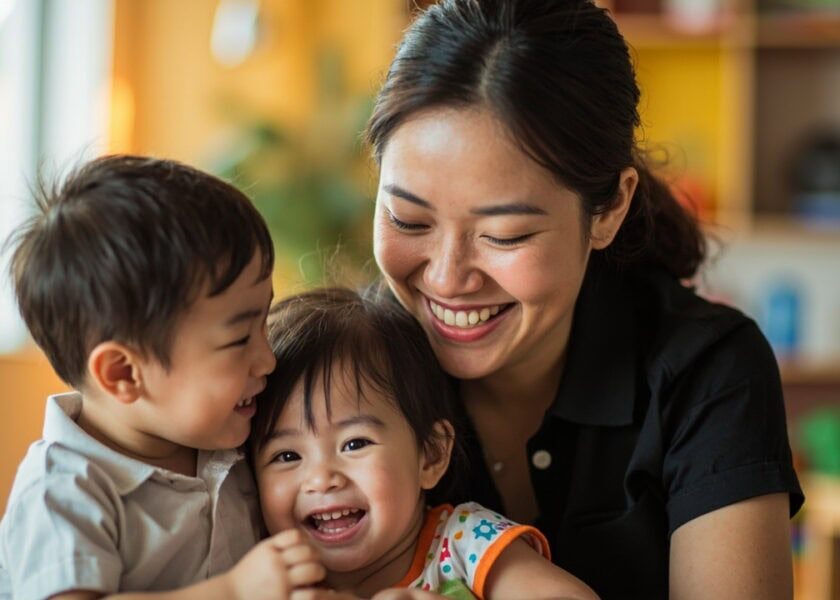
A childcare setting that understands this might celebrate Chinese New Year with the children making their own dumplings, learning the symbolism of the red envelope, singing songs about the spring festival. It might mark Hari Raya with shared storytelling about the meaning of forgiveness and gratitude. It might observe Deepavali with rangoli art and the lighting of small oil lamps.
Not in a superficial, performative way—but in a way that invites the children into the deeper meaning of these celebrations, that helps them understand why these moments matter to their families.
This is what cultural nurturing looks like in practice. It is not a curriculum. It is a way of being with children.
Questions to Ask Any Childcare Provider
So how do you find childcare that does this well? How do you know if a setting is genuinely committed to cultural partnership, or if it is simply going through the motions?
On language: Not just whether a language is spoken, but how. Is it woven into the fabric of the day, or only surfaced at circle time? Do the caregivers speak it naturally, comfortably, with the fluency and warmth of a native speaker?
On culture: How does the setting observe Singapore’s diverse cultural calendar? Are celebrations an afterthought, or are they thoughtfully integrated into the learning environment? Do the caregivers understand the meaning behind the rituals they share with children?
On communication: How will you know what happened in your child’s day? Will you receive regular updates about their learning, their development, their moments of joy and discovery?
On values alignment: A quality childcare provider will not be defensive about these questions. They will welcome them. They will see your desire to preserve and nurture your child’s cultural identity not as a complication, but as a shared mission.
EduNanny Singapore: A Partnership in Cultural Nurturing
EduNanny Singapore takes a different approach.
Operating within the ECDA Childminding Pilot, EduNanny was designed not just to provide childcare, but to elevate it. The pilot recognizes something that early childhood professionals have long understood: children thrive when they are cared for in environments that are warm, consistent, and attuned to their developmental needs.
That is why EduNanny maintains ratios that ensure every child receives the attention and individual care they deserve. Caregivers are trained not only in safety and pedagogy, but in the art of relationship—the foundational skill upon which all learning, including cultural learning, is built.
EduNanny offers both home-based and community or centre-based pathways, because every family is different, and the best childcare is the one that fits your life. Whether your child is cared for in the familiarity of your own home by a dedicated caregiver, or in a warm community setting with other little ones, the principles remain the same: intentional care, cultural respect, and a commitment to being your partner in your child’s development.
The practical details matter too. EduNanny’s care operates on Monday to Friday blocks, designed around the rhythms of working families. Fees within the pilot structure are structured to be accessible, and eligible families can utilize their Child Development Account and Baby Bonus schemes to offset costs.
For parents navigating the very real financial considerations of quality childcare, this is not a small thing. It is an acknowledgment that cultural nurturing should not be a privilege reserved for the wealthy, but a possibility open to every family committed to raising a culturally rooted child.
Questions Parents Often Ask
Will my child lose their home language?
Not if your childcare partner works in alignment with your family. When language exposure is intentional and consistent across both home and care environments, children do not lose languages—they build upon them.
Is my child too young for cultural exposure to matter?
No. The research on early brain development is clear: the first years are when neural pathways for language and cultural attunement are being laid most rapidly. Every song sung, every story told, every greeting offered in your heritage language during infant care is building foundations that will serve your child for life.
How do I know if a provider truly respects my culture or is just performing?
Ask about the meaning behind their practices. A provider who can articulate why they celebrate certain festivals—not just what they do, but what those celebrations mean—is one who has integrated cultural respect into their philosophy, not just their calendar. Trust your observations during visits: do caregivers speak the language naturally or stiffly? Do cultural elements feel woven into the day or stuck on as decorations?
For those just beginning to explore these options, EduNanny has developed Thomas—an AI chatbot that can answer your questions, guide you through the process, and help you understand what quality childminding can look like for your family. It is not a replacement for conversation, but it is a beginning.
Your Child’s Second Cultural Home
I want to return, for a moment, to where we began.
There is a question that many Singapore parents carry. Will my child still be mine? Will they still carry our language, our stories, our sense of home?
Here is what I have learned in this work: the answer is not found in the absence of childcare. It is found in the presence of intentionality. It is found in choosing a childcare partner who shares your values, who respects your cultural priorities, who understands that their role is not to replace the family but to extend it.
Quality childcare does not diminish your child’s cultural identity. It strengthens it. It gives them roots that go deeper than any single environment could provide. It surrounds them with the language you have chosen for them, in contexts you trust, with caregivers who honor the work your family is doing.
This is the truth that too few Singapore parents have been offered: that you do not have to choose between the career you have worked for and the child you have raised. That you do not have to choose between reliable, quality care and rich cultural nurturing. That these things can coexist, can complement each other, can become part of a whole.
There is a word that captures what quality childcare can be.
The word is home.
Not home in the literal sense—though a warm, safe environment is certainly part of it. Home in the deeper sense: a place where your child feels known, where their language is valued, where their culture is celebrated, where they are not asked to leave any part of themselves at the door.
A second cultural home.
This is what quality childcare can be. This is what EduNanny Singapore is working every day to create—not a place that watches your child while you work, but a place that grows them. That nurtures them. That joins you in the sacred, challenging, rewarding work of raising a child who knows who they are.
You are already making choices, small and large, that shape your child’s identity. You are already speaking to them in the language you promised yourself you would pass down. You are already telling them the stories of where they come from.
EduNanny Singapore is here to walk beside you. To be your partner. To be, in the truest sense, a second home for your child’s culture, their language, their sense of belonging.
That is not a small thing.
That is everything.
If you are ready to explore what a childcare partnership built on shared cultural values looks like for your family, EduNanny Singapore is here to start that conversation. Visit their website or speak with Thomas, their AI assistant, to learn more about options that fit your life, your values, and your vision for your child.
To learn more about EduNanny and their approach to quality childminding within the ECDA framework, visit the about EduNanny page or get in touch to begin a conversation about what partnership could look like for your family.