How Singapore Families Find Balance When Childcare Finally Clicks
What Singapore Parents Are Actually Carrying
There is a moment, somewhere between the second and sixth month of a new childcare arrangement, when something shifts that no one warned you about.
It is not the morning goodbye. You expected that — the small hand releasing yours at the door, the brief surge of guilt, the exhale as the car pulls away. You had braced for that.
What you did not expect was the Tuesday evening that arrived without warning. An ordinary night. Dinner on the table, your partner laughing at something your toddler said, and the sudden realization that the house felt different. Warmer. Lighter. The kind of warmth you remembered from before parenthood, when your home felt like a place you came back to rather than a place you were trapped in.
You could not quite name what had changed. The logistics were the same. You still worked the same hours. The commute had not shortened. But somewhere in the weeks before, a pressure you had not even recognized as pressure had lifted from your household — and now that it was gone, you felt its absence everywhere.
This is what most Singapore parents discover in pieces, across kitchen tables and late-night conversations, in the quiet space between dropping off and picking up. They chose childcare hoping it would help their child. What they found, months later, was that it had quietly transformed their marriage, their relationship with their extended family, their sense of who they were as parents, and the emotional climate of their home in ways they had not anticipated and could not have predicted.
This is not a side effect. This is not coincidence. This is what happens when a family system finds its balance — and it is the most important thing a childcare decision can do, long after the question of whether your child is safe and stimulated has been answered.
The Invisible Weight
The modern Singapore parent is navigating something genuinely unprecedented. You are managing the expectations of an extended family culture that still believes grandparents should be raising grandchildren, while simultaneously building careers that require the kind of focus and presence that parenthood makes difficult. You are balancing the cost of living in one of the world’s most expensive cities against the desire to give your children more than you had. You are negotiating, often in silence, the gap between the parent you imagined you would be and the parent you actually are on a Wednesday evening when dinner is late and everyone is tired.
It does not announce itself in crises or ultimatums. It lives in the sigh before you walk through your front door. In the way conversations with your partner have become logistics-heavy and tenderness-light. In the growing distance between you and your mother, who does not understand why you seem so stressed when she raised four children on much less. In the quiet recognition that parenthood has made you smaller rather than larger — less yourself rather than more.
The Family Systems Perspective
Family systems theory tells us, in language that matters more than the theory itself: a family is not a collection of individuals. It is an interconnected system, where what happens to one member ripples through everyone.
When a child is not thriving in their care arrangement, the entire household feels it. When a parent is chronically depleted, the marriage feels it. When the family rhythm is chaotic, every relationship in the home becomes a little more brittle, a little more guarded, a little more likely to fracture under small pressures that should be manageable.
The Singapore families we work with are not failing. They are struggling under a weight they did not design and cannot see clearly — and one of the heaviest pieces of that weight is the childcare question, which they have been approaching as a logistical problem when it is actually a systemic one.
The question is not only: Who will watch my child?
The question is: What will our family become with this arrangement in place?
This is the question that most childcare marketing refuses to ask. It focuses on your child — on safety, on development, on whether the walls are bright enough and the teachers trained enough. And those things matter. They matter enormously.
But they are not the whole story. Once you have met the baseline of care your child deserves, the question that will determine whether your family thrives or merely survives over the next several years is this:
What kind of family does this childcare arrangement make possible?
Four Transformations: How Quality Care Changes Everything
Parents Become Emotionally Present
Think with me for a moment about what actually changes when quality care arrives in a home. The first transformation is the one parents feel most immediately, though they rarely name it. It is the return of emotional presence.
You pick up your child at the end of the day, and you are actually there — not mentally composing tomorrow’s work email, not running through the checklist of things you forgot to do, not depleted beyond the point of real connection. You are tired, yes. But you are not hollow. There is something left in you for your child, for your partner, for the simple pleasure of an evening at home.
What children need is not a certain number of hours with a parent. What they need is the quality of presence that a parent can offer when that parent is not running on empty. A parent who is emotionally available for thirty minutes of genuine play and attention gives a child more than a parent who is physically present for three hours but emotionally absent, scattered, frayed.
When quality childcare removes the chronic depletion that most Singapore parents are carrying, it does something remarkable. It gives parents back to themselves. It gives them the capacity to be the parent they imagined they would be — not because they are trying harder, but because they are no longer running on reserves that do not exist.
Couples Find Each Other Again
The second transformation is the one that surprises couples most. There is a phenomenon that happens in households where childcare has been a source of strain rather than support: the marriage narrows.
Not intentionally. Not dramatically. But over months and years, the couple who used to stay up talking, who used to plan adventures together, who used to feel like partners in something larger than themselves — they become logistics managers. They coordinate. They divide tasks. They discuss schedules and costs and who will do pickup. The tenderness that was the foundation of their family gets buried under the weight of managing a family, and neither of them knows quite when it happened or how to get it back.
What we have observed, again and again, across families in Singapore, is that when childcare is working — truly working, at the level that gives parents back their capacity — something shifts between the couple:
- There is room for conversation that is not about the children
- There is room for touch that is not about exhaustion
- There is room for partnership, for fun, for the kind of intimacy that made them want to build a family together in the first place
One father told us, after a year in our programme, that he had remembered why he married his wife. Not because anything dramatic had happened. Because the pressure had lifted enough for him to see her again — to remember who she was before parenthood narrowed their world.
That is what quality childcare can do. It can give couples back to each other.
Extended Family Dynamics Soften
The third transformation touches something that Singapore families rarely discuss openly: the extended family dynamic. Singapore has a particular complexity here. We are shaped by multigenerational expectations that are both a gift and a burden. Grandparents often want to be involved. Extended family often has opinions. Cultural norms around how children should be raised create friction that is difficult to name and nearly impossible to resolve through willpower alone.
When a professional caregiver enters the picture — trained, transparent, accountable, and operating within clear systems — something interesting happens. The professional fills a gap that was creating pressure:
- The grandmother who was reluctantly providing childcare because there was no other option can step back into her proper role: grandparent, not primary caregiver
- The tension between generations about feeding methods or screen time or discipline styles diminishes because there is a neutral professional following evidence-based practice
- As the family sees the child thriving and the pressure on grandparents eases, the emotional climate of the extended family softens
There is less friction. There is more space for the grandparent-grandchild relationship to be what it was always meant to be: joyful, uncomplicated, a source of connection rather than obligation.
Quality childcare does not replace family. It restores family to its proper shape.
Parental Identity Expands
The fourth transformation is harder to see from the outside but more profound than any of the others: the transformation of parental identity.
Somewhere in the months after quality care is in place, parents realize that they have stopped defining themselves entirely by their role as parent. They are still parents — profoundly, lovingly, responsibly. But they are also something else:
- They are a person who has space for their own interests, their own friendships, their own ambitions
- They are a partner, not just a co-parent
- They are a child themselves, in relationship with their own parents, rather than a parent who is only defined by what they give to their children
This matters more than we typically acknowledge. Parental identity, when it consumes everything else, creates a kind of narrowing that is neither healthy for parents nor for children. Children need parents who are whole people, who have their own lives and passions and relationships, who can model what it looks like to be a human being rather than simply a parent.
When quality childcare gives parents back their evenings, their weekends, their mental space — it is giving them back themselves. It is saying, through the simple fact of its existence: You are more than what you do for your children. You are a person who deserves a life.
What Quality Childminding Looks Like
Now that we have explored why childcare matters so profoundly for your family system, let us be concrete about what quality actually means — because not all childcare arrangements are created equal, and the difference matters more than most parents realize when they begin their search.
Environment and Ratio
Research and practice consistently show that for infants and young children, care in a home environment — with a consistent caregiver, with ratios that allow for genuine attention — best supports both child development and family wellbeing. Consider what happens when caregivers are stretched too thin. The quality of attention drops. The warmth becomes mechanical. The child senses it, even if they cannot name it.
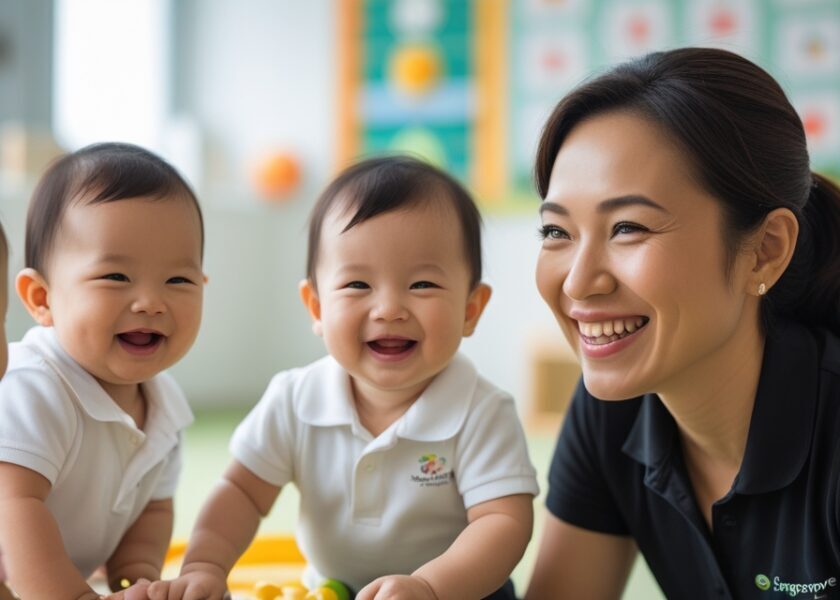
For infants, a ratio of up to three children with one dedicated caregiver is not a regulatory minimum to be sought — it is a standard that reflects what genuine attention requires.
Predictability and Rhythm
Singapore parents are managing complex schedules. Predictability is not a luxury — it is a foundation for the household rhythm that gives everyone more capacity. When care runs Monday to Friday in structured blocks, families can plan their lives. They know what to expect. They can build around it rather than constantly adapting to uncertainty.
Communication and Trust
Trust is not built on promises alone. It is built on transparency — on parents knowing what is happening with their children, in real time and in retrospect. Communication that is continuous, ongoing, and two-way creates the conditions for genuine partnership rather than anxious wondering.
What EduNanny Singapore Offers
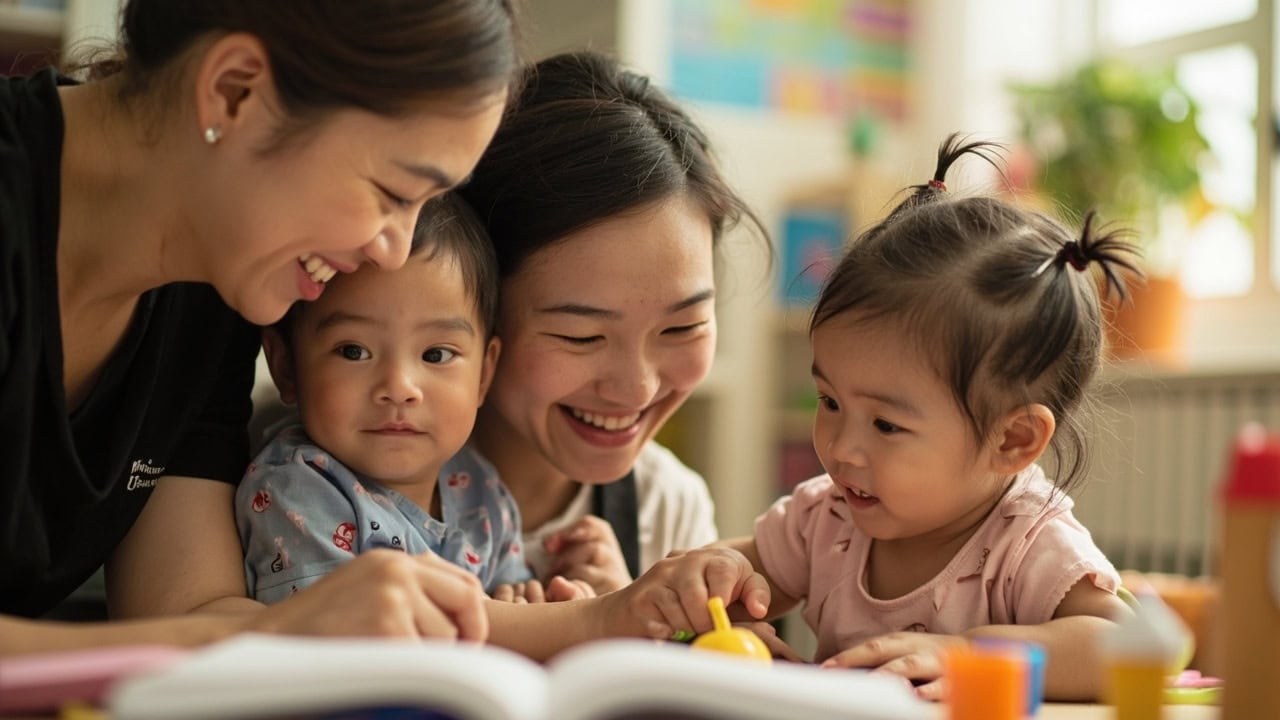
EduNanny Singapore is built on a conviction that has informed every decision we have made: childcare is not a product to be delivered. It is a relationship to be cultivated — a partnership between the family and the caregiver, supported by systems that create transparency, accountability, and trust.
We are part of the ECDA Childminding Pilot, operating within the home-based pathway. We believe that for infants and young children, care in a home environment, with a consistent caregiver, with a ratio that allows for genuine attention, is the arrangement that best supports the child’s development and the family’s wellbeing.
- Up to three infants in care, with one dedicated caregiver. This is not a regulatory minimum we are seeking. This is a standard we believe in.
- Monday to Friday, in structured blocks that give families the predictability they need to plan their lives.
- CDA and Baby Bonus funds accepted. The pilot fee structures have been designed to be accessible, and we make it straightforward to use what you already have.
- CCTV in place where we operate. Not because we assume anything will go wrong, but because parents deserve to know what is happening with their children, in real time and in retrospect.
- Thomas AI Chatbot. Available to support parents and caregivers with guidance, answers, and resources whenever they need them — because parenting does not stop at the front door of the childcare arrangement.
We do not believe in the kind of childcare where parents are left wondering. We believe in childcare where parents are partners.
Questions Parents Ask
“Will my child feel abandoned?”
Children are remarkably perceptive. What they feel is not whether you are with them every moment, but whether you are present when you are with them. A parent who is emotionally available for thirty minutes of genuine play gives a child more than a parent who is physically present for three hours but emotionally absent. When quality care gives you back your emotional reserves, your child feels the difference in your presence.
“Will my family judge me?”
This is one of the most common concerns we hear from Singapore parents, and one of the most important to name honestly. The judgment often comes from people who love you but who are operating from a different era and a different set of pressures. What we have observed, repeatedly, is that as the professional caregiver demonstrates their competence, as your family sees your child thriving, as the pressure on grandparents eases — that judgment softens. It may not disappear overnight. But it shifts, because the results speak for themselves.
“Can we afford this?”
The question of cost is real and deserves honest engagement. Singapore is expensive. But the question is not simply whether you can afford quality childcare — it is whether you can afford the cost of not having it. The depletion of parental capacity. The narrowing of your marriage. The friction in your extended family relationships. These have costs too, even if they are harder to measure.
“How do I know this will actually work for my family?”
No childcare arrangement is right for every family. What we offer is one pathway — home-based, with a dedicated caregiver, small ratios, structured hours, high transparency. We believe deeply in this approach because we have seen what it makes possible. But we also believe that the right fit matters more than any particular model.
Choose from clarity about what you are actually choosing for. Choose from a place of understanding about what your family needs to thrive. That is the only way to find the arrangement that will work for you.
A Guide for Your Decision
As you think about the decision ahead, here is what we would encourage you to consider:
- Ask the family question, not just the logistics question. Who will watch your child while you work? That is the logistics question. What kind of family will you become with this arrangement in place? That is the family question. Start there.
- Consider the ratio. For infants and young children, the ratio matters enormously. Ask how many children each caregiver will be responsible for. The answer should reflect what genuine attention requires, not just what the regulations allow.
- Look for transparency. How will you know what is happening with your child? Ask about communication, about updates, about how you can stay connected to your child’s day. Trust is built on visibility.
- Think about the household rhythm. Does the care arrangement support predictability? Can you plan your life around it? Or are you constantly adapting to uncertainty?
- Consider the whole family. Not just your child, but your marriage, your extended family relationships, your own sense of self. A childcare arrangement that is good for your child but depleting for you is not serving your family system.
- Trust your instincts. You know your family better than anyone. If something feels off, pay attention. If something feels right, trust that too.
The Invitation
What I want you to carry with you from this conversation is not a list of features or a sales pitch. What I want you to carry is a question — one that you are now, perhaps, equipped to ask more clearly than before.
What kind of family do you want to become?
Not what kind of childcare do you need. Not who will watch your child while you work. What kind of family do you want to become, over the years ahead, and what kind of childcare arrangement would make that family possible?
This is the question that quality childcare answers. It answers it in the emotional presence you recover for your child. It answers it in the space that opens again between you and your partner. It answers it in the softening that comes to your extended family relationships when the pressure eases and everyone can return to their proper role. It answers it in the parent you become — whole, resourced, capable of flourishing — when you are no longer running on empty.
EduNanny Singapore exists to give families back to themselves. Not to take your place. Not to replace what you do. But to create the conditions under which your family can be what it was always meant to be: warm, connected, resourced, and capable of joy.
That is not a small thing. In a city that demands so much of families, in a culture that carries so many expectations, in a season of life that asks everything of you — giving your family back to itself is one of the most important things you will ever choose.
Choose from that place. Not from fear. Not from logistics. From that expanded understanding of what you are actually choosing for.
We would be honored to walk that path with you.
If you are ready to explore what quality childcare can mean for your family, we invite you to connect with us to learn more about our approach to infant care and childminding. Your family deserves more than logistics. It deserves to flourish.