How Sibling Bonds Shape the Best Childcare Decisions in Singapore Families
Understanding the Sibling Effect in Singapore Families
When we talk about childcare in Singapore, the conversation often centers on finding someone trustworthy to look after a single child—one decision, one path forward. But for families with multiple children, and Singapore has one of the highest rates of two-child and three-child households in the developed world, the conversation shifts entirely. It becomes about ecosystems. About how two children can share space and attention and still emerge as fully themselves.
This is what we call the sibling effect, and understanding it is key to making childcare decisions that serve your whole family.
- Why siblings are not just two children sharing parents—they are each other’s first peer group, collaborator, rival, and teacher
- The real tension parents with multiple children carry, and why it is not a sign of weakness
- How quality childcare transforms sibling rivalry into sibling relationship
- What the ECDA Childminding Pilot means for families in Singapore
- How to choose childcare that sees each child as an individual and the sibling unit as an asset
What Quality Childcare Looks Like for Multiple Children
You do not need to replicate what you gave the first child. You need to understand what each child actually needs.
Siblings are not carbon copies of each other. They have different temperaments, different learning styles, different needs for closeness and independence, different rhythms of development. Your four-year-old may be flourishing in a structured environment with clear routines and peer interaction, while your eighteen-month-old may need more unhurried one-on-one moments to feel secure before branching out. Treating them differently is not favoritism. It is responsiveness. It is good parenting.
Individualized Attention Within a Group Context
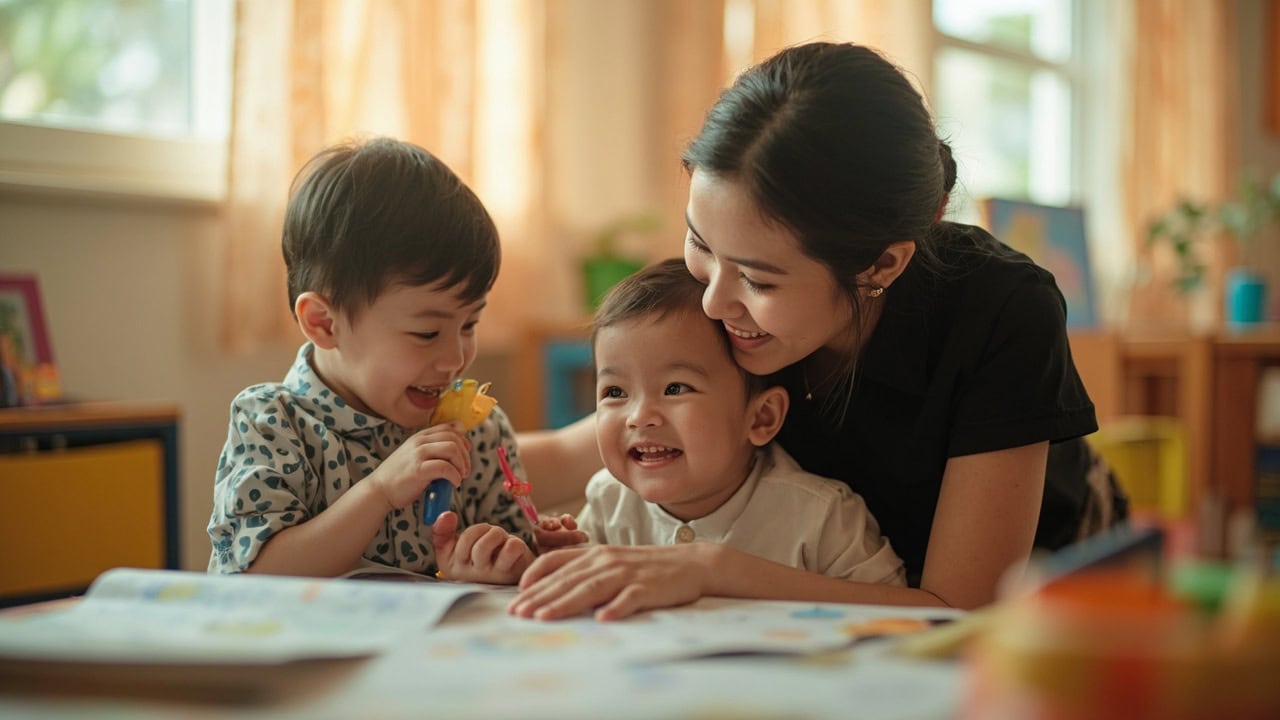
Every child in quality care has meaningful access to a caregiver who knows them—who notices their moods and milestones and small daily triumphs, who can respond to them as the specific person they are rather than as a slot in a schedule.
At EduNanny, our infant ratios are carefully maintained at up to one to three, meaning every child has genuine access to responsive, attentive care. This is not a marketing claim. It is a structural commitment that makes individualized care possible.
An Environment That Supports the Sibling Bond
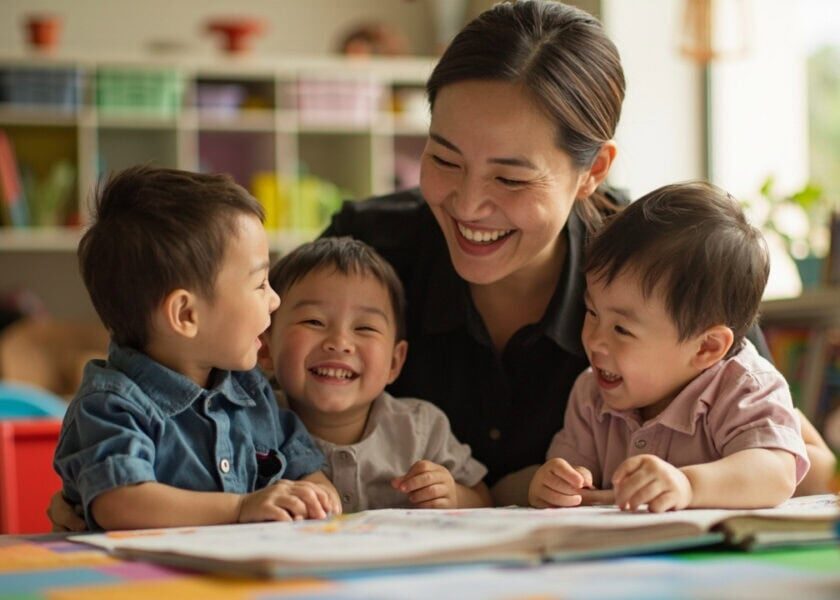
Siblings are each other’s first peer group, first collaborator, first rival, and often first teacher. The relationship between siblings is one of the most formative in human development, and professional childcare is uniquely positioned to support it—not despite the complexity it introduces, but because of the richness it offers.
When your children are in a quality childcare environment together, or when they are navigating arrangements that feel coordinated rather than fragmented, something remarkable happens. They learn from each other.
- Your older child, struggling with a new skill, watches your younger one try something fearless and discovers new courage.
- Your younger child, still building language and social awareness, watches your older one navigate a conflict and begins to understand how people work together.
- They learn, in real time, that they are not alone in growing up. They have a witness. A companion. Someone who shares their history and will share their future.
Managing Rivalry, Building Relationship
Sibling rivalry in childcare settings is managed, not eliminated. It is redirected, becoming one of the most powerful learning opportunities your children will ever have.
In a well-designed care environment, children learn that conflict has a resolution. They learn that sharing is not surrender. They learn that another child’s needs are real and matter, and that relationships require negotiation and compromise.
We have seen siblings arrive with a complicated dynamic and leave months later with new tools for relating to each other. Not because we separated them or gave them individual counseling, but because we created an environment where they could practice being together under supportive conditions. Where a caregiver could guide them toward understanding each other’s perspectives.
This is the sibling effect in action. Rivalry transformed into relationship. Competition softened by cooperation. Two children who know, in their bones, that they belong to each other.
The ECDA Childminding Pilot: What It Means for Your Family
At EduNanny, we are part of the ECDA Childminding Pilot—a framework specifically designed to honor the individualized attention that young children require. This is not just a designation. It shapes how we work, how we maintain ratios, and how we approach every family’s unique situation.
The pilot was designed with the recognition that Singapore families are diverse in their needs, their schedules, and their preferences. We offer home-based childminding, where a trained caregiver comes to your residence and provides care within the familiar environment your children already know. This can be especially valuable for families with infants or toddlers who thrive in predictable settings, or for families where multiple children of different ages need coordinated care in the same space.
Options Available to You
- Home-based childminding — A trained caregiver comes to your residence, providing care in your children’s familiar environment. Ideal for multiple children of different ages who need coordinated care.
- Community pathway — Connected to broader support structures that help families navigate transitions across different care arrangements as children grow and needs evolve.
- Monday to Friday care blocks — Available to meet the rhythm of working parents with predictable schedules.
For families navigating the financial realities of raising multiple children, there are real resources available to you. Your Child Development Account can be used for eligible early childhood services, and the Baby Bonus scheme offers additional support that can ease the cumulative cost of caring for more than one child simultaneously. We help families access these as part of our commitment to serving the whole family.
Addressing the Concerns Singapore Parents Carry
On Guilt and the Division of Attention
Choosing childcare for multiple children is not twice as hard as choosing it for one. It is differently hard—requiring more imagination, more flexibility, and more trust, not just in the caregiver, but in yourself.
You are not failing because you cannot be everything to both children at every moment. You are doing something extraordinarily difficult, and you are doing it with love.
On Whether to Keep Siblings Together or Separate
This is one of the most common questions we hear, and the answer depends on your specific children and their needs. There is no universal rule.
What matters is that the arrangement honors each child’s developmental stage, supports the sibling relationship in whatever way works for your family, and provides the individualized attention each child needs to feel seen.
Some sibling pairs thrive in shared care environments. Others benefit from separate arrangements that allow each child to have the caregiver’s focused attention. Many families find a combination that evolves as their children grow.
On Trust and Transparency
We understand that trust is not built through promises alone. It is built through transparency, and through systems that allow you to verify what you are being told.
Where our services include CCTV measures, we make this known. Where communication is ongoing and structured, we maintain it. You should never feel that you are leaving your children in a black box. You should feel that you are leaving them in a place where you are always welcome to ask, always informed about what is happening, and always confident that the people caring for your children are the people they appear to be.
On Finding Care That Adapts
The care you choose today is not a decision you make once and then forget. It is an ongoing relationship, and it deserves ongoing attention.
Your children will not be the same children they are today. They will grow. Their needs will shift. The sibling relationship will deepen and change and sometimes surprise you. The care environment you choose should be able to adapt with you.
What EduNanny Is Built For
We do not have a single answer for every family. We have an approach that adapts, that listens, that evolves with your children’s development and your family’s changing needs.
EduNanny is built for the real families. The ones with two children who need different things. The ones with a parent traveling and a grandmother who can help on Wednesdays but not Fridays. The ones where the second child has been in care for a year and is thriving, and you are wondering whether they need something different now that they have grown.
Our caregivers are trained not just in infant care and child development, but in the specific dynamics of multi-child environments. They know how to individualize attention while maintaining group cohesion. They know how to support sibling bonds and sibling autonomy simultaneously. They know that every sibling pair is unique, and that the care they receive should be equally unique.
We are committed to ratios that make individualized care possible. We are committed to transparency and communication that make trust achievable. We are committed to flexibility that makes multi-child arrangements workable—not just theoretically, but in the messy, beautiful, exhausting reality of modern family life.
A Story From the Families We Have Walked Alongside
We worked with a family recently. Two children, separated by two and a half years. The older child had been in centre-based care since the age of two and was thriving—social, confident, curious about the world. The younger child was approaching eighteen months, and the parents were anxious. They had seen what quality care had done for their first child, but they worried their second child was different. More sensitive. Less adaptable. They were not sure whether the same arrangement would work, and they were running out of patience for the logistics of coordinating two different schedules across two different providers.
What we offered was simple in concept but profound in practice. We took the time to understand both children. We spent time with the younger child in the home environment, observing how they moved through the world, what soothed them, what excited them, where they were in their development. We designed a care arrangement that honored the younger child’s need for gradual transition and the older child’s need for continuity. We kept them connected within the same care ecosystem, so that when they were together—whether in shared activities or simply in the same space for a home visit—the bond between them was visible and celebrated.
Six months later, the parents told us something we will not forget. They said, “We finally feel like we have a family, not just two children who happen to live in the same house.” The older child had become a mentor and a protector. The younger child had become brave. And the parents had become, in the truest sense, the architects of a family rather than just the administrators of childcare.
This is the sibling effect. It is not a program or a curriculum or a technique. It is the understanding that children raised together, in an environment that honors their individuality and their connection, become something more than the sum of their separate selves. They become a unit. A partnership. A lifelong resource for each other.
Your Next Step
If you are a family in Singapore with two children—or you are planning for two—and you are wondering whether there is a childcare solution that can serve your whole family, there is.
Your children are watching each other grow. They are learning from each other, teaching each other, becoming who they are in relation to each other.
Give them a place to do that. Give them caregivers who see both of them. Give them an environment where the sibling effect is not a problem to be solved but a gift to be nurtured.
That is what EduNanny is for. That is why we exist. And that is the promise we make to every family who trusts us with the most important work of their lives.
We would be honored to walk this path with you.
EduNanny is part of the ECDA Childminding Pilot, committed to individualized care for infants and toddlers in Singapore. If you have questions about how we can support your family, we welcome the conversation.