How Quality Childcare Turns Sibling Conflict Into Connection
What Siblings in Quality Childcare Actually Learn Together
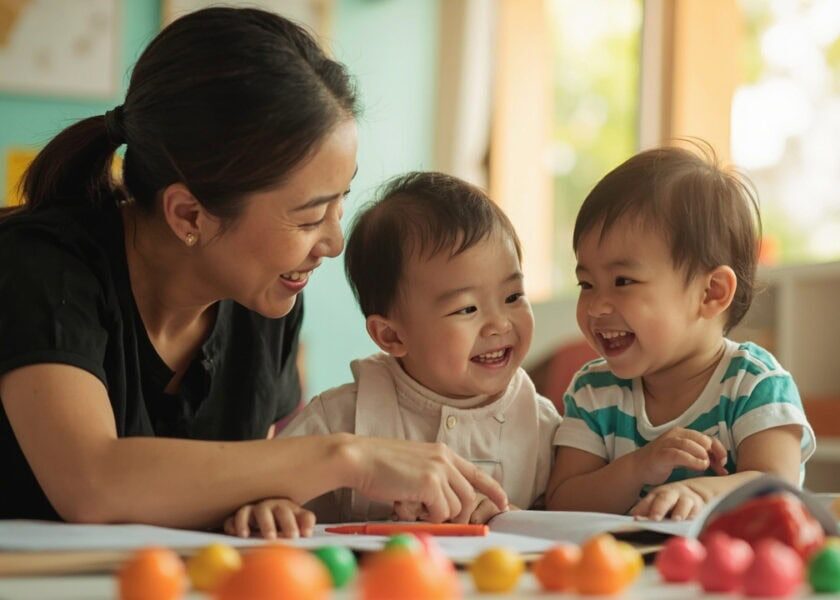
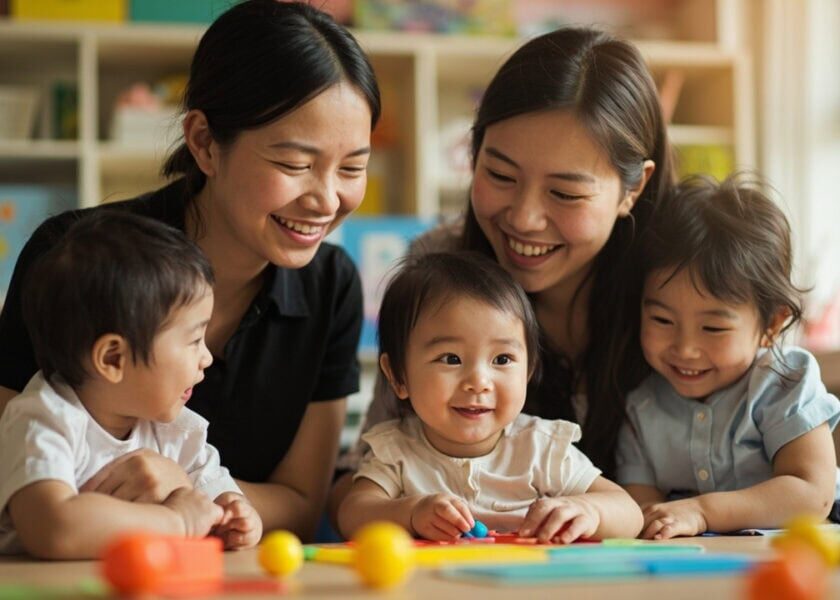
Consider what actually happens when siblings are in quality childcare together, day after day.
They develop a social vocabulary that siblings raised in isolation cannot give each other. They learn to share not because you asked them to, but because they have to. They learn to wait, to negotiate, to watch another child be comforted and to understand, over time, that comfort is available and not infinite.
They learn conflict resolution not from a poster on the wall but from watching a trained caregiver navigate a moment of tension between them with calm, specific, consistent intervention.
A caregiver who has observed your children over months understands that your older child escalates when they are hungry, not when they are tired. They understand that your younger child seeks reassurance through physical proximity, not through words. That knowledge, applied daily, is not babysitting. It is the slow, invisible construction of a sibling bond that will outlast your direct management of it.
This is the first thing worth understanding clearly: siblings in quality childcare learn social skills from each other that you, as their parent, cannot teach them. Not because you are doing anything wrong. But because you are too close. You are the emotional center of their world, and they will behave differently with you than they do with each other.
In childcare, with trained observers, they relate to each other as peers. And peers teach each other things that parents structurally cannot.
Why This Matters for Your Family
- Sibling bonds strengthen: Children in quality childcare develop social skills together that you alone cannot provide.
- Peer learning happens: They relate to each other as equals, creating dynamics that parent-child relationships cannot replicate.
- Conflict becomes curriculum: Rivalry is guided, not suppressed, becoming a foundation for social-emotional growth.
- Evenings improve: Children who have practiced navigating each other all day come home better equipped to coexist, play, and reconcile.
Managing the Age Gap: Parallel Experiences, Not Competition
A three-year-old and a seven-year-old are not simply at different developmental stages. They are operating in different emotional economies, different physical realities, different relationship frameworks.
A childcare arrangement that does not understand this will do one of two things: it will either treat them identically, which is inadequate, or it will inadvertently create a dynamic where the older child is always the model and the younger child is always the imitation, which breeds resentment on both sides.
Quality care manages the age-gap challenge by creating parallel experiences rather than competing ones. This is invisible work, and it rarely appears in childcare marketing because it is difficult to photograph. But it is the difference between a childcare arrangement that manages your children and one that understands them.
For the older child, the presence of a younger sibling in care can become a source of profound developmental richness. Not because the older child is parentified or asked to care for the younger one in ways that are inappropriate, but because their natural instinct to nurture, to explain, to model is acknowledged and gently supported by trained caregivers. They grow in emotional security precisely because their role is valued, not because it is erased.
For the younger child, imitation is not merely flattery. It is the engine of accelerated development. Watching an older sibling navigate a problem, handle a transition, or express an emotion gives the younger child a concrete, relatable model that no picture book can replicate.
Under trained observation, that imitation is supported, not exploited. The younger child is given the space and the encouragement to try what they have seen, and to fail at it safely.
Rivalry as Curriculum: What Happens When Siblings Fight
Rivalry is not a bug in sibling relationships. It is a feature. The question is never whether your children will compete. They will. The question is whether that competition will be managed in ways that deepen their bond or strain it.
Most childcare arrangements, if they address sibling conflict at all, address it by separating the children or by intervening in ways that stop the immediate incident without shaping the underlying dynamic.
Quality childcare, when it is doing its work properly, treats sibling conflict as curriculum. Not suppression. Not punishment. Not the rushed intervention that ends the noise without changing the pattern. But genuine, trained, consistent social-emotional guidance that helps children learn what rivalry is actually telling them and how to navigate it.
Your children are not competing for no reason. They are competing for something real: your attention, their place in the family, the assurance that they are seen.
In quality childcare, caregivers who understand sibling dynamics help children articulate these needs, sometimes without words, and help them find ways of meeting them that do not require the other child to lose. This is not soft or sentimental work. It is precise, skilled, and extraordinarily difficult. And it is the work that turns rivalry into something your children carry with them for life: the capacity to be close to someone who wants some of the same things they want, and to navigate that honestly.
The Invisible Coordination Work That Makes It Possible
Here is what most parents do not see, because it happens when they are not in the room: the invisible coordination work that makes multi-child childcare function.
The nap schedules. The different textures of comfort each child needs. The moment one child needs to be held and another needs to be given space. The transition between activities that one child navigates easily and another finds genuinely disorganizing. The food preferences, the emotional thresholds, the social preferences, the physical limits. All of this, managed simultaneously, by people who have learned to read your children not as a collection of individual needs but as a living system.
When ratios allow caregivers to actually see what is happening between siblings—not just what is happening to each child individually—this invisible coordination becomes possible. It cannot happen when one caregiver is managing eight children. It happens when there is time, attention, and trained eyes.
There is a specific exhaustion that comes from caring for multiple children. It is not the exhaustion of being busy. It is the exhaustion of divided attention, of feeling that you are always solving for one child at the expense of the other, of knowing that the time, patience, and emotional energy you have is finite and that your children can sense this, even when you hide it.
Quality childcare does not merely relieve that exhaustion. It changes the dynamic that creates it. When siblings come home from a day in which they have learned to navigate each other under trained observation, they return as children who have practiced being together. They have argued and been guided through the argument. They have shared and been helped to share fairly. They have watched each other grow.
Children who have been in quality shared care return home better equipped to coexist. They fight differently. They reconcile faster. They play with more sustained imagination, because they have learned to take turns not as a rule imposed from outside but as a rhythm they have internalized.
And this means that the evening window begins to feel different. It does not disappear, the complexity. But it softens. Because your children are not coming home as strangers who share a house. They are coming home as siblings who are already, quietly, in practice.
What EduNanny Was Built to Do
EduNanny is part of the ECDA Childminding Pilot, operating within a framework designed not just for childcare but for the full complexity of how Singapore families actually live.
The pilot offers both home-based pathways, where a trained childminder comes to you, and community or centre-based pathways, depending on what fits your family. This flexibility is not incidental. It is recognition that a family with two children under five and two working parents is not the same shape as a family with a four-year gap and a grandparent nearby. Good childcare meets you where you are.
EduNanny maintains up to one caregiver to three infants in its infant care arrangements. This ratio was chosen because when caregivers can actually see what is happening between siblings—not just what is happening to each child individually—the invisible coordination work described earlier becomes possible.
The costs are structured within ECDA Childminding Pilot guidelines to be accessible for families who need quality care. CDA and Baby Bonus funds can be used, which means the financial architecture of Singapore’s family support system is available to you here.
Monday to Friday care blocks are available, which means your children are in a consistent rhythm that becomes the structure around which your family life can actually plan.
Communication is not an afterthought. Where CCTV is deployed, you can see what your children are doing in real time. Where daily updates are given, they are provided by people who have spent the day with your children as individuals and as siblings. You are not receiving a generic report. You are receiving evidence that someone has been paying attention to the specific, unrepeatable, daily texture of your children’s lives.
What to Look for When Choosing Multi-Child Care
If you are researching childcare for more than one child, here are the questions worth asking:
- How do caregivers handle sibling conflict? Do they separate children, or do they use moments of tension as opportunities for social-emotional guidance?
- What are the actual ratios? Can caregivers observe what happens between your children, not just what happens to each one individually?
- How do they manage different age groups? Are children given parallel experiences, or is one always positioned as the model for the other?
- How do they communicate about siblings specifically? Do updates address individual children only, or do they also describe how your children related to each other that day?
- Can you see the invisible work? Ask to understand how nap schedules, comfort needs, and transition moments are coordinated. The answer will tell you whether your children are being managed or understood.
A Different Kind of Evening
You recognized the moment described at the beginning. Two children home in the evening, the household shifting, each child moving through the space differently than they do when alone. And that quiet worry, the one you have not quite been able to name, about whether you are giving each of them enough.
The anxiety about not giving each child enough individual attention is not solved by individual care alone. It is solved by understanding that your children are not only individuals. They are also siblings.
And the relationship between siblings, when it is supported, trained, and shaped by quality observation, gives each child something you cannot give them alone: the experience of being understood, challenged, comforted, and celebrated by someone who shares their world from the inside.
In Singapore, where family is not just personal preference but cultural architecture, where the sibling bond is one of the longest relationships your children will ever have, this may be one of the most consequential decisions you make as a parent.
The evening window you described is not something you have to carry alone. And the sibling bond your children are building is not something you have to leave to chance. It can be shaped. It can be supported. It can become the foundation they carry with them for the rest of their lives.
If you are considering your options for infant care or childminding in Singapore and want to understand how EduNanny’s approach to sibling dynamics might fit your family, explore the ECDA Childminding Pilot pathways available to you or get in touch to learn more.
EduNanny is part of the ECDA Childminding Pilot. Learn more about our approach to thoughtful, development-oriented childminding for Singapore families.