How Quality Childcare Helps You Understand Your Child Better
Understanding Quality Childcare in Singapore
In Singapore, parents are navigating something remarkable. You are raising children in one of the most dynamic, demanding, forward-thinking cities in the world—with high expectations, limited time, and a profound awareness that the early years are not merely a waiting room before school begins.
They are the foundation. They are the time when the architecture of identity is being quietly constructed, and you know that what happens in these years shapes not just academic readiness, but the shape of a human being.
When you select a childcare arrangement, you are not simply choosing supervision. You are choosing a daily environment that will shape, in some of the most formative years of your child’s life, how they see themselves, how they understand their own capacities, and how they learn to be in relationship with others and with the world.
What we have come to understand, through years of listening to parents, observing children, and thinking deeply about what quality care truly means, is this: the right environment does not just keep your child safe. It reveals your child. It creates the conditions in which their emerging self can be seen clearly, documented thoughtfully, and nurtured with intention.
Security as the Foundation
Consider what your child needs in order to show you who they are becoming. They need security—not just physical safety, though that is foundational, but the emotional security that comes from knowing they are held, known, and responded to.
When a child feels secure, they explore. They take risks with their curiosity. They try on ways of being. They reveal preferences that might stay hidden in a state of anxiety or uncertainty. Research consistently shows that children who feel secure in their relationships are most free to discover themselves. Security is not a soft concern. It is the prerequisite for everything that follows.
The Art of Being Noticed
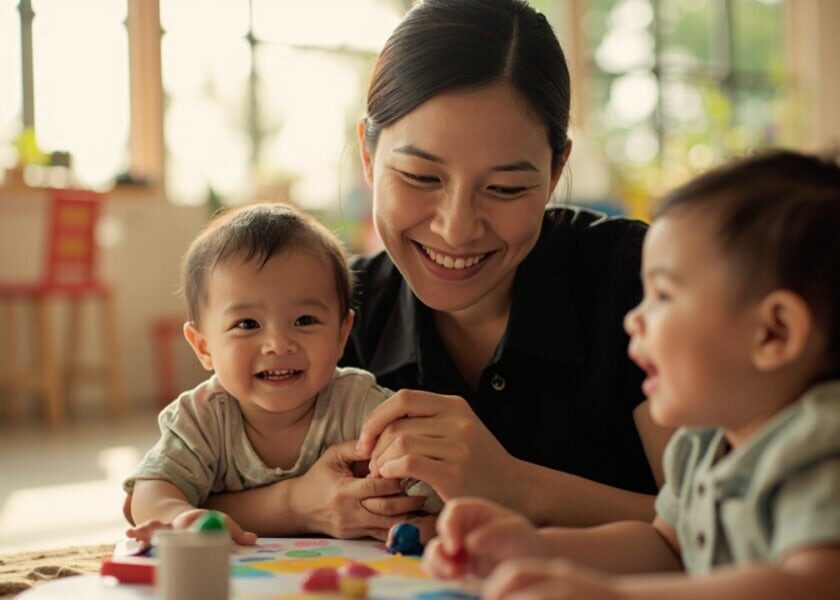
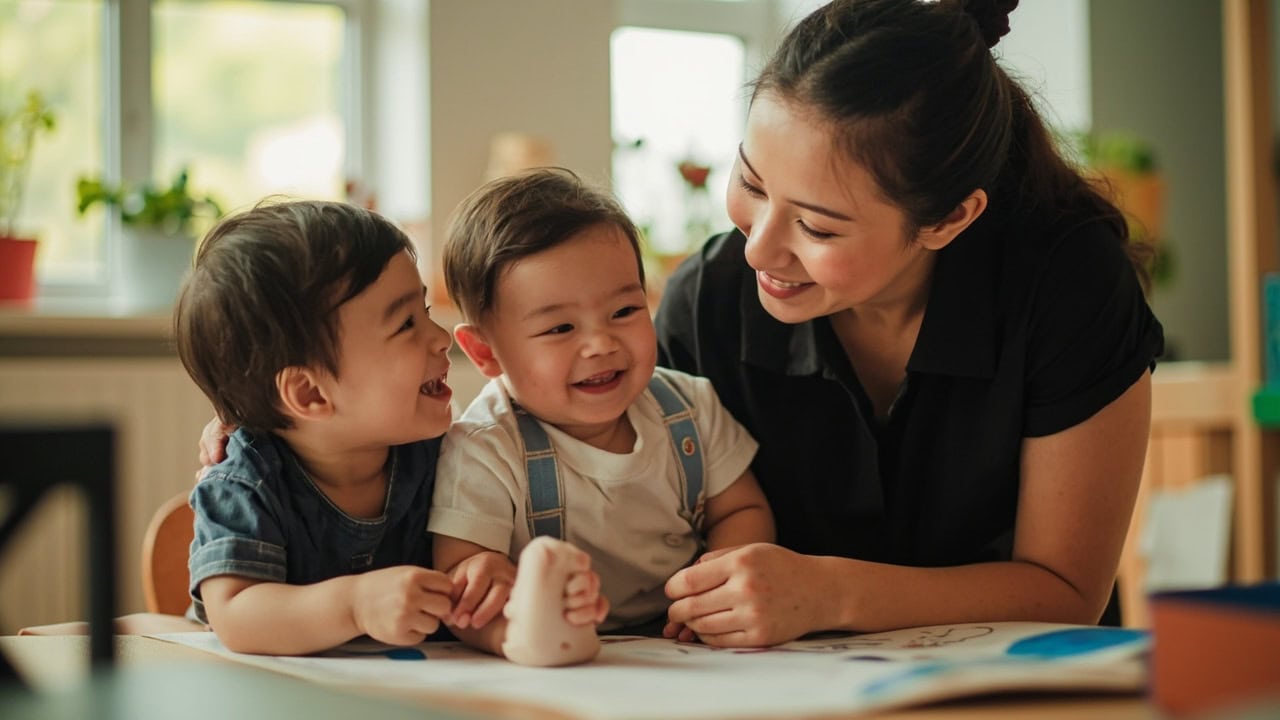
In a quality childcare environment—home-based or center-based, with trained caregivers who understand child development and ratios that allow for real observation—something begins to happen. Your child is not simply being watched. They are being noticed.
A trained caregiver sees that your son gravitates toward construction materials, that his fine motor skills are developing in tandem with his spatial reasoning, that he problem-solves by building and rebuilding. Another child shows a love of language that emerges from the songs sung at circle time, from the stories read with genuine expression, from conversations that treat her as a thinker whose opinions matter. Another child reveals a social instinct—the one who mediates disputes, who notices when another child is upset, who has an intuitive sense of group dynamics that will shape how she leads and collaborates for years to come.
These are not accidents. They are discoveries. And they happen because quality care creates the conditions for discovery.
Childcare as Partnership, Not Supervision
This is why we speak of childcare not as supervision but as partnership. Not as a service that manages your child while you work, but as a collaborative environment that helps you understand your child more fully, over time.
The daily updates, the documentation, the conversations at pickup—they are not administrative gestures. They are windows. They are the way a good caregiver says to you: here is what I observed today. Here is who your child showed me they are becoming. Here is something you might not have seen at home, because here they are in a different context, with different materials, with peers who challenge and mirror and reveal.
The Window or the Mirror
Here is where we want to speak directly to the tension that lives in the heart of every working parent. You want to be the one who knows your child best. Of course you do. You carried them, you birthed them, you have watched them sleep and wake and grow from the very beginning. You know things about them that no one else could know.
But you also know this: your child has a self that exists beyond your direct observation. There are dimensions of who they are that emerge in the world outside your home—in interaction with other children, in the freedom of a play environment, in the presence of adults who are not you.
You cannot be the only discoverer of your child. You need partners in this work of understanding. And the childcare you choose can either be a dim mirror, reflecting back only what you already know, or it can be a window—clear, open, illuminating—through which you see more.
We believe in windows. We believe in the kind of care that opens up your child to you, not one that obscures them.
What the ECDA Childminding Pilot Means for Your Family
The ECDA Childminding Pilot represents a framework for developmental partnership. Whether your family chooses a home-based caregiver or a center-based setting, the pilot is built on the understanding that quality is not a luxury. It is the baseline.
| What the Pilot Provides | Why It Matters for Your Child |
|---|---|
| Ratios of up to 1:3 for infants | Every child can be seen and known individually |
| Training requirements for caregivers | Observation and responsiveness are skills, not assumptions |
| Ongoing observation practices | Developmental patterns are tracked over time, not just noted |
| Communication structures | You stay connected to what is happening in your child’s day |
These are not bureaucratic details. They are the architecture of a system designed to notice your child.
What Quality Childminding Actually Looks Like
Let us paint a picture of what this means in practice, because the abstract idea of quality matters far less than what it looks like when your child is in someone’s care.
In a quality environment, your child is observed. Not watched passively, but noticed with intention. A caregiver sees that your daughter’s eyes light up when music plays, and offers more music. She notices your son returning again and again to water play, and creates more opportunities for sensory exploration that will later become a foundation for scientific thinking.
In a quality environment, development is documented. Documentation is not paperwork for its own sake. It is the record of your child’s unfolding—a narrative built over months and years that shows you not just where they are, but who they are becoming.
In a quality environment, peer interaction is intentional. Children discover themselves in relationship with others. A quiet child discovers they can lead through quiet strength. An assertive child learns to read the room. A child who struggles to share finds their own way to negotiation, with a caregiver nearby who knows when to step in and when to let the learning happen.
In a quality environment, you are a partner. The daily check-in is not a box to check. When a caregiver says, “Today she was so proud of herself—she built something that looked like a bridge and wanted you to see,” that is an invitation to know your child more deeply, to weave together a fuller picture of who they are becoming.
EduNanny by BUTLER: Our Approach to Noticing
When we talk about EduNanny by BUTLER, we are talking about a commitment to this kind of noticing. We are talking about caregivers who are trained not just in safety and hygiene—though those are foundational—but in the art of observation. Who understand that a child’s play is not idle time but serious work. Who can read the cues that indicate emerging interests, emerging strengths, emerging struggles.
Our caregivers document what they see not because it is required but because it matters. They share that documentation with you not as a report but as a conversation, because your child’s story is one we are writing together.
What This Looks Like in Your Day
- Morning handover: A genuine exchange about how your child slept, how they’re feeling, what you noticed at home that might help us understand them better today
- Midday observation: Our caregivers note moments of discovery—not just activities completed, but interests that emerged, social interactions that revealed something, creative breakthroughs worth tracking
- End-of-day window: An update that tells you something true about your child. Not “had a good day” but “she spent forty minutes arranging leaves by size and color—I think she might be ready for more sorting activities at home”
Answering What Singapore Parents Actually Ask
Can I afford quality care? The CDA and Baby Bonus structures exist to make quality care accessible. Quality is an investment in your child’s developmental foundation, and Singapore has built structures to help families access it.
How do I know what’s happening when I’m not there? Trust is built through transparency. The communication protocols, the updates, the measures where they are deployed—these exist because we understand that you have every right to know what is happening in your child’s day. This is not a concession to parental anxiety. It is respect.
Will my child be safe? Yes. Physical safety is the non-negotiable foundation. But we also believe in a broader definition of safety: the safety of being known, of having your needs met, of being in an environment where your emerging self is honored. True safety includes emotional security.
Will my child’s uniqueness be protected? Our answer is not a promise that cannot be kept. It is a commitment to the practices that matter: trained caregivers who observe and document, environments that invite exploration, communication that keeps you connected, ratios that allow for genuine attention, and a culture that believes every child deserves to be known.
Choosing Infant Care in Singapore: A Practical Guide
Choosing childcare is one of the most consequential decisions you will make. It is also one of the most intimate. Here is what we recommend looking for as you evaluate your options.
Questions to Ask a Potential Caregiver or Center
- How do you observe and track individual children’s interests and development?
- What does a typical day look like, and how is it adapted for individual needs?
- How do you communicate with parents about what is happening during the day?
- What is the caregiver-to-child ratio, especially for infants?
- How do you handle situations where a child’s temperament or needs don’t fit the group?
- What training have caregivers received in child development and observation?
Signs of Quality to Look For
- Caregivers who ask about your child—who they are, what they love, what challenges them
- Environments that offer variety: space for active play, quiet corners, materials that invite exploration
- Documentation that goes beyond daily logs to capture developmental moments
- Communication that feels like a conversation, not a report
- A clear philosophy that values the individual child, not just group activities
When you visit a potential childcare arrangement, ask yourself: Does this feel like a place where my child would be noticed? Where their emerging interests would be seen? Where a caregiver would notice that they gravitates toward construction, or music, or quiet observation?
If the answer is yes, you have found something worth considering.
The Philosophy Beneath the Practice
Beneath all of these practical structures, there is a belief held deeply: every child who enters our care is already someone. Already a whole person with a temperament, an emerging style of learning, a way of being in the world that is theirs alone.
Our task is not to create that person. Our task is to create the conditions in which that person can be discovered—by us, yes, but more importantly, by you.
So that when your daughter is five, or ten, or twenty-five, and someone asks who she is, you can answer with the confidence of someone who has watched her unfold, who has been part of that unfolding, who has had partners in the process who saw what you saw and helped you see more.
You are entrusting someone else with the most precious thing in your life, and you are asking them to see what you see, to love what you love, to protect what you would give anything to protect.
That is not a small thing to ask. It is not a small thing to receive. So we receive it with full understanding of its weight. And we respond not with promises that cannot be kept, but with a commitment to the practices that matter.
Not just care. Not just supervision. Partnership. The kind of partnership that sees your child clearly, and helps you see them more clearly too.
Ready to Learn More?
If you are exploring childcare options in Singapore and want to understand how EduNanny by BUTLER approaches infant care and childminding, we invite you to have a conversation with us.
We will answer your questions honestly, walk you through our approach to observation and partnership, and help you think through what quality care looks like for your family.
Every child deserves to be known. Let us help you find the care that will know your child.
Learn more about EduNanny’s participation in the ECDA Childminding Pilot, or read about our approach to developmental childcare.