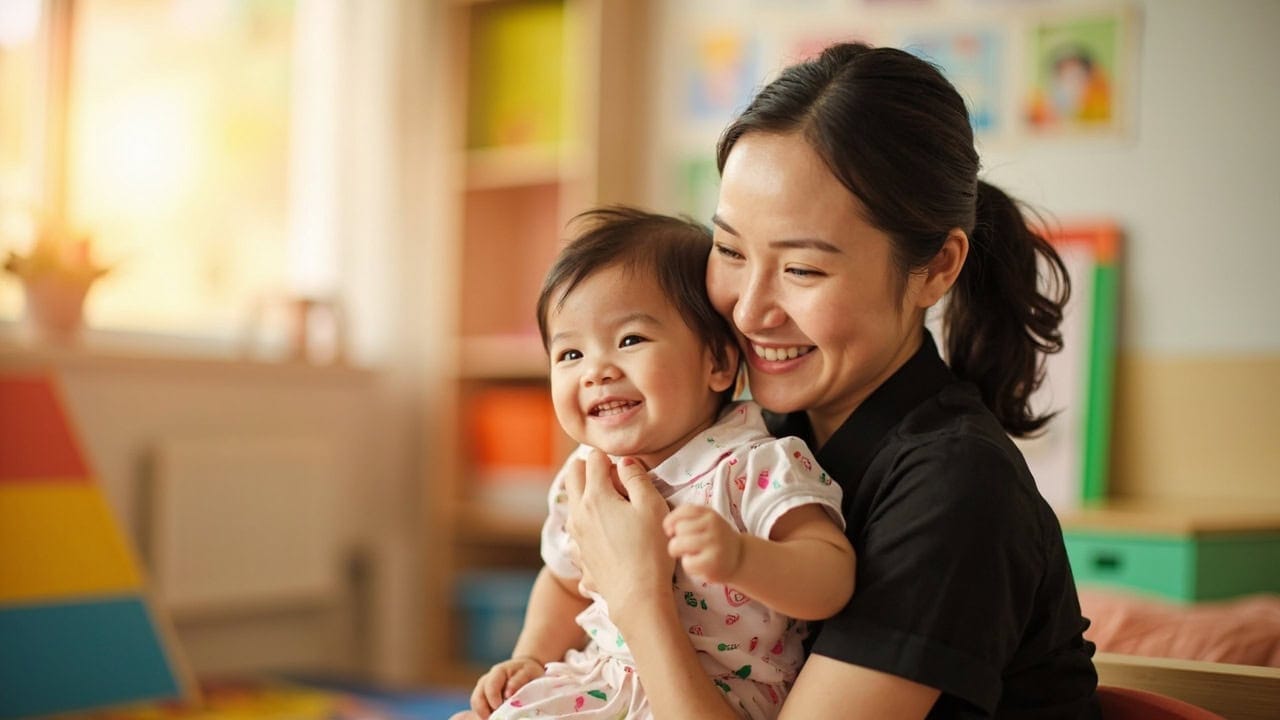
How Quality Childcare Bridges the First Thousand Days of Growth
The First Thousand Days: Why These Hours Matter More Than You Know
When you choose a childcare arrangement for your infant or toddler, you are making a decision that will shape thousands of hours of their early development. That is not a small thing. It is one of the most consequential decisions you will make in the first thousand days of your child’s life—a window of time that neuroscientists and developmental psychologists have described with increasing urgency over the past two decades.
The first thousand days, roughly from conception to age three, is the period when the architecture of the brain is most rapidly forming, most malleable, and most influenced by the quality of relationships and experiences your child encounters.
You may have heard this before. The critical window. Brain development at extraordinary speed. These phrases can start to feel abstract, even clinical, when you are standing in the grocery aisle at nine months pregnant, or managing a two-year-old’s meltdown at seven in the morning, or sitting in a meeting trying to focus while knowing your infant is adjusting to their first week of care.
So let us make this concrete. During the first thousand days, your child’s brain is building approximately one million new neural connections every second. Every sound they hear, every face they study, every time they reach for something and feel it in their hand, every moment of being soothed after a fright—these experiences are not just moments. They are the material from which your child’s future emotional regulation, cognitive flexibility, language capacity, and social intelligence are being constructed.
The care environment your child enters during these years is not a waiting room where development is paused until you return. It is an active, formative landscape where your child’s brain is being shaped by the quality of attention they receive, the richness of their sensory environment, the consistency of their relationships, and the challenges that are just slightly beyond what they can manage alone.
This is why the question of what happens during childcare hours is not trivial. It is not a matter of whether your child is adequately supervised. It is a matter of whether your child is in an environment that is actively, intentionally, and observantly nurturing the developmental trajectory that you, as their parent, have already set in motion.
And this is where the gap appears.
The Developmental Translation Gap
You have given your child the most important foundation. You have spoken to them in utero. You have responded to their cries. You have played with them, read to them, watched them discover their hands and then their feet and then the world beyond their crib. You know your child in ways that no one else will ever know them.
But you cannot be present for every moment of their development. And when you drop them off and step away, you step out of the most active developmental laboratory they will ever inhabit.
The question is not whether something important is happening. The question is: will anyone tell you what it is?
There is a difference—one that sounds subtle but is actually profound—between being told what your child did, and being told what your child learned.
Most childcare arrangements, when asked about your child’s day, will tell you about activities. There was circle time. There was music. There was outdoor play. They had a snack. They napped. They were fine.
These are facts. They are not insights.
A developmental observer sees something different. A developmental observer watches for the moments that reveal how your child is processing the world, testing their abilities, stretching toward new competencies, and building the internal architecture that will serve them for the rest of their lives.
What Trained Caregivers Actually Notice
A trained caregiver might notice that your twenty-two-month-old, who has always been hesitant around other children, spent twenty minutes today engaged in parallel play—sitting near another child, watching them build with blocks, occasionally reaching over to touch a block the other child was using, then returning to their own structure.
To an untrained eye, this might look like two children playing near each other but not with each other. To a developmental observer, this is a milestone. This is a child who is building the social awareness that will, in coming months, become true cooperative play. This is a child who is processing the question of how they relate to others, and tentatively finding an answer.
Or consider a younger infant. A caregiver trained in developmental observation might notice that your seven-month-old, during tummy time on a textured mat, spent several minutes experimenting with transferring objects from one hand to the other—picking up a small soft cube with the right hand, holding it, then deliberately releasing it and reaching for it again with the left.
This is not random movement. This is a child who is developing bilateral coordination, hand-eye coordination, and the cognitive understanding that objects have permanence and can be manipulated. These are the building blocks of later problem-solving, of fine motor skills, of the capacity to engage purposefully with the physical world.
When you hear about this at the end of the day, you are not just learning about a cute moment. You are learning about your child’s growing mind.
This is what we mean by developmental translation. It is the practice of observing carefully, understanding deeply, and communicating clearly—not what happened, but what it means. Not an activity log, but a growth narrative.
The Six Dimensions of Growth You Should Know About
The dimensions of development that quality care observes and nurtures are interconnected, but they are also distinct. Understanding them can help you see your child more fully in the hours after care—and know what questions to ask.
1. Social-Emotional Attunement
This is the capacity to recognize and respond to the emotional states of others, and to manage one’s own emotional responses in relationship. In the earliest months, this shows up in how an infant responds to a caregiver’s face, how they settle when picked up, how they begin to differentiate between familiar and unfamiliar people.
As children grow, attunement becomes visible in their ability to notice when another child is upset, to show concern, to seek comfort from trusted adults, and to begin to understand that others have feelings different from their own.
Trained caregivers notice the micro-expressions and subtle behavioral shifts that reveal a child’s emotional state. They notice when a child who usually runs to greet them at the door instead hangs back, withdrawn. They notice when a typically easygoing infant becomes fussy and difficult to soothe, which might indicate an ear infection or unusual fatigue. They notice when a toddler’s play shifts from engaged to frustrated, and they know when to offer support versus quiet presence while the child works through the challenge.
After care, notice: How does your child respond to your facial expressions and tone of voice? Do they try to manage a disappointment or express a feeling? These are signs of social-emotional development that quality care supports.
2. Peer Interaction Patterns
Long before children are capable of cooperative play in any formal sense, they are learning about relationship. They are watching other children. They are noticing how other children respond to the same caregiver. They are experiencing the social dynamics of a group—what it feels like to wait, what it feels like when a toy is taken, what it feels like when another child smiles at them.
In quality care environments with low ratios, every child receives the attention they need while being immersed in a rich social environment. They learn from watching. They learn from proximity. They learn from the small, supervised conflicts that teach them how to navigate the social world.
After care, observe: Does your child seek out peers at the playground? Attempt to engage other children in play? Show signs of social preference—enjoying some children more than others, which is itself a developmental achievement? These are the early signatures of social competence that quality care nurtures.
3. Emotional Regulation
This is one of the most important capacities your child will develop, and also one of the most invisible. Emotional regulation is not the absence of big feelings. It is the ability to experience big feelings without being overwhelmed by them, to gradually develop the internal resources to calm oneself, to seek comfort when needed, and to return to a state of equilibrium after distress.
In quality care, children are not left to regulate alone. They are co-regulated—by caregivers who model calm, who provide physical comfort, who name emotions and help children understand what they are feeling. Over time, with consistent responsive care, children internalize these experiences. They begin to develop their own regulatory capacities.
After care, notice: Does your child have a more varied emotional vocabulary? Do they sometimes use words to express frustration instead of just crying? Do they recover more quickly from setbacks? Do they have strategies for self-soothing—thumb-sucking, a comfort object, deep breaths? These are signs that emotional regulation is taking root.
4. Curiosity and Engagement
This is the spark that drives all learning. Children are born curious, but that curiosity needs to be nurtured. It needs an environment that rewards exploration, that provides age-appropriate challenges, that celebrates effort rather than just outcome.
In quality care, children are given the freedom to investigate, to experiment, to ask questions with their bodies and their eyes and eventually their words. A caregiver trained in supporting curiosity will notice when a child’s attention is captured, will provide materials that extend that interest, will sit with a child who is deeply engaged and offer quiet presence rather than interruption.
After care, notice: Does your child come home wanting to tell you about something? Do they show you something they made or found? Do they initiate play that reflects something they experienced? A child whose curiosity is being nurtured will often bring that curiosity home with them.
5. Confidence and Initiative
Closely related to curiosity, but distinct. Confidence is the willingness to try, to attempt, to take the first step even when the outcome is uncertain. Initiative is the drive to act without being prompted, to say “I can do it,” to persist when something is difficult.
Children develop confidence not through praise alone, but through the experience of mastery. When a child learns to climb the small ladder to the slide, when they learn to pour their own water, when they learn to put on their own shoes—even imperfectly—these are experiences that build the internal conviction: I am capable. I can affect my world. I am an agent of my own life.
After care, notice: Does your child show more willingness to try new things? Do they attempt tasks that previously frustrated them? Do they show pride in their own accomplishments? Do they, after a day in quality care, seem more secure in their own competence?
6. Language Exposure and Communication Growth
In the early years, language development is exponential. Infants who hear rich, responsive language—conversational language, not just commands and labels—develop larger vocabularies, more complex sentence structures, and stronger foundations for literacy. Language is not just about words. It is about connection. It is about the experience of being heard, of having one’s communications acknowledged and responded to, of learning that sounds carry meaning and that meaning connects us to others.
In quality care, language development is woven into every interaction. Caregivers narrate what they are doing. They respond to infant vocalizations as if they were contributions to a conversation. They introduce new words in context. They read, sing, and engage in the kind of back-and-forth communication that builds neural pathways for language.
After care, notice: Does your child’s vocabulary seem to have expanded? Do they use new words, or use old words in new ways? Do they attempt more complex sentences? Do they try to communicate more deliberately, with gestures and sounds and eventually words? Language growth during the early years is one of the most visible and measurable signs of developmental progress.
How Developmental Knowledge Transforms Your Evening
The gap between what your child learns in care and what you are able to see and celebrate at home is not just a logistical problem. It is an emotional one. It affects your confidence as a parent, your connection with your child, and your ability to build on the foundation that quality care is laying every day.
When you drop off your child in the morning, you are trusting that the hours ahead will be developmental—meaningful, purposeful, growth-inducing. And when you pick them up, if you have no window into what happened, you are left to guess. You wonder if today was good. You wonder if they played enough, learned enough, grew enough.
This is why developmental translation matters so profoundly.
When a caregiver shares with you—not just what your child did, but what they learned; not just that they played, but how their play revealed a new cognitive skill; not just that they napped, but how their emerging independence in the sleep routine showed growth in autonomy—you are receiving something invaluable. You are receiving the thread that connects their day in care to your evening at home. And with that thread, you can weave continuity into your child’s developmental story.
Imagine this. You pick up your child. The caregiver tells you that your twenty-month-old discovered today that stacking blocks is more stable when you start with a wide base, and that they spent twenty minutes experimenting with this principle, rebuilding and toppling and rebuilding again with evident determination.
You hear this. And that evening, when your child pulls out the tupperware containers and begins stacking them on the kitchen floor, you understand what you are witnessing. You are not just seeing play. You are seeing a principle that is becoming internalized, a cognitive skill that is being consolidated. And you respond differently. You name it. You celebrate it. You build on it.
This is how developmental knowledge transforms parenting. It is not about adding more activities to your evening. It is about seeing more clearly, responding more intentionally, and connecting more deeply.
What Quality Childminding Actually Looks Like in Singapore
If you are evaluating childcare options in Singapore, it helps to know what distinguishes quality care from adequate care—and why the distinction matters so much in the early years.
Quality childminding is not primarily about facilities or curriculum or even activities. It is about the quality of observation, the consistency of relationship, and the intentionality of response. It is about whether the caregiver is watching closely enough to notice when your child’s parallel play shifts into something more cooperative, or when your infant’s reaching movements reveal emerging hand-eye coordination, or when your toddler’s frustration holds within it the seed of a new skill they have not yet mastered.
In Singapore’s childcare landscape, there are several options: centre-based care, home-based childminding, and family childcares. Each has its place. What matters is not the setting alone, but the quality of observation and communication that the arrangement makes possible.
Under the ECDA Childminding Pilot, certain providers are part of a government-recognised framework designed to support quality home-based and centre-based care for infants and young children. This designation reflects a commitment to standards, to training, to the kind of intentional care that makes a measurable difference in children’s developmental outcomes.
When evaluating any childcare arrangement, consider asking:
- What will I be told about my child’s day, and in what depth?
- How do caregivers observe and track developmental progress?
- What is the caregiver-to-child ratio, especially for infants?
- How is developmental information shared with parents?
- What training do caregivers have in child development and observation?
These questions are not intrusive. They are exactly the questions that reveal whether a childcare arrangement is merely custodial or truly developmental.
EduNanny’s Approach
EduNanny operates under the ECDA Childminding Pilot, and our approach is built around a single conviction: that parents deserve to know what their child is learning during the hours they are apart.
Our caregivers are trained observers—trained in developmental milestones, responsive care, and the art and science of nurturing growth in the earliest years. In our infant care programme, ratios are maintained at up to one caregiver to three infants, meaning every infant receives the individual attention that their developing brain requires. This is not a luxury. It is a developmental necessity.
We understand that affordability matters. Singapore families are navigating real pressures—housing costs, the demands of dual careers, the expenses of raising children in one of the world’s most competitive environments. EduNanny is structured within pilot fee structures designed to make quality care accessible. CDA funds and Baby Bonus contributions can be used, which means the financial planning for your child’s care is manageable and transparent.
We also understand that trust requires transparency. Where deployed, communication tools and CCTV measures are in place to support the partnership between caregivers and parents. But the most important trust-building measure, we believe, is the quality of the observation and communication we provide. When a caregiver can tell you, with specificity and developmental understanding, what your child learned today, that is when trust becomes deep. That is when you know—not believe, but know—that your child is in the right place.
Our care operates Monday through Friday, in structured blocks that support both family routine and the consistency that young children need to thrive. Whether your child is in our home-based pathway or our centre-based programme, they are receiving the same commitment to developmental observation, to quality care, and to the partnership with parents that transforms uncertainty into confidence.
From Uncertainty to Confidence
If you are a parent who feels the quiet uncertainty we have described—the love that seeks information it cannot find on its own—I want you to know that your feeling is not weakness. It is love, seeking information. It is intelligence, recognizing that there is something important happening that you cannot see. It is the natural response of a parent who cares enormously about their child’s development and wants to be present for it, even when presence is not possible.
That feeling does not have to remain as uncertainty.
It can become knowledge. It can become partnership. It can become the confidence that comes from knowing that your child’s developmental progress is being observed, recorded, and shared with you by people who are as invested in your child’s growth as you are.
This is what quality childminding can offer. Not just care. Not just safety. But developmental partnership—the assurance that when you drop your child off in the morning, they are entering an environment where their growth is being noticed, where their milestones are being marked, and where someone is keeping the thread that you will receive at the end of the day.
When you pick up your child tonight, and they run to you with something to show, or bury their face in your shoulder, or climb into the stroller with the particular satisfaction of a child who has had a full and good day—you will know. You will know because you have been told. You will know because the observation has been translated. You will know because the gap between what happens in care and what you can recognize at home has been bridged.
And that knowledge will not make you less of a parent. It will make you more.
More present in your evening interactions. More intentional in your responses. More able to celebrate what your child is becoming, because you can see the path they are walking.
More confident in your choice. More at peace with the hours you are apart. More connected to the child who is yours, and who is also growing in the world beyond you, under the watchful, caring, developmental eyes of people who have made it their purpose to see what you cannot always see.
The early years are brief and irreplaceable. Every child deserves to be seen—truly seen—during the time when seeing them matters most.
And every parent deserves to know.
Learn More About EduNanny
If you are considering childcare options in Singapore and want to understand how developmental translation can transform your experience as a parent, we invite you to learn more about EduNanny’s approach.
Visit our website to explore our infant care and childminding programmes, understand our fee structures, and see how we support Singapore families in giving their children the developmental foundation they deserve.
The morning drop-off does not have to carry uncertainty. It can be the beginning of a partnership that keeps you connected to your child’s growth—even when you are not in the room.
You can also read more about our team and philosophy, or get in touch to discuss your family’s needs.