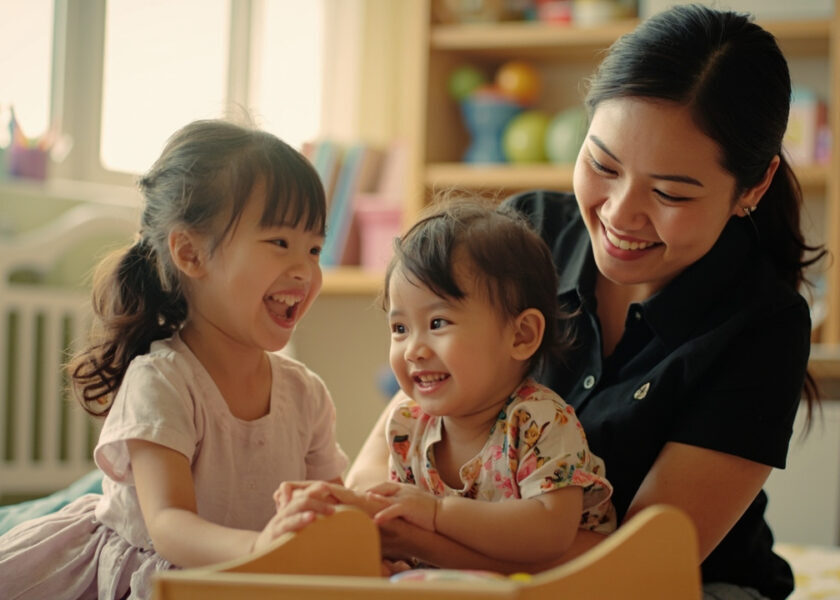
From Clingy to Running: How Quality Childcare Transforms Your Child
The First Hundred Days: A Journey in Quality Childcare
There is a trajectory that describes what happens when a child is held in the right environment — one where safety is not assumed but constructed, day after day, in a thousand small moments of attunement and care.
- Days 1–14: Adjustment and sensory unfamiliarity; building trust through consistent, warm caregiving
- Weeks 3–6: Growing recognition and attachment; the unfamiliar begins to feel known
- Months 2–3: Emerging confidence, first friendships, language breakthroughs, purposeful play
- Months 4–6: Visible transformation in language, motor skills, emotional intelligence, and independence
- Beyond 6 months: A confident, curious child who runs to the door — not away from it
This is not a guarantee. It is a description of what becomes possible when the foundations are built with care.
The First Mornings: Learning to Trust
The first mornings are hard. Not because anything is wrong, but because everything is new. The room smells different. The light falls at an unfamiliar angle. The toys are arranged in a way that no one at home has arranged them.
And there is a caregiver — kind, warm, trained, patient — crouching down to your child’s level, speaking softly, waiting without rushing.
Your child does not yet know that this stranger will become someone they run to. They do not know that in a few weeks, they will refuse to leave. Right now, they only know that you are letting go of their hand, and they do not understand why, and they need to know that when you go, you will come back.
This is not a moment to rush through. This is the foundation of everything.
In those first days, your child is doing the most important work of early childhood: learning to trust. Not trusting blindly, not trusting quickly, but learning — through a thousand small moments — whether the world outside your arms is a place where they can feel safe enough to grow.
What This Looks Like in Practice
- A caregiver who mirrors your child’s emotions rather than suppressing them
- A consistent daily rhythm that helps children anticipate what happens next
- Physical environments designed for small bodies — low shelves, soft corners, natural light
- Immediate, warm responses to distress — not after a waiting period, but within moments
- Ongoing communication with you about your child’s settling experience
The caregiver who notices the first sign of distress and responds before it escalates. The routine that begins to feel familiar: the song that signals nap time, the face that appears at the same moment each morning, the consistent order of the day that helps a child predict what comes next.
These are not incidental comforts. They are the architecture of security.
You may wonder, in those early days, whether you have made the right choice. Whether the tears will ever stop. Whether your child will ever feel at home in a place that is not home. We want to tell you something with complete certainty: the tears will stop. The clinging will ease. And what replaces them will not be resignation or mere adjustment.
What will replace it will be something far more beautiful.
Weeks Three to Six: The Unfamiliar Becomes Known
By the third or fourth week, something shifts. It happens quietly, in the margins of your observation, in the moments you are not there to see.
Your child wakes up and seems to know — in some pre-verbal, cellular way — that today is a day that includes the room, the friends, the caregiver, the rhythm. There is no resistance. There is, perhaps, a kind of recognition.
The unfamiliar has begun to feel known. The stranger has become familiar. The room that once felt overwhelming now holds small territories — the corner with the books, the table where they paint, the spot where they sit for snack time.
You drop them off in the morning, and there is still a flicker of hesitation at the door — because this is Singapore, and we are sensible people, and even the most secure child still benefits from a gentle transition. But that hesitation is shorter now. And when the caregiver opens her arms, your child goes.
This is not a small thing. This is a profound act of trust being extended and received. Your child has decided — not in words, but in behaviour, in body language, in the way they settle into play — that this place is safe. That these people are good. That when you leave, something worthwhile remains.
What Is Happening Beneath the Surface
During this period, your child’s brain is doing something remarkable. The stress hormones that spiked during the first days — cortisol, adrenaline — begin to settle. The amygdala, the brain’s alarm system, is learning that this environment does not require constant vigilance. The prefrontal cortex, where reasoning and emotional regulation will eventually live, is beginning to form its first connections.
The quality of care your child receives in these weeks literally shapes the architecture of their brain — forming circuits that will govern how they handle stress, form relationships, and learn for the rest of their lives.
Months Two and Three: Growing Confidence and Connection
In the weeks that follow, you will begin to notice other things. Your child is playing differently. Not just longer, but with more complexity, more imagination, more engagement.
They are talking about someone named Ming or Aaliyah or Mei Ling — friends, made in the quiet crucible of shared toys and parallel play. They are coming home with songs you have never taught them, rhymes you have never read, questions that startle you with their precision.
Where did this come from?
It came from the right environment, built with intention, holding your child in the precise way they needed to be held: with warmth, with structure, with expertise, with an infant-to-caregiver ratio that allows for real attention.
It came from a place where every room is designed not merely to occupy a child but to invite them into discovery. It came from caregivers who understand that a child’s play is not a break from learning — it is learning, all the way down, every moment of every day.
What Quality Play Looks Like
- Language development: Caregivers narrating actions, expanding on children’s sounds and words, reading aloud throughout the day
- Motor development: Purposeful physical environments that invite crawling, climbing, balancing, and fine motor exploration
- Social development: Guided parallel play that teaches sharing, turn-taking, and early friendship skills
- Emotional development: Caregivers who name feelings, model regulation strategies, and hold space for big emotions
- Cognitive development: Open-ended materials — blocks, paint, sand, water — that invite problem-solving and creativity
Three to Six Months: The Transformation You Will See
Three months in, you will catch yourself doing something you did not expect. You will catch yourself bragging.
Not in a loud or showy way, but in the quiet, wondering way of a parent who has suddenly noticed something extraordinary in ordinary circumstances.
- Your child is speaking in sentences now — not just single words, but real sentences, connected thoughts, stories about what happened during the day
- Your child is showing empathy, noticing when another child is upset, trying to comfort them
- Your child is climbing, jumping, drawing with purpose, building towers and knocking them down and building them again with greater ambition
Six months. A half-year. The child who clung to your leg now runs into the room. Not hesitating. Not looking back. Running toward something — a friend, an activity, a caregiver whose name they say with warmth and trust.
You watch this from the doorway and you feel something you may not have expected: pride, yes, but also a strange and tender grief. Your baby is becoming a person. A confident, capable, curious person. And it is happening so fast, and you are grateful, and you are a little bit heartbroken, and both of those things are true at the same time.
Why the Right Environment Architects Growth
There is a phrase we use when we talk about quality childcare: the right care environment architects growth. We use it deliberately. Architecture is not decoration. It is not superficial. Architecture shapes the experience of the people who live inside it.
A quality childcare environment — one built on the principles of safety, warmth, developmentally appropriate practice, and trained, attentive caregiving — shapes the architecture of a child’s brain in ways that compound over time. The first thousand days of a child’s life represent the period of greatest neuroplasticity — the time when the brain is building itself at the fastest rate it ever will again, forming the circuits that will govern language, emotional regulation, social reasoning, and executive function for the rest of their lives.
The care your child receives during this window is not a babysitting arrangement. It is a developmental environment. And the difference between an environment that merely minds and one that truly nurtures is not a small one. It is the difference between a seed planted in poor soil and one planted in soil that has been carefully tended.
What Quality Childminding Actually Looks Like
In Singapore, the range of childcare options can feel overwhelming. Centre-based care, home-based care, infant care, childcare, kindergarten — the labels alone can exhaust a parent who is already running on little sleep. So let us be clear about what we mean when we talk about quality childminding, and why it matters.
The Elements That Distinguish Quality Care
| Element | What It Means in Practice | Why It Matters |
|---|---|---|
| Caregiver attention | Small group ratios — ideally no more than 1 caregiver to 3 infants | Each child is seen, known, and responded to individually |
| Trained caregivers | Professional development in child development, not just childcare skills | Caregivers understand why they are responding, not just how |
| Sensory-rich environment | Natural materials, varied textures, outdoor access, natural light | Children learn through their senses; environments must feed that |
| Consistent relationships | Low caregiver turnover; primary caregiver systems for infants | Attachment requires consistency; trust requires predictability |
| Developmentally appropriate practice | Activities designed for where children are, not where they should be | Children are not small adults; their learning looks different |
| Family partnership | Transparent communication, shared observations, collaborative goals | You remain your child’s primary attachment; we complement, not replace |
The Difference Between Being Minded and Being Nurtured
There is a distinction worth making clearly: a child can be minded without being nurtured. Minded means their physical needs are met — they are fed, changed, kept safe, supervised. This is the floor, not the ceiling.
Nurtured means their emotional and developmental needs are met alongside their physical ones. It means someone is paying attention to the quality of their play, the progress of their language, the subtlety of their emotional signals. It means someone knows your child well enough to notice when something is off before it becomes a problem.
Addressing the Concerns Singapore Parents Carry
If you are a parent in Singapore researching infant care, you are navigating something genuinely complex. The cost of living, the demands of work, the guilt that arrives uninvited when you drop your child at the door in the morning, the fear that you are somehow failing them by needing to be here instead of there.
Will my child feel abandoned? No — not if the environment is warm, consistent, and attuned. Separation anxiety is a normal developmental stage, not a sign that childcare is harmful. In fact, research consistently shows that children who experience secure separations — where their distress is acknowledged and soothed rather than ignored — develop stronger emotional regulation than children who are never given the opportunity to learn that caregivers leave and return. The key word is “secure.” Secure separations require caregivers who respond quickly, warmly, and consistently. This is a trained skill, not a personality trait.
Is home-based care really safe? Home-based care is not automatically safer or less safe than centre-based care. What matters is the quality of the environment and the training of the caregiver. Within the ECDA Childminding Pilot, home-based caregivers receive structured training, ongoing supervision, and adhere to safety standards that are inspected and monitored. The advantage of a home-based environment for many children is precisely its intimacy: small numbers, predictable relationships, a domestic scale that can feel more manageable for a young child navigating change for the first time.
How do I know the caregiver is really attentive? You ask. You visit unannounced if possible. You ask for regular updates, photographs, observations. You ask what happened on difficult days, not just good ones. You ask what your child is working on developmentally — a caregiver who can answer this question with specificity is a caregiver who is paying attention. Communication is not a bonus feature. It is evidence of partnership.
Can we afford quality care? Quality childcare should not be a privilege reserved for those who can afford the most expensive option. Within the ECDA Childminding Pilot, fee structures are designed to be accessible. Your Child Development Account can be used. Baby Bonus funds can be applied. Subsidies are available for eligible families.
What EduNanny by BUTLER Offers
We want to say something clearly, because it matters.
EduNanny is not offering you a transaction. We are not offering you a service you evaluate and compare and choose based on features and price points. We are offering you a place — a real, physical, human place — where your child will spend their earliest, most important, most formative hours. Where they will take their first steps toward independence. Where they will learn, without knowing they are learning, that the world is a place worth exploring.
What This Looks Like in Practice
- Infant ratios of up to one-to-three — your child is not one of twelve in a room. They are seen. They are known. They are held in mind.
- Caregivers who are trained, supported, and valued professionals who understand child development not as a theory but as a daily practice
- Environments designed not merely to occupy a child but to invite them into discovery
- Communication that keeps you connected to your child’s day — updates, observations, photographs, stories
- A home-based model that combines the warmth of domestic care with the rigour of professional practice
How to Evaluate Whether a Childcare Environment Is Right
Before you choose any childcare arrangement, we encourage you to do more than tour the space. We encourage you to observe it — not on a scheduled visit, but with the eyes of your child.
- Watch the children: Do they seem engaged, calm, curious? Are they being held and spoken to as individuals, or supervised as a group?
- Watch the caregiver: Is she crouching down to children’s level? Does she narrate what she is doing? Does she respond to distress warmly and immediately?
- Smell the room: Clean, yes. But also warm — do the materials smell of wood and fabric and nature, or of plastic and sanitiser?
- Notice the noise: Not silent — children should be making noise. But is there a gentle hum of purposeful activity, or a chaotic scramble?
- Ask about transitions: How does the caregiver handle mornings? Drop-offs? What support is offered to parents during this period?
- Ask what you cannot see: How are developmental milestones tracked? What happens if a child is struggling? How are individual learning styles accommodated?
And then ask yourself what your child would feel if they could tell you.
A Note to the Parent Who Is Struggling Right Now
We want to tell you something that is true: you are not failing them. You are doing the bravest and most loving thing a parent can do — choosing to trust someone else with the care of your most precious person, because life requires it, and because you believe there is a place worthy of that trust.
The guilt you feel is not evidence that you are doing something wrong. It is evidence that you care deeply. It is the shadow that falls alongside love, especially when love requires letting go, even temporarily.
The parent who drops their child at the door in the morning and feels their heart crack is the same parent who chose carefully, who asked hard questions, who visited multiple places, who is still searching for reassurance at eleven o’clock at night. That parent is not failing. That parent is doing the work.
Because they will tell you, in time. Not in words yet, but in the way they run to the door. In the way they talk about their friends. In the way they climb and speak and create and care. They will show you, every single day, what your investment has returned.
The Child Who Was Already a Person
There is one more thing we want to leave you with, and it is this.
Your child is not waiting to become a person. They are already a person — complete, complex, capable, full of wonder and fear and curiosity and courage. Every day in quality care is a day they are discovering who they are.
The child who arrived gripping your hand, uncertain and small, is the same child who will leave in six months — or twelve, or twenty-four — running, talking, thinking, feeling, ready.
Ready not because they were rushed. Not because they were pushed. Not because they were processed through a system that treats development as a product to be manufactured.
They will be ready because someone held them when they needed holding. Because someone sat with them in their uncertainty and did not rush them through it. Because someone celebrated their first attempt at a new skill with more joy than they will ever know. Because someone paid attention — real, undivided, professional attention — to the small person in front of them.
That is what quality care does. That is what it is here for. That is what EduNanny by BUTLER is building, one child at a time, across Singapore, within the framework of the ECDA Childminding Pilot and beyond it.
Not a service. Not a solution to a logistical problem. A place where your child is held, seen, known, and given everything they need to become whoever they are meant to be.
You brought them into the world. You are giving them the world. And we are honoured — genuinely, quietly honoured — to be part of what that world looks like on the days when you cannot be there yourself.
When your child looks up at you from the doorway someday soon — confident, joyful, unafraid — you will know. You will know that you made the right choice. Not because of a brochure or a price or a location, but because you trusted your instincts and found a place that deserved that trust.
That child who comes home changed is not a marketing image. That child is someone’s daughter. Someone’s son. Someone’s whole world, small and growing, held in the most important hands.
Their own. And ours.
EduNanny by BUTLER is a quality childminding service operating within the ECDA Childminding Pilot in Singapore. We support families seeking warm, development-focused care built on trust, professionalism, and the belief that every child deserves to be truly seen. Get in touch to learn more about how we can support your family.