Finding Quiet Confidence After Singapore Childcare Decisions
The Silence After You Choose
There is a particular kind of silence that settles after you have made a decision.
You have toured the facilities, asked your questions, weighed the options, perhaps gone home and lain awake running through the same considerations again and again. You have done the research, trusted your instincts, and finally—finally—chosen. And then the door closes behind you after that last visit, and you sit in your car or stand on the sidewalk, and a quiet wondering sets in. A small voice that asks: did I get this right?
You are not alone in this. In fact, you are in very good company.
Singapore parents pour so much of themselves into finding the right care for their children. You read reviews, compare environments, observe how caregivers interact with the children already there. You notice whether the children seem at ease or on edge, whether the staff seem present or merely going through motions.
You do this because you care. Because this decision feels enormous, because your child is the most important thing in your life, and because Singapore—with its high expectations, its competitive landscape, and its long hours—asks so much of parents in ways that can feel both invisible and relentless.
So when you finally choose—when you sign the forms and receive the welcome pack and start counting down to the first day—there is a moment, and it is a completely human moment, when the certainty you felt in that decision room begins to soften. When you start to wonder if the grass might have been greener somewhere else. When you find yourself watching your child more carefully each evening, looking for signs, reading meaning into everything.
Is she tired because she was overstimulated? Is he clingier than usual? Is this normal, or is this a signal that something is wrong?
This is what we want to talk about today. Not the searching, though we know that journey well. Not the choosing, though that too carries its own weight. But the after. The quiet, uncertain space that comes after you have already made the best decision you knew how to make—and you are still waiting to feel sure.
Introducing the Confidence Gap
We call this experience the confidence gap.
And we want to tell you something important about it: that gap is not a sign that you chose poorly. It is a sign that you care deeply about getting this right. It is the mark of a parent who takes this responsibility seriously, who is paying attention, who is not sleepwalking through one of the most significant relationships your child will have in these early years.
The gap exists because you care. And it is also, we have found, the very space where the most important truths begin to reveal themselves.
Here is what we have learned from years of walking alongside parents through this transition: the confidence you are looking for does not arrive all at once. It comes in moments—small, quiet moments that, if you know what to look for, tell you everything you need to know.
We call these moments trust signals.
Trust Signals: The Evidence That Speaks for Itself
A trust signal is not the same as a reassurance. A reassurance is someone telling you that everything is fine, that you have nothing to worry about, that your child is happy and safe and thriving. Reassurances can be given by anyone, and they are easy to give and easy to receive with a polite nod and a lingering doubt.
A trust signal is something you observe yourself. It is evidence. It is the kind of thing that makes you pause, not because someone told you to notice it, but because something in you recognized its significance in the moment it happened.
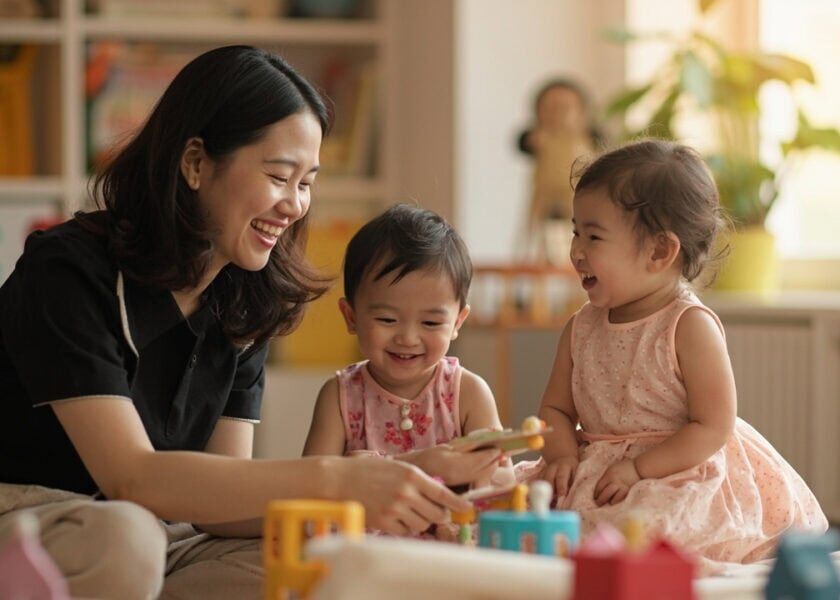
The caregiver who stops to truly see
One parent told us about the moment her daughter ran to her caregiver at pickup, not to say goodbye, but to show her something—a bug she had found on the playground. The caregiver stopped what she was doing, got down to the child’s level, and said, “Tell me about this.”
That moment was not scheduled. It was not part of any curriculum or assessment. It was a caregiver who was genuinely present, who cared about what this child cared about, who made a small child feel seen.
The caregiver who knows your child as an individual
Another parent described how, when she asked the caregiver how her son’s day had been, the caregiver did not say “He had a great day.” She said, “He ate well but he seemed a little tired this afternoon, so we took it slower during outdoor time. I think he might be coming down with something—let’s keep an eye on it.”
Specific knowledge. Real attention. The kind of detail that only comes from actually being there, actually watching, actually knowing this child as an individual.
What your child tells you in words—and in silence
The child who, after a few weeks, stops clinging at drop-off. Not because she has given up, but because she has learned that the transition will happen, and it will be okay, and there is something familiar and comfortable waiting for her on the other side.
The child who starts using words you have never taught her, or singing songs with hand motions you do not recognize, or describing a friend at “school” with a name and a story and a joy that is entirely her own.
These are not just cute anecdotes. These are the fingerprints of genuine care, of an environment where your child feels safe enough to explore, to learn, to grow.
Trust signals are designed, not accidental
When you see these moments—when you feel that small click of recognition that says, this is right, this is working—you are seeing trust signals. And they are not accidents. They are the result of design. Of intention. Of caregivers who have been trained not just to watch children but to truly see them, who have been supported by systems and structures that make it possible to give each child the attention they deserve.
Because here is the truth that we have built our work around: you cannot ask parents to trust a system that has not been designed to earn that trust. You cannot ask parents to relax into confidence when the conditions for confidence do not exist.
Understanding the Transition Period
The transition takes time. There will still be mornings when drop-off feels hard, when your child cries and you wonder if this is normal, if this is okay, if you are doing the right thing.
We want you to know that those mornings are part of the process too. They do not mean you chose poorly. They mean you are in the middle of something, and the middle is always the hardest part.
But we also want you to know that it changes. That the child who cries at drop-off will, in time, run to their caregiver with the same trust they run to you. That the parent who spent the first weeks watching anxiously will, eventually, stop watching quite so hard—because they no longer need to. Because the evidence has accumulated. Because the trust signals have done their quiet work.
This is what we mean when we talk about moving from anxious observation to quiet confidence. It is not that you stop caring. It is that the caring transforms. It becomes less about checking and more about trusting. Less about wondering and more about knowing.
Not because someone convinced you, but because you saw it for yourself, day after day, until the doubt you carried in the beginning has quietly, gently, been replaced by something else.
Something like peace.
Something like the deep breath you take when you realize that your child is in a place that sees her, that knows her, that welcomes her. That this was the right call, and you can finally let yourself believe it.
What Quality Childminding Looks Like in Practice
If you are currently researching infant care in Singapore, here are the observable indicators that matter most:
- Caregiver presence: Do caregivers engage with children at eye level? Are they on the floor playing, not just supervising from a distance?
- Individual knowledge: Can the caregiver tell you something specific about your child’s day—moods, preferences, interactions—not just “everything was fine”?
- Child comfort: Do the children appear at ease? Are there signs of genuine play and exploration, not just compliance?
- Transition warmth: How does the caregiver handle drop-off? Is there a genuine handover moment, or is it rushed?
- Consistent relationships: Is your child building familiarity with the same caregiver(s), or encountering constant rotation?
Questions worth asking during visits
- Ask about caregiver ratios. How many children per caregiver? Lower ratios typically mean more individual attention.
- Observe the environment. Are children engaged in genuine play or primarily being managed? Do caregivers seem present or rushed?
- Ask what a typical day looks like. A thoughtful answer reflecting children’s rhythms is more reassuring than a rigid schedule or a vague one.
- Notice how your child responds during any trial visit. Watch their body language, their comfort level, their curiosity about the space.
- Ask about communication practices. How will you know what happened during the day? How are concerns communicated?
- Ask about caregiver consistency. Will your child have primary relationships with specific caregivers?
- Trust your instincts. If something feels off during a visit, take it seriously. If something feels warm and genuine, pay attention to that too.
Addressing common concerns
“How do I know my child is truly safe?”
Safety is the baseline, not the aspiration. Parents need to feel it, to observe it, to come to their own conclusions based on evidence they can trust. This means transparency measures that exist not to surveil but to assure—giving parents visibility into the hours they are not there.
“What if my child cries every morning?”
Morning separation anxiety is a normal part of the transition for many children. What matters is how it is handled—whether the caregiver meets your child with patience and warmth, and whether, over time, your child develops genuine comfort with the routine. Crying at drop-off that persists without responsive caregiving is a different matter than a transition period with consistent, warm support.
“How do I evaluate this when I can’t be there?”
You evaluate it through trust signals—the observable evidence we have described. The caregiver who remembers your child’s favorite song. The friend your child made. The way she reached for the door handle when you pulled up, already knowing, in some deep place, that she will be okay.
“Is home-based care as good as centre-based?”
The right fit is the one that works for your child and your life. Both pathways can offer quality care. The question is not whether one format is inherently superior, but whether the specific arrangement—its ratios, its caregiver quality, its culture—genuinely meets your child’s needs and your family’s circumstances.
The EduNanny Approach
At EduNanny by BUTLER, we designed our approach with this very journey in mind. We know that parents do not need us to tell them that their children are safe—they need to feel it, to observe it, to come to their own conclusions based on evidence they can trust.
This is why we participate in the ECDA Childminding Pilot, which reflects our commitment to the standards and accountability that matter. It is why we maintain ratios that allow our caregivers to genuinely know each child—not just their schedules and preferences, but their moods, their interests, their unique ways of expressing joy and frustration and wonder.
Where deployed, our transparency measures—including thoughtful communication practices and CCTV in designated spaces—exist not to surveil but to assure. Because parents deserve to know what is happening in the hours they are not there, and because we believe that what we do should stand up to observation.
This is also why we offer both home-based and community or centre-based pathways, because families are not all the same, and the right fit is the one that works for your child and your life. Our care blocks run Monday through Friday, because we know the rhythms of working parents in Singapore and the importance of reliable, consistent schedules.
And it is why we have worked to ensure that our fees, within the pilot framework, remain accessible—so that quality care is not only for families with extensive resources. The CDA and Baby Bonus usability options exist for a reason: because we believe the financial logistics of childcare should not add another layer of anxiety to an already complex decision.
All of this is not accidental. It is the architecture of trust. It is how we work to create the conditions in which trust signals can multiply and grow, in which your child’s ease becomes visible and audible, in which your own observations confirm what you hoped was true.
From Doubt to Quiet Confidence
We believe that childminding is not a service transaction. It is a relationship—one that involves your child, your family, your trust, your hopes. And relationships, the real ones, take time. They require showing up, over and over, until the other person believes you will keep showing up. Until they relax into the knowledge that you are there, that you care, that this is a place where they are safe to be exactly who they are.
That is what we are building, every day, with every family who entrusts their child to us. Not a perfect system—there is no such thing—but one that is designed with integrity, that takes seriously the weight of what has been given to us, that aims to be worthy of the trust you extend when you make that first decision and then extend again each morning when you hand your child over.
If you are in that silence right now—if you have chosen and you are waiting to feel sure—we want you to know that your doubt is not a flaw. It is proof of how much this matters to you.
And we want you to know that the signals you are looking for are real. They are there. They are happening, perhaps even as we speak, in the small moments you have not yet noticed.
You chose. And you chose well.
The confidence will come—not all at once, but in waves, in glimpses, in the accumulating evidence of a child who is thriving not just in spite of your decision but because of it.
That is what we are here for. Not to tell you that you can stop worrying. But to make sure that, when the worry fades, it fades because the truth has shown itself clearly enough that you can finally, fully, rest.
That is the promise we make. And we intend to keep it, one trust signal at a time.
Ready to explore your options?
If you would like to learn more about how EduNanny supports families through this transition—with both home-based and centre-based pathways designed to build genuine trust—our team is happy to answer your questions and help you find the right fit for your family.
Schedule a consultation to discuss your needs, ask your questions, and see whether our approach aligns with what you are looking for.
You can also learn more about EduNanny and our commitment to thoughtful, development-oriented childcare in Singapore.