Every Word Counts: Why Conversation Matters More Than Lessons in Singapore Childcare
Language: The Architecture of the Mind
There is a moment, and if you are a parent in Singapore, you will know it when it arrives. Your child says something you did not teach them. Not a word you repeated together at home. Not a phrase from the bedtime book you read every night. Something new. Something that came from somewhere else. From the hours they spent in someone else’s care.
And in that moment, something shifts. You feel a flicker of relief, maybe even pride. But underneath it, a question forms: what else are they picking up in there? And is it enough?
That question is one of the most honest questions a parent can ask. It lives in the gap between what we hope for our children and what we can actually provide during the years when everything is developing all at once. In Singapore, where both parents often work, where the cost of living demands two incomes, where the pressure to prepare a child for Primary One begins earlier and earlier, that question becomes a constant hum beneath the surface of daily life.
This article is about that question. About what quality childcare actually does for your child’s language development — and specifically, about what it does for the one skill that makes every other skill possible.
Quick Summary
- Language is the foundation of cognitive development, school readiness, and cultural identity in the early years
- Real language building happens through responsive conversation, not screens or background noise
- Fewer children per caregiver means more meaningful verbal interaction
- Heritage languages and academic English can grow together when the underlying language structures are built well
- Primary One readiness depends more on communication confidence than on academic drilling
- The right childcare is not a substitute for your role — it is the village your child was meant to learn in
Singapore’s Multilingual Reality
Language is not simply the ability to speak. It is the vessel through which your child thinks, feels, connects, and learns. In the first years of life, before formal education begins, language is the architecture of the mind.
Every word a child hears builds a neural pathway. Every conversation they are part of, every story that is told to them, every song that slows down enough for them to catch the words inside it — these are not gentle pastimes. They are construction. They are building the infrastructure of a human being who will need to read, write, reason, argue, empathise, and understand in a world that runs on language.
Research in early childhood development has long established what parents intuitively sense: the number and quality of words a child is exposed to in the earliest years predicts academic outcomes more reliably than almost any other single factor. This is not about drilling a toddler on vocabulary cards. It is about the richness, the responsiveness, and the consistency of the language environment a child lives in.
Here is what makes Singapore both remarkable and uniquely demanding: our children are not building language in one tongue. They are building it in two, sometimes three, sometimes four.
English at school. Mandarin at home, or Malay, or Tamil, or Cantonese, or Tagalog. The languages of grandparents, of domestic helpers, of community. Singapore is one of the most multilingual places on earth, and we are raising our children inside that complexity from the very first day.
This is beautiful. It is also exhausting. And it raises a concern that I hear again and again from parents across this island: Will my child’s languages develop strongly enough? Will the heritage language survive alongside the English they need for school? Will they be ready, truly ready, when Primary One begins?
These are not anxious, irrational fears. They are the fears of parents who understand that language is not a single skill but a whole ecosystem, and that both its strength and its fragility can shape a child’s entire trajectory.
The Critical Difference: Exposure vs. Interaction
There is a distinction that matters enormously, and it is one that many parents are not given the language to articulate. The distinction is between language exposure and language interaction.
A child can be in a room where language is happening all around them and still not be building language. A television program, a tablet screen, a radio playing in the background — these provide sound, they provide some words, but they do not provide the thing that actually builds language in a young brain.
They do not provide response. They do not provide conversation. They do not provide the pause, the look, the wait, the smile, the answer that says: your words mattered, someone heard you, say it again.
This is what quality caregiver interaction provides. Not instruction. Not lessons. Interaction.
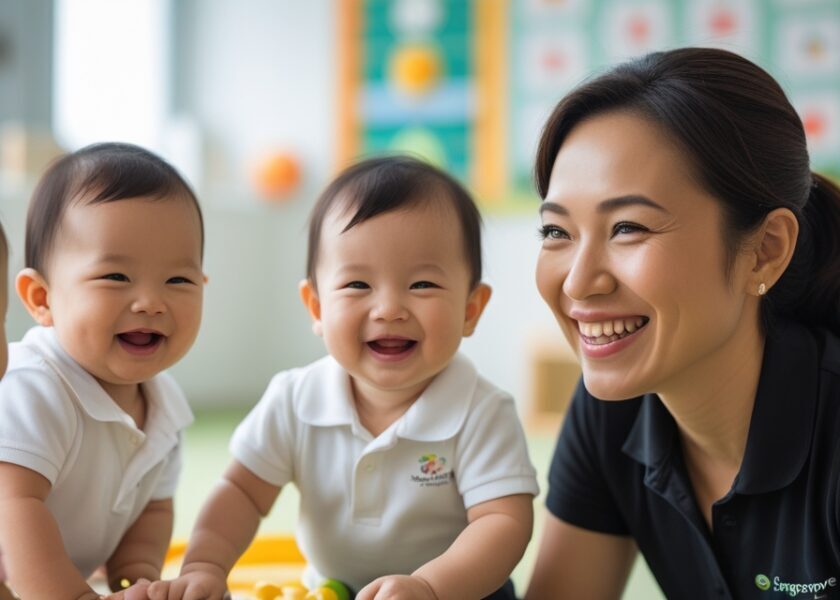
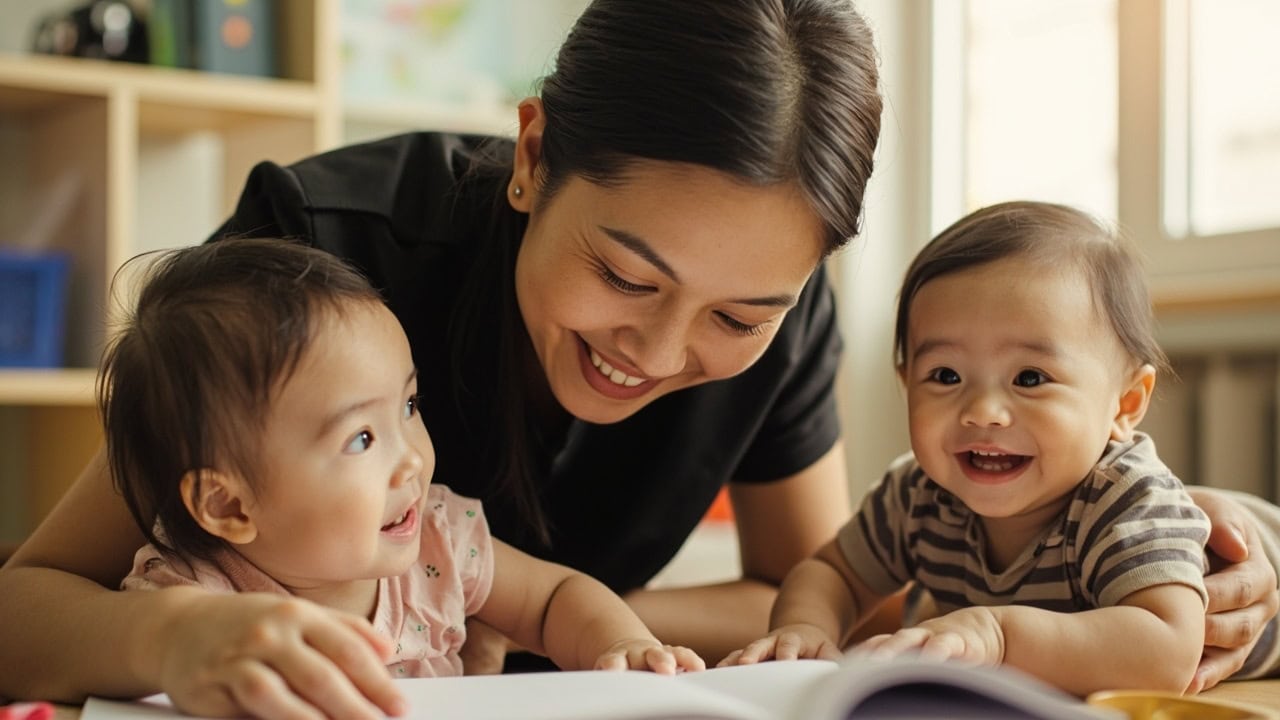
The caregiver who narrates what a child is doing, who mirrors their sounds and responds to them, who slows down and repeats a phrase so that a child can hear the shape of it, who reads a story and asks what might happen next, who sings a song and lets a child finish the line. These are not extras. These are the real curriculum — the one that is running all day long in the best childcare environments, and that is largely invisible to parents who are not inside the room.
What Quality Childcare Actually Looks Like
You are right to worry about whether your child is getting enough meaningful verbal interaction. You are right to worry about rushed caregivers, about high ratios, about environments where children are supervised but not spoken to. That worry is a sign that you understand what your child needs.
Here is what this looks like on a typical day, because parents deserve to know what they are actually buying when they choose a childcare environment.
A caregiver at a quality childcare setting is not simply changing a nappy and moving on. She is naming things. She is describing the texture of the cloth, the colour of the new clothes, the feeling of being clean and comfortable. She is not teaching vocabulary. She is using it, naturally and responsively, in a way that a child’s brain is exquisitely designed to absorb.
During play, she is narrating action, asking open questions, waiting for a response and then responding in turn. During meals, she is naming foods, describing tastes, chatting about the morning, about the weather, about what they might do in the afternoon. During story time, she is not reading at a child. She is performing with language, modulating her voice, pausing to let the child fill in a word, turning the page slowly so anticipation builds.
These are not techniques borrowed from a teaching manual. These are the instincts of a skilled, attentive caregiver who has been given the space, the training, and the ratios to do what she does best.
The Caregiver Ratio: Not Just a Safety Metric
Something that is not said often enough: the caregiver to child ratio is not just a safety metric. It is a language metric.
When a caregiver is responsible for three infants, she can talk to three infants. When she is responsible for six or eight, she cannot talk to six or eight in any meaningful way. The children are managed. They are kept safe. But the language environment flattens. The conversations stop being conversations and start being instructions.
And children, especially infants and toddlers who are building the very circuits that will carry thought itself for the rest of their lives, need more than management. They need interaction. They need to be responded to. They need the adult in the room to be as attentive to their language development as they are to their physical safety.
Heritage Languages and Academic English: Not an Either-Or
Let me address something that sits heavy on many Singapore parents’ hearts: the question of heritage language.
You speak Mandarin at home, or Malay, or Tamil, or Teochew, and you worry that the English-dominant environment of childcare will push your heritage language out. Or conversely, you speak English at home and you worry that your child will not develop sufficient English vocabulary before Primary One.
These are not either-or concerns. They are real tensions that reflect the genuine complexity of raising children in a multilingual society.
Here is what quality childcare does for both. It does not replace what you do at home. It cannot. Your home language is the language of your family’s heart. It carries identity, intimacy, and cultural continuity that no childcare can replicate, and no childcare should try to.
What quality childcare does is build complementary language strength. It builds vocabulary in the language of instruction. It builds the communication confidence your child will need to sit in a Primary One classroom and participate, to understand a teacher’s instructions, to read a comprehension passage and make sense of it.
And critically, it does this not by competing with your home language but by building the underlying language structures that transfer across languages. A child who has rich language interaction in any language develops stronger language circuits in the brain, and those circuits make learning additional languages easier, not harder.
What this means: when you choose childcare that is genuinely language-rich, you are not choosing between your heritage language and academic English. You are building both. You are giving your child the language foundation that will serve them in Mandarin and in Mathematics, in Malay and in Music, in Tamil and in science. Because language is not a subject. It is the medium through which every subject is taught.
Primary One Readiness: What Actually Matters
The transition to Primary School is one of the most significant thresholds in a child’s life, and the preparation for it is often misunderstood.
Parents rightly ask: Can my child recognise letters? Can they count? Can they sit still? These are not the wrong questions. But the questions that matter most are the ones that rarely appear on a school readiness checklist:
- Can your child express what they are feeling?
- Can they explain when something is confusing?
- Can they listen to a story and tell you what happened?
- Can they ask a question in front of a group?
- Can they follow a chain of spoken instructions without getting lost?
These are language skills. And they are the skills that predict Primary One readiness far more reliably than academic drilling.
A child who has been in a language-rich childcare environment, who has been talked to, listened to, read to, and engaged in conversation every single day, walks into Primary One with something that no workbook can build. They walk in with communication confidence. The quiet, deep-rooted belief that their words matter, that they know how to ask for help, that they can make themselves understood.
That is not a soft skill. That is the foundation on which every hard skill is built.
EduNanny’s Approach: Language Built with Intention
EduNanny operates within the ECDA Childminding Pilot, offering Singapore parents a pathway into childcare that is grounded not in convenience alone, but in developmental intention. Whether through home-based care or community and centre-based pathways, EduNanny is built on the conviction that the hours your child spends in someone else’s care are not hours subtracted from their development. They are hours added to it, when the environment is right.
The caregiver ratios within the pilot, reaching up to one-to-three for infants, are not arbitrary numbers. They are the conditions that make real language interaction possible. A caregiver who can give genuine attention to three infants, who can narrate, respond, and converse rather than simply supervise, is a caregiver who is building language in the way it must be built: word by word, moment by moment, day by day.
EduNanny is also committed to transparency, because trust is not built through promises alone. Where deployed, communication measures and observation tools allow parents to stay connected to their child’s day, not as surveillance, but as partnership. CCTV measures where applicable provide an additional layer of assurance, because when you are entrusting your child’s earliest years to someone else, you deserve to know what is happening in that room.
On the subject of access: the pilot fee structures are designed to make quality childcare more affordable, and the usability of the Child Development Account alongside Baby Bonus provisions means that for many families, the financial dimension of this choice is more manageable than it might first appear. These are not peripheral details. They are the conditions that make it possible for more Singapore families to choose quality over convenience.
Frequently Asked Questions
Will my child develop their heritage language if childcare is in English?
Quality childcare builds the underlying language structures that transfer across languages. Your role at home — speaking, singing, storytelling in your heritage language — is irreplaceable and powerful. What EduNanny adds is complementary strength in the language of instruction, giving your child the best of both worlds.
What if my child spends too much time with screens?
Screens provide exposure, not interaction. They cannot replace the response, the wait, the smile, the conversation. At EduNanny, language is built through human connection — through a caregiver who hears your child, responds to them, and treats every interaction as an opportunity to build.
How do I know the caregiver is actually talking to my child?
The caregiver ratio is your answer. When there are fewer children per caregiver, conversation becomes possible. When there are more, it does not. Ask about ratios. Ask about what a typical day looks like. Ask to observe, if you can. The difference between supervision and interaction is visible when you know what to look for.
Is my child too young for this to matter?
The first thousand days of life are not a waiting period before real education begins. They are education — the most important education there is. Language circuits are being built from birth. Every conversation your child is part of, from their first weeks onward, is contributing to the architecture of their mind.
You Are Choosing the Village
Let me say something directly, because if you are a parent reading this, you deserve to hear it plainly.
You are not failing your child by needing childcare. You are not outsourcing their development. You are making a decision that millions of parents around the world make, and that humans, in every culture and every century, have made. It takes a village is not just a saying. It is the neurological truth of how human children develop language, cognition, and social intelligence.
Your child was never meant to learn language from two adults in a closed apartment. They were meant to learn it in a community, with multiple caregivers, rich conversation, and the constant back-and-forth of human interaction.
What you are choosing when you choose quality childcare is not a substitute for parenting. You are choosing the village. And the question to ask is not whether the village can raise your child. It can, and it does. The question to ask is whether the village you are choosing is a place where your child’s language is being built with the same care and intention that you bring to it at home.
Questions Worth Asking
- What are the caregiver-to-child ratios? Fewer children per caregiver means more meaningful verbal interaction.
- What does a typical day look like? Are there regular story times, songs, and conversation, or is the environment quiet and screen-based?
- How do caregivers respond to children? Are they narrating, asking questions, waiting for responses — or simply directing and managing?
- Can I observe? Quality childcare should be comfortable with transparency.
- What is the communication like between caregivers and parents? You should feel like a partner in your child’s development, not a customer waiting for a report.
Remember that moment at the beginning — the moment when your child says a word you did not teach them, and you realise that learning happened somewhere outside your direct sight?
That moment is not a reminder of your inadequacy as a parent. It is proof that your child is learning, growing, and building language in a world that extends beyond your home. And if that learning is happening in an environment where language is treated as a living, breathing, intentional thing — where every caregiver interaction is a word in the sentence of your child’s development — then that moment is not a surprise.
It is a promise being kept.
Your child is building language right now. In every moment. In every conversation. Make sure the conversation is worthy of them.
If you are exploring childcare options in Singapore and want to understand how EduNanny’s approach supports your child’s language development from the earliest days, you are welcome to get in touch or learn more about how we work.