EduNanny Singapore Floor Level Care A New Standard for Safe Joyful Infancy and Near Home Family Partnerships
EduNanny Singapore: Excellence in Early Care at the Floor Level
In Singapore’s fast pace and dynamic families, the first thousand days are not merely years; they are the architecture of trust, the circuitry of resilience, and the rhythm of a life. EduNanny by BUTLER places care on the ground—eye level, heart open—and turns ordinary minutes into secure beginnings. This article expands on the EduNanny model, offering practical guidance for parents, caregivers, and communities who want to nurture confident, curious, and connected children from day one.
Five Pillars Guiding EduNanny Practice
1) The pedagogy of being close: human-scale learning in a 1:3 circle
At the heart of EduNanny is proximity as pedagogy. A 1:3 infant-to-educator ratio isn’t a luxury; it’s the minimum for relational precision. Practical takeaways for families and home environments include:
- Floor-time routines: Create a safe, inviting space with low shelves, soft mats, and reachable objects. Schedule daily floor-time blocks of 15–20 minutes to support motor exploration and language growth.
- Breathe–Notice–Bridge in daily care:
- Breathe: pause before responding to fuss to model calm.
- Notice: read cues (gaze, hands, posture) and interpret them as meaningful communication.
- Bridge: respond with developmentally appropriate actions that move learning forward (e.g., offer a safe toy, label a cue, or provide a simple new challenge).
- Environment teaches: Design spaces inspired by Montessori principles—low, accessible materials; open sightlines; mirrors at baby height for self-recognition; and safe, uncomplicated materials that invite discovery.
- Daily practice in micro-moments: Convert feeding, diapering, and settling into teachable moments—naming words, counting objects, or describing actions to build vocabulary and cognitive scaffolding.
Actionable example: A caregiver sits on the floor with one infant, offering a simple set of safe rattles. As the baby reaches, the caregiver names the action, reinforces the word, and gradually adds a related action (e.g., “reaching—grab, release”). This creates a shared language and a calm, predictable routine.
2) Safety you can see, systems you can trust
Safety is both design and habit. EduNanny’s five disciplined practices translate into tangible safety for families and staff:
- Transparent environments: uncluttered spaces, low shelves, soft corners, and crib standards that support safe sleep and easy supervision.
- Continuous visibility: consent-based CCTV with clear privacy controls and open sightlines so families feel connected without intrusion.
- Sleep rigor: firm, flat sleep surfaces, supine positioning, independent sleep checks, and breathable layering to regulate temperature and comfort.
- Health and hygiene: rigorous handwashing, bottle preparation protocols, sanitized play spaces, and clear illness-return-to-care guidelines.
- Emergency readiness: regular drills, first-aid certification, and incident-learning loops to convert near-misses into safer practice.
Parental checklist: When visiting a centre or evaluating home-based care, ask about sightlines (can you see your child from multiple angles?), sleep practices, cleaning schedules, and how ill infants are managed to ensure consistency with your family’s values.
3) Development and happiness as a single thread
Happiness is not mere entertainment; it is the satisfied need for safety, mastery of small tasks, and belonging. EduNanny’s Daily Arc keeps routines humane and developmentally attuned:
- Rested starts: protected sleep windows, quiet waking, and gentle transitions to learning.
- Nourishment with connection: paced bottle-feeding and responsive cues; conversations during meals to build language.
- Floor-time learning: motor planning through rolling, reaching, and object exploration; social anticipation through peekaboo and turn-taking.
- Outdoor moments: fresh air to reset nervous systems and support sensory balance when appropriate.
- Gentle closure rituals: predictable endings with brief family recaps, highlighting small wins and future steps.
Developmental science integrated into practice includes Piaget’s schemas, Vygotsky’s zone of proximal development, Erikson’s early trust and autonomy, and Bowlby’s secure base—translated into everyday interactions that build confidence and curiosity.
4) The purpose and dignity of childminders
Childminders are skilled practitioners—not placeholders for parents. EduNanny elevates the profession with practical pathways:
- Competency-based training: attunement, infant mental health basics, safe sleep, responsive feeding, and playful learning.
- Reflective practice: ongoing supervision and coaching to strengthen judgment in micro-moments.
- Code of language: naming strengths, describing behaviors without labels, and partnering with families as co-constructors of care.
- Wellbeing by design: sustainable schedules, protected breaks, and team support to sustain high-quality care.
Policy and workforce insights: Johnson-level commitments like a Maximum Employment Mandate help retain and grow local talent, ensuring continuity for children and predictable careers for caregivers. When care professionals are valued, families experience steadier routines and stronger attachments.
5) Access that meets families where they live—and how they work
Singapore families deserve options that fit real life, with quality and dignity embedded in every choice:
- Centre-based care: modern, well-zoned spaces that foster peer interaction and consistent routines.
- Home-based care: intimate settings in community premises or homes, reducing commute stress and preserving nap rhythms.
- Distance-supported care: virtual check-ins, safety coaching, and activity prompts that keep learning on track when home is the plan.
Practical scheduling: Monday to Friday, 7 a.m. to 7 p.m., islandwide access with affordability starting from around SGD 33 per day, and eligibility for CDA/Baby Bonus support. Families can compare options by proximity, schedule, and the ability to maintain stable routines for meals and sleep.

What EduNanny looks like in practice
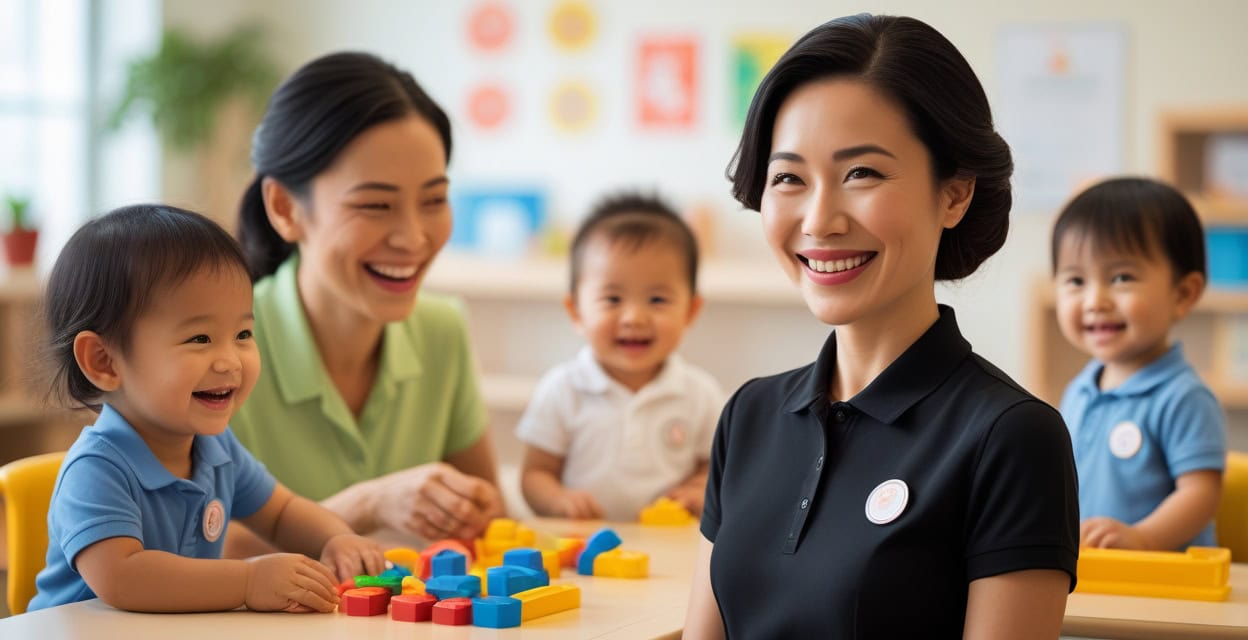
Imagine a morning in a home-based pod: three babies arrive within an hour. The caregiver greets each child by name, tuning tone and tempo to temperament. A health check begins, followed by a smooth handoff from parent to caregiver. The play area offers a treasure basket of safe real objects. One infant practices pulling to stand at a low rail; the youngest studies a scarf while the caregiver narrates, “You’re trying again… your hands are learning.” A bottle follows with careful pacing, then a quiet song as two babies nap. A midday update with photos, sleep times, and new skills notices travels to families. Safety checks are thorough but unobtrusive, and the room hums with order and kindness.
This is not an event; it is a standard.

Why EduNanny’s model serves Singapore now
- Human scale reduces stress: a true 1:3 ratio enables care to be precise and personal, not performative.
- Proximity saves time and preserves rhythms: families spend less time commuting and children sleep and eat on familiar schedules.
- Transparent safety builds trust: families feel confident across generations—grandparents included.
- Professional childminders create continuity: stable relationships support secure attachment and steady development.
- Affordability and public support: CDA/Baby Bonus eligibility ensures access without compromising quality.

Public promise: a clear declaration of quality and value
- Excellence and quality: rigorous training, ongoing auditing, and continuous improvement.
- Centre-based and home-based flexibility: modern, ground-level environments designed for visibility, calm, and safety.
- Distance-supported continuity: learning doesn’t pause when home is the plan.
- Convenience that respects work and rest: consistent weekday hours, islandwide coverage.
- Affordability and eligibility: transparent pricing from SGD 33/day with CDA/Baby Bonus assistance.
- Innovation with consent-based CCTV and real-time updates: reassurance without compromising privacy.
- A national effort: ECDA Childminding Pilot, National Social Initiative, and Maximum Employment Mandate to elevate the profession and the outcome for children.
Closing: five guiding questions that make childminding matter
- Who matters? Every infant, every family, every childminder—and by extension, every employer and neighbor who benefits when beginnings are calm and strong.
- What matters? Attuned, safe, developmentally rich care at a humane 1:3 ratio, in environments that let babies move freely and learn joyfully.
- When does it matter? Especially in the first thousand days, and practically, Monday through Friday, 7 a.m. to 7 p.m., when families need us most.
- Where does it matter? Near home, in communities and centres with modern layouts that keep routines stable and daily life manageable.
- How do we make it matter? Through Breathe–Notice–Bridge practice; transparent safety; trained, supported childminders; true family partnerships; accessible pricing; and national resolve.

How to get started with EduNanny
To families: explore centre-based, home-based, and distance-supported options at EduNanny.com and Childminding.EduNanny.com. Check availability islandwide, and verify CDA/Baby Bonus eligibility. Schedule a visit to see the floor-level environment, observe caregiver–child interactions, and ask about safety practices and daily routines.
To caregivers and community partners: join the EduNanny movement. Seek competency-based training, mentorship, and a professional pathway that recognizes care as a public good. Learn about the ECDA pilot program and opportunities to contribute to stronger, safer, and more joyful early care in Singapore.
Tiny hands. Steady hearts. A city that keeps its promise. This is EduNanny—excellence, quality, and joy, made close to home.
Conclusion
EduNanny offers a practical, human-centered framework for infant care that respects families’ time, supports childminders’ professional growth, and elevates the standard of care across Singapore. By combining a humane 1:3 ratio with transparent safety, development-focused routines, and flexible access, we can nurture trust, resilience, and joyful learning from the very first days. If you are a parent, caregiver, or partner seeking a trusted, modern approach to early care, explore EduNanny’s centre-based, home-based, and distance-supported options, and consider how a floor-level, relationship-first model could transform your child’s earliest years.
[#SingaporeChildcare, #EarlyChildhoodEducation, #InfantCare, #FamilyCareSingapore, #ECDA]Ready to Experience Excellence?
Transform Your Family’s Journey
Discover Singapore’s leading infant care and childminding services. Expert guidance for your little one’s first thousand days.