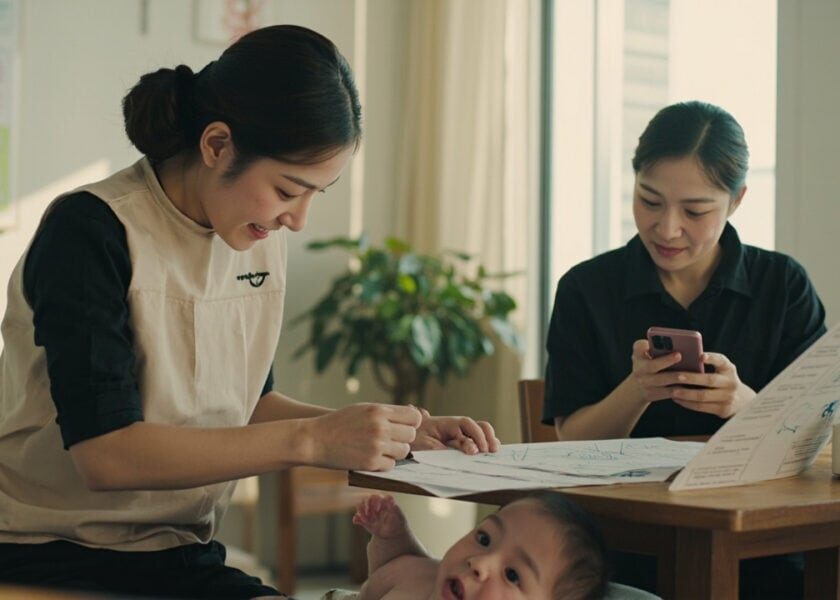
Childcare That Supports Your Ambition Too, Singapore Parent
The Unnamed Tension Every Singapore Parent Carries
In Singapore, we have become fluent in the language of family. We talk about the importance of the first thousand days, about attachment and development, about choosing the right environment for our children. We have built an ecosystem of parenting support that includes infant care centres, student care facilities, and a growing recognition that childcare is not merely a child welfare issue but a family infrastructure issue.
And yet, when we speak about childcare, the conversation almost always centres on the child. Where will my baby be safe? Who will care for my infant? Is the environment nurturing enough?
These are the right questions. They are essential questions. But they are not the only questions.
Because behind every Singapore parent making a childcare decision is another question, often unspoken, often unacknowledged. It is not simply about the child. It is about the parent. It is about the professional who still lives inside you—who still carries ambition and purpose and the desire to contribute meaningfully beyond the walls of your home.
The unspoken fear is not just whether your child is safe. It is whether choosing childcare means stepping off your own path permanently. It is whether saying yes to an infant care programme means saying goodbye to the career you have built, the identity you have earned, the self you have spent years becoming.
This fear is not irrational. It is the quiet reality of Singapore’s dual-income family structure, where two professional incomes have become not a luxury but a necessity for most households navigating the cost of raising children in one of the world’s most competitive cities.
It is the reality of maternal re-entry, where women who step away from their careers to care for young children return to a professional landscape that has shifted without them, where gaps are questioned and momentum is lost. It is the reality of professional identity, which does not pause for parenthood and which, if left unsupported, can quietly erode while we are focused entirely on the small human who needs us most.
The question we must ask, then, is not how to choose between our children and our careers. The question is how to build the infrastructure that allows both to flourish.
Childcare as Infrastructure, Not Surrender
Childcare, when understood correctly, is not a surrender of ambition. It is the platform that allows ambition to continue.
This reframe matters because the narratives available to Singapore parents today often frame childcare as sacrifice. You are giving up your career for your child. You are putting your professional dreams on hold until they are grown. You are making a choice between the person you were and the parent you are becoming.
And while these narratives come from a place of love, they carry within them a lie that does damage to both parent and child. The lie is that caring for your child and caring for your professional self are in opposition. That one must be sacrificed for the other. That wholeness, for a parent, is impossible.
But here is what we know: parents who feel supported in their professional identity return to their children with greater presence, not less. Parents who maintain their sense of purpose and competence carry that energy into their parenting. Parents who are allowed to remain whole—to be both the professional and the parent, to hold both identities with equal dignity—are parents who thrive, and so do their children.
Children do not need parents who have given up everything for them. They need parents who are fulfilled, resourced, and able to model what it looks like to live a full and purposeful life. And that requires, in many cases, returning to work, continuing to grow professionally, and trusting that your child can thrive in an environment that is safe, loving, and designed for their development.
Childcare, then, is not the thing you choose when you cannot be there for your child. Childcare is the thing you choose so that you can be there for your child—fully, present, without the weight of abandoned ambition pressing down on every interaction. It is the infrastructure that allows you to return each evening not depleted, but enriched. Not torn between two identities, but integrated.
Building Trust in Your Childcare Partner
What transforms childcare from a source of quiet anxiety to a source of quiet confidence is trust. Trust in the environment where your child spends their days. Trust in the people who care for them in your absence. Trust that the ratios are small enough for genuine attention, that the communication is open enough to reassure, that the standards are high enough to meet the expectations you would hold for yourself.
Trust that your child is not just being watched, but being seen. Not just being kept safe, but being nurtured. Not just occupying time until you return, but experiencing rich, responsive care that supports their development in these critical early years.
This trust is not given lightly. It is earned through transparency, through consistency, through the kind of care that treats every infant as a full human being deserving of dignity and attention.
What Quality Childminding Looks Like in Practice
When you are evaluating infant care options, it helps to know what to look for. Quality childminding has observable, practical dimensions that matter for both your child’s development and your peace of mind.
- Small ratios matter. In infant care, the number of caregivers relative to infants determines whether your child receives responsive, individualised attention or becomes one of many in an overwhelmed environment. Look for settings where each infant has meaningful access to attentive, consistent caregivers.
- Communication is ongoing, not occasional. You should feel connected to your child’s day even when you are apart. This means regular updates—not just when something goes wrong, but sharing the small moments that help you feel present in your child’s life even while you are in a meeting across the city.
- The caregivers are partners, not replacements. Quality care treats you as the expert on your child while bringing professional knowledge to support your child’s development. It is collaborative, not custodial.
- The environment is designed for infants. This means safety, stimulation, and routines that honour the developmental needs of the youngest children—not just scaled-down versions of older children’s programmes.
- Your professional life is treated seriously. Quality care understands that when you drop your infant at the door in the morning, you are stepping into a day where you need to be at your professional best. It supports your career continuity not as an afterthought, but as part of its core purpose.
The EduNanny Approach: Built for the Whole Parent
EduNanny was built with this trust at its centre, and with a recognition that modern Singapore parents need more than a service. They need a partner.
A partner who understands that when you drop your infant at the door in the morning, you are not simply leaving them. You are entrusting them with something precious, and you are stepping into a day where you will need to be at your professional best, where decisions will be made, where leadership will be expected, where the professional you has responsibilities that do not pause for parenthood.
EduNanny provides a childcare arrangement that communicates, updates, and shares not just the practical details of feeding and sleeping but the small moments that make you feel connected to your child’s day even when you are miles away. The kind of transparency that builds confidence—not performative transparency, but genuine openness about what happens in the hours you are apart.
The programme recognises that the infant in their care is not just a developing human being, but the child of someone who loves them deeply, who has made a considered choice to balance professional and parental identity, and who deserves to be seen as a whole person making a strategic life decision.
Not just infant care, but the infrastructure for parental confidence. Not just childminding, but partnership in the truest sense of the word.
ECDA Childminding Pilot Options
As part of the ECDA Childminding Pilot, EduNanny offers a pathway that aligns with Singapore’s broader vision for family support. The pilot programme provides both home-based and centre-based options, recognising that Singapore families are not monolithic in their needs.
| Care Option | Best For | Key Features |
|---|---|---|
| Home-Based Care | Families seeking a familiar, personalised environment | Trusted childminder integrated into household rhythm |
| Centre-Based Care | Families wanting structured socialisation | Community environment with additional learning dimensions |
For some families, the familiarity and comfort of home-based care—with a trusted childminder who becomes part of the household rhythm—is the right fit. For others, the community environment of centre-based care offers additional dimensions of socialisation and structured learning. Both pathways are designed to the same standards, held to the same expectations of quality and safety.
The ratios in infant care matter, and EduNanny maintains the high standards appropriate for this most vulnerable age group. With ratios of up to one to three in infant care, every infant receives the attention and responsive interaction that early development requires. This is not a logistical detail. This is the foundation on which trust is built.
When you know that your infant is not one of many in an overwhelmed environment, but one of very few in a space designed for their care, something settles. The day becomes navigable. The return becomes joyful.
Making Quality Care Accessible
The practical dimensions of the pilot reflect a genuine understanding of Singapore family economics. The fee structures are designed to be accessible within the pilot framework, and the integration of CDA and Baby Bonus usability means that eligible families can stretch their resources further, making quality care not just an aspiration but a realistic choice.
Monday to Friday care blocks provide the consistency that working parents need, with the reliability that allows professional planning and personal peace of mind. When your childcare is dependable, your career can be too.
Support That Meets You Where You Are
Modern parenting includes moments of uncertainty—questions that arise at odd hours, the need for reliable information at the point of need. EduNanny offers Thomas, an AI-powered chatbot that serves as an always-available resource for parents navigating the practical and emotional complexities of childcare decisions.
Not a replacement for human support, but an extension of it. A tool that respects your intelligence, answers your questions with care, and helps you make confident choices about your child’s wellbeing—whatever time of day or night.
What Singapore Parents Really Need to Hear
If you feel guilty about returning to work, I want you to know that this guilt is not a sign that you are doing something wrong. It is a sign that you care deeply, that you take your responsibilities as a parent seriously, that you are paying attention to the weight of the decisions you are making.
But guilt is not a reliable guide. It will tell you that any choice to invest in your professional self is a betrayal of your child. It will tell you that the only good parent is one who gives up everything. It will tell you that wholeness is impossible.
These are lies that do damage to you and to your child.
The truth is that your child needs you to be whole. They need you to model a life where ambition and love coexist, where professional contribution and parental presence are not in competition, where the adults around them lead full, purposeful lives.
For mothers who have spent time at home with young children, returning to the professional world can feel daunting. The landscape has shifted. Networks have evolved. The confidence that once came easily may feel harder to locate. Quality childcare does not erase these realities, but it does something important: it gives you the space to prepare for re-entry without the pressure of a decision already made. You can plan your return with intention. You can update your skills, reconnect with your professional networks, and step back into your career on your own timeline—not because you had no choice, but because you chose it.
Singapore families often carry the weight of two demanding professional lives alongside the demands of young children. This is not a failure of planning—it is the reality of building a life in one of the world’s most dynamic and competitive cities.
The narrative that suggests one parent should simply step back to care for children ignores the economic, professional, and personal costs of that choice. Both parents deserve to maintain their professional trajectories. Both parents deserve to feel that their careers matter, not as obligations to be endured, but as sources of meaning and contribution that they choose to sustain.
Career continuity is not just about maintaining income (though that matters). It is about maintaining identity, momentum, professional networks, and the sense of self that comes from being good at something and being recognised for it. When childcare is designed to support career continuity, it is not asking you to choose between your child and your career. It is saying: both can exist. Both can thrive. Both deserve investment.
A Checklist for Choosing Infant Care in Singapore
If you are evaluating childcare options, here are the questions that matter most:
- What are the caregiver-to-infant ratios? For infants, smaller numbers mean more individualised attention.
- How will I stay connected to my child’s day? Look for communication practices that share both milestones and daily routines.
- What are the qualifications and training of the caregivers? Quality care requires professional knowledge of infant development.
- Is the environment designed for infants specifically? Infant care is not the same as toddler care.
- How does the programme support working parents? Flexibility, reliability, and understanding of professional demands matter.
- What do fee structures include, and how can CDA or Baby Bonus be used? Understanding the financial picture helps with planning.
- How does the programme communicate about my child’s development? Regular, meaningful updates build trust over time.
- Do I feel respected as a partner in my child’s care? You are the expert on your child. The right programme will treat you that way.
The Support Singapore Parents Deserve
Singapore parents deserve to return to work and feel capable, confident, valued. They deserve to return home and feel present, engaged, whole. They deserve to make childcare decisions without guilt, without shame, without the weight of narratives that frame their choices as surrender.
They deserve childcare that sees them—the whole them—and treats their professional identity with the same seriousness and respect that it treats their child’s development.
We live in a city that asks much of its parents. The expectations are high, the pace is relentless, and the cost of choosing to raise a family while maintaining a career is real and demanding. Singapore parents carry more than most. They carry the weight of professional competition, of academic expectations for their children, of the constant calibration between time and money and energy and love.
And yet, so many of them navigate this complexity with grace, with intention, with a quiet ferocity that deserves not just admiration but support.
EduNanny was built to be that support. Not as a luxury. Not as a convenience. But as a recognition that quality childcare is parental infrastructure, and that infrastructure enables everything else.
It enables career continuity. It enables professional re-entry after maternity leave. It enables the mother who has spent two years at home with her infant to return to the boardroom without the quiet terror that she has fallen too far behind. It enables the father who wants to be present for his child’s first years without sacrificing the professional contributions that give his life meaning. It enables both parents in a dual-income household to work with the security of knowing that their child is thriving in their absence, so that when they return, they can be fully present.
When we talk about the first thousand days, we usually speak about brain development, about attachment patterns, about the foundations that shape a lifetime. And these things matter deeply. But the first thousand days also matter for parents. They are days of transformation, of identity reconstruction, of learning to hold new responsibilities without losing the self that existed before. They are days that, if unsupported, can quietly erode professional confidence and career trajectory.
And they are days that, if supported well, can become a period of integration rather than fragmentation—where the professional and the parent do not compete, but coexist.
The Promise
So to the parent who is weighing these decisions, who is navigating the unspoken tension between professional identity and parental love, who is carrying the quiet fear that choosing childcare means losing yourself—I want you to hear this:
You are not choosing between your child and your career.
You are building the infrastructure that allows both to exist, both to thrive, both to be honoured.
You are not failing by seeking quality care for your infant. You are investing in a partnership that supports your whole life.
You are giving yourself permission to be ambitious and loving, to be professionally engaged and deeply present, to be someone who contributes beyond the home and someone who shows up fully within it.
The professional you, the parent you, the whole person you—all of it matters. All of it deserves support. All of it is welcome here.
EduNanny is honoured to walk this path with you. To be the trusted partner that holds your child’s wellbeing with care and your professional future with equal seriousness. To provide the infrastructure that makes career continuity not just possible, but sustainable. To serve Singapore families with the respect, the transparency, and the genuine partnership that they deserve.
This is what we do. This is who we are. And this is the promise we make to every family who entrusts us with the most important work of their lives: raising the next generation, while remaining whole enough to lead them by example.
The future is built by parents who are supported, not depleted. By families where both child and adult flourish. By a society that recognises that childcare is not a women’s issue, not a family issue, not a corporate issue, but a shared investment in the kind of people we want our children to become.
EduNanny is proud to be part of that investment. And we are proud to stand beside you, as you build the life you want for your family, and the self you are still becoming.
Ready to explore what a childcare partnership built for the whole parent looks like? Connect with EduNanny to learn more about the ECDA Childminding Pilot and discover care options designed for your family’s needs.