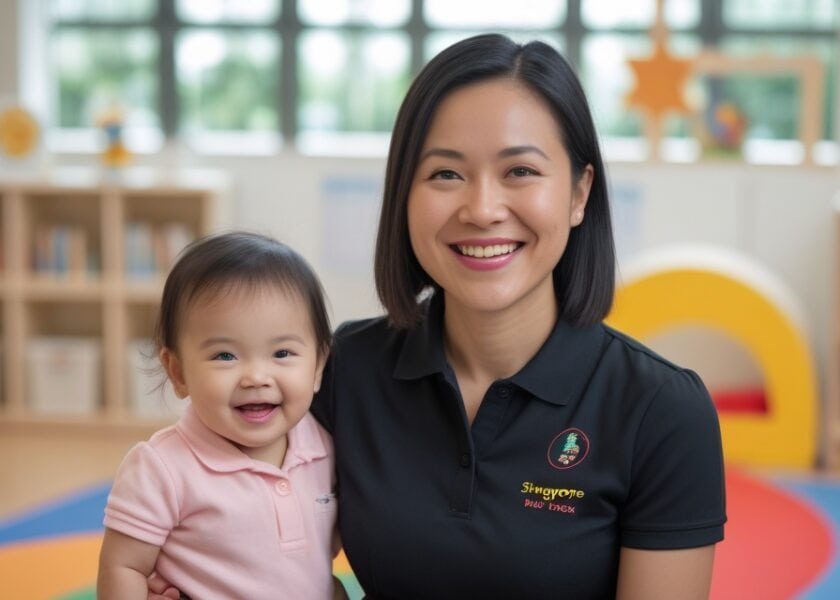
Childcare That Grows With Your Family in Singapore
“`html
The Moment Every Singapore Parent Recognises
There comes a moment—and most parents in Singapore will recognise it—when the childcare arrangement that once felt right begins to feel different. Not wrong exactly. Not a crisis. Just… different.
The baby who slept through anything now fights naps. The toddler who was content watching is suddenly everywhere at once, grabbing, climbing, needing. You find yourself wondering: did I choose the right thing? Is something broken?
The honest answer is almost always no. Nothing is broken. Your child has simply grown.
This is the moment the childcare conversation rarely addresses. We talk endlessly about choosing, about the decision itself, about finding the right fit at the start. But we rarely talk about what happens in the months and years that follow, when the child you enrolled is no longer the child in front of you.
These are not edge cases. They are the predictable, beautiful, sometimes exhausting rhythms of family life. And the childcare that served you beautifully at six months may need to look different at two years. At four. When a new sibling arrives. When school begins. When a grandparent’s availability changes, or a work schedule shifts, or your child develops needs that didn’t exist last month.
Nothing Is Broken. Your Child Has Grown.
Most parents experience this quiet shift and feel a corresponding guilt, as though the mismatch is a personal failing. As though they should have planned better, chosen more wisely, predicted the future.
But here is what hundreds of families have taught us: childcare is not a single decision made once. It is a living relationship that must grow as your child grows, as your family evolves, as life does what life does.
The childcare world, for the most part, is not built for this. Centres have fixed structures, fixed ratios, fixed programmes. They serve age brackets, not children. Agencies place caregivers into defined roles with defined expectations, and when the role needs to change, the relationship often ends. Parents are left to begin the search again, to explain their needs from scratch, to rebuild trust with someone new.
And yet the need for continuity is real. Your child does not experience their development in neat compartments. The infant who trusted their caregiver becomes the toddler who tests boundaries with that same trusted person. The toddler who learned to share with one familiar adult becomes the preschooler who carries that social knowledge into new situations. These progressions are not interruptions to be managed around. They are the actual work of early childhood.
Three Evolution Points Every Singapore Family Faces
From Infant to Toddler: When Care Needs a New Toolkit
When your child moves from infancy into toddlerhood, the care needs shift. Suddenly there is language, physical ambition, social curiosity. A caregiver who was perfectly calibrated for a newborn now needs a different toolkit.
In an EduNanny arrangement, this evolution is not a disruption. It is anticipated. The caregiver who has been with your child since four months knows their rhythms, their emerging language, their developing personality. That continuity is not sentimental. It is practical.
A caregiver who understands your child does not need to relearn them when they change. She adjusts her approach in real time, building on what she already knows. When your toddler begins asserting independence, she draws on months of relationship to understand what this behaviour means, what works, what soothes.
When a Second Child Arrives: The Mathematics Change
You are no longer managing one routine, one set of needs. You are managing two people, two temperaments, two nap schedules that rarely align.
This is where many childcare arrangements quietly break. A centre may have space for a second child but not the flexibility for two very different developmental stages. A domestic helper may be overwhelmed. But EduNanny’s home-based model, operating within the ECDA Childminding Pilot, is designed with this reality in mind.
With ratios that allow for individual attention, and a partnership approach that encourages honest conversation about what is working and what is not, families can scale their care without beginning from zero. You already have someone who knows your first child, who understands your family’s rhythms, who can gradually build a relationship with your second.
That is not a small thing. It is the difference between a caregiver and a partner.
School Entry: An Evolution, Not an Ending
This is the transition most parents imagine as an endpoint. You have survived infant care, toddler care, perhaps some enrichment. Now school begins, and surely this chapter closes?
But school entry is not an ending. It is another evolution. The child who spent mornings in a home-based setting now needs before-school care, after-school care, holiday coverage. The enrichment that made sense at four may need to shift at six. The caregiver who has been part of your family’s life since the beginning may be exactly the right person to walk with you into this new phase.
EduNanny’s structure does not treat school entry as a termination. It treats it as a transition, and transitions are where the partnership model proves its value most clearly.
How to Know When Your Childcare Is Evolving Rather Than Failing
All of this requires something from the caregiver that cannot be scripted: genuine attentiveness. But it also requires something from the model itself—flexibility, communication, and a willingness to revisit assumptions.
The signs are often subtle:
- Your child seems restless in a way they did not before
- Your own tolerance for the arrangement has shifted
- You find yourself dreading the morning handover, or counting down to the end of the day in a way that feels new
- The routine that once ran smoothly now requires more negotiation
- A new sibling has arrived and the old setup is showing strain
- Your child is approaching a developmental milestone and you sense the current arrangement may not be enough
These are not warnings of a broken system. They are invitations to look more closely, to ask whether the current setup still matches where your child and family are now. And if the answer is no, that is not a reason to feel guilty. It is a reason to adapt.
Why EduNanny’s Partnership Model Works Differently
To understand what makes EduNanny different, it helps to understand what most parents are working with.
Traditional childcare centres operate on fixed structures: fixed ratios, fixed programmes, fixed hours. A centre that excels at infant care may not excel at toddler care. A centre designed for toddlers may not have the space or training for mixed-age groupings when your second child arrives. You are choosing a structure, and structures have limits.
Agencies offer a different model: they match families with caregivers and move on. When the caregiver role needs to evolve, the agency has little capacity to support that evolution. Some families rely on domestic helpers, who often enter the picture without specific early childhood training and who may be managing household responsibilities alongside childcare.
What unites these models is a fundamental assumption: that childcare is a transaction, not a relationship. You purchase a service, and when the service no longer fits, you purchase a different one.
EduNanny Singapore was built on a different understanding. We are not simply a matching service. We are, at our core, a partnership model—one structured to grow alongside you, to flex as your situation changes, to stay with you through the transitions that most childcare arrangements cannot survive.
When your infant becomes a toddler, the caregiver draws on what she knows to meet the new needs. She has already observed your child’s emerging language, their motor development, their social preferences. She does not need to start over. She adjusts.
When your second child arrives, she integrates them into an existing relationship. Your first child already trusts this person. Your second child enters a household where that trust already exists. The adjustment is gradual rather than abrupt.
When school begins, she transitions alongside you rather than being replaced. Before-school care, after-school care, holiday coverage—these are not new arrangements requiring new trust-building. They are natural evolutions of a relationship that has already proven itself.
EduNanny operates within the ECDA Childminding Pilot, which means it is part of a broader movement to professionalise and support home-based and community-based childminding across Singapore. The pilot structure allows for thoughtful, supported care that is different in kind from the transactional models that dominate the industry.
For families, this means affordable, reliable care designed to flex with your family’s changing needs. CDA and Baby Bonus eligibility reduces the financial weight of quality care. Monday to Friday care blocks allow families to plan their weeks with confidence. Communication channels keep parents informed about their child’s day. Where deployed, CCTV measures mean parents are never left wondering.
You have a relationship with the person caring for your child. You have a partner, not just a service.
Practical Guidance: Choosing Care That Grows With You
If you are researching infant care in Singapore, here are questions worth asking before you commit:
- How does this arrangement handle developmental transitions? Ask specifically about how care adapts when your infant becomes a toddler. What changes? Who decides? How is the transition managed?
- What happens when our family grows? If you are planning more children, or if extended family availability may change, ask how the model accommodates growth and change.
- How is the caregiver supported? Training, oversight, and ongoing communication are signs that a model takes quality seriously rather than treating caregivers as interchangeable.
- What does continuity look like in practice? Ask how long caregivers typically stay with families. Ask how transitions are handled when they do occur. A model that plans for continuity will have answers.
- What financial support is available? CDA and Baby Bonus eligibility, pilot fee structures, and transparent pricing all reduce the financial uncertainty that adds to an already stressful decision.
Some parents ask whether home-based care is as reliable as a centre. The ECDA Childminding Pilot provides the oversight and infrastructure that addresses this concern directly. Families receive structured, supported care rather than informal arrangements—with standards, training requirements, and accountability measures in place.
The Trust That Grows Across Change
The trust that builds across these transitions is different from the trust you place in a fixed institution. It is earned slowly, over time, through consistency that persists through change.
When your child is two and again at four and again at six, and the same caregiver has been present through all of it, something profound develops. Your child knows, in their body, that some things do not change. That the world can bring new siblings and new schools and new schedules, but there are constants. There are people who know them.
That knowledge does not show up on any developmental checklist, but it shapes a child’s sense of security in ways that matter enormously.
What parents often tell us, months or years into their EduNanny arrangement, is that they stopped worrying about the childcare decision. Not because it became effortless, but because they realised they did not have to make it only once. The decision was made, and then it was made again, and again, in small ways, as their child grew. And each time, there was someone alongside them, adjusting, learning, staying.
That is the thing about the early years. They are short and they are intense and they are full of changes that no one can fully prepare you for. But when you have a childcare relationship that is designed to grow with you, you do not face those changes alone. You have someone who knows your child, who knows your family, who can evolve alongside you through every stage.
EduNanny is not the childcare choice you make and then forget. It is the partnership that grows with you, that adapts when your child changes, that stays when other arrangements end, that treats your family’s evolution as something to be welcomed rather than managed around.
The question is not whether childcare will need to change. It will. The question is whether the model you choose will change with it.
And that is a question worth asking, not just at the beginning, but at every stage that follows. Because the families who thrive in these early years are not the ones who found the perfect arrangement once. They are the ones who found a partner willing to grow alongside them, again and again, for as long as needed.
That is what EduNanny offers. Not a single solution, but a relationship that learns, that adapts, that stays.
If you are considering childcare that grows with your family, we welcome the conversation. Connect with EduNanny Singapore to explore how our partnership model might work for your situation, at whatever stage you are currently in.
To learn more about EduNanny’s approach and our work within the ECDA Childminding Pilot, visit our website at edunanny.com.
“`