
Fraud Blocker edunanny.com

Category: Childminding

edunanny-0631522197b07f2636a2cdc6d571a4b6
April 17, 2026

What No One Tells You About Your Child’s First Month in Childcare

Navigating the First Month of Childcare: What to Expect Week by Week

There is a particular quality to the silence in your car on the drive home after the first drop-off. You will notice it. The absence of your child’s voice in the backseat, the pause where their breathing usually fills the space, the strange lightness of a vehicle that no longer carries its most important weight. You will sit at a red light, and you will not know what to do with your hands, and you will wonder if you have made a terrible mistake.

I want to tell you something that may not feel true for weeks, maybe longer: you have not made a mistake. What you are feeling is the beginning of something, not the end of something.

Because here is what nobody tells you about the first month of childcare enrollment: it is not really about your child at all. Or rather, it is about your child, yes—but it is also about you. It is a passage you are walking together, and only one of you knows you are walking it.


Week One: The Goodbye That Breaks People

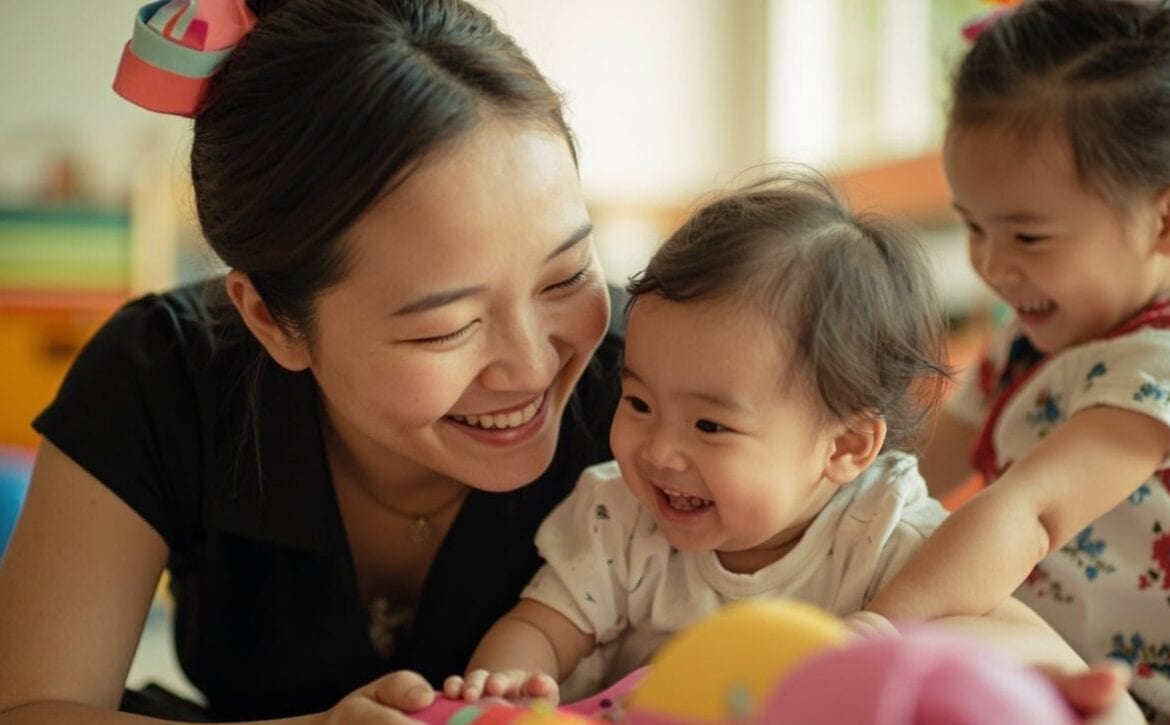
You walk through the door of the childcare centre or into the home where your child’s caregiver is waiting, and your child looks up at you with an expression that contains no past and no future, only the present moment of you. And then you kneel down, or you lean in, and you say the words you have rehearsed: I love you. I will come back. You are safe here.

And you mean them with every cell of your body, and your child cries anyway.

This is the moment that breaks people. Not because it is dramatic, not because something has gone wrong, but because it is so achingly ordinary. Your child cries, and you leave. You walk out the door, or you step into another room, and the sound of their cry follows you like a thread that has been cut loose.

You check your phone seventeen times before 9 a.m. not because you expect a message but because holding your phone gives your hands something to do. You sit in meetings and hear nothing. You answer emails and remember none of them. Your body is present, but your mind is back in that room, watching your child’s face as the door closes.

What Is Actually Happening in That Room

Your child is crying, and the caregiver—a trained, attentive, carefully chosen caregiver—kneels down to your child’s level. Not hovering, not forcing comfort, but present. Available. The way a lighthouse is available to a ship in fog: not steering the ship, but offering a point of reference.

Your child may cry for five minutes. They may cry for thirty. This is not a measure of damage. This is not an indication that you chose wrong. This is your child learning that the world contains more than the people they have known, and that this is survivable. This is adaptation. This is the work of a healthy, developing nervous system encountering something new and saying, through tears, I do not know this yet.

And slowly—sometimes very slowly, sometimes with surprising speed—the crying changes. Not always to contentment. Sometimes to confusion, to withdrawal, to a watchful silence that is its own kind of protest. Your child may not eat much. They may not sleep at their usual time. They may cling to the caregiver in a way that feels like a betrayal, or they may refuse the caregiver entirely and spend the day in a state of guarded, exhausted alertness.

All of this is within the range of normal. All of this is the first week.

What You Are Grieving

What matters in week one is not whether your child is happy. What matters is whether the environment is responsive.

A good childcare setting in this first week will not tell you only what you want to hear. A good childcare setting will tell you the truth: Your child cried for forty minutes this morning, and then they ate half their snack, and then they rested for twenty minutes, and they are okay.

A good caregiver will not minimize your child’s distress, but they will contextualize it. They will help you understand what you cannot see.

Here is what nobody talks about enough: the communication is for you. Not only for your child, but for you. Because your anxiety is not a separate problem from your child’s settling. Your anxiety is something your child can sense, and your child’s anxiety is something you can sense, and in week one, you are all sensitized to each other’s fear.

This is not weakness. This is attachment biology. You are wired to monitor your child, and your child is wired to monitor you, and when one of you is unsettled, the other knows.

A quality caregiver understands this. They know that part of their job is holding space for your worry, not dismissing it. They know that a text message from them—He had a difficult morning but is settling now—does more than update you on your child’s status. It regulates your nervous system. It gives your brain something to work with besides imagination. It breaks the loop of catastrophic thinking that feeds on silence.

So in week one, here is what you are doing, whether you know it or not. You are grieving something. You are releasing a version of your daily life that existed when your child was only yours, when the rhythms of their day were yours to shape. You are sitting with the fact that you cannot be in two places at once, that you have chosen or need to work, that the world requires you to divide yourself.

This is not a failure of love. This is the act of a parent who is trying to provide, to grow, to remain whole in a life that has become larger than one role.

Week one is brutal. Week one is also temporary.


Week Two: The Long Middle

By the beginning of week two, something shifts. Not dramatically. Not in a way that will make you jump up and celebrate. But you will notice something small.

Your child might settle slightly faster in the morning. They might look at the caregiver with something other than pure suspicion. They might ask a question—not necessarily about you, not necessarily about when they are going home, but a question. What is that? What are you doing?

This is enormous. The capacity to be curious in an unfamiliar place means something is opening. Something is beginning to trust.

The Evening Reunion: A Diagnostic Moment

Or perhaps your child is still struggling. Perhaps the second week looks harder, not easier. Some children spiral down before they spiral up. Some children hold themselves together at childcare and fall apart at home. Some children will not cry at drop-off but will cry the moment you pick them up, as if they have been holding something in reserve all day and now, finally, with the safe person, they can let it go.

This is not regression. This is release. This is your child saying, in the only language they know, I was scared, and I handled it, and now I am with you and I can finally stop handling it.

Watch your child when you pick them up. Watch their body:

  • Collapsed and boneless, seeking only to be held? That is overwhelm, and it will pass.
  • Manic, running wild, impossible to settle? That is discharge—nervous system release after a day of vigilance.
  • Quiet and watchful, studying your face with unusual intensity? That is recalibration. They are trying to figure out if the world is still the same, if you are still you, if they are still the child they were before.

Your job at pickup is not to fix them. Your job is simply to be there. To be the consistent, warm presence that proves they survived the day. To receive their dysregulation without panic, because your calm is the message: You are safe now. I am here. We made it.

When Doubt Deepens

By the middle of week two, most children have found some kind of rhythm, even if it is not the rhythm they had before. They know the layout of the room. They know where the toys are. They know that this person—this caregiver who is not Mommy or Daddy—has a name, has a voice, has a way of doing things that is learnable.

And parents—parents are still in the thick of it. Week two for parents is often when the doubt deepens rather than lifts. The initial shock has worn off, and now you are in the long middle where you have to live with your decision.

You second-guess the choice of centre or caregiver. You wonder if you should have waited another month, another year. You notice that your child seems tired, and you blame the childcare. You notice that your child seems happy, and you feel guilty for not being the source of that happiness. You oscillate between relief that someone is helping and grief that you need help at all.

What you are feeling is not evidence that you chose wrong. The caregiver who sends you honest updates—even updates that are hard to hear—is doing exactly what a quality caregiver should do. The transition is not a test of your child’s resilience or your own judgment. It is a passage. And passages have difficult middle sections. You do not abandon a passage just because the middle is hard.


Week Three: Evidence Emerges

Your child comes home and does something you have not seen in weeks. They play. Not the exhausted, flattened play of a child who is simply depleted, but actual play—imaginative, engaged, at-ease play.

Or they eat a full dinner, and you realize they have barely eaten anything in the past two weeks. Or they crawl into your lap and fall asleep in the middle of a sentence, and you realize they have been holding themselves awake all day, and now, finally, they feel safe enough to rest.

These are not coincidences. These are evidence.

Evidence that your child’s nervous system has begun to register this new environment as survivable. Evidence that the caregiver has built enough of a relationship that your child is not in constant vigilance. Evidence that the transition, which you feared had broken something, has actually done the opposite—it has expanded your child’s world.

The Secondary Attachment

You will also notice, probably around this time, that your child mentions the caregiver. Not you asking, not prompted, but volunteer:

Ms. Rachel says we should wash our hands before snack. Ms. Rachel has a dog named Mochi. Ms. Rachel let me help her water the plants.

This is monumental. Your child is building a secondary attachment—not replacing you, not forgetting you, but adding to their emotional world. They are learning that love is not a finite resource, that they can care about more than one person, that other adults can be trusted and kind and interesting.

And if that sentence makes you feel something complicated, I want to name that feeling. It is not jealousy, exactly. It is something older and deeper. It is the realization that your child is becoming a person with a life that includes spaces you cannot enter.

That is what parenthood is. It is a slow series of goodbyes to the fantasy that your child only needs you. And each goodbye is a gift, even when it aches.

You Are Settling Too

In week three, you may also notice that you are checking your phone less. That you can get through a work meeting without your stomach in knots. That when the caregiver sends a message, your first instinct is curiosity rather than dread.

This is you settling too. You are learning the rhythms of this new arrangement. You are developing trust—not blind trust, but earned trust, the kind that comes from seeing consistent, responsive care over time.


Week Four: The Recognition

I want to tell you about a parent I know. She walked into childcare on the first day and left her daughter, who was fourteen months old, and spent the entire drive home crying so hard she had to pull over twice.

She spent the first week certain she had made a terrible mistake. She spent the second week barely sleeping, checking her phone constantly, imagining the worst. She spent the third week starting to relax, cautiously, like someone testing thin ice.

And then one morning, in week four, she dropped her daughter off, and her daughter turned to her and said, without any drama, without any tears, See you later, Mama. And walked into the classroom.

She stood in the doorway for a moment, and she realized she was crying again—but differently now. She was crying because she understood something that she could not have understood four weeks ago.

Her daughter had not forgotten her. Her daughter had not been damaged by the separation. Her daughter had grown. And so had she.

What Week Four Offers

Not a return to who you were before enrollment, but the recognition that you have become someone new. A parent who can hold two things at once: the love that aches when you leave, and the trust that knows your child is okay. A parent who has walked through the passage and come out the other side with a child who is more capable, more flexible, more expanded than they were a month ago.

You will hear people talk about the first thousand days of a child’s life as if they are magic, and in some ways they are—the brain is developing faster than it ever will again, the capacity for connection is at its most open, the foundations for everything that comes after are being laid.

But the first thousand days are not only about what you provide directly. They are also about what you make possible. The decision to seek quality care is not an abdication of your role in those thousand days. It is an assertion of it. It is saying, I want my child to have more than just me. I want my child to have a rich, safe, stimulating environment that reflects my values, even when I am not there.


What Quality Childminding Looks Like

A word here about what quality caregivers are doing specifically during these transition weeks, because this matters.

They are not just watching your child. They are holding a kind of emotional space that allows your child to fall apart and come back together. They are tracking your child’s states—what fills them up, what dysregulates them, what soothes them, what they need more of and what they need less of.

They are communicating with you in a way that is honest and frequent enough that you do not have to fill the void with fear. They are, without fanfare, doing the work of transition.

Signs of Quality Care Over Time

Not just in the first month but beyond, quality care looks like:

  • A child who is comfortable with multiple adults, not clingy and fearful
  • A child who can separate easily and reunite easily, who has learned that people come back
  • A child who has been talked to, played with, held appropriately, and given enough stimulation to grow
  • A child who is ready—not because they have been drilled, but because they have been loved in multiple places

Finding the Right Caregiver

Ask yourself: Do they communicate honestly, even when the news is hard? Do they notice your child—really notice them, not just supervise them? Do they seem comfortable with your child’s distress, rather than flustered or dismissive? Do they send updates that help you understand your child’s day, or do they leave you to imagine the worst?

The right caregiver does not promise you a perfect day every day. The right caregiver walks the transition with you, honestly, and helps you understand what you are seeing.

Addressing Common Concerns

Will my child be damaged by the separation?

No. What you are seeing in the first weeks is not damage. It is adaptation. A healthy, attached child may cry, may protest, may seem changed—and then, with consistent, responsive care, they return to themselves and then expand beyond themselves. The children who show signs of damage are those in environments that are neglectful, unresponsive, or chaotic. A quality care setting is not a risk to your child’s attachment. It is an opportunity for its growth.

Is this abandonment?

No. Abandonment is the absence of return. What you are doing is the opposite: you are leaving your child somewhere safe and coming back. Every single day, you are proving that you come back. Your child is learning this lesson so thoroughly that it becomes part of their core understanding of the world. People leave, and then they return. I can be okay without my parents because my parents always return. That is not abandonment. That is trust.

What if my child never settles?

Some children take longer than others. Some children have harder transitions than others. But the pattern is remarkably consistent: with a quality caregiver and honest communication, children settle. It may take six weeks instead of four. It may take eight. But the trajectory, with the right environment, is always toward expansion, not collapse. If you are past week four and you are not seeing any movement toward settling—if your child is not eating better, sleeping better, or showing any signs of curiosity or ease—it may be worth exploring whether the fit is right, or whether there is something else going on that a qualified caregiver should be communicating to you.


EduNanny’s Approach to the First Month

At EduNanny, we understand what this transition requires. As part of the ECDA Childminding Pilot, our caregivers are trained not just in infant development and safety protocols, but in the specific emotional choreography of those critical first weeks.

We know that small ratios matter—up to one-to-three infants in our home-based and community pathways, so that every child receives the individual attention that transition demands. We know that communication is not optional. We send updates because silence is not neutral; silence is anxiety’s fuel. And we know that parents need reassurance as much as children need care, because you cannot separate the two.

EduNanny offers pathways designed for the realities of Singapore family life:

  • Monday to Friday care blocks that work with your work schedule
  • Home-based care for children who need a quieter, more intimate start
  • Community or centre-based care for children who thrive in a more social environment
  • CDA and Baby Bonus usability that makes quality care accessible without compromising your family’s financial wellbeing

Our support extends beyond the caregiver relationship. We are here to answer the small questions that keep parents up at night: Is this normal? What should I expect? When should I worry? These questions deserve knowledgeable, responsive answers—not silence, not waiting until morning.


This Is Where the Story Widens

I want to close by talking about what this first month really is. Not a problem to solve. Not a hurdle to get past. But a passage.

A passage for your child, who is learning that the world is larger than your arms, and that this is survivable, and that more people can love them than they knew.

A passage for you, who are learning that you can be needed and trusted to leave, that your child can miss you and be okay without you, that love does not require constant physical presence.

And a passage for the relationship between you and your caregiver—not replacing you, but partnering with you in the long project of raising this child.

The fear you feel in week one is not irrational. The doubt you feel in week two is not weakness. The tentative hope you feel in week three is not foolishness. And the recognition you feel in week four—that this was never abandonment, but expansion—that is not naive. That is the truth that you could not see from inside the passage.

You have done something brave. You have trusted someone else with the most important thing in your life. And that trust—hard-won, vigilantly maintained, regularly tested—is exactly what your child is learning from you.

They are learning that it is possible to be loved in one place and then go somewhere else and be loved again. They are learning that the world is full of Ms. Rachels and Mr. Dans, of caregivers who notice them and respond to them and keep them safe. They are learning that Mommy and Daddy come back.

They are learning this because you chose a place that teaches it. And because you walked through your own fear to let them learn it.

This is the first month. It is not the whole story. But it is where the story widens.

If you are beginning this passage with your family and would like to explore what thoughtful, development-oriented care looks like, we would be glad to hear from you.


edunanny-06314e6e8a80111e769923f46bf1a136
April 17, 2026

Beyond Safety: What Trained Caregivers Notice in Your Child

The Question Every Working Parent Carries

We live in an age where parents are told, quite rightly, to trust their instincts. To observe their child. To be attentive to developmental cues. We are encouraged to read the signs of readiness, to notice the milestones, to be present and informed.

But here is the paradox we rarely name aloud: parents are told to trust their instincts about their child, yet most have never been trained to read developmental cues. They trust what they feel. They observe what they notice. But they have no framework for interpreting what they are seeing.

And so the tension sits at the heart of every childcare decision a parent makes in Singapore. We want to believe our child is in capable hands. We need to believe it, because we have to go to work, because we have to earn a living, because we have to trust that the world will look after what we love most.

But we have no professional language for evaluating whether the person caring for our child is merely attentive, or genuinely trained. We cannot see behind the classroom door. We do not have a checklist for what developmental expertise looks like in practice.

And so we fall back on what we can assess: warmth, cleanliness, whether the centre looks organised, whether the caregiver smiles. These things matter. But they are not the whole picture.

Safe Is the Floor, Not the Ceiling

What most childcare messaging does, across the industry, is reassure parents that their child will be safe. That the caregiver will be trustworthy. That the centre will be clean and well-run. These are not small things. Safety and trust are the absolute foundation.

But they are the floor, not the ceiling.

When we stop there, we leave the most important question unanswered: What is my child learning, and who is teaching them?

The Caregiver Who Follows Routines

There is a caregiver who follows routines. She arrives, she prepares the space, she follows the schedule. Meals at the right time, naps at the right time, play at the right time. She is attentive. She is consistent. She is warm.

For many children, this is enough. Routines matter. Predictability matters. Children thrive when the world around them is reliable and calm.

The Caregiver Who Reads Developmental Opportunities

But there is another kind of caregiver. One who follows routines too, but who sees them differently. Who reads the routine not as a sequence of tasks but as a series of developmental opportunities.

She notices that a toddler who has been pulling herself up to stand for weeks is now beginning to cruise along the edge of the table with increasing confidence. She recognises that this is not just a physical achievement but a cognitive one: the child is learning about space, balance, consequence, her own agency.

She adjusts the environment accordingly, ensuring there is something safe and interesting just slightly out of reach, so that the child can practice the next step of her journey.

This caregiver does not just keep the child safe and comfortable. She creates the conditions for the child to grow.

What Trained Caregivers Notice That Others Miss

A trained caregiver notices things that an untrained observer misses. Here are some examples of what that looks like in everyday moments:

  • The moment of discovery: She notices the micro-expression of surprise when a toddler discovers that a ball rolled under the sofa and still exists even when it is no longer visible. This is the beginning of object permanence, a cognitive milestone that will underpin so much future learning.
  • The difference between reaching: She notices the way a baby moves her fingers differently when she is reaching for a toy versus reaching for a face. These are different intentions, different neural pathways, and understanding the difference matters.
  • The gathering before the attempt: She notices the slight hesitation before a ten-month-old attempts a new sound, the way her whole body gathers before the attempt. This is the child preparing to learn, and being there at that moment is not accidental.
  • Repetition as learning: She notices the play pattern that a one-year-old returns to again and again, and she understands that repetition at this age is not boredom but the brain’s way of consolidating a new skill.

These are not random observations. They are the observations of a professional who has studied child development, who knows what developmental milestones look like across domains, who understands individual temperament, and who has been trained to look with intention rather than simply with attention.

This is what makes developmental observation a professional skill. It is not something that anyone can do by caring enough, or by loving a child enough. It is a discipline. It requires knowledge. It requires practice. And it requires the habit of reflecting on what you see, rather than simply documenting it.

Professional Communication as Partnership

When EduNanny caregivers communicate with parents, they do not just report that the child napped well and ate a good lunch. They report what the child’s afternoon play suggested about her current interests, her emerging skills, her social development with peers.

They might say: “She spent almost twenty minutes today building towers with the soft blocks. She knocked them down each time and then rebuilt them with the same serious concentration. She is really working on her understanding of cause and effect, and also on her persistence. These are both important skills for her development right now.”

This is not guesswork. This is informed observation, shared in language that helps the parent understand what is happening and why it matters.

There is also a warmth that comes from personality, from instinct, from a natural affinity for children. This warmth is real and it matters. But there is another kind of warmth, one that is informed by knowledge. A caregiver who understands the significance of her smile when a baby wakes from a nap. A caregiver who knows that her tone of voice during feeding is shaping the baby’s earliest associations with trust and regulation. A caregiver who recognises that the way she greets a toddler at the beginning of the day is not just a social nicety but a moment of neurological importance.

When warmth is trained rather than instinctive, it is not less genuine. It is more intentional. And intention, in the first thousand days of life, is everything.

When a caregiver speaks about a child with professional clarity, it gives the parent a lens. Suddenly the parent sees things they did not see before. They start noticing the same patterns at home. They begin to understand their child with a depth that surprises them.

The caregiver becomes not just someone who cares for their child in their absence, but someone who helps them understand their child in their presence. That is a developmental partnership.

What EduNanny Delivers

EduNanny operates within the ECDA Childminding Pilot, which means it is part of a national initiative that takes childminding seriously as a profession, not just as a service.

Standard What It Means for Your Child
Infant ratios up to 1:3 Every baby receives the individual attention their development requires
Monday to Friday care blocks Reliable, structured support that integrates into your working life
Community and centre-based options Choose the arrangement that fits your circumstances
Singapore-wide reach Professional infant care available beyond premium districts

The pilot fee structures are designed to be accessible. CDA and Baby Bonus funding is usable, so that the financial planning families have already done for their children can be applied here, where it matters most.

EduNanny believes that professional infant care should not be a luxury reserved for families who can afford premium pricing. It should be available to any parent who wants it, who recognises its value, and who trusts that their child’s early years are worth this kind of investment.

Where CCTV measures are deployed, they serve not as surveillance but as accountability, giving parents the assurance that they can see, if they need to see, what is happening in their child’s day. But the deeper transparency is professional. It is in the quality of the updates. It is in the specificity of the observation. It is in the way caregivers are trained to speak about what they see, what it means, and why it matters for this particular child at this particular moment in their development.

Questions to Ask Before You Commit

  1. Can the caregiver explain what she observes? A trained caregiver should be able to tell you not just what happened but what it means for your child’s development.
  2. Does she speak about developmental milestones? She should be able to tell you where your child is in their developmental journey and what they are working on.
  3. Is her communication specific? “Your child played well today” is not the same as “Your child spent twenty minutes working on cause and effect with the stacking toys.”
  4. Does she adapt the environment? Trained caregivers adjust the space, materials, and interactions based on what they observe.
  5. Is there evidence of reflective practice? She should be able to share her thinking, not just her observations.

What Singapore Parents Actually Worry About

In Singapore, parents carry pressures that are particular to this place. The cost of living. The expectations of academic achievement. The long working hours. The distances between home and office. The commute that takes an hour each way on a good day.

These are real pressures. And the guilt that comes with them, the sense that you are somehow failing your child by being away from them, is a weight that no parent should have to carry alone.

Here is what we want to say to those parents: the person caring for your child does not need to be you in order to be right for your child. What your child needs is not a specific face but a specific quality of engagement.

  • They need someone who is present, who is trained, who is looking for what they need even when they cannot ask for it
  • They need someone who will notice when they are about to take their first step, and who will create the space for that step to happen safely
  • They need someone who will read their cry not as a problem to be solved but as a message to be understood

EduNanny caregivers are that someone.

This is not about replacing parents. It is about extending them. It is about giving parents an ally who shares their commitment to the child’s development, who brings professional training to the task, and who communicates in a language that parents can use to deepen their own understanding of their child.

Why the First Thousand Days Deserve This Standard

The human brain develops more rapidly in the first two years than at any other time after birth. The neural pathways that will govern learning, emotion, language, and behaviour are being laid down at a speed that will never be matched again.

What happens during these days, and crucially who is present and how they engage, has implications that echo across a lifetime.

Your child is not just a baby who needs to be fed and changed and put down for naps. Your child is a person in the most rapid and important phase of their development. Your child is building the architecture of everything they will become.

Every day, in these first thousand days, the person who is with your child during the hours you cannot be there is shaping that architecture. They are either doing it with professional intentionality or without it. They are either reading what the child needs or guessing. They are either seeing the child as a developing person or as a small human to be kept safe and content.

EduNanny caregivers see the child. They read the child. They understand what they are seeing. And they tell you about it in a way that helps you understand too.

That is not a service. That is a calling. And we treat it as such.

Your Next Step

Choosing childcare is one of the most personal, most consequential decisions a parent makes. Trust is not given, it is earned, and it is earned through consistency, through transparency, through results, through the daily small evidence that your child is known, noticed, and nurtured by someone who takes that responsibility as seriously as you do.

EduNanny is here to be that someone. Not because we say so, but because we have built the model to make it true:

  • Professional caregivers selected and trained for developmental expertise
  • Reflective practice built into every interaction
  • Clear, specific communication with families
  • ECDA-endorsed, within the Childminding Pilot framework
  • Family-accessible through CDA and Baby Bonus funding

If you are a parent in Singapore who has been asking the quiet question, who has been wondering what is happening while you are not in the room, we invite you to learn more about what professional infant care can look like when it is done with intention.

Every child deserves a trained eye. Every parent deserves a professional ally. And every first thousand days deserves to be treated as the extraordinary, unrepeatable, foundational time that it is.

That is the EduNanny promise. And we intend to keep it, one child, one family, one carefully observed and lovingly supported day at a time.

Ready to learn how EduNanny can support your family? Get in touch to schedule a consultation and discover what professional infant care looks like when it is built around your child’s development.

You can also learn more about EduNanny and our approach to developmental childminding, or return to our homepage to explore our full range of services.

edunanny-06314ad34595f2f8842e36db60ad2ef5
April 17, 2026

Why Singapore’s Top Primary Schools Value Confidence Over Content

The Question Behind the Question

This question sits at the heart of something we hear constantly from parents who come to EduNanny. Beneath all the practical concerns—quality, trust, safety—lies something deeper. Parents truly want to know whether they can have both.

Whether their child can enter school already in love with learning, genuinely excited to be there, and yet somehow ready—truly ready—for what awaits.

Most available guidance presents these goals as a binary. Either you prioritize happiness and emotional development, or you prioritize preparation and academic outcomes. The market offers either enrichment programmes that emphasize creativity and self-discovery, or rigorous academic tracks designed to give children a head start.

But this framing misses something fundamental about how children actually develop—and about what Singapore’s best primary school teachers consistently observe in the students who do not just survive the transition to Primary One but genuinely thrive there.


What Primary One Teachers Actually See

We have had conversations with educators who have spent decades in Primary One classrooms, watching thousands of children make this transition. They describe a pattern that is both revealing and, for parents, deeply reassuring.

The children who struggle in Primary One are not, more often than not, the ones who came in with less academic knowledge. They are the children who arrived without confidence—who freeze when they do not immediately know the answer, who interpret difficulty as failure, who give up too quickly, who have not yet learned that learning is something they can do.

The children who thrive are the ones who come in curious. Who are genuinely interested in what the teacher is saying. Who ask questions because they want to know, not because they are performing. Who make mistakes and try again without their sense of themselves collapsing.

They are the children who can work with others, who can wait, who can manage the social and emotional demands of a classroom—not because they have been drilled in compliance, but because they have learned, through quality early care, that the world is navigable and that they are capable of navigating it.

The children who struggle in Singapore’s academic system are not, overwhelmingly, the ones who learned too slowly or too late. They are the ones who lost the love of learning somewhere along the way. Who learned to perform rather than to understand. Who learned to fear mistakes rather than to learn from them.

Quality childcare does not compromise academic readiness. It builds the only kind that truly lasts—the kind that comes from within. The kind that says: I am a learner, and I can learn anything.


What Quality Childcare Actually Builds

Let us be specific about what this means in practice.

Security and the Neurological Foundation of Confidence

When a child feels secure in the care of a responsive adult, something essential happens in their brain. They begin to believe that the world is a place where their needs matter, where their efforts lead to responses, where reaching out produces connection.

This is not sentiment. This is the neurological basis of confidence—the foundation upon which a child will later build the courage to raise her hand in class, to try a problem she is not sure she can solve, to believe that her intelligence can grow rather than being fixed at birth.

Age-Appropriate Challenge and the Relationship with Effort

When a child is given challenges that stretch them slightly beyond their comfort zone—not worksheets before they are ready, but puzzles, conversations, social situations that require growth—they are learning that effort produces results. They are experiencing what it feels like to work toward something and achieve it.

This is not preparation for academics in the narrow sense. This is preparation for the fundamental relationship with learning that will determine how a child approaches every academic challenge they ever face.

Peer Interaction and Executive Function

When a child plays alongside other children, navigates small conflicts, learns to share, to wait, to express what they need and to hear what others need—they are not just socializing. They are building the executive functions that research consistently links to academic success: working memory, cognitive flexibility, and self-regulation.

These are not soft skills. They are the cognitive infrastructure that allows a child to sit still, focus, manage frustration, and stay on task through a forty-minute Maths lesson.

Exploration and Intrinsic Motivation

When a child is given space to explore without excessive direction, to follow their own interests, to get bored and then discover what captures their attention next—they are building the intrinsic motivation that will carry them through years of formal education long after external rewards lose their power.

They are developing the internal compass that tells them learning is worth doing, even when it is hard, even when no one is watching, even when there is no immediate reward.


How EduNanny Approaches This

EduNanny was built for parents who have looked at the choices available and felt that something was missing. Parents who sense, perhaps without being able to articulate it, that there is a deeper answer than either end of the spectrum offers. Parents who want more for their children than mere performance. Parents who want their children to thrive, not just survive.

What we have built through the EduNanny model is a response to that want—a childminding and infant care approach grounded in what developmental science tells us actually works. Not what sounds good in a brochure, but what builds children who are genuinely ready for everything that lies ahead.

We keep our infant ratios low, because children need responsive attention to build the neurological foundations of confidence. We ensure consistency of caregivers, because the security of knowing who will be there builds the safety that enables exploration. We design daily rhythms that balance structure with freedom, giving children the predictability they need to feel secure and the stimulation they need to grow.

We integrate play-based learning not as a compromise but as the serious work it is. Through play, children build the cognitive flexibility, the problem-solving skills, the social intelligence, and the intrinsic motivation that make academic learning possible.

Our approach is part of the ECDA Childminding Pilot, reflecting our commitment to the belief that quality infant and toddler care is not a luxury but a necessity for Singapore’s families. Whether care is delivered through home-based arrangements or our centre-based programmes, the principles remain consistent: responsiveness, consistency, developmentally appropriate challenge, and the understanding that these early years are when the foundation for everything is laid.

We offer Monday to Friday care blocks that work with the rhythms of working families, and we make quality care accessible through pilot fee structures and the ability to use CDA and Baby Bonus funding. This is not incidental to our mission. It matters that quality care is genuinely available to the families who need it.

We believe in transparency. Parents should know what happens in the hours they are not there. Our communication practices, including CCTV where deployed, reflect a commitment to building trust not through reassurances but through visibility.


Questions to Ask and Signs to Watch For

As you evaluate your options, here are the questions that will help you see past the brochures and understand what quality care actually looks like:

  1. How many children does each caregiver look after? Lower ratios mean more responsiveness, which builds stronger foundations.
  2. Will my child have consistent caregivers, or will they see different faces each day? Consistency builds the security that enables exploration and growth.
  3. What does a typical day look like? The best programmes balance structured activities with free play and exploration.
  4. How do caregivers respond when a child is frustrated or upset? Look for responses that validate feelings while gently helping children learn to manage emotions.
  5. Can I observe a session before enrolling? Quality programmes welcome transparency and trust.
  6. How do they communicate with parents? Regular updates help you stay connected to your child’s daily experience.
  7. What happens during free play time? Is it truly unstructured, with caregivers nearby but not hovering? Or is it tightly directed? The former builds intrinsic motivation; the latter does not.

And during pickup, watch for these signs that your child’s love of learning is being nurtured:

  • Your child runs to greet you, eager to share something. A child who has been engaged in meaningful play wants to tell you about it.
  • Your child mentions activities by name, with excitement. “We did the puzzle with the animals!” or “I played with the blocks!”—specific memories of play suggest meaningful engagement.
  • Your child seems neither overstimulated nor withdrawn. The right level of challenge produces children who are alert and calm, not exhausted or checked out.
  • Caregivers can tell you something specific about your child’s day. When caregivers know the details of your child’s experience, it suggests the attention and responsiveness that builds confidence.
  • Your child talks about other children. Social engagement and conflict navigation are part of building executive function.

The Compounding Advantage

Here is what is easy to miss when you are making decisions in the early years: the advantages of quality care compound over time.

A child who enters Primary One with genuine confidence in themselves as a learner, with the persistence to work through difficulty, with the emotional regulation to manage frustration and the social skills to collaborate with others—this child does not just have a better first year. They have a better relationship with learning that will serve them through every examination, every streaming decision, every transition and challenge that Singapore’s education system presents.

A child who believes that effort leads to growth does not just perform better academically. They recover from setbacks faster. They seek out challenges rather than avoiding them. They develop the resilience that serves them not just in school but in life.

Singapore’s education system is demanding. But it is also a system that rewards genuine understanding over rote performance, persistence over speed, and growth mindset over fixed ability. Quality early care builds exactly these capacities.

This is the compounding advantage of quality early care. It is not about getting a head start in the narrow sense of memorizing facts earlier. It is about building the inner architecture that makes every future lesson more accessible, every future challenge more navigable, every future setback more recoverable.


The Choice That Matters Most

Your concern is not a weakness. Your desire for your child to be both happy and prepared is not naive. The tension you feel between wanting your child to love learning and knowing they will face an academic system that can feel demanding and competitive is not a sign that you need to choose between two irreconcilable things.

It is a sign that you understand something true. That the kind of readiness that matters most is not about worksheets or assessments or even curriculum. It is about the internal architecture of a child who believes in themselves as a learner. Who believes that effort leads to growth. Who believes that their questions matter and their curiosity is valuable. Who believes that they can navigate difficulty and emerge stronger.

That architecture is built in these early years. By the experiences you provide. By the people you trust with your child’s care. By the daily rhythms that teach your child, day after day, that the world is a place of wonder.

Quality childcare plants the seeds of curiosity, of confidence, of a genuine love of learning. And those seeds grow into something that no academic programme can replicate and no assessment can measure: a child who will not just survive the journey through Singapore’s education system but who will find meaning and purpose in it.

A child who will ask questions in class not because they are supposed to but because they genuinely want to know. A child who will face setbacks not with defeat but with the resilience that comes from having learned, long ago, that struggle is how we grow.

Beyond any single feature or practice, what EduNanny represents is a belief about what matters most in these early years. A belief that the child who arrives at Primary One curious, confident, and hungry to learn is not an accident or a fortunate coincidence. That child was built. Through thousands of hours of responsive care. Through daily rhythms that taught them the world is safe. Through challenges that taught them they are capable. Through play that taught them learning is wonderful. Through relationships that taught them they are loved.

The choice you make in these early years is not just a childcare decision. It is one of the most consequential investments you will ever make in your child’s future—not just as a student, but as a human being who will spend a lifetime learning, growing, and discovering who they are.

We understand the weight of that. We do not take it lightly. And we are here, ready to walk this path with you.


Curious about what this looks like in practice? Schedule a conversation with our team or visit one of our centres to see these principles in action. We welcome questions, observations, and the honest conversations that help you make the right choice for your family.

When your child arrives at Primary One ready—not just academically, but emotionally, socially, and in their very core, ready to learn—that will not be a fortunate accident. It will be something we built together.

EduNanny. Where the love of learning begins.

edunanny-063147425077e5537d279f72c0cafe09
April 17, 2026

The Second Act of Trust: Navigating Singapore Childcare with Confidence

Why Your Doubt Is Wisdom, Not Weakness

The choice to place your child in someone else’s care is one of the most intimate decisions a parent makes. It involves trust at its most vulnerable—not trust in systems or institutions, but trust in a person. A person who will hold your child when they fall asleep. Who will be there when they say their first words, when they take their first steps without you watching.

In Singapore, this decision carries particular weight. The stakes feel impossibly high. The extended village we once relied on has been replaced by systems, pilots, and professionals. And yet, the parental instinct remains unchanged—deep, primal, and demanding.

No decision carried with that kind of gravity can be resolved simply by making it. Yet most of the conversation around childcare ends at the choice. As if the enrollment form were the conclusion, and not the beginning of something far more complex and ongoing.

The truth is that choosing well is only the first act. The second act—the one that unfolds over months and years—is learning to trust what you chose. And that second act is where most parents find themselves quietly struggling, without the language to name it, without the permission to acknowledge it.

Let me be clear: not all uncertainty is the same. Learning to distinguish between different types of doubt is not weakness. This is wisdom. This is the very thing that makes you a good parent.


Distinguishing Nervous System Anxiety from Genuine Concern

There is the anxiety that quickens your heartbeat when your phone stays silent too long. The wave of unease when your child clings a little tighter at the gate. This kind of uncertainty is neurological. It is your nervous system responding to the primal truth that you have placed your most vulnerable person in the care of another.

This is ancient. Automatic. And it does not discriminate between good care and poor care. It fires regardless, because it cannot tell the difference. It only knows separation.

This is not a red flag. This is biology.

And then there is the uncertainty that arises when something feels genuinely off. When a pattern shifts. When your child comes home changed in ways you cannot quite name. When the communication from your caregiver feels thin, or the environment seems to have shifted, or the care that once felt warm now feels routine.

This kind of uncertainty deserves attention. It is the instrument of your parental vigilance, and it exists to be listened to.

The challenge is that these two forms of uncertainty often arrive wearing the same clothes. They feel identical in the moment. And so parents learn to second-guess their own instincts, or worse, to override them entirely—to dismiss the quiet signal because they feel foolish for noticing it.

The Relationship Versus Outcome Test

When the feeling arrives, how do you know whether it is worth acting on? Ask whether the feeling is about the relationship or about the outcome.

Type of Uncertainty What It Looks Like What It Needs
Nervous System Anxiety Your child is thriving—meeting milestones, developing language, sleeping well, coming home happy and secure—but you still feel a low hum of unease Patience. Validation. Time. This feeling is normal, valid, and not a sign that anything is wrong.
Genuine Concern Your child shows signs of distress that are new or persistent—behavioral shifts, developmental plateaus, visible changes in their relationship with the caregiver Investigation. Communication. Curiosity rather than fear. A conversation with your caregiver to understand what you are observing.

The difference matters enormously. One requires patience. The other requires communication.


What Quality Childminding Looks Like

Understanding what quality looks like can help you evaluate whether your current arrangement is working—or whether genuine concerns warrant further conversation.

Signs of Quality Care

  • Consistent communication: You receive regular updates not just at pickup, but throughout the day. Reports are narratives, not just checklists. You feel seen as a partner, not managed as a client.
  • Responsive partnership: Your questions are welcomed and answered thoughtfully. Concerns are addressed without defensiveness. Adjustments are made when needed.
  • Observable child wellbeing: Your child shows healthy attachment, meets developmental milestones, and demonstrates security in the environment. They may have difficult mornings, but overall, they are thriving.
  • Transparent practices: You know what is happening in the care setting. Communication flows freely. There are no hidden dynamics that make you feel uncertain about what your child experiences.

Red Flags Worth Investigating

  • Persistent changes in your child’s behavior or mood that do not resolve
  • Communication that feels defensive, dismissive, or consistently sparse
  • A gap between what you are told and what you observe in your child
  • Your instinct telling you something is genuinely off, even if you cannot name it

Building Trust Through the ECDA Childminding Pilot

When communication flows freely—when you receive not just reports but narratives, when you feel seen as a partner rather than managed as a client—the uncertainty does not vanish, but it transforms. It becomes less jagged. It becomes something you can hold alongside your confidence rather than against it.

The ECDA Childminding Pilot exists because Singapore recognizes that childcare is not a solved problem. It is an evolving conversation—one that requires responsiveness, humility, and a willingness to adjust when evidence suggests a different approach. For parents, this matters: you are not working with a frozen system. You are working with a model that is learning, adapting, and improving based on what families actually need.

Within this framework, EduNanny was designed with parental uncertainty in mind—not to eliminate it, because that would be a false promise, but to hold it. The arrangement offers home-based care alongside community and centre-based pathways. With ratios of up to one to three in infant care, the intimacy of attention is preserved. With Monday to Friday care blocks, the rhythm of family life is respected.

Beyond the infrastructure, EduNanny has been designed with the emotional architecture in mind: the way a childcare arrangement can either amplify a parent’s doubt or slowly, steadily, quiet it. CCTV measures are deployed where applicable—not as surveillance, but as transparency. For parents who need to see. For caregivers who want to be seen. For the relationship to have nothing hidden. The use of CDA and Baby Bonus funds is facilitated, not buried in paperwork—because financial stress on top of emotional uncertainty is a weight no parent needs.

These are not features. These are the practical expressions of a deeper conviction: that parents deserve to be treated as thinking, feeling adults who are doing something extraordinarily difficult, and that the childcare relationship must honor that difficulty rather than minimize it.


The Long Arc of Confidence

Most childcare conversations focus on the decision moment. A moment of choice. A moment of enrollment. A moment of the first drop-off, which feels enormous. And then we imagine that at some point, confidence arrives—like a destination reached—and the uncertainty ends.

It does not work that way.

Confidence in your childcare choice is not a destination. It is a landscape. It has hills and valleys. There will be mornings when you feel completely at peace, when the drop-off is seamless and your child runs toward the caregiver with genuine delight, and you drive away thinking, yes, this is right. And there will be other mornings when the peace fractures, when your child clings and cries, when you question everything in the car, when you sit at your desk and feel the weight of what you have done.

Both experiences are real. Both are true. And neither one tells the whole story.

The caregiver who enters your home or whom your child enters each day is not a substitute for you. The caregiver is an extension of your family’s love. A hand extended to your child when your own hands must be elsewhere. A voice that speaks to your child in the hours you cannot be there. A presence that fills a gap, not a void.

When that relationship is strong, when it is built on mutual respect and honest communication, something remarkable happens. The uncertainty does not disappear, but it finds a home. It is held by the knowledge that your child’s caregiver sees you, understands you, and will tell you the truth.

The parents who settle most peacefully into their childcare choices are not the ones who stopped questioning. They are the ones who learned to hold the question differently. Who made peace with the fact that loving your child will always produce some measure of uncertainty—not because the care is inadequate, but because your love is not inadequate.


You Are Not Alone in This

There is a particular kind of silence that happens after the morning routine ends. And in that silence, the question arrives: did I choose well?

If you are sitting with that question now, I want you to know that the question itself is evidence of your fitness for this task. It shows that you are paying attention. That you are not sleepwalking through the arrangement. That the gravity of the responsibility has not been lost on you.

Post-enrollment doubt is normal. It does not mean you chose poorly. It means you care deeply. The depth of your attachment to your child is proportional to the weight of the trust you extend to others on their behalf.

Choosing well does not silence the inner questions. It never has. What it does is create the conditions for those questions to eventually soften—not because you stopped caring, but because the care you chose began to show you, day by patient day, that your child is in the right hands.

The choice you made was serious because your child is serious. The uncertainty you feel is serious because your love is serious.


If you are exploring childcare options in Singapore and want to understand what a genuine, development-oriented partnership feels like, we invite you to connect with EduNanny. Our team is here to answer your questions and help you think through what matters most to your family.

Learn more about EduNanny’s approach within the ECDA Childminding Pilot, or visit our about page to understand the values behind how we work with families.

edunanny-063143df3dd2a9e9dd7a529424dcc5c5
April 17, 2026

What Your Child’s Brain Is Building in the First Critical Years

Understanding Your Child’s Development: What Parents Actually Need to Know

You watch your baby sleep, and you wonder what is happening behind those closed eyes. In the first few months of life, a child’s brain forms more than one million new neural connections every single second. You have likely heard this figure before. but knowing the number and feeling what it means are two entirely different experiences.

Here is what you can actually see. Your newborn turns her head toward your voice. Your three-month-old holds your gaze for a long moment before looking away. Your six-month-old reaches for a toy and misses, then tries again. Your one-year-old points at a bird in the park with unmistakable intention. These are not just adorable moments to capture on your phone. These are your child’s brain building itself in real time.

You know, intellectually, that your child is developing at a pace that will never be matched again in their lifetime. But between the science and your lived experience as a parent, there is a gap, a wide, quiet space where you find yourself asking questions that no one seems to answer in terms you can actually use: Is my child doing what she should be doing? How would I know if something was off? Is this thing I am noticing a sign of progress or a sign of concern?

And the question underneath all the others, the one that sits heaviest when you drop your child at childcare in the morning: Is this place actually helping my child grow?

If you have asked yourself these questions, you are not alone. You are exactly where most thoughtful Singapore parents find themselves. What we lack is not information. What we lack is a reliable framework that translates developmental science into what you can actually observe in your own child and in the people caring for your child every day.


The Five Developmental Domains That Shape Your Child’s First Years

Developmental researchers have identified five interconnected domains that matter most in your child’s early years. Understanding these domains gives you a map. You do not need to become an expert. You need to know what healthy development looks like and what quality care produces in each area.

Attachment and Emotional Regulation

In the first year of life, your child’s primary developmental task is learning that the world is a safe place, that their needs will be met, and that the people who care for them are reliable sources of comfort and joy. This sounds like philosophy. Here is what it looks like in practice:

  • At three months: A baby who is developing secure attachment will show excitement when a familiar caregiver approaches and has begun to show a clear preference for familiar faces over strangers.
  • At six months: That same baby will use specific sounds or facial expressions to communicate distress and will settle more quickly when picked up by someone they know well.
  • At nine months: Your baby will check in with their caregiver’s face when encountering something new. Researchers call this behavior social referencing. They are asking, without words, whether this thing is safe.
  • At twelve months: If your child has had consistent, responsive caregiving, you should observe something remarkable. They will show genuine pleasure when reunited with you after a period apart. They may run to you, arms raised. They may bury their face in your neck.

This is not just love, although it is certainly that. This is the foundation of your child’s ability to eventually regulate their own emotions, to trust others, to take age-appropriate risks, and to form healthy relationships throughout their life. The research on this is unambiguous: secure attachment in the first years predicts emotional resilience, academic achievement, and social competence well into adulthood.

Communication and Language

By the time a child speaks their first word, they have already been practicing communication for months. They have been listening to the cadence and rhythm of your voice. They have been experimenting with coos and gurgles and eventually consonants. They have been pointing and gesturing and watching your face for response.

These milestones serve as a useful map. The important thing is not whether your child hits each milestone exactly on schedule. The important thing is the trajectory, the progression, the sense that language is expanding and deepening over time.

Age What You Should Typically Observe
4 months Babbling that includes consonant sounds (ba, da, ma)
6 months Taking turns in vocal exchanges, a back-and-forth that looks like conversation
9 months Responding to their name and understanding simple requests
12 months Saying one or two words with meaning
18 months A vocabulary of roughly 10 to 50 words, putting two words together

A child who is not yet speaking at eighteen months but who is babbling extensively, gesturing, and understanding simple requests is on a different path than a child who is not babbling at all and shows no interest in communication. One is potentially a late talker. The other may need a more thorough evaluation.

Cognitive Exploration and Problem-Solving

In the first years of life, your child is essentially a scientist. They are formulating hypotheses, testing them, and revising their understanding of how the world works. This process looks like play, and it is play, but it is also the most serious learning your child will ever do.

  • At four months: A baby will bat at a mobile because they have discovered that their actions produce effects.
  • At six months: They will look for a toy that has rolled out of sight, demonstrating that they understand objects continue to exist even when they cannot see them.
  • At nine months: They will experiment with cause and effect by dropping things from their highchair and watching where they go.
  • At twelve months: They will use objects as tools, such as using a stick to reach something.
  • At two years: They will engage in symbolic play, using a banana as a telephone or a block as a car.

These are not random behaviors. They are developmental milestones that reflect the growth of executive function, working memory, and logical thinking. A child who is consistently engaged in rich, open-ended play is building the cognitive architecture that will later support academic learning, problem-solving, and creative thinking.

Motor Skills and Physical Confidence

Motor development follows a predictable sequence, but the timeline can vary considerably among healthy children. Understanding this variability is important for reducing unnecessary parental worry.

Age Large Motor Skills Fine Motor Skills
2–4 months Lifting head, pushing up on arms during tummy time Raking objects toward themselves
6–9 months Sitting with minimal support, pulling to stand Transferring objects from one hand to another
12 months Cruising along furniture; some children taking first steps Using a pincer grasp to pick up small objects
24 months Walking well, beginning to run and climb Stacking blocks, turning pages, using a spoon

What parents should understand is that motor development is not just about big movements. Fine motor skills are equally important and often receive less attention. The ability to control small movements, to manipulate objects with precision, forms the foundation for later writing, drawing, and self-care skills.

Social Curiosity and Peer Engagement

In the first year of life, social development is primarily about the child and their caregivers. The baby smiles at familiar faces. They laugh when played with. They show stranger wariness and eventually stranger anxiety, which is actually a sign of healthy attachment. By nine to twelve months, they begin to show interest in other children, watching them, reaching toward them, and eventually engaging in simple social exchanges.

In the second and third years, social development becomes more complex:

  • By 18 months: Many children engage in parallel play, playing near other children but not yet cooperatively.
  • By 2 years: True social interest emerges, imitating other children’s actions, offering toys, and showing early signs of empathy.
  • By 3 years: Cooperative play becomes more common, and children begin to form preferences for certain playmates.

What Quality Childcare Looks Like: A Framework for Observation

Now that you understand what healthy development looks like across these five domains, here is what you should expect to see when you visit a childcare arrangement that is genuinely supporting your child’s development. These are not vague ideals. They are observable, specific behaviors and environmental features you can look for during a visit.

In Attachment and Emotional Regulation

  • Do caregivers respond promptly when children show distress?
  • Do they get down to the child’s eye level when speaking with them?
  • Do they speak in warm, calm tones even during routine transitions?
  • Do you see caregivers noticing early signs of frustration and intervening gently before a full meltdown occurs?

In Communication and Language

  • Do caregivers talk with children throughout the day, not just during designated story time?
  • Do they narrate what is happening, name objects, expand on children’s sounds and gestures?
  • When a child reaches for something and makes a sound, does the caregiver respond as if having a conversation?
  • Do you hear back-and-forth exchanges between caregivers and children that go beyond simple instructions?

In Cognitive Exploration

  • Do children have access to open-ended materials like blocks, art supplies, and natural objects?
  • Is there time for unstructured play without immediate adult direction?
  • Do caregivers ask questions that extend children’s thinking rather than solving problems for them?
  • Are children given the opportunity to persist at challenging tasks before receiving help?

In Physical Development

  • Is there space and opportunity for tummy time, crawling, climbing, and running appropriate to the children’s ages?
  • Are fine motor materials available and age-appropriate?
  • Do caregivers balance safety with appropriate challenge?

In Social Development

  • Do children have opportunities to interact with peers in a supervised environment?
  • Do caregivers support conflict resolution without taking over?
  • Is there a visible culture of kindness, sharing, and respect among the children?

If you cannot answer these questions by observing during a visit, ask them directly. Quality childcare should be transparent about what happens in their environment and should be able to give you specific examples rather than general reassurances.


Common Concerns Singapore Parents Have—and How to Address Them

“How do I know if my child is actually on track?”

The key is to focus on trajectory rather than exact timing. Milestones are guideposts, not deadlines. What matters is the sense that your child is progressing, that language is expanding, that skills are building on each other over time. If you have concerns about your child’s development, bring them to your paediatrician. Asking questions is not a sign of anxiety. It is a sign of engaged parenting.

“Is my childcare actually helping my child develop?”

You should be able to answer this question. Quality childcare will be able to tell you specifically what your child worked on, what they observed, and how your child is progressing across domains. If you are getting vague answers or if you do not know what is happening while your child is in care, that is worth addressing directly.

“What if my child misses a milestone?”

Missing a single milestone is not necessarily a cause for alarm. Children develop at their own pace, and some variation is normal. What warrants attention is when you see a plateau or a regression, when a skill that was present seems to disappear, or when your child shows no interest in communication, social engagement, or exploration at all. If you notice these patterns, speak with your paediatrician. Early intervention makes a real difference.

“I feel guilty about leaving my child in childcare.”

Many parents feel this. The research on early childhood development does not say that parents should never work or that children must be with their parents constantly to thrive. What the research says is that children need consistent, responsive, warm caregiving. That caregiving can come from parents, from qualified childcare, or from a partnership between both. What matters is quality. If your childcare is genuinely supporting your child’s development, you are making a good choice. Guilt is a feeling. It does not always correspond to what is actually best for your family.

“Singapore’s education system feels so competitive already. Does early childhood really matter this much?”

Yes. And not in the way the anxiety suggests. The early years are not about academic acceleration or getting a head start on primary school. They are about building the foundation that makes all future learning possible. Secure attachment, language development, cognitive flexibility, physical confidence, social skills. These are not soft extras. They are the platform on which everything else is built.


How EduNanny Singapore Supports Your Child’s Development

Here is what we believe. You, as a parent, deserve to know what to look for. You deserve to understand the difference between a childcare arrangement that merely supervises your child and one that deliberately nurtures development at each stage. And you deserve a partner in your child’s early years who can translate developmental science into the everyday observations that help you feel confident about what is happening while you are apart.

This is why EduNanny Singapore exists. Operating under the ECDA Childminding Pilot, we offer a deliberate, structured approach to early childhood development that brings together the warmth of home-based care with the accountability and transparency that modern parents rightly expect.

Observation and Documentation

Our caregivers do not simply watch your children. They observe them. They track their development across multiple domains, document progress, and communicate it to you regularly and transparently. You will know where your child stands in each developmental area and what you can do at home to support what we are doing together.

Small Ratios, Higher Quality Attention

Our infant ratios are kept to a maximum of one to three. This means your child receives the attention and responsive caregiving that developmental science tells us is essential in the first years of life. In our home-based and community pathways, this small number is not a limitation. It is a design feature that enables the quality of attention that makes a real difference.

Trained Caregivers Who Understand Development

At EduNanny, our caregivers are trained professionals. They understand the science of early childhood and take their responsibility to each child seriously. They are coached in the art of responsive caregiving, in reading the subtle cues that indicate a child needs comfort or stimulation or simply peaceful presence. They are trained to be intentional language partners, to scaffold social interactions, and to support cognitive exploration without taking over.

Transparent Communication

We communicate with parents about what we observe. You will understand not just that your child played today, but how your child approached challenges, what strategies they used, and what they seemed to be working on cognitively. We celebrate milestones with you and raise concerns with sensitivity and care, connecting you with appropriate resources when needed.

Flexible Pathways for Singapore Families

We offer both home-based and community-based pathways, depending on what suits your family best. Where deployed, CCTV measures provide additional transparency and peace of mind. Our Monday to Friday care blocks are designed around the realities of working parents, and our pilot fee structures support the use of CDA funds and Baby Bonus where applicable.


Practical Steps for Evaluating Childcare in Singapore

If you are evaluating childcare options right now, here is what we suggest you do:

  1. Visit more than once. First impressions can be misleading. Visit at different times of day, including during transitions like drop-off and pick-up.
  2. Observe, then ask. Before asking questions, spend time just watching. Notice how caregivers interact with children, how the environment feels, how children move and play.
  3. Ask specific questions. Instead of “Do you support my child’s development?” ask “Can you tell me about a recent situation where a child was frustrated and how your caregiver responded?” Specific answers reveal more than general ones.
  4. Notice the ratios. How many children per caregiver? For infants, lower ratios mean more individual attention and responsive caregiving.
  5. Ask about communication. How will you know what your child did during the day? How often will you receive updates? What does a typical report look like?
  6. Trust your instincts. If something feels off, pay attention to that. If the environment feels warm and calm, if caregivers seem genuinely engaged, those are good signs.

A Final Word: What You Are Really Deciding

Choosing childcare is not just a logistical decision. It is a statement about what you believe matters in the early years. It is a choice about who will be part of your child’s life during a time when the brain is developing faster than it ever will again.

Every child deserves to be seen clearly in those early years. Every child deserves caregivers who understand what they are building and who help them build it. And every parent deserves to understand what is happening, to feel confident in what they are observing, and to have a trusted partner in the most important work of their lives.

We know that Singapore parents face real pressures. The cost of living, the demands of work, the expectations of an education system that can feel competitive before it has even begun. We know that parents often feel pulled between the desire to be present for their children and the reality of professional obligations. We do not judge these pressures. We simply believe that even within them, parents should have access to childcare that genuinely supports their child’s development, that keeps them informed, and that treats them as partners rather than customers.

What is happening inside your child is extraordinary. It is the most complex, most rapid, most consequential developmental process that any human being will ever undergo. And you, as a parent, are not merely a spectator. You are the most important variable in your child’s development. The relationships you build, the environments you choose, the questions you ask, the confidence you cultivate in your own ability to understand and respond to your child, all of these matter enormously.

But you should not have to do this alone. That is why we are here.


If you are considering your childcare options and want to understand how EduNanny Singapore approaches early childhood development, we invite you to speak with us. We will answer your questions, show you our environment, and help you understand whether we are the right partner for your family during these critical years.

This is not just childcare. It is a developmental partnership built on science, grounded in observation, and delivered with the warmth and respect that every family deserves.

Thank you for the extraordinary privilege of caring for your children.


Learn more about EduNanny Singapore:

  • Home — Our approach to childminding and early childhood development
  • ECDA Childminding Pilot — Our regulatory framework and standards
  • About Us — Our story, values, and commitment to families
  • Contact Us — Start a conversation about your child’s care

edunanny-06314045e507a6752003f4f8d3204d9f
April 17, 2026

Why Singapore Parents Take This Childcare Decision More Seriously

The Weight of This Decision

For parents who want the key points before diving deeper, here is what this article covers:

  • Why choosing childcare feels fundamentally different from other parenting decisions
  • What you are actually choosing — and why it matters more than logistics
  • How the seriousness you feel becomes your greatest asset in choosing well
  • What quality infant care looks like in practice
  • How to evaluate your options with clarity and confidence

Why This Decision Is Different — And What You Are Actually Choosing

We live in a city that never stops rewarding decisiveness. Singapore parents are, by necessity, exceptional at choosing. You navigate school admission timelines with precision. You weigh curriculum frameworks, compare facility reviews, cross-reference developmental milestones against standardized checklists. You do the research thoroughly.

And for most parenting decisions, that instinct serves you well — because most parenting decisions are, by nature, reversible. You can switch pediatricians. You can change the bedtime routine. You can revisit a dietary approach, adjust a sleep strategy, try a different enrichment class. The best parents among you treat every choice as a version 1.0 that can be updated.

But there is one decision that does not quite work that way. And it is the one sitting in front of you right now.

When you choose who will care for your infant — who will be present during the hours when your child’s brain is building its architecture for understanding trust, for forming language, for learning what the world feels like when they are not with you — you are not choosing a service. You are choosing a daily world.

You are choosing the environment that will hold your child during the most formative, most impressionable period of their entire development. This is not a product to be returned if it does not fit. This is not a class that can be dropped and replaced with something else.

The people, the rhythms, the quality of attention your child receives in these early years — these do not simply pass through them and leave no trace. They become part of the child’s internal working model of what the world is, of what safety feels like, of what it means to be loved and held and seen.

That is why this decision feels different. And that is why, when parents describe that feeling to us — that sense that this one carries a weight the others do not — we do not try to reassure them that it is not that serious.

It is that serious. And the parents who feel it most deeply are not anxious. They are paying the kind of attention that every child deserves.


The Irony That Works in Your Favour

There is a genuine irony worth sitting with: the very thing that makes this decision feel so heavy is also the thing that will help you make it well.

The parent who treats childcare selection as a logistical box to check will make a logistical choice. The parent who understands, at a bone-deep level, that they are choosing the daily world their infant will inhabit will look differently — more carefully, with more of themselves in the looking.

They will ask different questions. They will notice different things. They will trust a different kind of instinct — not the anxious, second-guessing kind, but the rooted, serious kind. The kind that says: I know what is at stake here, and I refuse to settle.


What Quality Childminding Looks Like — And Why EduNanny Was Built for This

For a decision this important, parents deserve clarity about what they are looking for — not vague ideals, but concrete indicators of genuine quality.

Individual Attention That Cannot Be Rushed

Infants do not thrive in groups that exceed the capacity for individual awareness. When ratios are too high, attention becomes fragmented. A caregiver can ensure safety, but they cannot ensure knowing — knowing how your child is feeling today, what makes them calm, what makes them curious, what their particular way of seeing the world looks like.

That knowledge only comes from unhurried, genuine attention. It cannot be scheduled or mandated. It emerges from relationships built over time, with the space and staffing to allow it.

Environments That Feel Like Worlds

A child’s daily world is not just about who is there, but what the space itself communicates. Is it warm? Is it responsive to a baby’s emerging interests? Does it allow for the kind of exploration that builds confidence alongside safety?

Quality care happens in spaces that have been thoughtfully considered — not from a checklist perspective, but from the perspective of what a developing child actually needs to feel secure and curious at the same time.

Communication That Goes Both Ways

Parents in Singapore carry enough worry. What they deserve is not reassurances, but visibility — the kind of informed trust that comes from knowing what your child’s day actually looked like. Not in vague generalities, but in specific, real details that tell you your child was seen, was held, was tended to with full attention.

The communication between caregivers and families should not be administrative. It should be relational — an ongoing, daily conversation between people who are all invested in the same small, irreplaceable human being.

Pathways That Work for Real Families

Quality care means nothing if it remains out of reach. For Singapore families, this includes honest conversations about practical realities:

  • Reliable scheduling — structured care arrangements that families can plan a life around
  • Accessible fees — structures designed with genuine affordability in mind
  • Existing support systems — integration with CDA and Baby Bonus pathways that families have already earned and are entitled to use

EduNanny Singapore: Built for Parents Who Feel the Weight

That is the parent EduNanny was built for — not the parent looking for a convenient option, but the parent who understands what they are choosing and refuses to settle for less than it deserves.

We did not build this service the way you build a convenience. We built it the way you build something that has to last — with the understanding that what we are being entrusted with is not childcare in the administrative sense. It is the daily architecture of a child’s earliest understanding of the world.

We know what that means because we have sat across from enough Singapore parents to recognize that look — the one that says, “I need to know that whoever I leave my child with understands what they are holding.”

EduNanny by BUTLER operates as part of the ECDA Childminding Pilot — not as a compliance measure, but as a commitment to a standard of care that goes beyond the minimum. The pilot framework reflects something we believe deeply: that home-based childminding, when done with genuine intentionality, offers something that institutional settings often cannot.

It offers continuity, closeness, and the kind of individual attention that a child can feel even before they have words for it.

We also maintain ratios that reflect the reality of what infant care requires. Because we know that infants need more than warmth — they need watchful, trained, attentive presence.

Care Setting Our Commitment
Infant Programme Up to 1:3 ratio — your child receives the individual attention these early months demand
Transparency CCTV measures deployed so parents have visibility that replaces worry with informed trust

This is not a marketing number. This is a commitment to the kind of care that allows a caregiver to know not just that your child is safe, but how your child is feeling, what makes them calm, what makes them curious, what their particular way of seeing the world looks like.


Questions Singapore Parents Actually Ask — Answered Honestly

“Can I actually afford the right care?”

Cost should not be the reason a child receives less than they deserve. Our pilot fee structure has been designed with genuine affordability in mind. We have also built in the financial pathways that already exist within Singapore’s family support systems — CDA and Baby Bonus usability — so that the families who choose us can access the resources they have already earned.

“How do I know I can trust someone with my child?”

Trust is not built through promises alone. It is built through transparency — the kind of visibility that lets you see what your child’s day actually looked like, that lets you ask questions and receive real answers, that treats you as a partner in your child’s care rather than a customer at a service.

We believe in transparency not as a policy but as a practice. Where CCTV measures are deployed within our settings, they are deployed so that you, as a parent, can have the kind of confidence that comes from knowing.

“Is home-based care really as good as a centre?”

Both settings can offer excellent care, and both can fall short. The question is not home versus centre — it is quality, intentionality, and whether the environment matches what your child actually needs. Home-based settings offer something particular: the warmth and consistency of a smaller, more personal environment where your child can develop trust and security at their own pace.

What matters is that whichever path you choose, you choose it because it is right for your child — not because of assumptions or defaults.

Questions to Ask When You Are Choosing

When you understand the weight of this decision, you will naturally ask better questions. Not just about schedules and fees, but about:

  • How does this arrangement handle my child’s individual rhythms and needs?
  • Who will be the people in my child’s daily world, and what do I know about them?
  • How will I know what my child’s day looked like?
  • What happens when something doesn’t feel right — how do we work through it together?
  • Does this feel like a partnership, or a transaction?

Begin the Conversation

You already know what matters. You have always known. The infant who reaches for a caregiver’s hand is not confused about what they need. The parent who lies awake thinking about whether they have chosen well is not overreacting.

The weight you feel is the weight of love made specific — love that cannot be abstract, love that has to be placed somewhere, love that wants so badly to be placed in the right hands.

You are right to feel what you feel. And that is exactly why you will choose well.

EduNanny Singapore was not created to offer you one more option in a crowded marketplace. It was created because we believe that Singapore’s children deserve a standard of infant and childminding care that matches the seriousness with which their parents approach the choice.

We believe that childminding — real, trained, dignified, attentive childminding — is not a compromise. It is not a fallback. It is one of the most foundational acts of care a family can arrange for their child, and it deserves to be treated with the same respect, the same rigour, and the same love that you are bringing to this decision right now.

The parent who feels the weight and does not flinch from it is the parent who will ask the right questions, who will look past the surface and into the substance, who will trust the instinct that says this matters too much for shortcuts.

That is the parent we want to walk alongside. That is the parent EduNanny was made for.

If you are ready to explore what care that matches the weight of this decision actually looks like, we invite you to speak with us. No pressure. No rush. Just a conversation with people who understand what you are carrying — and who take seriously the privilege of walking this path alongside you.

EduNanny Singapore — built for parents who know what matters.

edunanny-06313cb5422a043b2813884984dda446
April 17, 2026

Finding Quality Childcare That Helps You Become More Yourself

The Story That Gets Lost

Singapore parents carry something particular in their bones. The weight of expectation. The knowledge that every choice you make is being measured against some invisible standard—grandparents who did it differently, friends who seem to be doing it better, an entire culture that tells you to do more, be more, sacrifice more.

When you are considering childcare, the weight becomes almost unbearable. Because the voice inside you says: choosing this means you are choosing yourself. It means you are outsourcing something essential. It means that something will be lost in the relationship with your child that you cannot get back.

That voice is lying to you.

Not because the choice is easy or obvious. It is neither. But because the voice is telling you a story about scarcity—that there is only so much parent to go around, and if someone else has some of it, you will have less. That love is a finite resource that gets diluted with distance. That the hours apart will create a gap that grows wider every day.

The truth is exactly the opposite. And the parents who have walked this path before you—the ones who were sitting exactly where you are sitting right now, full of doubt—they will tell you so.


What Changes When You Find Quality Care

When you are with your child every single hour of every single day, you become everything to them. Playmate, teacher, caregiver, emotional regulator. The schedule is relentless. The demands never stop.

And somewhere in the exhaustion, something happens that is so subtle you almost do not notice it: you start to dread the moments you used to love. Bedtime becomes a countdown. Playtime becomes another task. You are physically present but mentally elsewhere—already thinking about the next thing, already dreading the next meltdown, already depleted before the day has even begun.

But when your child spends their days in a quality environment—with trained caregivers who are fresh and engaged and genuinely delighted to be there—your child receives something new. A different kind of attention. A different kind of learning.

And when you come back, you are not depleted. You are refilled.

The paradox is this: you become a better parent precisely because you are not your child’s only parent.

Think about what happens during that reunion. You pick your child up and you have that precious window of time together—dinner, bath, books, bedtime. And you are not rushing through it. You are not counting down to when you can finally sit down. You are there. Fully there.

Because you have had the space to be someone other than parent for a few hours, you can be more fully present when you return to the role. The love does not diminish with distance. It intensifies with attention.

This is not about being selfish. This is about sustainability. About the long game of raising a human being across years, not just days. You cannot give what you do not have. And if you pour everything out, every single day, with no space to refill, eventually there is nothing left to give.

Quality childcare does not replace your role. It restores your capacity to fulfill it.


The Ripple Through Your Whole Family

For families with more than one child, the transformation I’m describing does not stop at the parent-child bond. It ripples outward through the whole family system.

When you bring your children into a quality childcare environment, something shifts in the sibling dynamic as well. Children learn from each other in ways they cannot learn from adults. They negotiate. They share. They navigate social complexity with a sophistication that surprises you. They watch other children solve problems and try those solutions themselves. They develop empathy through watching, through interaction, through the natural laboratory of peer relationships.

At home, with just one child, the dynamic is always one-to-one. The attention flows in one direction. But in a quality environment with trained caregivers and small ratios, your child receives individual attention while also benefiting from the group. They learn to wait. They learn to share. They watch others and they are watched. And they come home with stories, with skills, with a kind of social confidence that you could not have given them on your own.

And then there is the family as a whole. When your children are thriving in their day, when you are not exhausted and frayed at the edges, when your work life and your home life have a natural rhythm of separation and reunion—your family becomes more cohesive.

Dinner becomes a time to share stories. Weekends become truly meaningful because you are not dragging yourself through them. You have the energy to play, to explore, to be fully present with your children in a way that continuous exhaustion had stolen from you.

This is what families discover, often to their own surprise. Not that childcare divides them. That it gives them back to each other.


The Self You Reclaim

Perhaps the most important transformation—and the one that is hardest to articulate because it happens so quietly, so gradually—is the one that happens to you. Not to your child. To you.

Before quality childcare, you were doing everything. Teaching, feeding, playing, soothing, managing schedules, worrying about whether you were doing enough. The pressure was relentless. And somewhere in the midst of all that doing, you lost something essential—you lost yourself. Not in a dramatic way. Just a little bit, every day. Until you looked in the mirror and saw someone who was exhausted, diminished, slowly disappearing.

This is not a failure. This is the reality of modern parenting in Singapore, where expectations are high and the village is small and everyone seems to be doing more than you while somehow still looking pristine on their screens.

What quality childcare does is it gives you back the other parts of yourself. The professional who has ideas and ambitions and conversations that stretch beyond bedtime routines. The partner who has energy and attention for their spouse. The friend who can show up when called. The person who exercises, who reads, who thinks thoughts that are not about parenting.

And here is the remarkable thing: when you reclaim those parts of yourself, you do not become less of a parent. You become more. Because you are modeling something essential for your child. You are showing them that a person can have many roles and do them all well. That parenthood is not about sacrifice to the point of self-annihilation. That taking care of yourself is not selfish—it is how you ensure you have something real to give.


What Quality Childminding Actually Looks Like

Singapore parents deserve clarity on what they should be looking for—not as a checklist to paralyze you, but as a map to guide you. Quality childminding is not just about ratios on paper. It is about what your child actually experiences.

  • Small ratios that allow real attention. For infants, a ratio of up to one to three means your child is not a number in a room. They are seen. They are known.
  • Trained caregivers who are genuinely present. Not burned out. Not going through the motions. People who chose this work because they care, and who have the capacity to care because they are not stretched beyond their limits.
  • Communication that creates trust. Regular updates. Honest conversations. Visibility into your child’s day—not because trust is absent, but because visibility creates peace for parents who are learning to let go.
  • Partnership with you, not replacement of you. The best childminding programmes see themselves as collaborators in your child’s life, not substitutes for your role.
  • Support that extends beyond the centre walls. Access to guidance when questions arise at 9pm. Resources that are patient and always available. A village that augments, not replaces, what you provide.

The EduNanny Approach

EduNanny is built on a simple belief: that every family deserves access to quality care. Not just the wealthy. Every parent who is ready to grow into the best version of themselves.

The EduNanny by BUTLER programme is part of the ECDA Childminding Pilot, designed to be genuinely affordable within pilot fee structures—using mechanisms like CDA and Baby Bonus that Singapore families already have access to.

The programme offers home-based and community-based pathways, depending on what fits your family. Monday to Friday care blocks, for the rhythm of a working week. And a ratio of up to one to three for infants—real attention, real care, real capacity to see your child as an individual rather than a number in a room.

We know that trust is earned, not assumed. That is why communication and transparency are built into the programme at every level. Where deployed, CCTV measures give you a window into your child’s day—not because we doubt our caregivers, but because we know that visibility creates peace. Regular updates, honest conversations, genuine partnership. You are not outsourcing parenting. You are inviting someone into collaboration.

Modern parenting comes with questions—constant, sometimes urgent questions about development, about behaviour, about what is normal. Questions that arise at 9pm when you’re wondering if what you’re seeing is typical. That is why we have Thomas, our AI chatbot. Not to replace the human guidance of trained caregivers, but to give you a place to ask the questions that do not need an answer right now but need an answer eventually. A resource that is always available, always patient, always ready.

This is what quality looks like when it is designed with intention. Not just care. Partnership. Not just a service. A relationship. Not just a solution to a problem. A foundation for growth.


The Parent You Become

There is a moment that arrives quietly. Usually three or four months after enrollment. You will not notice it as it happens. It will not announce itself.

You will simply be doing something ordinary—folding laundry, driving to work, making breakfast—and suddenly you will realize that you cannot remember the last time you lost your temper over something small. You will realize that when you pick your child up at the end of the day, you are genuinely happy to see them. Not relieved. Not counting down. Happy.

And you will wonder, briefly, where that parent came from. The one who is patient and curious and present. Because you have a vague recollection of someone else—someone who was always tired, always rushing, always feeling like they were failing at something.

That someone was you. And the person you are now—the one who can sit on the floor and really play, who can listen without formulating a response, who can witness a meltdown without collapsing into one—this is who you have become.

Not despite finding quality childcare. Because of it.

Parents, months after enrollment, often describe a shift. They say things like: I used to feel guilty about going to work. Now I realize that the work I do, the person I am outside of being a parent, makes me a better parent when I’m with my child.

They say: I used to count down the hours until bedtime so I could have a moment alone. Now I’m genuinely sad when the weekend ends because I love my time with my kids so much more.

They say: I don’t feel divided anymore. I feel whole.

That word—whole—is the one that matters most. Not balanced. Not managed. Whole. Like a person who has all their pieces intact, all their roles honoured, all their humanity intact.

If you are pregnant, thinking about what comes next. If your child is about to turn eighteen months and you have to make a decision. If you have already started looking and the weight of it feels enormous—I want you to know that you are not alone in this fear, and the fear is not the truth.

Choosing quality childcare is not the sacrifice you fear. It is an expansion. A door opening into a version of parenthood you did not know was possible.

The parent you become after finding the right childcare is not a lesser parent. Not a substitute. Not a compromise.

It is the parent your child needs. It is the parent you were always capable of being. It is the parent you get to be when your family is supported, when your village is real.

That is who we are here for. Not just for your child’s first thousand days. For yours.

Explore the EduNanny by BUTLER programme and discover what partnership looks like when it is designed with your whole family in mind.


At EduNanny, we believe that raising a child takes a village—and that village should be built on trust, quality, and genuine care. Learn more about our approach or get in touch to start a conversation about what support could look like for your family.

edunanny-06313936fe6bedb76eca08db08d768f6
April 17, 2026

The Restored Family: How Quality Childcare Changes Everything for Singapore Parents

The Fear That Deserves an Honest Answer

Before we go further, let us be direct about what parents actually fear.

It is not the childcare centre itself. It is not the caregiver. It is the idea—the belief that by enrolling a child, you are choosing career over family, practicality over love, the economy over the child. You are handing something precious to someone else because you were not enough.

This guilt is so common that the industry has almost normalized it, treating it as the unavoidable cost of modern parenting. But here is what years of watching families move through this decision have taught me: the guilt is a signal that you care deeply. It is not a reliable guide to what your family actually needs.

What your family actually needs is a household that functions. A partnership that can sustain itself. Parents who arrive home in the evening with something still to give. Children who are met fully by adults who have the capacity to meet them.

Quality childcare does not steal these things from your family. It builds the conditions under which they become possible again.


How Quality Childcare Transforms the Whole Family

The transformation begins the moment a household moves from running on empty to running on something sustainable. Here is how every member of the family benefits.

The Couple

There is a conversation that stops happening in households under strain. It happens quietly, in the minutes between the last bath and the last story, when two parents who love each other sit on opposite ends of a couch and do not speak—not because they have nothing to say, but because they have said everything urgent, and the urgent has exhausted the bandwidth for the rest.

What stops happening is the mid-conversation. The parenthetical thought. The observation about something in the news, the memory that surfaces unbidden, the question about the weekend, the small joke that has no punchline but keeps two people laughing anyway.

When a household is running on empty, the first thing that goes is not the chore schedule or the grocery runs. It is the texture. It is the intimacy that does not announce itself, the connection that lives in the margins of the day.

Enrollment changes this. Not dramatically, not with a single conversation, but with the slow, patient restoration of capacity. When both parents begin to arrive home in the evening with something still to give—not physically depleted husks running on caffeine and guilt—the children feel it, the home feels it, and the partnership that brought the family into being remembers itself again.

The Home

Ask any parent in Singapore what their home feels like most evenings, and you will hear a version of the same answer: a pressure zone. A place where the to-do list multiplies faster than it can be completed. Where meals are eaten standing up, where important calls are taken in bathroom stalls, where the word “just” has become a reflexive modifier for everything—”just five more minutes,” “just finish this one thing,” “I just need to get through tonight.”

The home that was meant to be a sanctuary has become a staging ground for survival.

Here is what quality childcare does to that home: it stops the bleeding. Not immediately, and not without effort. But reliably, over time, it restores the home’s original purpose.

Because when you know your child is in consistent, reliable, nurturing care during the day, something in your nervous system unclenches. The background hum of anxiety about who’s watching, whether she’s crying, if the temperature is right—that hum quiets. And in its place, something else emerges. The home becomes a place you want to return to.

Families who have made this transition often notice the same small but telling shift: they start cooking again. Not assembling—they cook. They set a table properly, even if it’s just for two. They light a candle on a Tuesday because the Tuesday feels like it deserves one.

This is not luxury. This is sustainability. This is what it looks like when a household stops running on emergency reserves and starts running on something steadier.

The Children

There is a misconception worth correcting here. When parents enroll one child, they often worry about the child who remains at home. The older one. The sibling who will have to share parental attention with a new arrangement.

What is observed, again and again, is the opposite of what parents fear.

Children do not suffer from having parents who are depleted by the demands of a new sibling. They suffer from having parents who are emotionally unavailable—not because they don’t love their children, but because they have nothing left to bring to the interaction.

When childcare restores parental capacity, the quality of presence that parents bring to their children changes completely.

  • A parent who is rested can sit on the floor and play without checking the clock.
  • A parent who is not perpetually behind can listen—really listen—to the long, winding story about what happened at recess, even though the story has no point and goes on forever and the dishes are still in the sink.
  • A parent with more to give gives it more freely. Brothers and sisters grow closer not because they are forced into proximity, but because they are given the gift of parents who can hold them both fully.

The Extended Family

There is one more relationship that transforms, and it is the one that is hardest to talk about because it is the most tender: the relationship between the family and its extended network—the grandparents, the aunts and uncles, the wider circle who care deeply but who, in moments of household strain, can become sources of friction rather than support.

Here is what happens in families under pressure. The extended family wants to help. They offer opinions, suggestions, unsolicited wisdom born from love and a genuine desire to see the family succeed. But when a household is running on empty, these offers land differently. They land as judgment. They land as one more thing to manage.

And so the family that most needs support begins to pull away from the very people who could provide it. Not from malice. From depletion.

When childcare restores a household to sustainable functioning, something remarkable happens. The bandwidth for relationship returns. Grandparents who were kept at arm’s length become again what they always wanted to be: co-conspirators in the raising of the child. Aunts and uncles become again the village that Singapore families have always relied on.

The family becomes porous again. It lets people in—not because the pressure is gone, but because there is finally room for what was always there underneath it.


What Quality Childminding Actually Looks Like

At this point, you might be asking: How do I know if the childcare I am considering will actually produce these results?

It is a fair question. Not all childcare is created equal, and the difference between care that relieves household pressure and care that adds to it is significant.

Here are the markers of quality, as observed in the families who have experienced this transformation:

  • Small ratios. In home-based settings, a ratio of one caregiver to up to three infants allows for genuine attention. Every child is known, not just watched.
  • Consistency. The same caregiver, the same environment, the same rhythms day after day. Children thrive on predictability, and parents thrive on knowing what to expect.
  • Transparency. Clear communication channels that keep parents informed without overwhelming them. Visibility into the child’s day. No black boxes.
  • Nurturing environment. A space designed for children—safe, engaging, developmentally appropriate—not a converted office or a crowded corner.
  • Partnership orientation. The caregiver or centre treats parents as partners, not customers. Your knowledge of your child is valued, not overridden.

These are not luxury features. They are the foundation. Without them, the promise of household transformation remains out of reach, regardless of how premium the branding might be.


EduNanny Singapore: Family Infrastructure That Works

This is why EduNanny Singapore was built with intention and purpose.

EduNanny is not a directory or a matchmaking service. It is a supported care ecosystem, operating under the ECDA Childminding Pilot as an ECDA-licensed provider, with trained childminders and structured home-based care pathways alongside centre-based options.

The pilot structure is designed to keep ratios small—up to one to three infants in home-based settings—so that every child receives the attention that genuine care requires. This is not a marketing claim. It is the architecture of the programme.

EduNanny understands that trust is built in the details: through communication channels that keep parents informed, through transparency measures that give families visibility into their child’s day, through a culture that treats parents as partners rather than customers, and children as whole people rather than slots to be filled.

When you choose EduNanny, you are not choosing a service that will watch your child while you work. You are choosing infrastructure—family infrastructure—that restores the conditions under which your household can thrive.

The fee structures within the pilot have been designed with accessibility in mind. Families may find that subsidies, the Child Development Account, and Baby Bonus schemes apply to their situation. This is not an afterthought. It is recognition that quality care should not be a privilege available only to the affluent.


Common Concerns and Practical Guidance

“Will my child adjust?”

Adjustment takes time, and that is normal. Quality care programmes build transition periods into their approach, recognizing that separation is a process, not a single event. The families who thrive are the ones who trust the process while staying attuned to their child’s signals.

“Am I choosing career over family?”

Choosing childcare is not a trade-off between family and career. It is an investment—in your family’s capacity to function, in your partnership’s ability to sustain itself, in your children’s access to parents who are present and calm and capable of meeting them where they are.

“What if I still feel guilty?”

Guilt is not a sign of failure. It is a sign of love. The shift that transforms guilt into clarity comes not from eliminating the feeling, but from seeing clearly what is actually happening: you are not a parent who is leaving your child. You are a parent who is building a family system that can hold everything it needs to hold—work, rest, connection, growth—without collapsing under the weight.

What to Look For When Visiting a Provider

If you are researching infant care or childminding options in Singapore, here is what matters most when you visit:

  1. Trust your senses. Does the environment feel warm? Are the caregivers genuinely engaged with the children present?
  2. Ask about ratios. Specifically ask how many children per caregiver, especially for infants. Small numbers are not a luxury—they are a necessity.
  3. Ask about communication. How will you know what happens during the day? What are the channels? How quickly can you reach someone if you have a concern?
  4. Ask about transition. How does the programme handle the adjustment period? A quality provider will have a considered approach, not a one-size-fits-all drop-off.
  5. Check licensing. In Singapore, legitimate providers under the Childminding Pilot are ECDA-licensed. This matters for accountability and safety standards.
  6. Trust yourself. You are making this decision out of love and practical wisdom. That is enough.

The Restored Home

What does a home look like when it has been restored?

Not restored to some ideal that never existed. Not restored to the photographs in the baby announcements. But restored to itself—to the family that lives in it, with all their imperfections and ambitions and daily dramas and small victories.

In that home, there is conversation at dinner. Not coordinated logistics, not the managerial shorthand of two co-executives managing a project. Conversation. The kind where people say what they actually think, and listen to what the other person actually says, and come away feeling more known rather than less.

In that home, there is time—not infinite time, never infinite time, but enough. Enough to read the extra story. Enough to walk to the park slowly instead of rushing. Enough to be bored together, which is one of the most underrated forms of intimacy a family can practice.

In that home, there are rituals that form not because someone scheduled them, but because the household has come to love them. Sunday mornings. Wednesday baths. The drive to school with the wrong song on the radio and no one caring enough to change it.

The night before enrollment, there will still be silence. But it will be a different kind of silence. The silence of readiness. The silence of a household that has prepared—not perfectly, never perfectly—but well enough.

And then the morning comes. And the child walks through a door, or a caregiver arrives at the home, and something shifts. Not catastrophically. Not tragically. But quietly, fundamentally, permanently.

The family begins to breathe.

And in breathing, remembers what it was always meant to be: not a collection of individuals racing in separate directions, but a unit that moves together, rests together, grows together. A household that functions. A partnership that endures. Children who are met fully by parents who have the capacity to meet them.

This is not a dream. This is what happens, every day, in families who have been given the right support, the right infrastructure, the right partner in the long and rewarding work of raising children.

EduNanny Singapore is that partner.


Choosing quality childcare is one of the most personal decisions a family can make. At EduNanny Singapore, we are here to answer your questions and help you find the right fit for your family. Learn more about our ECDA-licensed Childminding Pilot, read about who we are, or get in touch to start a conversation.

edunanny-063136368c813465754ecca876077c4f
April 17, 2026

How Your Child’s Brain Builds Communication Foundations in the First Thousand Days

The Science Behind Your Child’s Communication Foundations

There is something remarkable unfolding in your child’s brain right now. In the first three years of life, the architecture for communication is being built with a speed and intensity that will never be matched again.

Neuroscientists call this the critical period for language acquisition. What they have discovered is both humbling and empowering: before your child turns three, their brain is forming more than one million new neural connections every single second. Language is not one of these connections. It is woven throughout the entire tapestry.

What does this mean practically? It means that the words your child hears, the responses they receive, the stories told in their presence, the conversations held over meals and baths and walks to the park—these are not simply nice moments. They are construction.

Every time a caregiver responds to your child’s coo with a word, every time a storybook is read with expression, every time your child points and you name what they are pointing at, you are laying foundation. You are building the scaffold upon which all future communication will rest.

This is why the science matters. Not as an abstraction, but as an invitation to understand what you are already doing, and what quality childcare adds to that picture.

Rich Language Environments: What Quality Actually Looks Like

Here is a truth that many parents sense but rarely have articulated for them: passive supervision and rich language environments are not the same thing.

Any setting can keep a child safe. Keeping a child safe is necessary and important. But it is not sufficient for the kind of communication development we are describing.

A room where a child is simply minded, where interactions are minimal, where speech is reserved for directives and corrections—that room is a container without content. It protects the child but does not grow them.

A quality language environment sounds different. You can hear it when you walk into certain childcare settings.

Caregivers are talking, not just announcing. They are narrating what they are doing. They are responding to a child’s gesture with words, building vocabulary through connection. They are reading stories not as a scheduled activity but as a living exchange—pausing to ask questions, laughing at the funny parts, letting the narrative breathe.

This is not complicated to understand, but it is profound in its effect. Research consistently shows that children in rich language environments hear millions more words by age three than children in language-sparse environments.

And it is not just quantity. It is quality. The back-and-forth, the turn-taking, the way a caregiver mirrors and extends a child’s attempt at communication—responsive dialogue helps vocabulary grow into sentence structure, understanding deepen into expression.

What to Look and Listen For

  • Conversation instead of commands. Are caregivers speaking with children, not just to them? Are they narrating activities, responding to gestures, engaging in back-and-forth?
  • Stories that breathe. Is reading treated as a living exchange or a scheduled task? Do caregivers pause, ask questions, let children turn pages at their own pace?
  • Responsiveness over efficiency. When a child points or babbles, does someone respond? Is the child’s communication attempt met with words, attention, and engagement?
  • Individual attention. Can caregivers actually respond to each child? Smaller ratios mean more conversation, more naming, more engagement for every child.
  • Language across languages. In Singapore’s multilingual context, quality care means diverse caregivers comfortable code-switching, where all languages are spoken with warmth and engagement.

Communication Milestones You Can Actually Observe

Here is something practical and grounded—something that transforms this science from abstraction into what you can see in your own child.

These are meaningful milestones that quality childcare quietly builds. We share them not as a rigid checklist to trigger anxiety, but as signs of a healthy communication journey.

Before Age One: Joint Attention

Watch for joint attention. This is when your child looks at something, then looks at you, then looks back at the thing—making sure you are sharing the experience. This is communication in its earliest form.

It says: I see this, and I want you to see it too.

Quality childcare builds this by responding to a child’s focus, by naming what the child is looking at, by following the child’s lead rather than redirecting them.

Around Eighteen Months to Two Years: Vocabulary Explosion

Watch for the vocabulary explosion. Children typically acquire a handful of words in early toddlerhood and then, quite suddenly, begin adding new words at remarkable speed. A quality language environment accelerates this.

Ask your childcare provider, not about curricula or activities, but about this:

  • What words is my child saying?
  • What words do they seem to understand?
  • What are they trying to communicate when words fail them?

These answers tell you something real about your child’s communication journey.

Between Two and Three Years: From Words to Narrative

Watch for the shift from single words to simple sentences, from pointing and grunting to “I want milk,” from labeling to storytelling. Watch for the emergence of narrative.

Children in rich language environments begin to tell you about their day, to describe things that happened, to make up stories. This is not just cute. It is the foundation of classroom readiness—the ability to sequence, to explain, to participate in group discussion.

These milestones are guideposts, not gatekeeping tests. They are meant to help you see progress, trust your observations, and open conversations with your childcare provider grounded in what you are actually seeing.

Multilingual Development Without the Pressure

We want to speak directly to the multilingual dimension, because this is real, it matters in Singapore, and it is too often addressed with either silence or pressure.

Here is what the science actually says: children are not confused by multiple languages. They are equipped for them.

The critical period for language acquisition applies across languages, not just to one. A child who hears Mandarin and English in warm, responsive, language-rich environments does not get half of one language and half of another. They build the capacity for both. The neurological pathways for communication develop broadly and flexibly, and the child carries this advantage forward.

What children need is exposure that is consistent, meaningful, and emotionally positive. They need to hear languages spoken with joy, not anxiety. They need caregivers who are comfortable code-switching, who narrate and respond and engage, who are not afraid of their own accents or imperfect vocabulary in a second language.

Quality childcare provides this by bringing together caregivers who speak different languages, by creating environments where diverse language is a resource, not a problem to be solved.

You do not need to choose between languages for your child. You need to choose environments where all languages are valued and where your child is spoken to, responded to, and engaged with across the languages they will carry with them.

From Communication Foundations to School Readiness

The connection between language development and school readiness is often missed. Here is how they connect.

When we talk about school readiness, we are not just talking about academic skills. We are talking about the ability to sit, to listen, to follow multi-step instructions, to express a need, to engage in group conversation, to understand narrative structure, to ask questions.

All of these are language skills. All of them are built in the years before school begins. And all of them can be observed—by you—in your child, long before a formal assessment ever takes place.

The child who arrives at Primary One ready to learn is not the child who memorized letters. It is the child who can communicate, who can engage, who can participate.

And this child was built, word by word, in the first thousand days.

EduNanny’s Approach to Language and Communication

EduNanny was built on a simple conviction: the early years matter not because they are a race to be won, but because they are a foundation to be laid.

We are part of the ECDA Childminding Pilot, and we take this seriously. It means our approach is grounded in the same developmental science we have been describing.

It means our infant ratios are designed to allow for responsiveness, for conversation, for the kind of individual attention that rich language environments require. We know that a 1-to-3 infant ratio is not just a number. It is the difference between a child being cared for and a child being truly engaged.

Our caregivers are trained not only in safety and health protocols—though these matter—but in the pedagogy of early communication. They understand that when a baby babbles, a response is required. They understand that storytelling is not entertainment but architecture. They understand that every interaction in the first three years is a language opportunity.

Pathways Designed for Singapore Families

We offer care pathways designed around how Singapore families actually live:

  • Home-based care for families who value the intimacy and consistency of a known caregiver in the child’s own environment.
  • Community and centre-based care for families who value the social dimension of early learning.
  • Structured blocks, Monday to Friday, because we know your life is structured too.
  • Accessible fee structures, because excellence in early care should not be a privilege.

Transparency You Can Trust

We know that Singapore parents want transparency. You want to know what is happening when you are not in the room. You want to trust but also verify.

Our communication practices, our transparency measures, and our CCTV deployments where applicable—these are not bureaucratic additions. They are respect for your relationship with your child, respect for your need to know what you cannot see.

Support That Extends Beyond Care Hours

We have built tools to support you beyond the hours of care. Our Thomas AI Chatbot is available to answer your questions, to help you understand what you are observing in your child, to guide you in extending at home what quality care is building during the day.

This is not technology replacing human connection. It is technology supporting the human connection you already have.

Questions to Ask When Choosing Infant Care

If you are researching childcare options, here are the questions that matter most for your child’s communication development:

  1. What does a typical day look like in terms of caregiver-child interaction? Look for settings where talking, reading, and responsive conversation are woven throughout the day, not scheduled into isolated slots.
  2. What is the caregiver-to-child ratio? Smaller ratios mean more individual conversation, more responsiveness, more language opportunity for each child.
  3. How do caregivers respond when a child points, babbles, or attempts to communicate? The answer reveals whether the environment is truly language-rich or simply supervised.
  4. How is multilingual exposure handled? You want environments where diverse languages are welcomed, not where children are expected to focus on one at a time.
  5. Can I observe or speak with my child’s caregiver about what my child is communicating? Quality providers welcome these conversations and can tell you about your child’s specific words, understanding, and attempts at expression.

Your Child Is Building Language Right Now

In all of this—the science and the milestones and the ratios and the pathways—we have not forgotten what it feels like to be a parent in Singapore right now. The pressure. The comparisons. The quiet worry that you are not doing enough, that other children are ahead, that your child is somehow behind in ways you cannot yet see.

We want to tell you something that anxiety sometimes obscures: your child is building language right now.

In every conversation you have, every book you read, every time you kneel down and say what is in your heart even when your child cannot yet understand the words, you are building. Quality childcare adds to this, amplifies it, structures it—but it does not replace what you are already doing.

You are not failing. You are laying foundation.

And when you drop your child at a quality childcare setting, when you hand your child to a caregiver you have chosen carefully, you are not abandoning the work. You are expanding the team. You are adding voices to your child’s world. You are giving them more words, more stories, more responses, more reasons to communicate.

We know that leaving your child in someone else’s care, even for a few hours, even when you trust that care completely, is an act of courage. It requires letting go of control, placing faith in another human being, believing that your child will be known and valued and grown in your absence.

We do not take that faith for granted. We earn it, every day, in every interaction, in every word spoken to your child.

What we are offering through EduNanny is not a replacement for your role as a parent. It is an extension of it. These are the same people who are teaching your child the words they will carry forever. We take this responsibility with the gravity it deserves.

There is a moment, and it will come—perhaps sooner than you expect—when your child says something unprompted. Not a word you taught them, not a request or a label, but something they chose to say because they had something to say.

A story about their day. A question that surprised you. A sentence that arrived fully formed, as if it had been waiting inside them all along.

When that moment comes, and it will come, you will know. You will know that all the worry, all the waiting, all the foundation-laying was worth it.

And you will also know something else: your child was not doing this alone. Wherever they were, whoever was caring for them, someone was building with you. Someone was adding words to your child’s world. Someone was investing in this moment, quietly, patiently, one conversation at a time.

What we want for your child is not a test score or a head start on phonics. We want a love of language. A confidence in communication. The ability to express what they feel, to understand what others say, to enter any room and find their voice.

These are the foundations that come first. Before school readiness. Before literacy. Before everything.

And we would be honored to help build them with you.

The early years are where everything begins. Let us build it together.

edunanny-0631322997e0ab67faa8c0d1c0d26213
April 17, 2026

The Most Overlooked Investment in Your Child’s First Thousand Days

The Question Smart Singapore Parents Are Starting to Ask

There is a question that lives quietly in the minds of many Singapore parents—rarely spoken aloud but felt deeply:

Why do we plan so carefully for everything else, and yet approach this—with our children, their earliest years, the people who will care for them when we cannot—with so little framework?

You would never choose a flat without thinking through location, space, future growth, and the needs of everyone who will live there. You would never select a school without researching curriculum philosophy, teacher quality, and how the environment shapes the children who pass through it.

You plan for CPF. For insurance. For enrichment. You have spreadsheets, timelines, and logic.

And yet, when it comes to childcare, something shifts. Decisions become reactive. Emotional. Driven by proximity, availability, a friend’s recommendation, a slot that opened up at the last minute.

You tell yourself there is no time to think bigger. You tell yourself this is just a temporary arrangement.

Here is what we want you to consider: that assumption—that childcare is temporary, that it is a service to purchase rather than a foundation to build—is one of the most consequential misframings in modern parenting.


Infrastructure: The Real Cost of Reactive Decisions

We live in a country where the word “infrastructure” is used with precision. We speak about transport infrastructure, digital infrastructure, healthcare infrastructure. We understand that infrastructure is not a line item. It is the load-bearing system that allows everything else to function.

When infrastructure is weak, the whole system strains. When it is strong, everything above it performs better, lasts longer, and holds.

Now ask yourself: What is the infrastructure of your family?

Most parents will answer with the home they live in. The school they have chosen. Perhaps the support network of grandparents and relatives. These are real foundations. But there is another layer that sits beneath them, earlier than them, and more formative than most parents have been invited to consider.

It is the environment where your child spends their earliest waking hours. The quality of care your infant receives in the first thousand days of life. The daily architecture of attention, responsiveness, and security that either strengthens or depletes your child’s developing sense of the world.

When a childcare decision is made without strategic thought, the costs do not remain contained. They compound. They ripple.

A child who is in a mismatched care environment does not simply have a difficult morning. That child carries tension into their afternoon, into their evening, into their sleep. That tension arrives home in their body, in their regulation, in their capacity to connect warmly with siblings and parents who have also had long days.

Not because the care is malicious or neglectful—most often it is simply a poor fit, an environment chosen quickly rather than wisely—but because infants are exquisitely sensitive to the quality of their care environment. Early relational experiences shape stress response systems, language development trajectories, and the capacity for trust that a child carries forward into every future relationship.

And parents feel it. The parent who sends their infant to a setting where communication is sparse, where they are not updated meaningfully about their child’s day, where they hand over in the morning with a vague unease that never fully resolves—that parent is operating at reduced capacity. Their attention at work is fractured. Their patience at home is thinner than it should be. Their own sense of parental confidence erodes, quietly, over months.

This is the hidden cost of poor childcare architecture. It does not appear in any invoice. But it shows up in parental burnout, in sibling tension, in the slow drift of a family system that feels like it is working harder than it should.

“The family that plans its childcare infrastructure does not become a perfect family. No family is. But they become a family that operates with less unnecessary friction.”


What Quality Childcare Actually Looks Like

So what would it look like to choose childcare the way you choose everything else you have planned carefully for your family?

It would mean asking different questions. Not just “Is there a slot available?” but “What is the caregiver-to-infant ratio, and what does the research say about what infants actually need?”

Not just “Is the centre reputable?” but “How do they communicate with parents, and what systems are in place so that I remain a participant in my child’s day even when I am not physically present?”

Not just “Can we afford it?” but “What is the true cost—not just the fee, but the compound cost of a decision made without strategy?”

When you evaluate a care environment, these are the signals that separate strategic selection from reactive assignment:

  • Ratios that reflect developmental needs: Infants need attentive, responsive care that cannot be delivered at scale. A ratio that prioritizes adult convenience over infant need is a signal worth noticing.
  • Communication systems, not guesswork: You should not wonder what your child’s day looked like. Meaningful updates—not a photograph of a smile that tells you nothing—should be standard, not exceptional.
  • Transparency infrastructure: When parents can have reasonable visibility into the environment their child occupies for eight hours a day, the anxiety that comes from not knowing becomes curiosity that can be held lightly.
  • Caregiver support and training: The quality of care your infant receives is only as good as the support structures in place for the person delivering it. Caring for an infant is skilled, nuanced, emotionally demanding work. Caregivers deserve training and ongoing professional support—not because it is nice, but because it is architecture.

Here is a practical starting point for parents who want to apply the infrastructure mindset to their childcare decision:

Instead of asking… Ask this instead…
Is there a slot available? What is the caregiver-to-infant ratio, and how does it compare to what developmental research suggests infants need?
Is the centre well-reviewed? How do they communicate with parents on a daily basis? What does a typical update look like?
Can we afford the fees? What is the true cost—including the hidden costs of a poor fit that may not show up immediately?
Is it convenient to our home or office? Does the care model match our family’s rhythm and configuration?
Do we feel okay about it? Do we have a framework for evaluating this beyond instinct? Have we asked about caregiver training and support systems?

The EduNanny Approach: Built Around Family Infrastructure

EduNanny Singapore was built with this framework in mind—not as an afterthought, not as a service added to a list, but as a considered response to a gap we observed: the gap between the intelligence Singapore parents bring to every other family decision, and the lack of strategic clarity available to them when it comes to the care of their youngest children.

Part of the ECDA Childminding Pilot

We operate within a framework designed to expand the pathways available to Singapore families. This means our model is not standardized or one-size-fits-all.

Whether your family benefits most from home-based care—where your infant is held in the familiarity of their own environment with dedicated attention—or from a community or centre-based pathway with small group ratios, the architecture of care should serve your family’s architecture, not the other way around.

Ratios That Match Developmental Reality

Our infant ratios reflect what developmental science and ECDA standards indicate infants need: attentive, responsive care that cannot be delivered at scale.

When EduNanny maintains ratios of up to one to three infants in appropriate settings, understand what that means in practical terms. It means your child is seen. It means the caregiver can respond to distress before it escalates. It means individual interaction that supports language development. It means the small milestones that happen in a single afternoon are noticed.

It means the care environment is scaled to the developmental needs of the children in it, not to the convenience of the provider.

Building Trust Through Systems

We believe trust is not built through faith. It is built through systems.

Where deployed, EduNanny maintains CCTV measures in care environments—not as surveillance, but as transparency infrastructure. When parents can check in on the environment their child occupies for eight hours a day, something shifts. The relationship between parent and caregiver becomes a partnership rather than a leap of blind faith.

Communication is structured, not left to chance. You will receive meaningful updates that give you a sense of what your child was engaged in, how they responded to it, what small moment of connection happened in your absence. This is the kind of transparency that allows a parent to release their grip on the day, to trust the system they have chosen, and to arrive home ready to receive their child fully rather than anxiously.

Transparent Fees and Accessible Quality

For many families, cost is not an abstraction. It is a real consideration in the architecture of your plan.

EduNanny operates within pilot fee structures designed to make quality care accessible—not as charity, but as a recognition that family infrastructure should not be the exclusive domain of the wealthiest households. We are transparent about fees because we believe parents deserve to make decisions with full information, not with the anxiety of hidden costs.

Where applicable, CDA and Baby Bonus funds can be used. Singapore has already built some smart infrastructure for families—the government has given you tools, and we will help you use them wisely.

On the Dignity of Caregiving Work

Caring for an infant is not simple labor. It is skilled, nuanced, emotionally demanding work that requires training, temperament, and genuine vocation. The childminder who holds your infant with attentiveness, who responds to cries with calibration—neither too quickly nor too slowly—who creates an environment of security and warmth, is doing work of genuine dignity.

She is not a stopgap. She is not a placeholder. She is, in the truest sense, a formative presence in your child’s life.

EduNanny selects for this. We do not simply fill slots. We build a community of caregivers who understand that their role is foundational, who receive training and ongoing support, who are treated as professionals because the work they do deserves professional respect.


Singapore Parents Are Not Failing. They Are Missing a Framework.

We want to be direct about something, because it is the heart of what we believe.

Singapore parents are not failing at childcare. They are failing at nothing. What they are missing is not effort or love or even intelligence. What they are missing is a framework that treats childcare as what it actually is: a foundational system with compounding long-term returns, not a service to purchase but a structure to build.

When you shift from reactive decision to intentional architecture, everything changes. The anxiety that comes from not knowing whether you made the right choice begins to dissolve, because you made a considered choice. You had a framework. You asked the right questions. You understood what you were building.

Parents who plan with infrastructure in mind begin to see something important: quality childcare is not a luxury expense. It is a long-term investment with measurable returns across multiple domains of family life.

  • The child who is well cared for in the first thousand days arrives home regulated, curious, socially ready.
  • The parent who trusts their care environment arrives home present, not depleted.
  • The sibling dynamic remains warmer because the family system is not compensating for strain in one area.
  • Work performance improves because mental load is distributed more effectively.

This is the compound effect. And it is the reason Singapore parents deserve a framework, not just a list of options.

Reducing the Mental Load of Parenting

We also know that modern parenting comes with a particular kind of exhaustion: the exhaustion of having to figure everything out alone. The mental load of research, comparison, decision-making, and second-guessing. The loneliness of being responsible for a small person whose wellbeing depends entirely on choices made by people who are tired, overwhelmed, and often without a clear framework.

This is why we built Thomas, our AI assistant. Not to replace the human warmth of care, but to carry the cognitive burden of information that parents should not have to hold in their heads.

Thomas is there when you have a question at 10 PM after the house is finally quiet. When you wonder whether your infant’s sleep pattern is developmentally typical. When you need to understand your CDA options or compare pathways or simply talk through a concern without the anxiety of judgment.

Thomas does not replace judgment. It supports it. It gives you information so that you can make better decisions, not decisions for you. Because the goal was never to make parents dependent on us. The goal is to give you a framework strong enough that you can trust your own decisions.


Start Building Your Family’s Infrastructure Today

EduNanny Singapore exists because we believe Singapore families deserve better than improvisation in the most formative years of their children’s lives.

We believe parents deserve to be treated as the sophisticated, strategic thinkers they are—and offered the same depth of planning support for childcare that they receive for every other domain of family life.

We believe infants deserve environments scaled to their developmental needs, not to adult convenience.

We believe caregivers deserve dignity, training, and support, because the quality of their work shapes the future of the children in their care.

And we believe that when all of this is aligned—when the infrastructure is strong—families do not just survive the early years. They build something durable. Something warm. Something that holds.

That is what EduNanny is here to help you build.

Not a service. A foundation.

Not a choice you make once. An architecture you build with intention, over time, with the right partner beside you.

If you are ready to approach your child’s care with the same strategic clarity you bring to every other family decision, we invite you to begin a conversation with us. We will not tell you what you want to hear. But we will help you build something that lasts.

Welcome. We are glad you are here.


Learn more about EduNanny’s ECDA-approved childminding approach, or connect with our team to explore how we might support your family.