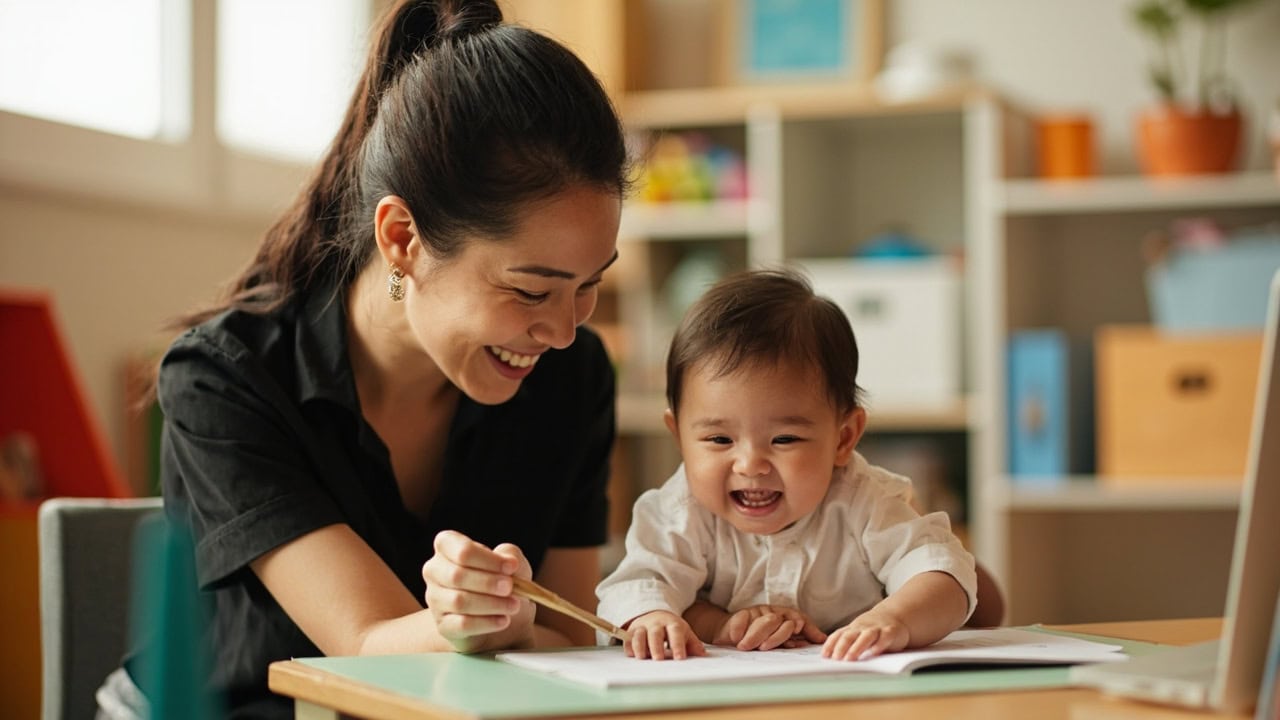
Building School Readiness Through Sensory Motor Foundations
What Your Child’s Body Knows About School Readiness
There is a question that arrives in quiet moments. A parent messages late at night, their children finally asleep, and writes: I do not know if my child is ready for Primary One. There is a pause in the conversation. Then: I do not even know what ready means.
That pause. That hesitation. That quiet admission of uncertainty in a city that asks so much of its children and so much of their parents. This is one of the most honest and vulnerable moments a parent can have. And it is happening more and more.
Singapore parents are extraordinary. You plan ahead. You prepare. You enroll your children in enrichment classes before they have mastered walking steadily up a staircase. You know the cut-off dates, the ballot procedures, the waiting lists. You have done the research. You have the spreadsheets. You have the anxiety.
And yet, when asked what they believe their child needs to be ready for school, the answers almost always land in the same territory. They can recognize letters. They can count to twenty. They know their colors. They sit still when asked. They can follow instructions.
All of these things matter. But there is something else. Something quieter. Something that begins in the body long before it ever appears in the mind. Something that most parents in Singapore have never been told they should be looking for.
This is what your child’s body knows.
The Readiness Paradox: Why Movement Matters More Than Academics
When we speak about readiness for Primary One, we enter a conversation saturated with academic expectations. The cut-off point looms. The pressure builds. Parents feel they must fill their children’s early years with letters, numbers, worksheets, and assessments. The world around you makes it feel as though anything less than acceleration is failure. As though the only preparation that matters is the preparation that can be measured and compared.
But here is what years of observing hundreds of children in the early years has taught us. The children who arrive at Primary One genuinely ready are not always the children who could recite the most. They are often the children who could balance, climb, jump, catch, and land. They are the children who could sit still not because they were forced to, but because their bodies had learned to settle. They are the children who could focus not because they were trained with screens or drills, but because their nervous systems had been given the right kind of movement experiences in the years before.
These children did not learn to read and write despite their bodies. They learned to read and write because of their bodies.
When a child learns to write, they are not only exercising their fingers. They are engaging an entire system of balance, shoulder stability, wrist control, hand-eye coordination, and body awareness that took years to construct. When a child learns to read, they are not only processing symbols on a page. They are using their visual system, their postural system, their auditory system—all working together, all calibrated through thousands of hours of movement and sensory exploration.
The brain does not develop in a vacuum. It develops on a foundation of physical experience. It grows where the body goes.
The Hidden Systems: How Your Child’s Body Builds the Foundation for Learning
From the moment your child is born, their nervous system is building itself through sensation and movement. Every time a baby kicks their legs, reaches for a toy, rolls over, or pushes up onto their hands and knees, they are not merely being physically active. They are sending messages to their brain. They are building circuits. They are creating the architecture that will later support attention, memory, emotional regulation, and academic learning.
There are systems in the body that most people never think about—systems that are absolutely essential to learning—yet they are almost never discussed in conversations about school readiness.
The Vestibular System
The vestibular system lives deep in the inner ear, and it tells your child where their body is in space. It tells them if they are moving or still, going fast or slow, upside down or right side up.
When this system is well-developed, a child can sit upright in a classroom chair without fidgeting compulsively. They can walk down a crowded school corridor without bumping into everyone. They can tolerate the noise and movement of a playground without becoming overwhelmed. A child with a well-tuned vestibular system has a body that feels safe and steady. And a body that feels safe and steady can learn.
The Proprioceptive System
The proprioceptive system is the sense that tells your child where their limbs are without looking at them. It lives in the muscles and joints.
When this system is strong, a child knows how hard to press when holding a pencil. They know how much force to use when opening a door. They can navigate a staircase without looking down at every step. They can complete a puzzle without constantly dropping the pieces.
Proprioception is built through heavy work—through climbing, carrying, pushing, pulling, through the resistance of the physical world. And when it is strong, a child moves through their school day with a quiet confidence that others notice even if they cannot name it.
The Tactile System
The sense of touch shapes how a child experiences the world. A child with well-regulated tactile processing can wear a school uniform without complaint. They can handle glue and paint without distress. They can be in a crowded classroom without becoming overwhelmed by incidental touch.
These seem like small things. But in the daily reality of Primary One, these small things are the difference between a child who can focus and a child who is quietly struggling in ways no one else can see.
Movement as the Brain’s Engine
When children move, their brains release a protein called brain-derived neurotrophic factor (BDNF), which helps neurons grow, connect, and strengthen. Movement is not separate from cognition. Movement is cognition’s engine. The child who runs, jumps, climbs, and plays is not wasting time. They are building their brain.
This is not a metaphor. This is developmental neuroscience.
- The pathways in the brain that will later support reading require visual tracking, ocular motor control, and sustained fixation. These skills are built through active play—through chasing bubbles, tracking rolling balls, and following movement with the eyes.
- The pathways that will later support writing require bilateral coordination, fine motor strength, and praxis (the ability to plan and execute a movement). These skills are built through climbing, digging, pouring, building, and manipulating objects in play.
- The pathways that will later support concentration require a calm, regulated nervous system. A regulated nervous system is built through movement experiences that challenge and then settle the body.
A child whose body feels capable and confident has a different relationship with the world than a child whose body feels uncertain or fragile. When a child can trust their physical self, they are braver. They try new things. They recover from setbacks more easily. They regulate their emotions more successfully. They enter a school setting not with fear of failure, but with the quiet resilience that comes from knowing their body can handle what life asks of it.
The child who has not had enough of this kind of experience does not arrive at Primary One empty. But they arrive with an unfinished foundation. And no amount of academic drilling can replace what was not built in the body during those early years.
What Quality Childcare Actually Looks Like
When evaluating a childcare arrangement, it is worth looking past the flashcards and the certificates on the wall. Ask instead: what does your child do when they move freely through the space?
The best childcare for school readiness is not a program that teaches children to be ready for school. It is a place that helps children build the foundations in their bodies so that school becomes something they can truly participate in—not just survive.
Quality childminding builds sensory-motor foundations through:
- Gross motor opportunities: Climbing structures, jumping activities, balancing games, outdoor exploration
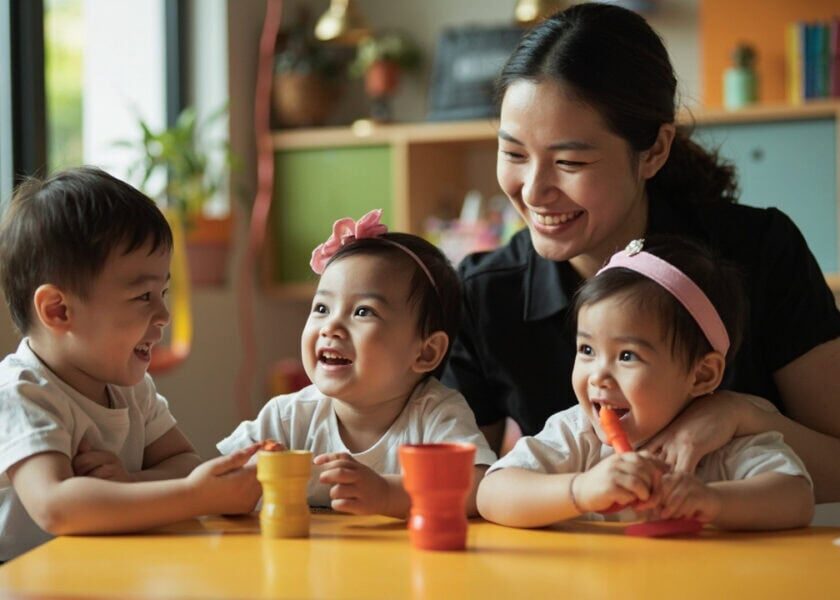
- Fine motor experiences: Pouring, squeezing, pinching, threading, building with blocks, playing with playdough
- Sensory-rich environments: Textures to touch, sounds to process, movement challenges that engage the vestibular and proprioceptive systems
- Heavy work: Carrying, pushing, pulling, resistance activities that build body awareness and strength
- Attentive observation: Caregivers who notice how your child moves, climbs, lands, reaches, and navigates the world
- Consistent communication: Regular updates about developmental progress and specific physical skills being built
Here are the questions that matter most when researching infant care or childminding options in Singapore:
- Are there daily opportunities for climbing, jumping, balancing, and running?
- Are there materials and activities that develop hand strength and coordination?
- Does the environment offer a variety of textures, sounds, and movement experiences?
- Do caregivers watch and document how children move, climb, and navigate challenges?
- Will you receive regular updates about your child’s physical and overall development?
- Is the care consistent enough for developmental foundations to be built over time?
- Are there enough caregivers to observe each child attentively?
How EduNanny Singapore Nurtures These Foundations
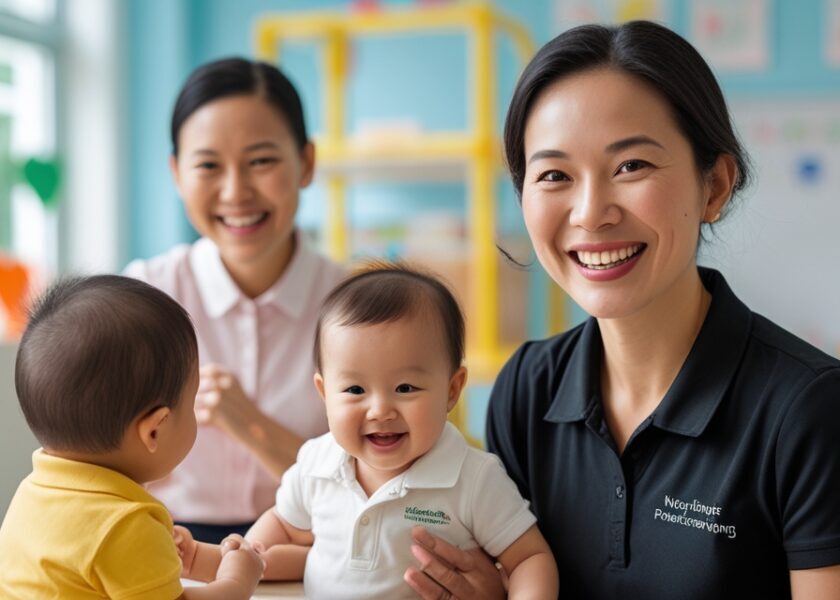
Every day, the team at EduNanny Singapore watches how your child moves through the world. They watch how your child navigates a step or a ramp. They notice whether your child seeks out movement or avoids it. They observe how your child catches a ball, how they hold a spoon, how they climb, how they land, how they turn pages, how they pour water, how they sit on the carpet, how they rise again.
These are not idle observations. These are the data points that tell us whether your child’s body is building the readiness it needs. And when something needs attention, caregivers notice. They document. They communicate with you. They work with you as partners in your child’s development.
Our Commitment to Quality
EduNanny Singapore is part of the ECDA Childminding Pilot, which means our program operates within a framework of quality standards, caregiver training, and developmental oversight that gives parents confidence and accountability.
- Infant ratios designed to ensure every child receives the attention and observation they deserve
- Pathways including both home-based and centre-based options, because families in Singapore have different needs and circumstances
- Pilot fee structures designed to be affordable, with support for Child Development Account and Baby Bonus schemes
- Monday to Friday care blocks providing the continuity children need to build foundations session by session, day by day
- Communication practices ensuring you are never left wondering what your child’s day looked like
- CCTV measures where deployed, giving parents additional transparency and peace of mind
What Sets EduNanny Apart
Beyond the logistics and compliance, there is a philosophy that guides everything we do.
We believe that the body is not a vehicle that carries the mind to school. We believe the body is the mind’s first home, its first teacher, its most faithful collaborator. Every time a caregiver creates space for a child to climb, balance, pour, build, and explore, they are doing the most important academic preparation that exists. Not because we ignore cognitive goals, but because we understand that cognitive goals are built on physical ones.
We are part of the EduNanny by BUTLER family, carrying forward a commitment to excellence in early childhood care grounded in real developmental science, real caregiver training, and real love for the children we serve.
A Body That Knows How to Learn
What we build in the early years does not end when the early years end. The foundations laid in movement and sensation—in the first thousand days, in the quiet hours of crawling and climbing and playing and exploring—these foundations become the architecture of who your child becomes.
Your child’s body knows things that their report card cannot show. It knows how to steady itself. It knows how to reach. It knows how to grow stronger through effort. And when we honor that knowledge, when we give it the space and the attention it deserves, we give our children something that no workbook can provide.
We give them the readiness that lasts.
Imagine your child on their first day of Primary One. They are standing at the gate. They are holding your hand, or they have just let go of it. Their uniform is crisp. Their bag is heavy with books and expectations.
But beneath all of that, something else is carrying them. It is the work their body did in the years before. The hours spent climbing and balancing and exploring. The sensory experiences that built their brain. The movements that taught them they could land, recover, try again. The caregiver who noticed when they stumbled and gave them the space to rise.
That is what EduNanny Singapore is here to give your child. Not supervision. Not acceleration. A body that knows how to learn.
Ready to learn how EduNanny Singapore can support your child’s development? Speak with our team to discover how we build school readiness through the foundations that matter most.
Learn more about who we are and our approach to quality childminding in Singapore.