Beyond Worksheets: Why Movement Is the Real Foundation of Learning
The Question We Are Not Asking
Here is what years of working alongside young children and the families who love them have taught me: the questions we ask about school readiness are often backwards.
We look at what a child knows. We rarely ask how they came to know it — or what had to be in place, beneath the surface, before that knowing was even possible.
Consider this. Before your child can hold a pencil with control, their hands need to have built strength and coordination through years of grasping, pouring, tearing, building, and exploring. Before they can sit still and attend, their body needs to feel organised. Before they can focus in a noisy classroom, their sensory system needs to have learned how to filter out what is irrelevant and attend to what matters.
These are not soft skills. These are neurological achievements. And they are built in the body, long before the mind is asked to follow.
When a toddler climbs a low structure and decides to jump, their brain is doing extraordinary work — calculating distance, managing fear, coordinating muscles, regulating their nervous system, and building the proprioceptive awareness that will later help them sit upright in a classroom chair.
We live in a culture that celebrates what we can see and measure. Report cards, assessment books, weekend enrichment classes. There is nothing wrong with any of this.
But when preparation for Primary One becomes synonymous with academic drills alone, we risk missing something essential — something that no worksheet can teach, and no assessment can fully capture.
Learning Begins in the Body
I want to introduce you to a concept that may sound clinical but is actually beautifully simple: sensory-motor development.
This is how your child experiences the world through their body — how their senses work together, how their muscles learn to respond, how their nervous system builds the capacity to focus, to adapt, to regulate, and ultimately, to learn.
Think about it this way. When your baby mouths a teething ring, they are not just relieving discomfort — they are building the neural pathways that will later support speech and feeding. When your toddler pours water from one container to another, they are learning volume, causality, concentration, and fine motor control simultaneously. When your preschooler climbs, jumps, runs, falls, and recovers, their brain is doing the most sophisticated kind of work.
The body is not separate from the mind. The body is where the mind learns.
This is what neuroscientists call embodied cognition — and it is why the sensory-motor framework is so critical for Singapore parents. Your child’s academic skills — the reading, the writing, the arithmetic — will come. But they will come more easily, more durably, and more joyfully when they are built upon a body that has learned to feel safe, to move with intention, and to process the world through all of its senses.
Why This Matters More Than Ever in Singapore
Here is what we must honestly acknowledge: the experiences that build sensory-motor foundations are becoming rarer.
Not because parents do not want them for their children — of course they do. But because the world is changing. Urban living means less outdoor space. Schedules are tighter. Screens are everywhere. And in many early childhood settings, the pressure to demonstrate academic outcomes has crowded out the time and space for the kind of embodied play that builds the foundations children truly need.
In Singapore, where we are deeply proud of our education system and where Primary One readiness carries real weight, this tension is especially acute. Parents feel the push — from schools, from other parents, from the invisible benchmarks of playground conversations — to ensure their child can read, count, and perform before they step through the school gates.
We understand that pressure. And we are here to offer a more complete picture.
What Sensory-Motor Readiness Looks Like in a Child
Watch a child who has strong sensory-motor foundations. Notice what you see:
- They move through new environments with curiosity, not anxiety. A trip to a new playground, an unfamiliar classroom, a school assembly hall — their body feels capable of navigating it.
- They can transition between activities without falling apart. They have the internal regulation to shift from one thing to another, even when they were deeply engaged in something else.
- They can manage physical demands alongside social demands. Holding a conversation while also managing their backpack, their lunchbox, and the social complexity of a playground full of children.
- They approach new challenges with curiosity rather than fear. When something is hard, they try. When something is new, they lean in.
This is not luck. This is development. This is a nervous system that has been given what it needs to grow.
What this means for your child as they enter Primary One: they will not just perform better academically — though they often do. They will feel better. They will feel capable. They will see themselves as someone who can learn, who can adapt, who can belong.
That self-perception, that embodied confidence, is one of the greatest gifts we can give a child.
A Sensory-Motor Readiness Framework for Parents
So what does this look like in practice? How can you recognise quality sensory-motor development — in your own child and in a childcare setting?
Think of these as five windows into your child’s physical and sensory development.
1. Observe Movement
How does your child move through space? Is there open space for gross motor play, or are they mostly seated? Do they have opportunities to climb, jump, and balance?
Watch how your child navigates a change in surface or height. Watch how they manage their body in relation to other children. These are windows into their physical development and their emerging sense of agency.
A child who can climb, balance, and move confidently has built something inside themselves that goes far beyond their muscles.
2. Observe Sensory Richness
Are the environments your child spends time in alive with sensory experience? Is there access to natural materials — sand, water, leaves, fabric, wood?
Are they given time to engage in sensory exploration without rushing to the next activity? Do you hear the sounds of purposeful play — the mixing of materials, the construction of towers, the quiet concentration of a child working with their hands?
Sensory-rich environments are not chaotic. They are thoughtfully designed to offer the input a developing nervous system requires.
3. Observe Regulation
How does your child manage transitions? How do they respond to frustration or disappointment? Can they recover from big emotions?
This is not about children who never cry or never struggle — all children do. This is about whether children are supported in developing their own capacity to regulate.
Watch how caregivers respond to a child who is upset. Are they present? Are they warm? Do they help children name and manage their feelings, or do they simply suppress behaviour?
Regulation is built in relationship. It cannot be rushed.
4. Observe Fine Motor Development
Can your child manipulate small objects with increasing precision? Do they have opportunities to strengthen their hands — through tearing, squeezing, pouring, drawing, building?
Fine motor skills are the unsung heroes of school readiness. They underpin handwriting, they support self-care skills, and they are deeply connected to cognitive development.
Watch what your child’s hands are doing. That is where so much of learning is happening.
5. Observe Attention and Presence
Can your child sustain interest in an activity? Can they persist when something is difficult? Can they orient toward a caregiver or a peer and engage in meaningful back-and-forth interaction?
These capacities — attention, persistence, social engagement — are the products of a well-developed sensory-motor system. They do not appear out of nowhere. They are built through experience.
What Quality Childminding Looks Like
When you visit a childcare setting — when you are doing your due diligence, trying to understand whether this place will truly serve your child — you need a way to see beneath the surface.
Here is what quality looks like in practice.
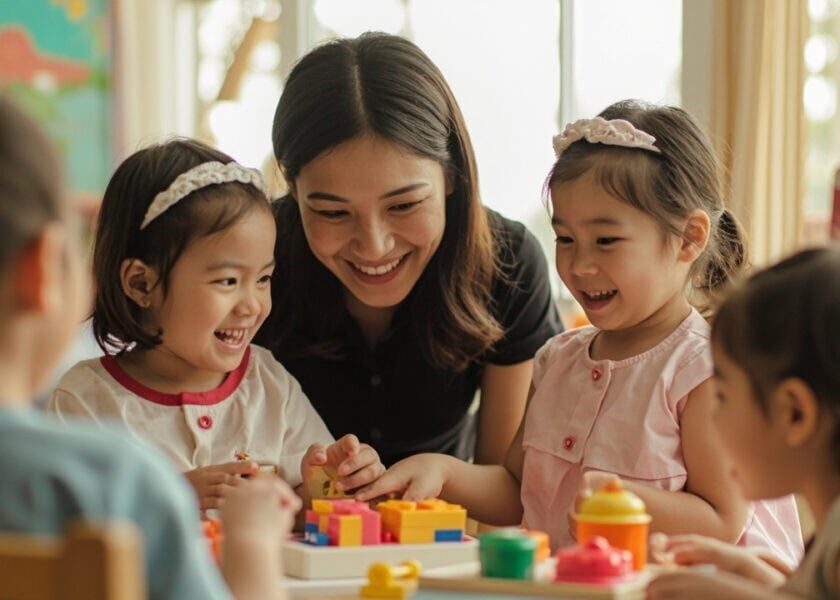
In quality childminding, children are not sitting at tables doing worksheets for most of their day. They are moving. They are exploring. They are building their bodies as they build their minds.
In quality childminding, the environment is designed with intention. The feel of natural materials, the sounds of meaningful activity, the visual complexity of a space that invites exploration — all of this has been considered.
In quality childminding, caregiver ratios matter. When there are fewer children per adult, every movement is noticed, every developmental milestone is observed, every sensory experience can be curated with attention. Children are not just supervised — they are seen.
In quality childminding, caregivers are trained and supported. They understand the science and the tenderness of early childhood development. They know that the early years are not a gap to be filled before real learning begins. They know that the years from birth to six are the years in which everything is established.
This is the approach we hold at EduNanny — part of the ECDA Childminding Pilot. We offer both home-based and community-based pathways, because families are different and children deserve environments that meet them where they are.
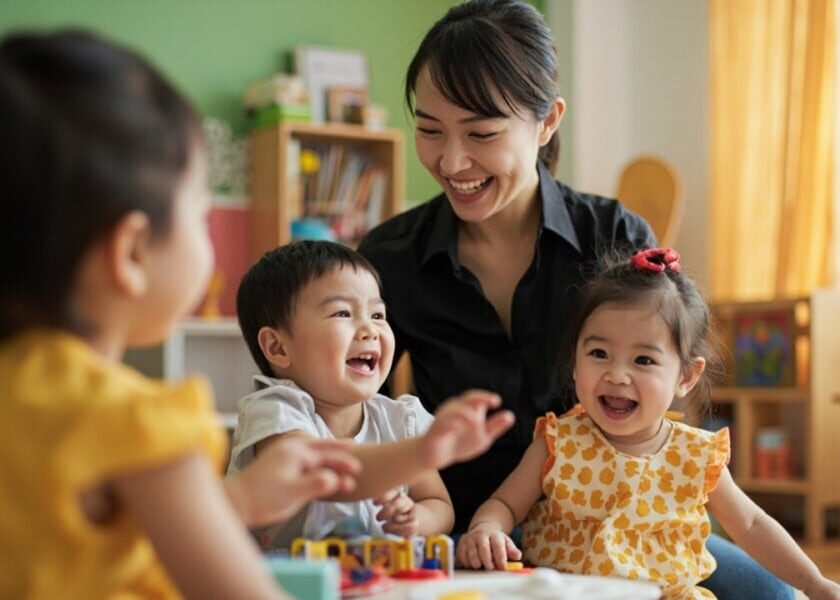
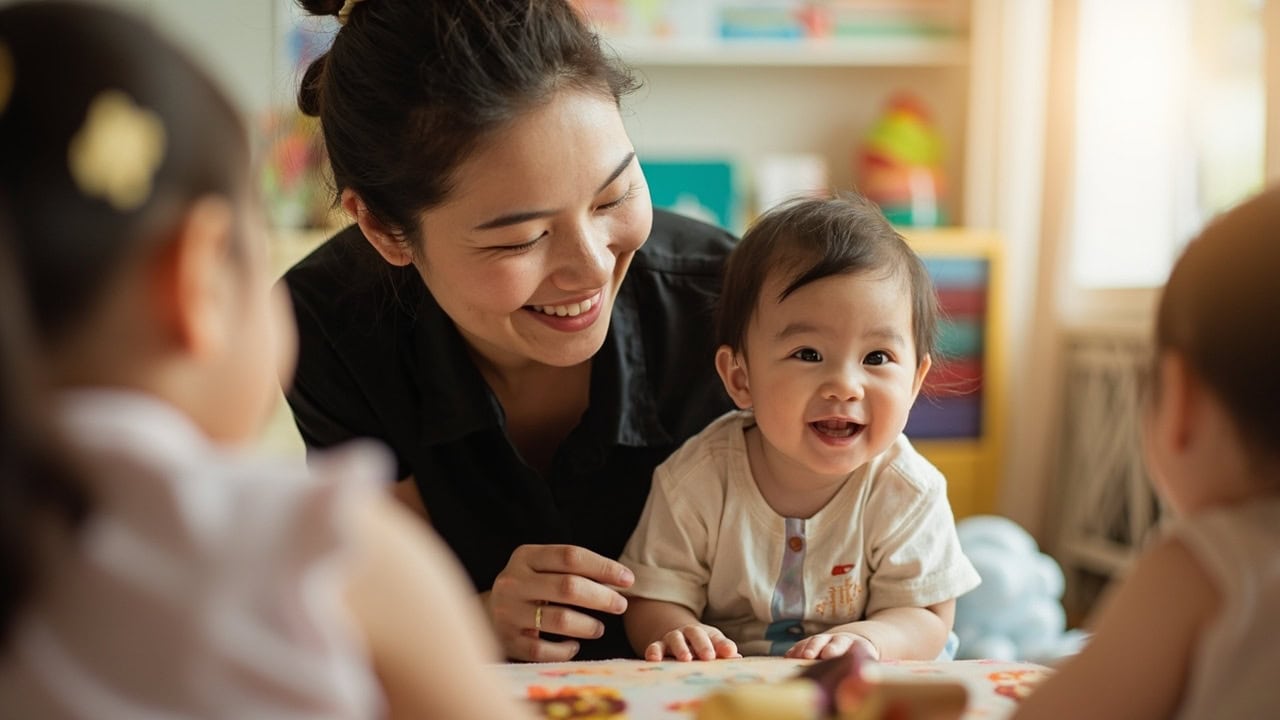
In our home-based settings, ratios are kept intentionally low — up to one caregiver to three infants. This means every child is seen. Every child’s development is observed and supported by an adult who knows them, who has watched them grow over time, who notices the small milestones as well as the big ones.
Our care operates Monday to Friday, in blocks designed to support working families without the exhaustion of hourly calculations. The pilot fee structures have been designed to be affordable — because quality care should not be a privilege — and families can access their child’s CDA and Baby Bonus funds to support their care arrangements.
We communicate with transparency. Where observation and developmental tracking occur, families are partners, not recipients. You will receive regular updates. You will feel connected to your child’s day. This is not a convenience feature. It is an expression of our belief that parents and caregivers are on the same team, working toward the same goal: a child who is safe, who is developing, who is known.
You are choosing what experiences your child will have during the years when the foundations are being laid. That choice matters. And you are right to take it seriously.
None of this — not the ratios, not the training, not the communication — matters if we do not hold the right philosophy at the centre.
And our philosophy is this: the body is not a vessel for the mind. The body is the mind’s first home. Every sensation a child feels, every movement they make, every physical experience they have — these are not peripheral to their development. They are the development.
This is why we have designed our environments to offer rich sensory input. This is why our caregivers are trained to observe movement, regulation, and attention — not just compliance and performance. This is why we believe in the serious work of play, and in the intelligence of the child’s body as the first and most faithful vehicle for everything they will come to know and do and become.
Addressing Common Concerns
Will my child fall behind if they are not doing academic work?
This is one of the most common fears we hear, and we understand it. The pressure is real. The timelines feel urgent.
Here is what we want you to know: academic skills will come. Children who have strong sensory-motor foundations do not struggle to learn to read or count — they often learn them more easily and with greater joy. Because their bodies are ready. Their nervous systems are organised. Their attention can be sustained.
The child who has climbed, jumped, poured, and played their way through the early years has built the neurological architecture that academic learning requires. They are not behind. They are built on a deeper foundation.
But what about Primary One registration? The school will expect certain things.
Primary schools in Singapore are increasingly aware of the value of holistic development. More importantly, the children who arrive at Primary One with strong sensory-motor foundations are not just academically ready — they are emotionally and physically ready. They can manage the noise, the transitions, the physical demands of a school day. They can focus. They can adapt.
These are the children who thrive, not just in Primary One, but across their schooling years.
How do I know if my child is on track?
Rather than asking “Is my child meeting milestones?”, we encourage you to ask “Is my child building the foundations?”
Can they move with confidence? Can they manage their emotions with support? Can they engage in play that challenges their body and their mind? Are they curious, capable, and calm?
These are the real indicators. And they are observable — by you, and by the caregivers who spend their days with your child.
When Your Child Is Ready — Truly Ready
I want to paint a picture for you.
It is the morning of your child’s first day at Primary One. You watch them walk into the school corridor for the first time. Their backpack is a little too big for them. Their lunchbox is heavy. The corridor is noisy, crowded, full of children who are also finding their footing.
And your child — your child walks through it. Not with anxiety. Not with hesitation. With something like confidence. With something like readiness.
You will feel something different in that moment if you know in your bones that your child is not just academically prepared. You will feel something different if you know that their body is ready. That their sensory systems are integrated. That their nervous system can manage the noise and the crowd and the transition.
That is the readiness your child deserves. That is the readiness we are building, every day, at EduNanny.
When you evaluate a childcare setting — when you visit, when you observe, when you make your decision — I invite you to look for the things that cannot be measured on a report card.
- Look for the way children move.
- Look for the sensory richness of the environment.
- Look for the regulation and responsiveness of the caregivers.
- Look for the evidence that your child’s body is being treated as the foundation it truly is.
And if you find that at EduNanny — if you see children who are confident in their bodies, if you see caregivers who understand the science and the tenderness of early childhood development, if you see an environment that is designed not just to keep children safe but to help them flourish — then I hope you will trust that feeling.
Because it is not a feeling that can be manufactured. It is the result of intention, of expertise, of a deep respect for the way children actually develop.
We are not the right choice for every family. We know that. But for families who share this vision — who believe that school readiness is more than literacy, who understand that development is embodied, who want their child to be known and supported by adults who care — we would be honoured to walk alongside you.
Your child is not a deficient adult. Your child is a whole person, with a body that is magnificently designed to learn, grow, and make sense of the world — one sensation, one movement, one discovery at a time.
Not worksheets. Not anxiety. Not a checklist that reduces childhood to metrics.
Just this: a child, in their body, moving toward the world with confidence and curiosity and the deep, embodied knowledge that they are ready.
Visit us. Observe. Ask questions. And trust what you feel when you see children who are ready — truly ready — in the only way that counts.
At EduNanny, we believe that every child’s first teachers are their own bodies — and that the years from birth to six are when the foundations for everything are quietly, powerfully laid. If this vision resonates with you, we welcome you to connect with us or learn more about who we are and how we approach this work.