Beyond the Worksheet: What Research Reveals About Real School Readiness
“`html
The Pressure Is Real—And It Comes From Love
The anxiety that rises when another parent mentions their child is already reading chapter books or mastering addition and subtraction—that anxiety is legitimate. It comes from love. It comes from a genuine desire to give your child every advantage in a world that feels increasingly competitive.
Singapore parents are not bad parents for feeling this pressure. Singapore parents are loving parents navigating one of the most intense educational landscapes in the world.
For decades, Singapore has built its educational success on clear pathways, measurable outcomes, and the principle that early preparation creates lasting advantage. These values built a nation. They gave millions of families stability, opportunity, and upward mobility. There is genuine wisdom in the Singapore approach to education.
But somewhere along the way, that wisdom got extended into territory it was never designed to cover. We began applying primary school standards to preschoolers. We began treating four-year-olds as if they were taking PSLE tomorrow. We began measuring the worth of early childhood by the same ruler we use to measure academic achievement in older children.
The result? A generation of young children spending their formative years in academic centres designed for older students, completing worksheets that would challenge much older children, and learning to associate learning with anxiety before they have learned to associate it with wonder.
What Research Actually Says About School Readiness
Here is what developmental science tells us—not to make any parent feel guilty, but because you deserve to know what research actually demonstrates.
School readiness, the true kind, the kind that predicts long-term academic success and emotional wellbeing, has almost nothing to do with academic content.
Children who arrive at Primary One knowing how to read do not maintain reading advantages into secondary school. Children who arrive knowing addition and subtraction do not perform better in mathematics by the time they are ten. The academic gains from early drilling fade. They fade consistently, reliably, and across cultures.
What does predict long-term success? The research is clear: it is executive function, emotional regulation, and the capacity to focus attention, manage impulses, recover from frustration, persist when something is difficult, cooperate with peers, ask for help, and feel curious rather than threatened by new challenges.
These are the true readiness skills. They are built in the first five years of life, during a period of neural development that will not repeat itself. And they are not built by worksheets. They are built through relationships, through play, through responsive caregiving, through the kind of learning that engages a child’s natural drive to understand the world.
When Early Academics Crowds Out What Matters
Consider what happens beneath the surface when a child spends their early years in an environment that emphasizes compliance, memorization, and academic performance.
They may appear ready. They may recite letters and numbers with pride. They may sit quietly in a classroom setting. But something important is being shaped that we cannot see.
The stress response system, still developing in those early years, learns to associate learning with pressure. The intrinsic motivation to explore and discover—which is the engine of all genuine learning—begins to dim. The neural pathways that support curiosity, persistence, and flexible thinking are not being strengthened. They are, in some ways, being crowded out.
This does not mean children who have been in academic programmes are damaged or will fail. Many children adapt and thrive despite these early experiences. But we owe it to ourselves as parents to understand what we may be trading away when we choose acceleration over foundation-building.
What Quality Childcare Actually Builds
Quality early childhood care is not the absence of learning. It is a different kind of learning—and it is the kind that matters most.
Consider what happens in an environment designed to build executive function and emotional regulation:
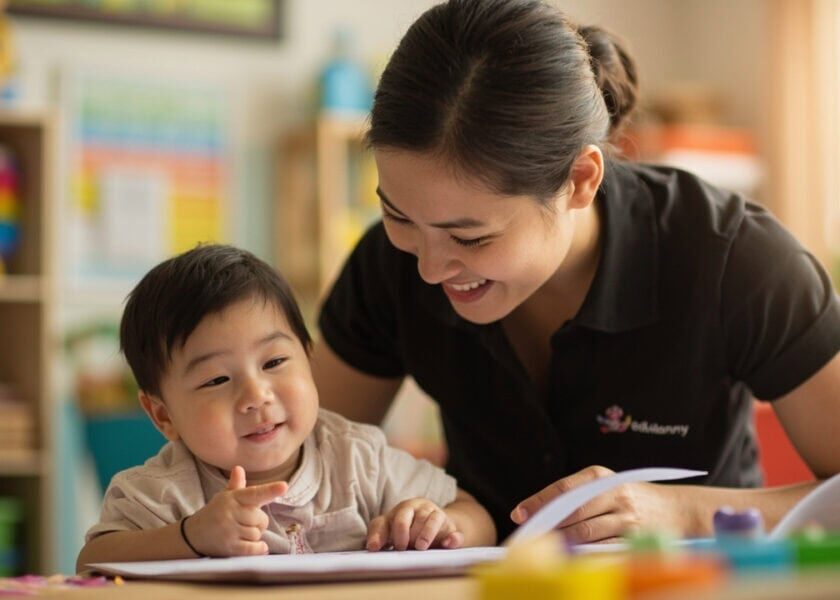
- A skilled caregiver notices when a child is becoming frustrated with a puzzle and offers just enough support to help them persist without taking over.
- Children experience manageable failure—learning that mistakes are part of learning rather than evidence of inadequacy.
- Peer interaction creates opportunities for sharing, negotiating, and the complex social dance that prepares children for primary school.
- Stories are read in ways that invite children to think and question rather than simply absorb.
- Routines build security and predictability, which free up mental energy for learning rather than anxiety management.
- Responsive caregiving builds secure attachment, which research links to academic achievement, emotional resilience, and relationship health throughout life.
This is what quality childcare looks like. It is not passive. It is not daycare in the sense of simply keeping children occupied and safe. It is active, intentional, relationship-based early childhood education that builds the foundations no worksheet can build.
The Readiness That Actually Matters
Ready is not a worksheet. Ready is a child who wants to learn, who knows how to try, who can manage their emotions when things are hard, and who trusts that the adults around them will support them through difficulty.
When experienced primary school teachers are asked what they wish incoming Primary One students had more of, the answers rarely mention academic content. They mention the ability to focus. They mention resilience when tasks are hard. They mention social skills—the ability to share, take turns, resolve conflicts with words. They mention curiosity and a genuine love of learning.
These are the readiness skills that will serve your child across their entire educational journey, not just in the first term of Primary One.
EduNanny Singapore: Built Around the Science
I want to speak directly about what this means for families in Singapore, because the practical reality of childcare matters. I know the logistics. I know the costs. I know the guilt that many parents feel about returning to work, or about not being home with their children during these formative years. I know that quality feels like a luxury and that affordable options often feel inadequate. These feelings are real, and they deserve acknowledgment.
EduNanny Singapore, part of the BUTLER family, was built with these realities in mind. As a participant in the ECDA Childminding Pilot, EduNanny represents a genuine attempt to make quality early childhood care accessible to Singapore families—not as a promise, but as a structure.
- Small ratios. Up to one caregiver to three infants, because relationship quality depends on the number of relationships each adult must sustain. Your child is not one of fifteen. Your child is seen.
- Flexibility for real families. Both home-based and centre-based pathways, because families are different and one size does not fit all.
- Affordable access. Pilot fee structures designed to be within reach, with CDA and Baby Bonus payment acceptance, because these resources should support what matters most in your child’s development.
When you leave your infant in someone else’s care, you are making yourself vulnerable in one of the most profound ways a parent can be vulnerable. You need more than promises. You need transparency. EduNanny has implemented communication protocols that allow parents to feel connected to their child’s day. Where deployed, CCTV measures provide additional assurance. Not because surveillance is the answer to everything, but because transparency builds trust—and trust is the foundation of every successful caregiving relationship.
This is not a premium service for families who can afford the best. This is a serious attempt to offer quality early childhood care across Singapore, with the recognition that every family deserves access to the kind of care that builds foundations.
Questions That Research Says Matter Most
If you are currently researching infant care or childminding options in Singapore, here are the questions worth asking:
- What is the caregiver-to-child ratio? Smaller groups allow for more responsive relationships.
- How do caregivers handle frustration and conflict? Look for environments that teach emotional regulation rather than simply managing behaviour.
- Is there time for child-initiated play? This is where executive function is built.
- What does a typical day look like? Does it include routines that build security? Stories that invite thinking? Opportunities for physical movement?
- How do caregivers communicate with parents? Transparency is not optional—it is essential.
- Do children seem curious and engaged, or anxious and compliant? Observe, if you can.
Ask not just about curriculum. Ask how caregivers respond when a child is frustrated. Ask whether children have time for unstructured play. Ask what your child will be doing on a typical morning—and whether that includes opportunities to persist, to fail safely, to collaborate, and to wonder.
What if your child is already in an academic programme? I am not here to condemn any parent for decisions made in an environment that makes those decisions feel necessary. If your child is in an academic programme and is loved and thriving, that matters. I am here to offer a different framework for going forward—a way to think about what your child needs most in the time that remains before Primary One.
The best childcare does not look the most academic. It looks warm, engaged, and alive with children’s natural drive to learn.
The Gift You Give Your Child
Early childhood is not a race to be won. It is not a competition to be strategized into advantage. It is the brief, unrepeatable window during which your child’s brain is forming the architecture that will support or constrain everything that comes after.
The neural connections being made in these years, the emotional patterns being established, the relationship templates being formed—these are the foundations upon which your child’s entire future will be built.
You have the opportunity, in these years, to give your child something more valuable than academic acceleration. You have the opportunity to give them the capacity to learn—not just now, but for the rest of their lives.
The intrinsic motivation to discover. The emotional resilience to persist. The social skills to build relationships. The executive function to focus, plan, and adapt.
These are the gifts that keep giving. These are what your child will carry into Primary One, into secondary school, into university, into their careers and their families and their lives.
The WhatsApp groups will keep buzzing. The academic centres will keep advertising. The comparison will keep coming. But you now know something that many parents have not yet learned.
You know what readiness truly means. You know that the pressure you feel is real, but that the anxiety it creates is based on a framework that does not serve your child. You know that protecting your child’s early childhood is not a failure of ambition.
It is, in fact, the most ambitious thing you can do.
EduNanny Singapore stands beside you in this. We understand the science. We understand the Singapore reality. We understand the love that drives these decisions. And we have built our approach around the truth that every child deserves to start their educational journey not with a worksheet completed, but with a heart that knows how to learn, a mind that is ready to grow, and a soul that still believes—at six years old—that learning is wonderful.
If you are exploring infant care or childminding options in Singapore and want to learn more about an approach built around what children truly need, we welcome the conversation.
“`