Beyond the Smiles Understanding Your Child’s True Experience in Childcare
The Invisible World Inside Your Child’s Day: Understanding What Quality Childcare Really Feels Like
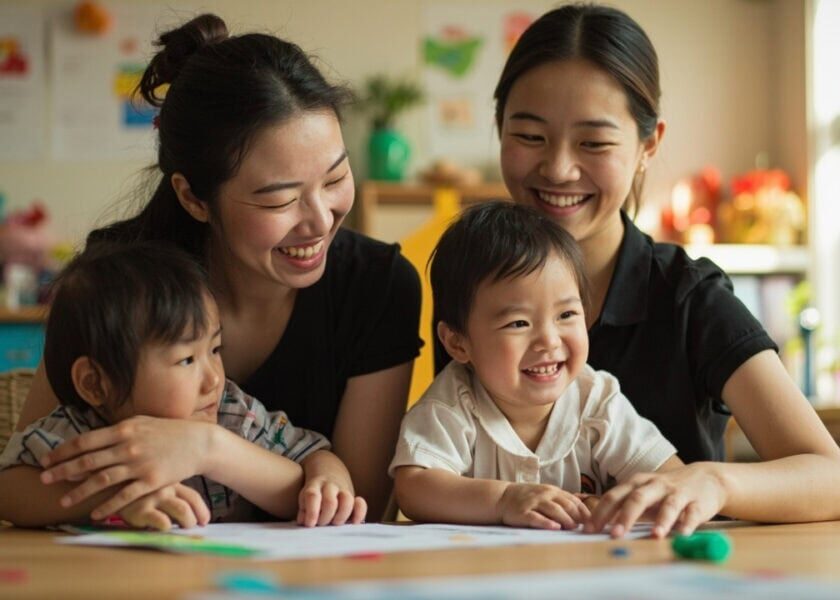
There is a moment familiar to every working parent in Singapore. You arrive at the childcare door at pickup time, and there she is—your daughter, building something with wooden blocks. She looks up. She smiles. You feel the knot in your chest loosen. She runs toward you, her small body warm and trusting in your arms, and you think: this was the right choice.
But in that same moment, there is something you cannot see. The inner life of a young child operates in a register that even the most attentive parent can only partially access.
Your daughter smiled. She ran to you. These are real and meaningful signals. But they are also the surface of something deeper—something she has been living inside all day, in the hours you were not there, in an environment whose texture and emotional quality have been shaping her in ways you can only partially imagine.
This is the quiet, invisible territory we want to invite you to understand today. Not the territory of parental doubt or guilt—those have been explored endlessly. This is about something more fundamental: the actual experience of the child.
Choosing With New Eyes: From Parent Anxiety to Child Understanding
Most childcare conversations start with parents. They ask: How do I know I can trust this caregiver? How do I manage my own anxiety? What signs should I look for?
These are reasonable questions, and they deserve good answers. But they all begin from the same assumption—that the childcare decision is fundamentally about the adult’s experience, the adult’s peace of mind, the adult’s need for reassurance.
We want to suggest a different starting point. Not to replace the parent’s perspective, but to expand it.
Because the truth is, when you choose childcare in Singapore—when you make that decision that will shape how your child spends thousands of waking hours in the first and most critical years of life—you are not primarily choosing a service for yourself. You are choosing an environment that will become, in many ways, your child’s first world.
A world with its own textures, rhythms, relationships, and emotional climates. A world that will teach your child something profound about whether people are reliable, whether the world is interesting, whether they are worthy of attention, whether their feelings matter.
These are not small things. These are the foundations of everything that comes after.
And so the question we want to put before you is not just “How do you feel about this choice?” It is: “What is your child actually experiencing in there? And how would you know?”
What Developmental Science Tells Us About Your Child’s Inner Experience
Developmental science has given us remarkable insight into the inner lives of young children—insight that has accumulated over decades and continues to grow. We now understand, with substantial evidence, that children are not passive recipients of care.
They are:
- Active experiencers who are constantly processing their environment
- Emotional mathematicians calculating the safety of their world with every interaction
- Sensory explorers building models of how the world works through play
- Communicators whose behavior is always saying something, even before they have the words
A child in quality care is not simply a child who is safe and occupied. That is the floor, not the ceiling.
A child in quality care is one who is learning, in real time, what it feels like to be understood. What it feels like when an adult notices frustration before the puzzle is thrown. What it feels like when someone slows down to follow their lead rather than rushing them toward a predetermined activity. What it feels like when they cry and are comforted—not just physically, but with a quality of presence that communicates: I see that you are upset, and your upset matters.
These experiences do not leave a mark that shows up on any developmental checklist. But they leave a mark nonetheless. They become part of the child’s internal working model of relationships, of self, of what to expect from other people.
They accumulate into either a foundation of security or a background hum of unease that the child may not be able to name but will carry with them.
This is why childcare is never just logistics. It is the architecture of your child’s inner world.
The Three Conditions That Allow Your Child to Genuinely Flourish
So what does quality care actually feel like to a young child? What are the conditions that allow a child to not just survive a day in care but to genuinely flourish in it?
1. Emotional Attunement: The Experience of Being Met
The first condition is what developmental psychologists call emotional attunement—and it is perhaps the most important thing you can look for in any care arrangement.
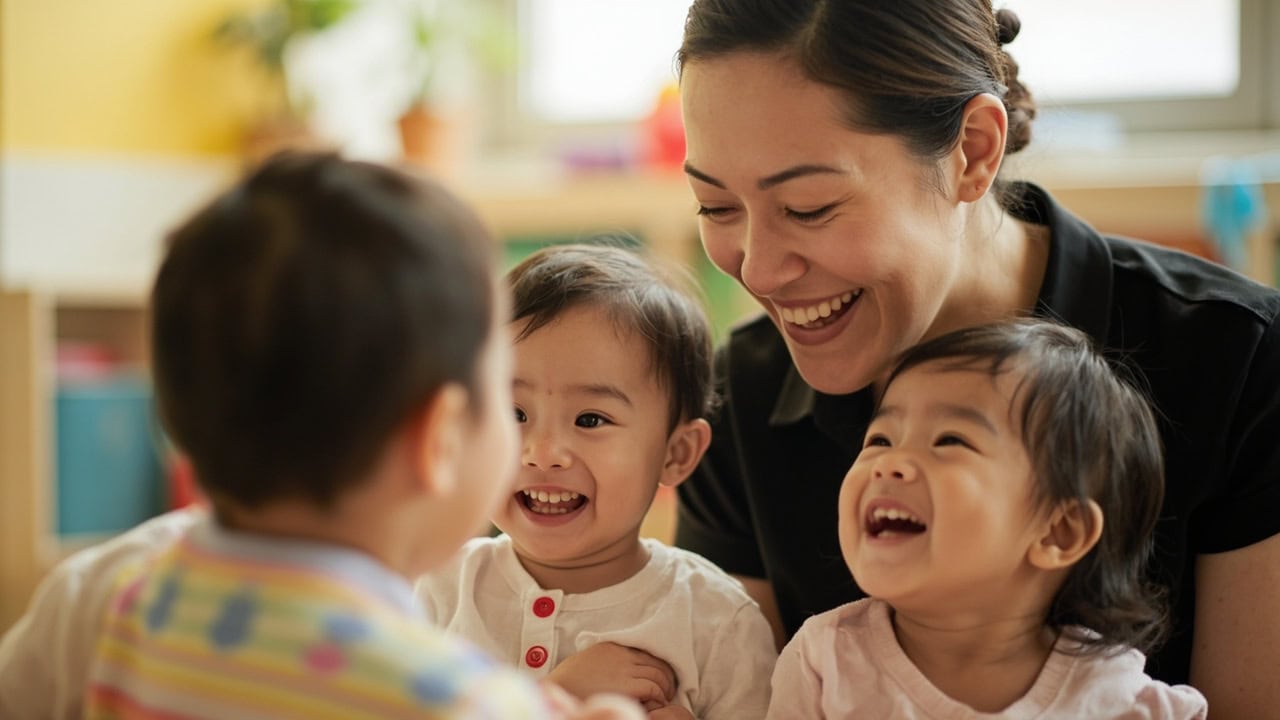
When a caregiver is truly attuned to a child, something subtle but unmistakable happens. The caregiver is not just watching the child; they are reading the child’s internal state through their eyes, their posture, their engagement, the pitch of their cry or the rhythm of their play. They are making ongoing, minute-to-minute adjustments based on what they observe.
When the child is overstimulated, the attuned caregiver slows things down, creates calm, offers proximity. When the child is understimulated and drifting, the attuned caregiver introduces novelty, invitation, gentle challenge.
This is not a checklist behavior. It is a quality of presence. And a child feels it.
A child knows, in their body, when they are being read correctly. They know when the adult in the room is truly interested in them versus simply managing them. And when they are read correctly—when someone gets them—they respond with a particular kind of aliveness that is different from mere compliance.
2. Developmental Hospitality: An Environment Organized Around Your Child
The second condition is what we might call developmental hospitality—the sense that the environment has been organized around the child’s needs and rhythms rather than the adult’s convenience.
This shows up in small things:
- The toys that are actually interesting to a two-year-old, not just safe or colorful
- The schedule that allows for long, uninterrupted stretches of play—because play is how young children learn and process
- The rhythm of the day that feels natural rather than rushed
- The opportunities for autonomy—the low shelf where the child can reach what they want, the caregiver who steps back and lets them try before stepping in
When a child experiences this kind of hospitality, they develop something precious: a sense of themselves as capable, as having some agency in their own life, as people whose preferences and impulses matter.
This is not a small thing. This is the beginning of healthy selfhood.
3. Relational Continuity: Being Known Over Time
The third condition is relational continuity—the experience of being known over time by the same caring people.
Young children do not generalize easily. They do not experience “a caregiver” as an interchangeable category. They experience specific people with specific histories of interaction.
When a child has the same caregiver or small team of caregivers over months and years, something deepens. The caregiver learns the child’s rhythms, fears, joys, and quirks. The child learns to trust that this person will be here tomorrow, that the relationship is stable, that they do not have to start over every morning.
This predictability is not boring to a child; it is the very ground of their emotional security.
Reading Your Child’s Signals: What Thriving Looks Like
Children are extraordinarily expressive. They communicate constantly. The challenge is that they do not communicate in words—not primarily, and not at the earliest ages. They communicate through behavior, through play, through their bodies, through the quality of their engagement.
Here is what to look for:
- The ease in their body as they move through the care environment
- The way they initiate play with other children or engage deeply with materials
- The way they can tolerate frustration without collapsing
- The way they seek out their caregiver for comfort and then return to play
- The way they are curious rather than withdrawn, engaged rather than compliant
These are signs of a child who is not just supervised but genuinely satisfied. A child who is having an experience that is, on balance, meeting their developmental needs.
Conversely, watch for:
- Increased tantrums at pickup or drop-off that persist beyond the initial adjustment period
- Withdrawal or listlessness
- Regression in skills they had mastered
- A glazed quality to their engagement
These are not behavioral problems to be managed; they are communications to be heard. They are the child saying, in the only language they have, that something in their experience is not quite right.
What Quality Childcare Looks Like in Practice: A Framework for Singapore Parents
When you understand what your child is actually experiencing, the childcare decision transforms. It is no longer just about logistics, convenience, or even cost. It becomes a decision about what kind of inner world you are creating for your child during their most formative years.
You are choosing:
- An environment where someone is reading your child—really reading them
- A rhythm of day that respects how young children actually learn and develop
- Relationships that deepen over time rather than starting fresh each week
- A team who understands that every behavior is communication
- Partners who are asking the same question you are: Is my child actually happy and growing in ways I cannot see?
Questions to Ask as You Evaluate Your Options
Keep these questions at the forefront of your evaluation:
- Observe the environment: Does it feel calm and organized around children’s needs? Are the toys interesting and accessible? Is there space for play, not just containment?
- Notice the caregivers: Do they seem genuinely interested in the children, or is their attention divided? Are they reading children’s cues and responding in real time?
- Ask about ratios: How many children is each caregiver responsible for? Can genuine attunement happen at that ratio?
- Ask about continuity: Will my child have consistent caregivers over time, or will they see different faces regularly?
- Ask about communication: What will I know about my child’s day? How will you share observations about their development and wellbeing?
- Trust your child’s signals: Pay attention to how your child responds after time in care. Are they easeful or tense? Curious or withdrawn? These responses are data.
This is the kind of childcare that makes a difference. Not just in the moments you observe, but in the thousands of moments you don’t.
How EduNanny Singapore Approaches Your Child’s Experience
Understanding the child’s inner experience is not just theory for us—it shapes how we operate every day.
EduNanny operates within the ECDA Childminding Pilot, a framework that allows us to deliver high-quality, home-based and community-based care under standards designed to protect and support Singapore’s youngest children. We are not an app, and we are not a matching service. We are a care organization with a deliberate philosophy and the structure to back it up.
Ratios That Make Attunement Possible
Our infant care ratios are designed with developmental reality in mind. When a caregiver is responsible for only one to three infants, something becomes possible: genuine attunement.
The caregiver can actually observe closely. They can actually learn each child’s patterns. They can actually respond to the subtle communications we have been describing. This is not a luxury; it is a prerequisite for quality.
You cannot attune to twelve infants simultaneously. You can only manage them.
Caregivers Who Understand Child Development
Our caregivers are not randomly assigned. They are selected, trained, and supported to understand child development, to read infant and toddler communication, to create environments that are genuinely hospitable to young children’s needs.
They are part of a community of practice where knowledge about child development is shared, where challenges are reflected on, where excellence is expected.
Transparency and Partnership
We know that parents need more than trust; they need visibility. That is why we build communication into the fabric of our service.
When you entrust your child to EduNanny, you receive regular, meaningful updates—not just photographs, but narratives of your child’s day, their engagement, their moments of discovery and connection. Where deployed, our CCTV measures allow for additional reassurance. Where appropriate, our Thomas AI Chatbot provides accessible, real-time support for the questions parents have about their child’s development and care.
These are not marketing features; they are tools for the partnership between parents and caregivers that quality care requires.
Accessibility for Singapore Families
We also understand that affordability matters. The ECDA Childminding Pilot fee structures are designed to make quality care accessible. Your child’s CDA and Baby Bonus funds can be used. Care blocks run Monday through Friday, with the flexibility and reliability that Singapore families need.
And our reach is Singapore-wide. Whether you are in Tampines or Bishan, Jurong or the city center, EduNanny is structured to serve families across this island with consistent standards of care.
The Decision You Are Really Making: A Partner Who Sees What You Cannot See
Let us return, for a moment, to that pickup scene. Your daughter building blocks. Her smile when she sees you.
Here is what we want you to know: that smile is real, and it matters. But it is not the whole story.
Behind that smile, there is a whole day of experience—moments of frustration resolved, moments of curiosity sparked, moments of connection with a caregiver who noticed her, moments of discovery through play, moments of security in a predictable routine. There is a child who has been learning something about the world and about herself, hour by hour, in an environment organized around her needs.
That is what quality care looks like from the inside.
And when you make the decision about where your child will spend these foundational years, you are not just choosing supervision. You are choosing an environment that will shape who your child becomes. Not just their skills or their knowledge, but their sense of self, their capacity for relationship, their trust in the world.
EduNanny Singapore asks, every single day, from the inside of your child’s experience: Is this child understood? Is this child secure? Is this child growing in ways that will serve them for a lifetime?
We are honored to walk alongside families in this work of raising the next generation—not just to survive these early years, but to flourish in them.
Because every child deserves an inner world that is warm, that is secure, that is full of the kind of attunement that tells them, silently but unmistakably:
You matter. You are understood. You are held.
That is what we do. That is who we are. And that is the promise we make to every family who trusts us with their most precious responsibility.
Ready to learn how EduNanny Singapore can partner with you in your child’s early years?
Reach out to discuss how our infant care and childminding services can support your child’s development with the attention, understanding, and warmth they deserve. You can also learn more about our approach and the standards that guide everything we do.