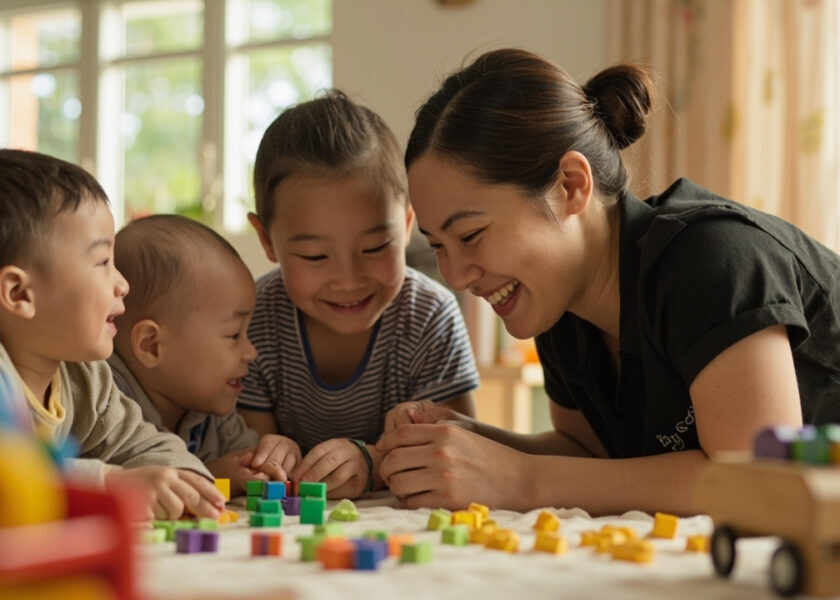
Beyond the Smile: What Real Growth Looks Like in Singapore Childcare
How Do You Know Your Child Is Actually Growing? A Singapore Parent’s Guide to Developmental Milestones in Quality Childcare
There is a question that sits quietly in the back of every parent’s mind, often unspoken at pickup time. It hovers somewhere between the gratitude you feel when your child runs into your arms and the uncertainty that surfaces when you wonder what actually happened in those hours in between.
It is not a question of safety. By now, you have likely satisfied yourself that your child is in a secure place. It is something more specific and, in its own way, more important: whether your child is genuinely growing.
Whether the people caring for your child understand what growth looks like in the earliest years. Whether the place you have chosen is not just safe and comfortable, but actively building the foundations of who your child is becoming.
If that question has ever visited you, I want you to know something right away. You are not overthinking this. You are not being difficult or demanding. You are being a parent. And the fact that you want to understand what quality looks like—rather than simply trusting that it exists—is one of the most important things you can bring to this decision.
The challenge is this: most of us were never taught what to look for. We know what happiness looks like on our children’s faces. We recognize when something feels off. But developmental milestones—the specific, observable signs that a child is building language, learning to regulate emotions, developing physical confidence, and becoming curious about the world around them—these are not things that come automatically with parenthood. They require a framework.
This guide offers that framework. Here is what it covers:
- Why developmental observation matters more than instinct alone
- What thriving looks like from infancy through the preschool years
- Age-specific milestones you can observe and track
- Practical questions to ask caregivers that reveal real insight
- When to feel confident and when to ask harder questions
- How quality childcare creates measurable growth in Singapore
Understanding Developmental Milestones: Why a Framework Matters
Every parent watches their child. You notice when they smile, when they reach for you, when something makes them curious. But watching and systematically understanding are different things.
Developmental milestones are not arbitrary checkpoints. They are observable behaviors that tell you whether the brain is building the connections it needs for language, coordination, emotional regulation, and social connection. When you know what to look for, you can tell whether your child is on a healthy trajectory—not by comparing them to other children, but by understanding the range of what typical development looks like at each stage.
This matters for two reasons. First, it helps you understand your own child with greater depth. Second, and equally important, it helps you evaluate the quality of care your child is receiving. Because quality childcare is not just about keeping children safe and content. It is about creating the conditions for growth.
When you ask a caregiver, “What did my child do today?” and receive a vague answer, you cannot evaluate whether meaningful development happened. But when you know what developmental progress should look like at your child’s age, you can ask better questions—and recognize when the answers reveal genuine attention to your child’s growth versus routine supervision.
What Developmental Progress Looks Like: Age by Age
The Infant Stage (0–12 Months): Building the Architecture of Everything
Let us start with the youngest ones, because the earliest months are when the foundations are most quietly and profoundly being laid. When your infant is in quality childcare, you should expect to see something remarkable happening even in the absence of words. In those first months, development moves faster than it will at almost any other point in life.
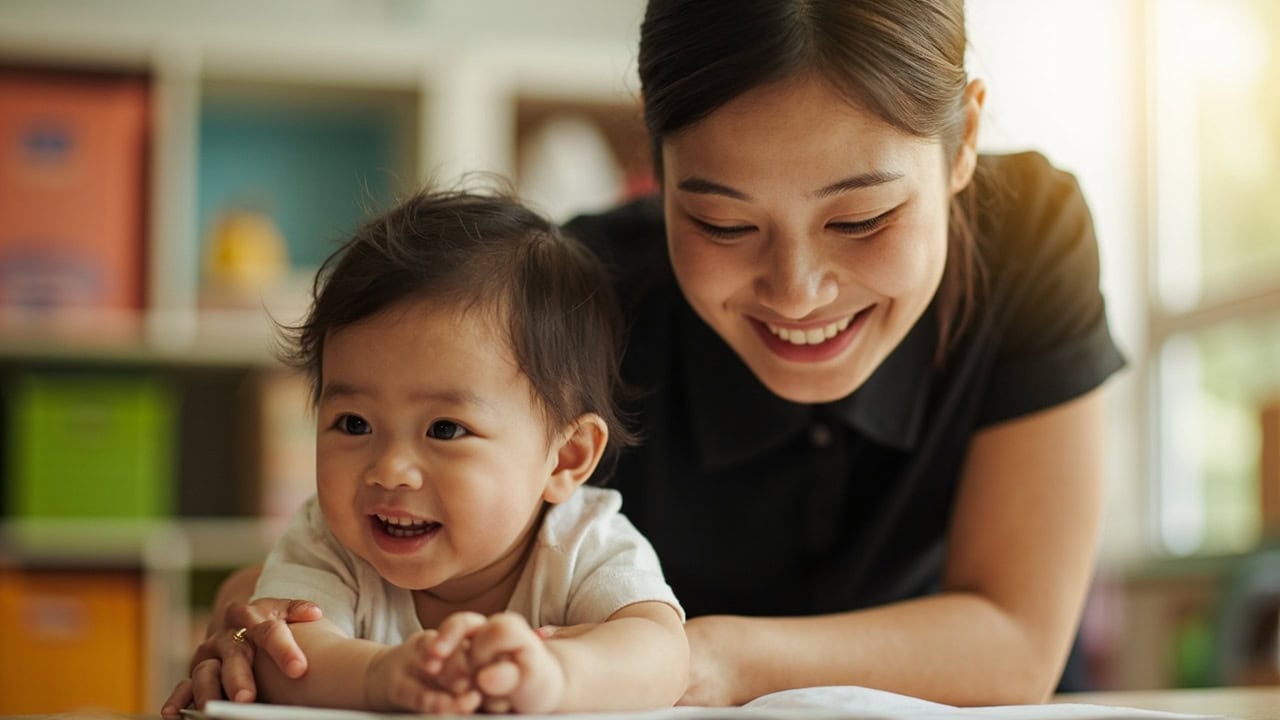
What you should look for in quality infant care is not a miniature classroom. It is responsive interaction. Watch whether your baby’s cries are met with consistent, warm responses. Observe whether caregivers kneel down to your infant’s level, make eye contact, and speak in the gentle, exaggerated tone that research tells us helps language development. These are not luxuries. They are the architecture of attachment, and attachment is the foundation upon which every other skill is built.
Milestones to observe: 0–6 months
- Rolling from tummy to back
- Reaching for toys with both hands
- Tracking objects with their eyes in a way that looks purposeful rather than random
These are signs that the brain is building the connections it needs for coordination and spatial awareness.
Milestones to observe: 6–12 months
By nine to twelve months, language development becomes visible in ways you can actually observe. Your baby may be babbling with increasing complexity, using sounds that seem to mimic the rhythms of conversation even before they are words. You may hear consonants emerging—ba-ba, da-da, ma-ma—not yet attached to meaning, but close. The gestures come first. Pointing. Waving. Lifting arms to be picked up. These are the precursors to communication, and quality infant care understands that every interaction is a language lesson waiting to happen.
Socially, around this age, your infant should be showing preferences for familiar faces. They may show stranger wariness, which is actually a sign of healthy attachment—not a problem to be solved. They may seek comfort from caregivers they know well and show distress when those familiar faces are absent. This is development happening on schedule.
The Toddler Stage (12–24 Months): The Revolution Begins
Between twelve and twenty-four months, children undergo what can only be described as a revolution. They go from being entirely dependent beings to walking, talking, exploring creatures who are beginning to understand themselves as separate individuals with their own preferences, opinions, and increasing will.
It is exhausting and exhilarating in equal measure, and quality childcare should be right in the middle of it—supporting every new skill with intention.
Language development accelerates rapidly in this period. By eighteen months, most children have a vocabulary of somewhere between ten and fifty words, though the range is wide and healthy. By twenty-four months, you may start hearing two-word combinations emerge: “More milk.” “Daddy go.” “No sleep.” These are not random pairings. They represent a cognitive leap in understanding how words relate to each other and to the world.
In quality childcare, you should see caregivers narrating activities, naming objects, reading books interactively rather than just reciting text. You should hear language coming from multiple directions—songs, conversations during meals, commentary during play. Language exposure is not passive. It is built into every interaction when care is deliberate.
Motor development also progresses rapidly. Between twelve and eighteen months, most children are pulling to stand, cruising along furniture, and beginning to take those first independent steps. By two years, running, climbing, and the beginning of more coordinated movements should be visible. Fine motor skills develop too—the pincer grasp becomes more precise, and you may see your toddler trying to stack blocks, scribble with crayons, or turn pages in a book.
What you should observe in quality care is not just that these skills are possible, but that they are being encouraged safely. A toddler learning to climb needs supervision, but they also need space to test their abilities. The difference between adequate care and quality care is often visible in how much purposeful physical opportunity a child is given within safe boundaries.
Socially and emotionally, this is when the most fascinating and sometimes most challenging developments occur. Around eighteen months, you may notice what people sometimes call “the terrible twos” beginning—not because two-year-olds are terrible, but because they are discovering their own agency.
They want to do things themselves. They say no constantly. They have fierce preferences about who holds the spoon and which cup is used. This is not rebellion. It is development. Quality childcare recognizes that a toddler asserting independence is a toddler building autonomy, and the response is not to suppress but to guide with patience.
You should see caregivers who acknowledge feelings, set consistent boundaries, and offer choices where choices are possible. “Do you want the red cup or the blue cup?” is a simple sentence, but it is also a developmental tool that teaches toddlers that they have some control over their world while still operating within the structure adults provide.
The Constellation Phase (24–36 Months): Everything Starts Connecting
Between twenty-four and thirty-six months, children enter what I think of as the constellation phase. Everything starts connecting.
Language becomes more complex. Sentences grow longer. Questions become relentless: Why sky blue? Why dog bark? Why moon come out? This is cognitive development at its most visible, and quality childcare welcomes it rather than stifles it.
Vocabulary should be expanding rapidly. Most three-year-olds have vocabularies of several hundred words and can construct sentences of four to six words with increasing accuracy. They begin to use pronouns, talk about the past and future, and narrate their own experiences: “I went to the park and I saw a bird and the bird was yellow.”
In quality care, you should see children being given language for their experiences. Caregivers who narrate, who ask open-ended questions, who respond to a child’s communication with more words rather than fewer, are building cognitive architecture that will serve that child for years to come.
Motor skills reach new sophistication. Most three-year-olds can run, jump, climb, and pedal a tricycle. They can stack six or more blocks. They can use crayons and paintbrushes with increasing control. These are not just activities to keep children occupied. They are building the neural pathways that support concentration, hand-eye coordination, and physical confidence.
Socially, this is when parallel play begins to evolve into genuine interactive play. Three-year-olds may begin to engage in cooperative pretend play, assigning roles and building scenarios together. They are learning to share, though this skill is still developing and should not be expected to be perfect. They are learning to read social cues, to notice when another child is upset, to seek comfort and offer it.
Emotionally, you should see children in quality care developing a vocabulary for feelings. They may not always manage their emotions well—that is still very much a work in progress—but they should be learning that feelings have names, that they can be expressed, and that adults in their lives take those feelings seriously.
School Readiness (3–4 Years): Stepping Forward
By the time children reach three to four years, they are approaching what educators call school readiness—though I prefer to think of it as readiness for broader exploration.
- Language becomes increasingly sophisticated, with complex sentences and the ability to tell stories that follow a logical sequence.
- Motor skills should show strong coordination, including the ability to dress and undress with some independence, to handle utensils reliably, and to engage in physical play with confidence.
- Cognitive development is visible in sustained attention, in the ability to follow multi-step instructions, and in curiosity that goes deeper than before.
- Socially, children this age should be navigating friendships, understanding rules, and developing empathy in increasingly nuanced ways.
Quality childcare at this stage should feel almost like a partnership between the caregiver and the child, with the caregiver stepping back more and more as the child steps forward. The best preschools—and the best in-home care arrangements—are ones where children are given increasing autonomy while knowing that support is still there when needed.
Practical Questions to Ask Your Child’s Caregiver
Whether your child is an infant or a preschooler, these questions reveal developmental attention rather than just routine supervision:
- “What sounds/words has she been making lately?”
- “What does his play look like when he is most engaged?”
- “How does she handle big emotions like frustration?”
- “What seems to interest him most right now?”
- “How does she play with other children?”
- “Has she started reaching for things deliberately?”
If a caregiver cannot answer questions like these, that is important information. In quality care, you should feel like you are part of a conversation about your child’s growth, not a bystander receiving occasional photos and general reassurances.
Understanding the Range: Milestones Are Guides, Not Grades
Before we go further, I want to pause here and speak directly to something important.
These milestones are guides, not grades. Children develop at their own pace, and the range of what is normal is far wider than most parenting advice implies.
- A child who walks at twelve months and one who walks at fifteen months are both walking on schedule.
- A child who speaks in full sentences at two and a half and one who speaks in full sentences at three are both developing language normally.
The signs of true concern are patterns that deviate significantly from developmental ranges, or regression rather than progress. If your child is consistently losing skills they once had, that warrants conversation with a professional. But general variation in pace is not a failure. It is simply the reality of human development.
What matters is momentum. Is your child moving forward? Not at someone else’s pace, but at their own. Is quality care supporting that individual momentum?
When to ask harder questions:
- When you receive only general reassurances (“She’s doing great!”) without specifics
- When your child does not seem engaged or interested in the caregiver
- When your child shows signs of regression or significant disinterest in activities they previously enjoyed
- When your questions are deflected rather than answered thoughtfully
You deserve to understand what is happening in those hours you are apart. And you deserve a partner in your child’s care who wants you to understand—not just trust.
What Quality Childcare Actually Looks Like in Practice
Now that you have a framework for understanding developmental milestones, let me be direct about what quality looks like in observable terms.
Quality childminding is not:
- A television playing in the background
- A caregiver who spends most of their time on their phone
- An environment where children are merely kept safe and fed
- A place where “play” means anything goes without intentional guidance
Quality childminding is:
- A caregiver who gets down to your child’s level during interactions
- An environment where language is abundant—narrated activities, songs, conversations
- Activities that are purposeful, even when they look like play
- Milestones that are noticed and documented
- Communication that flows both ways—regular updates that go beyond “she had a good day”
- A caregiver who can tell you what your child is working on developmentally
In Singapore’s context, where many families rely on infant care and childminding due to work demands, this distinction matters enormously. You are not just looking for someone to watch your child. You are looking for someone who understands that every interaction in these early years is building the person your child will become.
Use this checklist as a quick reference when evaluating any childcare arrangement:
| What to Look For | What to Ask |
|---|---|
| Caregivers who kneel to your child’s level | “What developmental milestone is my child working on right now?” |
| Language-rich environment (songs, narration, conversation) | “What sounds/words has she been making lately?” |
| Responsive interactions—not just when crying | “How does he respond when he needs help?” |
| Activities that encourage independence | “What choices does she get to make during the day?” |
| Physical environments that allow safe exploration | “What does his play look like when he is most engaged?” |
| Emotional attunement and feeling-naming | “How does she handle big emotions like frustration?” |
| Social guidance that supports peer interaction | “How does he play with other children?” |
| Regular, specific communication about your child | “What seems to interest her most right now?” |
The First Thousand Days: Why This Actually Matters
Let me close with something I hope you will take with you, whether or not EduNanny is your ultimate choice.
The early years are not a waiting room for the real stuff to begin. They are the real stuff.
Every word your child hears in these first years builds the architecture of their capacity to think, speak, and connect. Every safe attachment they form becomes the inner working model they carry into every future relationship. Every time they solve a problem, persist at a difficult task, or learn that they can be frustrated and still be loved, they are building the emotional resilience that will carry them through challenges you cannot yet imagine.
This is not exaggeration. This is what developmental science tells us, and it is why quality infant care matters so profoundly. Not because it is an added bonus if you can afford it, but because the first thousand days are genuinely foundational, and the environments we create for our children during this window shape outcomes in ways that last a lifetime.
The very fact that you want to understand what quality looks like—that you are willing to ask the harder questions, that you refuse to accept vague reassurance when your child’s development is at stake—this tells me that you are the kind of parent every child deserves. And you deserve a childcare partner who recognizes that.
Finding Your Childcare Partner in Singapore
EduNanny Singapore exists to be that partner. Not the one who simply holds your child while you work, but the one who understands that holding your child is itself a developmental act, and that every hour in our care should be building toward something meaningful.
We operate as part of the ECDA Childminding Pilot, which means our model is grounded in standards developed with recognition that infant and early childhood care is not simply babysitting. It is the work of nurturing who a child is becoming.
We track milestones not because we are required to, but because we believe every child’s progress deserves to be noticed. We communicate not because parents demand it, but because parents have a right to understand what is happening. We train our caregivers not just to be competent, but to be genuinely curious about child development, because curiosity is what turns routine into opportunity.
Our ratios reflect this commitment. With up to one to three infants in care, there is space for genuine responsiveness. There is time to notice when a child is about to take their first independent steps and the attunement to support them through the frustration of learning to fall and get back up. These ratios are not just numbers on a page. They represent the difference between adequate supervision and quality growth support.
Whether home-based care in your own environment or access to community and centre-based settings, you can find what fits your family’s rhythm and your child’s needs. Monday to Friday care blocks provide the consistency that young children thrive on, because development happens best when the environment is predictable enough to feel safe and stable enough to allow real growth.
Where our community settings have CCTV measures in place, families have visibility into daily life. Communication is not something that happens when you remember to ask. It happens as a regular rhythm, because we know that parents cannot evaluate quality care if they do not know what is happening.
We also offer Thomas AI Chatbot, designed to give parents easy access to developmental guidance and practical parenting support at any hour. This is not a replacement for human expertise. It is an extension of our commitment to being a resource, not just a service. Because we believe that the more parents know, the better decisions they make, and the more confidently they can partner with the people caring for their children.
The best question is not whether a place feels good to you, though that matters. The best question is what you can observe there that tells you your child is growing.
Ask for specifics. Look for milestones. Have conversations with caregivers that go beyond “Is my child happy?” Because happy is a beginning, but it is not the whole story.
Your child is becoming someone. Every day, in every interaction, the person they will be is being built. And you have the right to know that the people helping to build them understand what they are doing and why it matters.
That is what quality childcare offers. That is what EduNanny Singapore is here to provide.
Every child’s growth deserves to be noticed, supported, and celebrated. If you are ready to explore what a genuine partnership in your child’s developmental journey looks like, we welcome the conversation.
Learn more about EduNanny Singapore · About Us · ECDA Childminding Pilot
Related Topics: Child Development Singapore, Infant Care Singapore, Quality Childcare, Developmental Milestones Singapore, EduNanny Singapore