Beyond the Door: Understanding Your Child’s Inner World in Care
The Door Closes Every Morning: What Your Child Actually Experiences in Childcare
There is a moment, familiar to every parent who has placed their child into the arms of another, when the door closes and you are left standing on the other side of something you cannot see.
You know the one. The morning drop-off. The brief handover. The wave through the window or the reflection in the glass as you walk away. You have handed over the most precious thing in your life, and now you must simply wait — go to work, attend meetings, move through all the places adulthood demands of you — while somewhere across the city, your child is beginning their day in a world you cannot enter.
Here is the truth that sits quietly in the chest of every parent who makes this choice: you do not fully know what happens in those hours. You trust, yes. You have chosen carefully. You have asked questions, read reviews, perhaps visited the space more than once. But trust is not the same as certainty. And the distance between the two can feel, on some days, impossibly wide.
This is not a failure of modern parenting. This is the nature of it. From the moment a child enters childcare, a new and unspoken question begins to pulse beneath the surface of every parent’s day: What is my child actually experiencing right now?
Quick Reference: Key Understandings for Parents
- Children communicate non-verbally through body tension, breathing, eye contact, and micro-expressions
- The sensory environment profoundly affects young children’s nervous systems
- Attunement — the caregiver’s capacity to notice and respond to non-verbal cues — is the foundation of quality care
- Your child’s behavior at pickup contains meaningful information about their daily experience
- Observation is a learnable skill that builds parental confidence
The Weight Every Singapore Parent Carries
We live in an age of extraordinary parental anxiety, and Singapore parents know this better than most. The pressures here are particular and real: the cost of raising a child, the demands of dual-income households, the fierce and tender hope that every investment in your child’s early years will ripple forward into the person they will become.
Singapore parents are not negligent. They are not distant. They are doing what generations before them have done, but in a world that moves faster, expects more, and offers fewer of the village structures that once made early childhood a shared endeavor rather than a private worry.
The decision to place your infant or toddler in care is rarely made lightly. And yet, once made, it opens a door to a new kind of uncertainty: the uncertainty of the unseen day.
What does your child’s world look like between nine and five? What sounds reach them? What faces do they see? How do they feel when you are not the one holding them, and what happens inside them in the long hours when they must make sense of that absence on their own?
These are not small questions. They go to the heart of what early childhood actually is.
What Developmental Science Tells Us About the Young Child’s Inner World
Developmental science has given us a remarkable window into the inner life of the young child, and what we find there is both humbling and illuminating.
Children in their first six years do not experience the world the way adults do. They lack the language to narrate their experience, the cognitive framework to organize it into a story, and the reflective capacity to look back and say, “Today I felt anxious in the morning, but by afternoon I was calm.” Instead, they experience the world directly, somatically, through their bodies and their senses.
Consider what this means in practice:
- A harsh fluorescent light is not merely unpleasant — it is overwhelming
- An unfamiliar voice is not just strange — it may trigger a full-body stress response
- A caregiver who does not notice the slight hitch in a toddler’s breath before a meltdown may never know that the meltdown was preventable
The child was trying to communicate something that never found its words.
This is why the child’s interior world is so often invisible to us. We are looking for the wrong things — for language, for explanation, for the kind of narrative that would satisfy an adult mind.
But the child speaks in an entirely different register:
- In the way they hold their body
- In the speed of their breathing
- In whether they can be comforted
- In whether they can play
- In how they sleep
- In the quality of their eye contact
- In the micro-expressions that flicker across their face faster than we can consciously register
The child is always communicating. The challenge is that most of us have never been taught to listen in this language.
Consider what is actually happening from the child’s perspective when they arrive at a care environment. Perhaps they are still warm from the car, still holding the shape of your hand, still wearing the scent of your home. The room they enter is a sensory world: the light, the acoustics, the temperature, the smell, the textures of the toys and surfaces around them.
Young children are exquisitely sensitive to environmental quality. A room that feels chaotic or overstimulating to an adult may be genuinely overwhelming to a child whose nervous system is still forming its capacity to filter and regulate. A room that feels calm, warm, and organized is not merely aesthetically preferable — it is neurobiologically supportive. It tells the child’s body: this is a place where you can breathe.
Here is one of the most important, yet least discussed, realities of quality infant and toddler care: the child’s primary task each day is not to learn colors or numbers or shapes. Their primary task is to regulate their nervous system in an environment where their attachment figures are absent, and to do so in the company of adults who are, at least initially, strangers.
This is enormous. Try to imagine carrying that weight, and you will begin to understand what your child is actually navigating each time you say goodbye at the door.
Attunement: The Quality That Separates Good Care from Great Care
What separates a childcare environment that merely supervises from one that genuinely supports the child’s development is something researchers call attunement.
Attunement is the caregiver’s capacity to notice, interpret, and respond to the child’s non-verbal communications with accuracy and care. It is:
- The subtle dance of noticing when a toddler is about to tip into frustration and intervening before the frustration becomes a full collapse
- Reading the infant’s face and understanding that the slight furrow of the brow means something different than the wide-eyed alertness that preceded it
- Knowing that when a two-year-old suddenly goes still, something important is happening in their internal world that deserves a gentle acknowledgment rather than dismissal
In attunement, the child learns something foundational: my signals matter. Someone is paying attention to me. I am not alone in this world, even when the people I love most are not in the room.
This is not a soft or sentimental observation. It is a neurobiological one.
When a young child’s nervous system registers consistent attunement from responsive caregivers, it builds what researchers call internal working models — deeply encoded templates for what relationships feel like, what trust feels like, what safety feels like. These templates become the invisible architecture of the child’s future capacity for connection, for emotional regulation, for the ability to be alone without being lonely, for the resilience that will carry them through the inevitable challenges of growing up.
The hours your child spends in quality care are not merely hours of babysitting. They are hours of profound neural and emotional construction. The question is not whether this construction is happening — it is always happening. The question is what is being built.
When evaluating childcare options, these are the markers that distinguish environments where attunement is practiced from those where it is not:
- Caregiver-to-child ratios — In infant care, ratios of one caregiver to every three infants or fewer allow for genuine noticing. When caregivers manage too many children, attunement becomes impossible regardless of their intentions.
- Physical environment — Calm, organized spaces with natural light. The sensory quality of the room affects the child’s nervous system directly.
- Communication patterns — Do caregivers share observations about your child’s mood, play, and emotional regulation — not just logistics like feeding and sleeping times?
- Response to distress — When a child is upset, how do caregivers respond? Do they attempt to soothe before correcting? Do they read the child’s signals as communication?
- Consistency of caregivers — Young children build trust through predictability. Frequent caregiver changes disrupt the attachment process.
- Transparency — Does the environment invite your engagement, or does it create distance? Are you welcomed as a partner in your child’s care?
Reading the Signals: What Your Child Is Telling You at Pickup
You may have noticed, at pickup, certain things about your child that you have not quite known how to interpret. These are not random. They are information. Your child is telling you something about their day, in the only language they have.
| Behavior at Pickup | What It May Signal |
|---|---|
| Unusually clingy | Processing the separation with their whole body; still building trust that the reunion will hold |
| Paradoxically calm — almost detached | May have learned to expect less; developed protective emotional distance |
| Ravenously hungry | May have been too anxious to eat, or expended energy regulating their nervous system |
| Exhausted beyond what the hours seem to warrant | System has been working hard to self-regulate in an unsupportive environment |
| Sleeps differently after care | Processing new experiences or elevated stress from the day’s demands |
| Runs happily into classroom without looking back | May have genuinely had a wonderful day — or learned not to show attachment |
| More rigid about rituals | Seeking predictability to compensate for uncertainty elsewhere |
| Lighter, more playful, more curious | Environment is supporting their natural exploration and joy |
None of these signals are diagnostic. None of them tell the whole story. But taken together, over time, they form a portrait of your child’s felt experience that no daily report can capture. No checklist of activities, no photograph of a craft project, no note that says “had a good day” can substitute for this kind of deep, observational literacy.
Developing this observational capacity begins with a gentle shift in attention. Instead of asking yourself, “Did my child have a good day?” — a question framed in the adult’s language of judgment — try asking:
“What is my child communicating to me through what I can observe?”
Here are the dimensions worth noticing:
- The quality of your child’s gaze — Is it focused, scattered, avoidant, or seeking?
- Their posture — Is there tension or ease in their body?
- Whether they reach for you or turn away — both are information
- Tolerance for brief separations in play — Can they engage independently, or do they need physical closeness?
- Patterns across days — Are certain days consistently harder? Can you identify triggers?
- What helps — What soothing approaches work? What makes things worse?
Here is what often happens when parents begin this kind of noticing: they start to ask different questions.
Instead of “Is this childcare good enough?” they begin to ask, “What does my child need in order to feel safe and known here?”
Instead of “Am I a good parent for choosing this?” they begin to ask, “What can I learn from watching how my child responds to this environment?”
These are not just better questions. They are the questions that lead to genuine insight, and from genuine insight, a different kind of confidence emerges — not the false confidence of never doubting, but the quiet assurance of a parent who has learned to read their child and trust what they see.
EduNanny Singapore: Where Attunement Becomes Practice
EduNanny, a service by BUTLER, was built on a conviction that has guided the best early childhood practice for decades: the child is not merely a being to be managed, but a person to be known. In the ECDA Childminding Pilot, EduNanny has pursued this conviction with remarkable intentionality, creating pathways for infant and toddler care that are rooted not in throughput and efficiency, but in the quality of the relational experience each child receives.
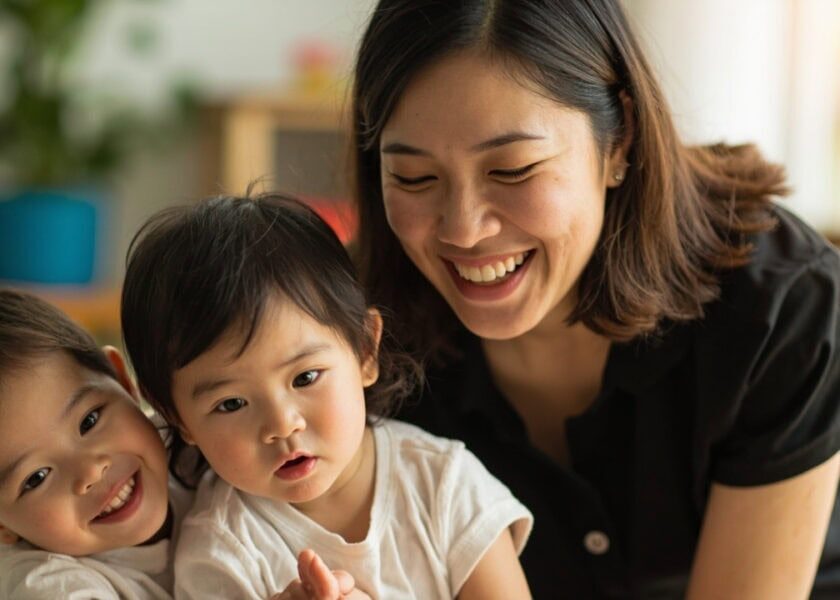
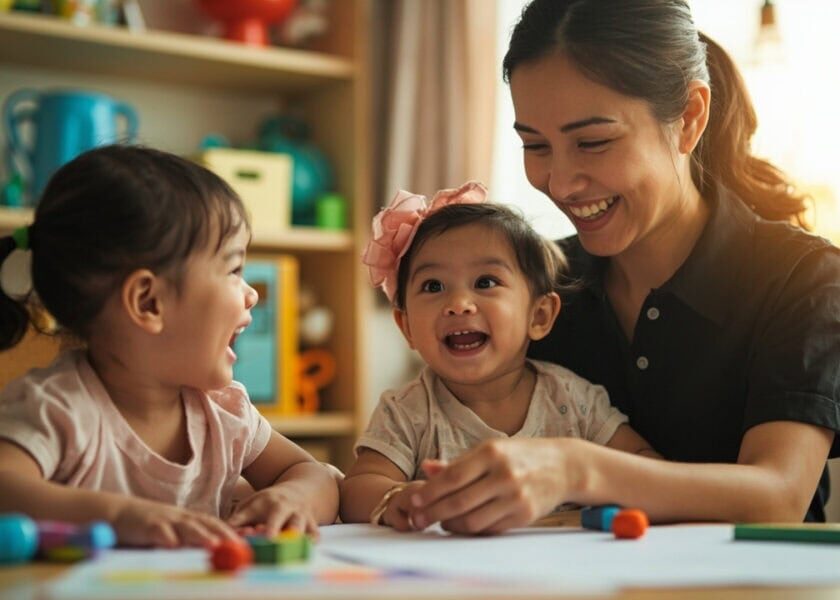
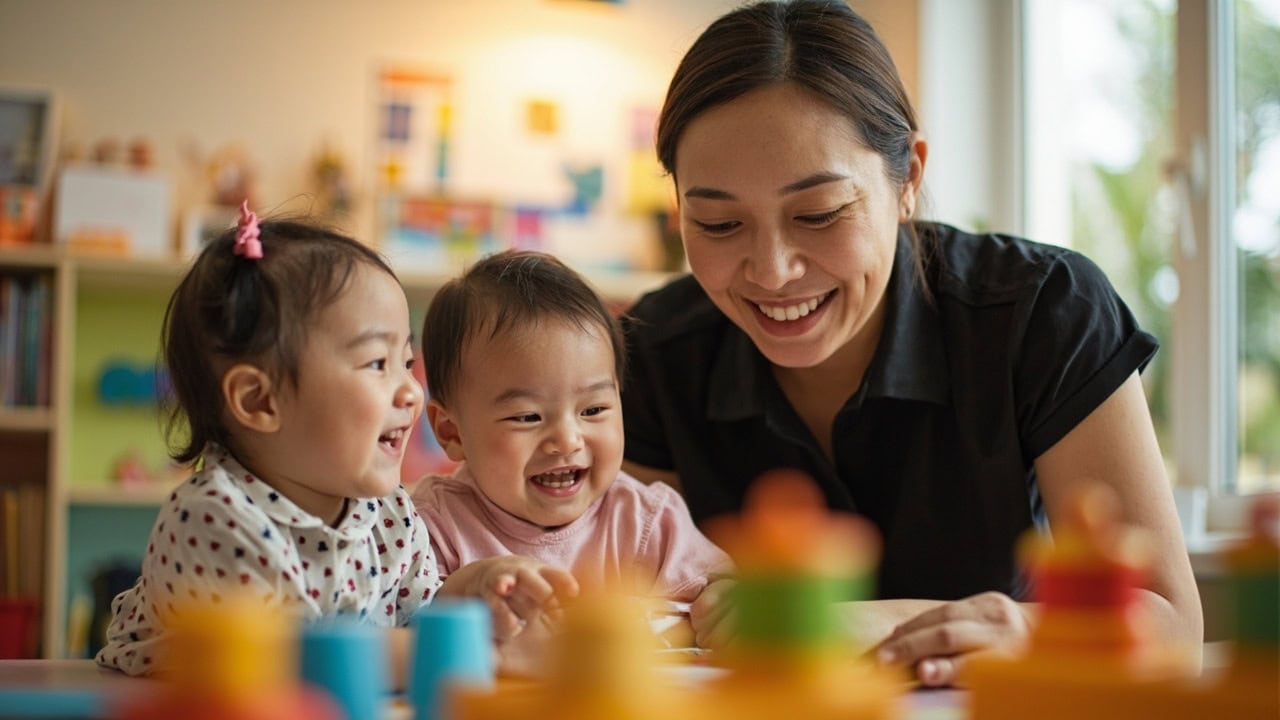
In EduNanny’s home-based childminding model, the ratio of caregivers to infants is deliberately kept small — up to one to three in infant care. This is not an accident. It is not a compromise. It is a structural commitment to the reality that young children need individual attention, that their non-verbal signals require a caregiver who is not simultaneously managing six other children, and that attunement at the level that actually supports healthy development cannot be achieved in high-volume environments.
Smaller ratios mean more moments of genuine noticing. They mean that the caregiver learns your child’s particular signals — not the generic signals of “a toddler” or “an infant,” but the specific, individual patterns of your specific, individual child. They mean that when your baby reaches up with that particular arm gesture, someone is there who knows what that gesture usually means for her.
This is not a luxury. For the developing brain and nervous system, it is a necessity.
The early years are not a countdown to something else. They are, in themselves, the foundation. What builds that foundation is not flashcards or worksheets or the premature acceleration of cognitive milestones. What builds it is:
- The felt experience of safety
- The repeated experience of being seen and responded to
- The gradual development of trust in the world and in other people
- The slow and magnificent emergence of a self that knows it is worthy of attention
Caregivers are trained not just in the mechanics of infant care — feeding, sleeping, hygiene — but in the art of attunement. They are taught to notice, to pause, to interpret, to respond with sensitivity. They understand that a child’s play is not idle activity but the medium through which the child makes meaning of their experience. They know that a toddler’s tantrum is not bad behavior but an overwhelmed nervous system communicating something the child cannot yet articulate.
They hold these children with the quiet attentiveness that allows the child to feel: I am known here. I am not just watched. I am seen.
EduNanny also attends to the parent’s need to know. Where deployed, CCTV measures provide transparency. Caregivers share observations about the child’s mood, play, social engagement, and emotional regulation — going beyond logistics to the quality of the experience. This is not surveillance. It is partnership. It is the acknowledgment that the parent is not an outsider to the child’s day but the most important person in it.
The Thomas AI Chatbot, developed by EduNanny, offers parents a thoughtful partner in understanding their child. It helps interpret observations, connect developmental milestones to daily experiences, and navigate the landscape of early childhood with greater clarity and confidence. For parents who lie awake at night wondering whether they are making the right choices, Thomas offers something rare: an evidence-informed presence that does not dismiss their concerns but helps them contextualize and address them.
Technology in service of the human relationship, not technology as a shortcut around it.
For Singapore parents specifically, EduNanny has also attended to the practical realities that determine whether quality care is truly accessible:
- Pilot fee structures designed with affordability in mind
- Monday to Friday care arrangements recognizing the rhythms of working family life
- CDA and Baby Bonus funds usable for eligible services
These are not peripheral details. For many parents, they are the conditions that determine whether the kind of care they want for their child can become the kind of care they actually have.
The Door Closes. What Happens Next Does Not Have to Be a Mystery.
If you are the parent who stands at the window watching your child settle in, the one who drives to work wondering if today is the day the signals were different, the one who lies awake constructing narratives from fragments — I want you to hear this:
You are not a negligent parent for feeling uncertain. That uncertainty is not a sign of failure. It is a sign that you are paying attention to something real.
Your child’s inner experience is rich, complex, and only partially visible to you. The hours they spend in care are hours of genuine significance — hours in which their nervous system is being shaped, their sense of safety is being constructed, their capacity for trust and connection is being built in ways that will ripple through their entire life.
The question is not whether to worry. The question is what to do with that caring, that attention, that desire to understand.
Here is what you can do:
- Look more closely at what your child is showing you at pickup and in the evenings
- Seek out environments where your child is known as an individual, not just managed as a slot
- Find caregivers who practice attunement — who notice, who respond, who see
- Demand transparency as an act of partnership, not distrust
- Trust the process of observation and learning — confidence will come
EduNanny was founded on the belief that the early years matter — that they matter in ways that cannot be rushed or shortcut, and that the child’s felt experience, quiet and unspoken, running beneath the surface of every day, is the true measure of quality.
In a city that moves as quickly as Singapore, where children are sometimes treated as projects to be optimized rather than persons to be known, EduNanny stands for something different: childcare and childminding rooted in developmental value, thoughtful care, and the quiet conviction that every child deserves to be known.
Your child is living a full and complex experience in the hours you are apart. They are feeling things, learning things, processing things, growing in ways that will shape who they become.
The question is whether the environment they are in is one that holds them with the attention they deserve — and whether you can learn to read what they are showing you with the clarity that will bring you peace.
The door closes every morning. But what happens on the other side of it does not have to remain a mystery.
Explore EduNanny Singapore’s infant and toddler childminding services. Small ratios. Attuned caregivers. Transparent partnership. Because your child deserves to be known, and you deserve to understand.
Learn more about EduNanny · Get in touch
#SingaporeChildcare #InfantCareSG #ToddlerDevelopment #ChildmindingSingapore #EduNannySG