Beyond the Checklist: What Singapore Parents Should Know About Early School Readiness
The Question Singapore Parents Carry
Somewhere in the last few months, you walked your child to school for the last time. Not because you had to. But because they didn’t need you to anymore.
And as you watched them walk through the gate — backpack a little too big, shoulders a little too small — you felt something you couldn’t quite name. Pride, yes. But underneath it, a quieter question, the one that’s been living in your chest since the day you first left your child in someone else’s arms:
Was that okay? Was what I did — the choice I made — was it building something, or did I miss my chance?
You made that choice. Maybe it was logistics. Maybe it was necessity. Maybe it was the mortgage, or the career you weren’t ready to lose, or the simple fact that someone had to go back to work and it was you.
You toured a centre. Or you met a childminder in her home, in a neighbourhood that felt warm and safe and close enough. You looked around at the small tables and the low shelves and the windows with their careful sightlines, and you told yourself this would be fine.
But underneath that, in the part of yourself you don’t always let others see, you wondered whether the hours you wouldn’t be there would leave a gap. Whether your child would somehow, quietly, arrive at Primary One lacking something — something that only you could have given.
Here is what someone should have told you earlier: the years you built were a foundation. Not a compromise. Not a second-best option. A foundation.
Understanding why that is true changes everything about how you see those years — and how your child will carry them.
School Readiness Runs Deeper Than a Checklist
There is a version of school readiness that people talk about a lot. The checklist version. Can your child hold a pencil. Can they recognise letters. Can they sit still for forty minutes. Can they follow instructions.
These things matter, yes. But they are the surface of school readiness, not its depth.
The depth — the part that determines whether your child thrives or merely survives those first years of formal education — is built from something far less visible. It is built from trust.
Think about what your child actually does in those early years, in the hours you are not there. They learn, for the first time, that the world contains people beyond you. That someone else can meet their needs. That when a caregiver says come, it’s time to eat, the world does not collapse — it continues, predictably, safely.
That when a friend takes a toy, the world does not end — there is language for it, and a trusted adult to help. That when they walk into a room full of children they have never met, the discomfort is not a danger. It is an invitation.
This is not softness. This is architecture.
What Your Child Carries Into Primary One
Self-Regulation
Your child carries self-regulation. They learned it not in a lesson but in a moment — the moment they were upset and a trusted caregiver sat with them and said, I see you are angry. That is okay. Let’s breathe together.
They carry it because that moment happened a hundred times, in small ways, in the ordinary hours. Not because someone taught them to manage their emotions but because someone modelled it, patiently, every single day.
Peer Competence
Your child carries peer competence — not just the ability to play alongside another child, but to navigate the intricate, exhausting, beautiful complexity of other people.
To share. To wait. To be told no and survive it. To ask for what they want. These are not small things. These are the hardest things humans ever learn.
The Capacity to Belong
Your child carries the capacity to belong, because they have belonged. Because someone held them when they were new to this arrangement, and another child shared a toy with them on a Tuesday morning, and the routine became so familiar that Monday felt safe before it arrived.
Curiosity
Your child carries curiosity. The kind that asks why without fear. The kind that reaches for a butterfly before wondering whether it will get away.
This curiosity survives — and thrives — in environments where it is safe to ask, where the answers are not impatient, where the adults lean in rather than move on.
Emotional Language
And your child carries language. Not just vocabulary — though that matters — but the language of feeling. The words for lonely and proud and not fair and I missed you.
The ability to say what is inside them, clearly enough for another person to respond to it.
That is not a school readiness skill. That is a human readiness skill.
You Built This Together
You built this foundation with the caregivers you chose. You built it in every conversation you had about your child’s day — the real ones, where you asked what they were curious about and what made them laugh and what made them afraid.
You built it every time you handed your child to someone else and felt that sharp pull in your chest and still did it, because you trusted the process more than you trusted your fear.
That trust was not naive. That trust was the first, most important lesson your child ever received — because they learned it from you.
What Quality Care Actually Looks Like
Quality matters here, and it is not enough to simply say childcare works. It works when it is intentional.
When the ratio of caregivers to infants is small enough that each child is seen — really seen — not just watched over but known. When the person holding your child during those first wobbly months of separation has time to notice that this child is frustrated, not just crying, and has the space to respond with curiosity rather than routine.
When the environment is safe not just in the obvious ways — no sharp edges, proper ratios, secure access — but in the ways that matter to a developing brain: consistent, warm, predictably responsive.
When a caregiver can tell you not just what your child ate, but how they ate it — whether they lingered over the porridge or rushed through to get to the blocks.
The Role of the Childminder
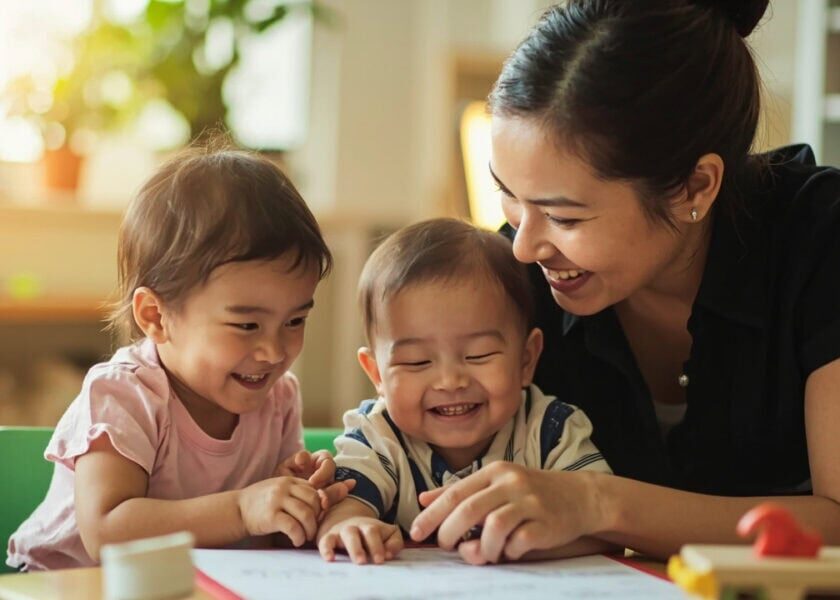
A childminder is not a convenience. They are a professional in the most profound sense — a person who holds a child’s world together while that world is still forming.
Who notices the small things that will become big things. Who sits with a toddler’s tantrum not because it is their job but because they understand what that tantrum means. Who celebrates the first time a child washes their own hands not because it is remarkable by adult standards but because they know exactly how many small steps it took to get there.
Singapore’s ECDA Childminding Pilot represents a recognition that where you live should not determine whether your child is held by one person who loves them or processed through a system that barely knows their name.
Intentional Childminding for Singapore Families
For families seeking care that holds their child the way this article describes — with patience, attention, and genuine developmental purpose — there are pathways designed to deliver exactly that.
EduNanny by BUTLER, operating through the ECDA Childminding Pilot, is built around the standards this kind of care requires: smaller ratios so each child is truly seen, consistent caregivers who build real knowledge of each child’s rhythms and needs, and communication that keeps parents inside their child’s day rather than watching it from outside.
It means home-based settings where your child is not one of many in a room but one of perhaps two or three, in an environment that feels familiar and warm. It means Monday to Friday consistency — the kind that a young child’s sense of security is built on. And because CDA and Baby Bonus can be used within the pilot, the financial architecture of care becomes a support rather than an obstacle.
Home-based, community, centre-based — each pathway is valid, and each one, when done with intention, gives your child what they need: a consistent, warm, knowledgeable presence in their early years.
Addressing Your Concerns
“Will my child feel abandoned?”
Your child may cry at the door. This is not a sign that childcare is wrong for them. It is a sign that they have a healthy attachment to you and are processing a real change. What matters is what happens next — whether the caregiver meets that distress with warmth and consistency, whether your child learns, over time, that goodbye is not permanent.
Most children, in quality care, settle. And in settling, they learn something profound: that the world is safe enough to explore, even when you are not in the room.
“Am I missing their firsts?”
You might not be the first person to hear a new word or see a first step. But you are the person who made it possible for your child to be in an environment where those firsts could happen.
And you will still be there for so many firsts — the ones that happen at home, in the evenings, on weekends. The first time they read a word they’ve been practising at school. The first time they tell you a joke they’ve learned from their friends. These are yours in a way that nothing can take from you.
“How do I know the care is good enough?”
Ask questions. Visit unannounced if you can. Ask the caregiver what your child’s day looks like — not just the schedule, but the texture of it. How do they respond when a child is upset? What do they do when a child is struggling with sharing?
Look for a place where your child is seen as an individual — where the caregiver knows their rhythms, their preferences, their fears. Where they can tell you something specific about your child that you didn’t already know.
“Will this affect our bond?”
The opposite is true. Children who have experienced consistent, quality care in the early years tend to have stronger attachments to their parents, not weaker ones. Because they have learned that the world is safe, that people can be trusted, that leaving and returning is a rhythm they can survive.
You are not replaced by your child’s caregiver. You are complemented by them. And your child knows the difference — even when they can’t articulate it.
What to Look For When Choosing Care
- Ratio matters. How many children are there for each caregiver? The smaller the ratio, the more attention your child receives.
- Consistency matters. Will your child have the same caregiver over time, or will faces change frequently? Attachment requires predictability.
- Communication matters. Will you know what your child’s day looked like? Not just a photo — a story. A sense of who they were that day.
- Values alignment matters. Do the caregivers approach discipline the way you would? Do they speak to children with the respect you want your child to receive?
- Proximity matters. For young children, a home-based setting with a trusted caregiver can be as valuable — sometimes more valuable — than a centre, especially in those first wobbly months.
The Truth About the Years Before Primary One
The years before Primary One are not a prelude to your child’s education. They are your child’s education.
The most consequential years. The years when the brain is building the architecture it will use for everything that follows — how it processes stress, how it forms relationships, how it sits in a classroom, how it reaches for help when it needs it.
The research on the first thousand days is real, and it is compelling. But you do not need the research to believe it. You have watched your child. You have seen what they know, what they feel, what they can do.
None of that came from nowhere. It came from you. Even when you were not there, it came from you. Because you chose. Because you trusted. Because you showed up in the evenings with open arms and asked the right questions and held the weight of the day so your child didn’t have to carry it alone.
You became the architect of an entire system of care. Not just a mother or a father, but a builder of environments. A builder of trust.
Your child walked into Primary One. Not because they were ready in the way the school measures readiness. But because they were ready in the way that actually matters.
They walked in with trust — in themselves, in the world, in other people. They walked in knowing that they had been loved, consistently, in multiple places, by multiple people who all, in their different ways, had the same intention: to help this child become who they are.
You were not absent from your child’s education. You were its architect.
Every choice you made — the centre you toured, the caregiver you hired, the conversation you had at the door, the questions you asked at pickup, the evening you sat on the floor and played without your phone — every one of those choices was a brick.
And the building your child walks into every morning, the one that is shaped like curiosity and trust and the quiet confidence to try and fail and try again — that building is real.
You built it. No one else could have.
That is not a consolation. That is the truth.
And it is more than enough.
If you are considering what intentional, quality childminding can look like for your family — with the consistency, transparency, and genuine care your child deserves — the EduNanny team is here to talk it through with you honestly.
No judgment. No pressure. Just an open conversation about what your child needs and how supported, professional care can meet them there.