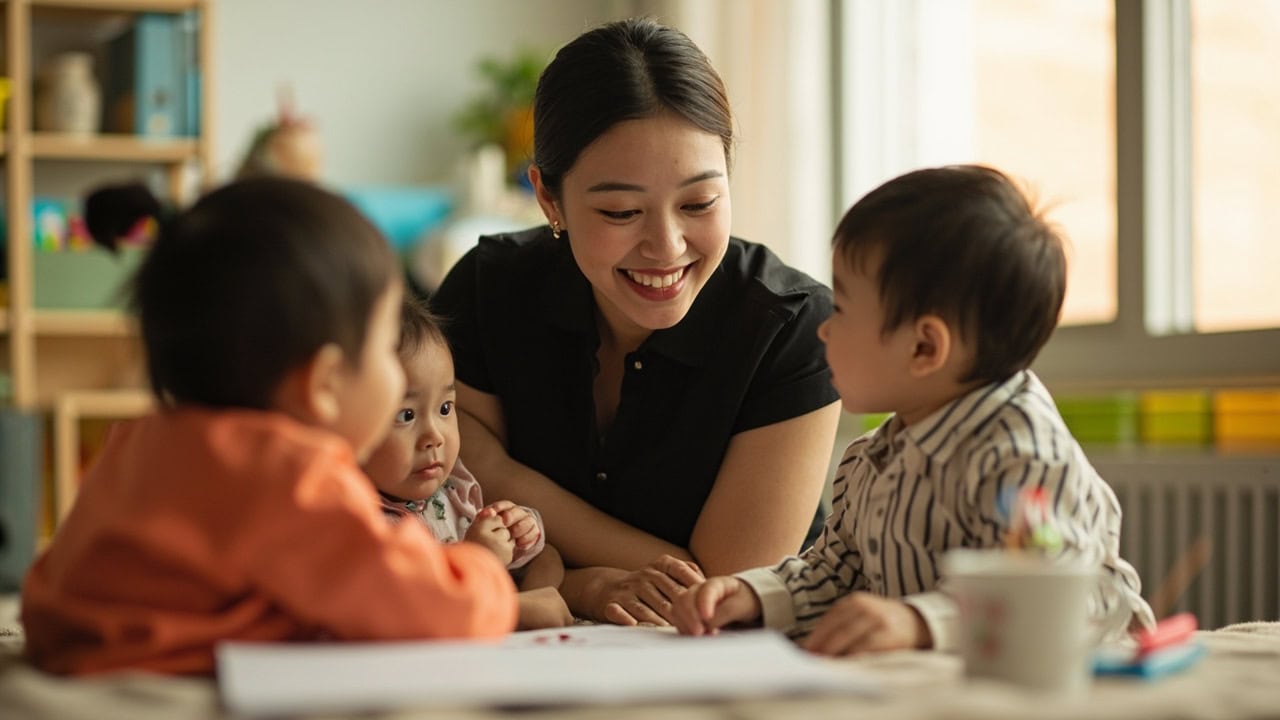
Beyond the Checklist: What Real Child Development Looks Like for Singapore Families
The Comparison Trap: Why Singapore Parents Feel This Way
Most parents, if they slow down and listen to themselves, actually do know their children. They know when their child is engaged and curious. They know when she is frustrated in ways that are productive versus ways that are depleting. They know when she is thriving in the quiet, inward sense that no report card could ever capture.
What parents lack is not knowledge. What they lack is permission to trust that knowledge, and a language for what they are actually seeing when they look at their children’s development.
Every enrichment program promises to accelerate something. Every assessment tool positions itself as essential. Every conversation at the playground can turn, almost without warning, into a quiet arms race of developmental one-upmanship.
Here is what I want you to hear clearly: most of the signals that our comparison culture tells you to watch for are noise. They are false signals. They tell you almost nothing about whether your child is genuinely developing well, and they tell you almost everything about whether your child is conforming to a narrow, culturally specific, academically-oriented definition of what development should look like.
What Genuine Child Development Actually Looks Like
Let me begin with a simple question. What does it mean for a child to develop well?
The answer most parents have been given, explicitly or implicitly, looks something like this: development means acquisition. Words added to vocabulary. Skills stacked upon skills. Motor milestones hit in the correct sequence and within the correct timeframes. A child who can identify colors, count to twenty, write her name, socialize with confidence, sleep through the night, eat everything on her plate, and demonstrate readiness for primary one before she has turned six.
That is the script. That is what our culture has decided development looks like.
And here is the problem with that script: it describes a performance. It describes a child who has been shaped to meet external standards, to demonstrate growth in ways that are visible, measurable, and impressive to other adults. But development in the truest sense is not a performance. It is a process. It is internal, uneven, deeply personal, and often invisible to anyone who is not paying the right kind of attention.
It is the child who is increasingly able to regulate her own emotions when she is frustrated. It is the one who, at two, can sit with a sensory activity for twenty minutes not because she has been trained to focus but because she is genuinely fascinated by the texture of rice or the way water moves. It is the three-year-old who, when another child takes a toy from her, does not immediately escalate into tears or aggression but pauses, looks at the other child, and tries to solve the problem. It is the four-year-old who asks why the sky changes color, and who will sit with your answer and turn it into four more questions.
These are not performances for adults. These are the signatures of a child whose mind and heart are growing in the ways that actually matter.
The Five Domains of Whole-Child Development
Understanding genuine development means understanding its different dimensions. These domains are not separate tracks running in parallel. They are braided together, each influencing the others in ways that make whole-child development the only kind worth nurturing.
Emotional Development
When we talk about emotional development, we are not talking about whether a child cries frequently or rarely. We are talking about something more structural. We are talking about whether a child is building an inner life, whether she is beginning to understand that she has feelings, and that those feelings have names, and that they can be managed rather than only expressed.
A toddler who has access to skilled emotional coaching will, over time, develop what child development researchers call emotional literacy. She will learn that it is okay to be angry but not okay to hit, that sadness is not dangerous, that she can ask for help when a feeling feels too big for her body.
This is not something that can be rushed or taught from a worksheet. It is built slowly, in moments of attunement with caring adults who notice what the child is feeling and reflect it back with calm, specific language.
“I see that you are really frustrated that the tower fell. You worked so hard on that.”
That sentence, spoken genuinely and often enough, does more for a child’s emotional development than any app or program.
Cognitive Development
Cognitive development, in the genuine sense, has almost nothing to do with academic readiness. It has to do with the quality of a child’s curiosity and the depth of her engagement.
A cognitively developing child is one who wants to understand things, who asks questions because she is genuinely interested in the answers, who can sustain attention on a problem or a puzzle or a story because she is internally motivated rather than externally directed.
The difference between a child who has been trained to answer questions and a child who asks them is the difference between performance and genuine cognitive development. When you hear your child asking “why” for the hundredth time in a day, you are not experiencing an annoyance. You are witnessing cognition unfolding.
Social Development
Social development is frequently misunderstood as sociability. A socially developing child is not necessarily the most outgoing child in the room. Some of the most profound social development happens quietly, in the careful, tentative exchanges between toddlers who are learning the rules of human connection: how to share, how to take turns, how to notice another child’s feelings, how to recover when an interaction goes wrong.
Social development is about the capacity to be in relationship, to navigate the space between self and other with growing grace. It is built in small moments: the child who offers a toy to a peer, the child who notices that another child is upset and brings a book or a stuffed animal, the child who is learning that she exists as a person in relation to other people.
Physical Development
Physical development is perhaps the domain most prone to comparison, because bodies grow on observable timelines and because we can see motor skills with our own eyes. But even here, the meaningful indicators are not always the obvious ones.
Yes, we want to know that a child can walk, run, climb, and manipulate objects with increasing precision. But genuine physical development is also about the child’s relationship with her own body: whether she feels safe in it, whether she is building confidence in what it can do, whether she is developing a sense of physical agency rather than physical caution.
A child who is allowed to climb, fall, and try again, in an environment that is safe but not over-protected, is building not just motor skills but something deeper. She is building resilience. She is building trust in her own capacity to meet physical challenges.
Communicative Development
And then there is communication, which is the domain most likely to trigger parental anxiety in Singapore because language is so visible, so measurable, and so tied to academic success in our cultural imagination.
But genuine communicative development is about far more than vocabulary size or sentence length. It is about the child’s growing ability to express herself, to be understood, to understand others, to use language as a tool for connection rather than only for request.
It is the infant who is learning that crying will bring a response, and that the response is meaningful. It is the toddler who is learning that words have power, that they can make things happen, that they can create connection. It is the preschooler who is learning the nuances of conversation, how to listen as well as speak, how to adjust language for different listeners, how to use stories to make sense of experience.
A child who is communicating genuinely is not just producing words. She is entering into the human conversation.
Why Milestone Checklists Miss the Point
Understanding these domains helps us recognize the difference between genuine developmental signs and the false signals that comparison culture amplifies.
The child who speaks late but with precision and purpose is not behind. She may be building a deeper understanding of language before she launches into speech—a pattern seen in many children who later become eloquent and precise communicators.
The child who is not reading at four is not disadvantaged. He may be developing spatial reasoning, physical competence, social intelligence, or emotional depth at a pace that will serve him far better in the long run than early literacy would.
The child who is not the first to share, the first to climb, the first to perform, may still be developing the inner architecture that will allow him to be patient, reflective, and deeply capable when the time comes.
This is not to say that developmental concerns should never be addressed. Of course there are children who need early intervention, and the earlier such needs are identified and supported, the better. But the ambient anxiety that Singapore parents carry—the daily, low-grade worry that their child is not measuring up—is not a sign of responsible parenting. In most cases, it is a sign that the environment has succeeded in making you doubt what your eyes and your instincts are telling you.
What School Readiness Actually Means
Singapore parents carry a particular burden around school readiness. We talk about children being “school-ready” as though readiness were a switch that flips on at a particular birthday, as though there were a checklist of skills that, once completed, marks a child as prepared for primary one.
But real school readiness is not about academic content. It is about emotional foundation. It is about whether a child can manage frustration, delay gratification, engage with curiosity, navigate social dynamics, and believe that learning is worthwhile. These are the capacities that determine whether a child thrives in school or merely survives.
A child who enters Primary One able to read but anxious about failure, unable to regulate her emotions, and disconnected from her own curiosity is not truly school-ready. A child who enters Primary One not yet reading fluently but confident in her ability to learn, comfortable asking for help, curious about the world, and capable of sitting with challenge—this child is ready.
The school system will change. What your child needs from you and from her caregivers is the foundation that will serve her across a lifetime of learning, not just the performance that will impress at a single point in time.
How Skilled Caregivers Observe and Support Real Development
So what does it actually look like when a skilled caregiver observes and supports genuine development? This is the question that shapes everything about how we approach childminding at EduNanny Singapore.
When an EduNanny caregiver enters into a day with your child, she is not entering with a checklist. She is entering with trained eyes and an attuned presence. She is noticing not just what the child is doing but how the child is doing it. She is noticing the quality of the child’s engagement, the ease or effort in the child’s movements, the texture of the child’s emotional state. She is noticing whether the child is curious, whether the child is connected, whether the child is building something inside herself that cannot be measured on any standardized scale.
Observation Versus Checklist
Consider a two-year-old at play with a set of stacking cups.
A checklist approach would note whether the child can stack the cups in size order. A developmental observation would note something deeper. It would note that the child is experimenting with the cups not just as objects to be stacked but as containers to be filled, as tools for understanding volume, as instruments for producing sound, as social objects to be offered to another child or to the caregiver.
It would note the child’s persistence when the cups fall, the child’s experimentation with different configurations, the child’s use of language or gesture to communicate something about the cups. It would note that the child is not performing for the caregiver but is genuinely absorbed in the process of understanding.
That is what skilled observation looks like. It is not watching for the output. It is attending to the process.
Multiply that kind of observation across a full day, across a week, across months and years of care. The EduNanny caregiver is building, over time, a portrait of your child that goes far deeper than anything a periodic progress report could convey. She knows how your child handles frustration. She knows how your child approaches new experiences. She knows whether your child is a social explorer or a social observer, and whether she is comfortable in both modes. She knows what makes your child laugh, what makes your child pause, what makes your child’s whole face light up.
Your Role as Your Child’s Developmental Partner
Something essential is rarely discussed: the parent’s role as interpreter and advocate alongside caregivers. Here in Singapore, where so much of the childcare infrastructure is institutional, parents are often positioned as consumers or clients rather than as partners in their child’s development.
You receive reports. You attend meetings. You are told how your child is doing relative to expected benchmarks. But rarely are you invited into a genuine dialogue about what you are observing at home, what your instincts are telling you, and how the caregiver’s observations interact with your own.
At EduNanny Singapore, we believe that you are your child’s first and most important developmental partner. You know your child in ways that no caregiver, however skilled, can replicate. You have seen your child across thousands of hours of life, in every emotional state, in every kind of day.
Your observations matter. Your intuitions matter. And when those observations and intuitions are brought into conversation with a trained caregiver’s observations, something richer emerges than either perspective could offer alone.
What Sets Quality Childminding Apart in Singapore
This is what transforms childcare from supervision into partnership. When you drop your child off in the morning, you are not leaving her in a holding pattern until you return. You are placing her in a relationship that is actively nurturing her development.
Several elements distinguish genuine developmental partnership from basic childcare supervision:
- Trained observation—Caregivers who know what genuine development looks like and can recognize it in everyday moments
- Attunement over compliance—Responding to the child’s actual needs rather than imposing external schedules
- Communication that builds understanding—Regular, meaningful conversations about what your child is experiencing and becoming
- Partnership with parents—Inviting your observations and intuitions into the developmental conversation
- Whole-child attention—Recognizing that emotional regulation, cognitive curiosity, social confidence, physical competence, and communication are all braided together
The ECDA Childminding Pilot
The ECDA Childminding Pilot represents an important acknowledgment that home-based and community-based care pathways have a legitimate, valuable role to play in Singapore’s childcare landscape alongside centre-based options. It is an acknowledgment that children develop best in environments that feel like home, that are grounded in real relationships, that are woven into the fabric of daily life rather than divorced from it.
EduNanny Singapore is proud to be part of this pilot, because it aligns with everything we believe about how children grow. The pilot makes quality care accessible, with fee structures designed to be affordable and payment options that include CDA and Baby Bonus usability, so that more families across Singapore can benefit from the kind of developmental partnership we offer.
How to Choose Childcare Based on What Actually Matters
As you evaluate childcare options, it helps to know what to look for—not for performances, but for signs of genuine thriving:
- A child who persists at something challenging, not because she is being watched, but because she is genuinely engaged
- A child who can name and manage her emotions, not just suppress them
- A child who asks questions because she wants to understand, not because she wants the answer right
- A child who notices other people’s feelings and responds with care
- A child who is physically confident, not fearless, but trusting of her own capacity to try and recover
- A child who uses language to connect, not just to request
- A child who is sometimes bored, sometimes frustrated, sometimes quiet—and who is okay in those states because she feels secure
If you are researching infant care or childminding options for your child, here are questions worth asking:
- How do caregivers observe children? Look for a focus on process and engagement, not just milestone checklists.
- How do caregivers communicate with parents? You should feel like a developmental partner, not just a recipient of periodic reports.
- What is the caregiver-to-child ratio? With a maximum of one caregiver for every three infants, genuine observation becomes possible.
- How do caregivers respond to emotional moments? This is where attunement is tested—in frustration, in conflict, in the hard moments.
- What does a typical day look like? Look for a balance of free play, guided exploration, and rest—not a schedule optimized for parental perception.
- How are parents invited into the conversation? You should feel that your observations at home are valued and integrated.
Coming Back to That Moment at the Pick-Up Gate
Let me close by returning to where we began.
When you stand at the pick-up gate, searching your child’s face for that sign, you are not being a bad parent. You are not failing to trust your child or the people you have chosen to care for her. You are participating in a deep, ancient human impulse: the desire to know that your child is well, that she is growing, that the world is a good place for her to be becoming herself.
That impulse is good. It is part of what makes you the parent your child needs.
But here is what I want you to know. The sign you are looking for is not on a checklist. It is not in a milestone chart. It is not in the number of words your child speaks or the colors she can name or the preschool she will attend.
The sign you are looking for is written in the quality of her engagement, the steadiness of her curiosity, the depth of her connection to the people who love her, the growing grace with which she navigates her own inner life and the world around her.
These are the signs of genuine development. These are the signs of thriving.
Your child is not a project to be optimized. She is a person in the process of becoming. And that process is unfolding, in ways that are profound and real, whether or not you are watching a progress report or comparing her to another child at the playground.
What EduNanny Singapore offers is companionship on that journey. It is the assurance that in your absence, your child is in hands that understand her, that see her, and that are actively helping her to grow into whoever she is meant to become.
Your child is becoming. Let us walk that path together.
To learn more about EduNanny Singapore and our approach to developmentally-aligned childminding, or to connect with our team, we welcome you to reach out. You can also read more about our story and our values.