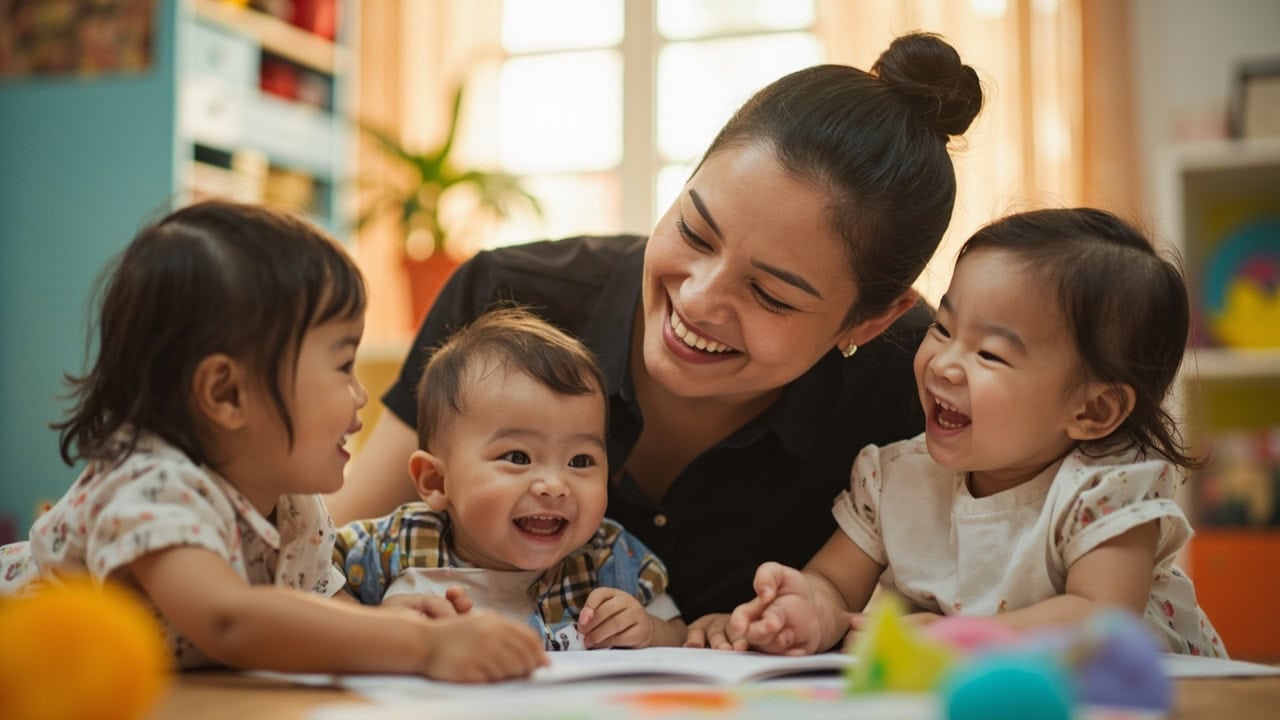
Beyond the Checklist: Teaching Your Child to Belong
Beyond Safety: What Every Parent Is Really Asking
When Singapore parents evaluate childcare options, the conversation naturally begins with safety. Is the environment clean? Are the ratios compliant? Is the food nutritious? These are the questions that can be answered on a tour, documented on a checklist, confirmed by a licence on the wall.
But beneath those questions sits something harder to inspect. It is the feeling you have when you close the car door or step onto the train after drop-off. It is the vague unease that follows you into your first meeting of the day. It is not about safety at all. It is about whether your child is flourishing—emotionally, socially, in ways that have nothing to do with being fed and rested and everything to do with feeling at home when you are not in the room.
This distinction matters enormously, because it changes what you are actually choosing when you select a childcare provider. You are not just selecting a safe space. You are choosing a community your child will belong to—or try to. You are choosing the adults who will stand in the gap between family and world, showing your child: I see you. I remember what you like. I will be here tomorrow.
In Singapore, where the dual-income household is the norm rather than the exception, where nuclear families often live far from the grandparents who once formed part of the village, this choice carries particular weight. The childcare you choose is not filling a gap. It is building something. And what it builds—or fails to build—shows up years later in how your child enters a classroom, approaches a new teacher, sits with peers, and eventually, relates to the whole wide world beyond your arms.
The Science of Belonging: How Secure Bases Shape Early Development
In the first years of life, children are not just growing bodies and developing brains. They are building the architecture of relationship itself. Attachment science—the research tradition that has followed children and families for decades—tells us something remarkable: the capacity to feel secure with one person does not limit a child to that one person. It expands them.
A child who feels safely attached to their parent carries that feeling like a compass into every new room, every new face, every new experience. They use it to explore. They use it to trust. They use it to find their place.
Developmental psychologists call the feeling this creates a secure base. It is the knowledge, felt in the body before it is understood in the mind, that I can leave the people I love and find people who will hold me. I can enter a new place and feel at home. I can belong somewhere that is not home, and still feel whole.
This is the insight that separates quality infant care from mere supervision. When your child walks into a space where the caregiver knows their name, where the morning routine follows a rhythm they recognize, where their hunger and tiredness and curiosity are met with consistent attention—that child is not just being watched. They are forming a secure base. They are learning to belong.
And here is what every parent in Singapore should know: this is not sentiment. It is skill. And like all skills, it can be taught well or poorly, deliberately or accidentally. Children who build this capacity early show it in how they enter peer groups, in how they handle the inevitable conflicts of sharing and waiting and wanting, in how they sit in a classroom and feel that school is a place where they belong rather than a place they are merely passing through.
How Quality Childcare Teaches Belonging: The Four Pillars
1. Consistency of Relationship
Belonging begins with familiarity. When a child knows the face that will greet them each morning, when they can predict the sequence of the day, when no sudden change arrives without warning—their nervous system can relax. Safety, for a young child, is not an abstract concept. It is a pattern. It is the same sequence of events that says: the world is organized, and I am held within it.
At EduNanny, this consistency is built into the structure of care. Through our ECDA Childminding Pilot, families can choose between two pathways: home-based childminding, where one caregiver and one home environment become a familiar anchor, or centre-based care, where consistent ratios and predictable routines create the same felt safety across a group setting. Both pathways maintain up to one-to-three infant ratios, because belonging is built in small moments of individual attention, not in the background supervision of larger groups.
When both parents are back at work by 8 AM, the morning handoff needs to be a transition your child can trust, not a scramble you both dread. A child who knows what to expect at drop-off does not just feel calmer in the moment—they are actively learning a skill: how to leave someone they love and enter a new world with confidence.
2. Sensory Familiarity and the Body’s Memory
Children belong to places with their senses before they belong to them with their minds. The smell of a familiar cream, the weight of a specific blanket, the sound of a door that always opens the same way—these are not decorations. They are the texture of belonging. They are sensory proof that this place is mine.
This is why quality childcare environments are designed intentionally, not just practically. Your child needs spaces where they can orient themselves, where the known is within reach, where the environment holds its shape even as they grow and change within it. The difference between a space that changes unpredictably and a space that is warm but consistent is the difference between a child who is merely tolerating a place and a child who is beginning to call it home.
In practice, this means thinking about the small sensory details that communicate safety to a young child: predictable mealtimes, consistent sleeping arrangements, the same greeting each morning. These details are not luxuries. They are the grammar of belonging, taught in a language the body understands before the mind can follow.
3. Daily Rituals and the Trust of Time
Every good childcare day is built on rituals that do the work of belonging automatically. The greeting. The handwashing before meals. The song before nap time. The same goodbye sequence each afternoon. The final wave from the gate.
We maintain these rituals not because they are efficient—they are not always—but because they teach your child to trust time itself. That morning comes and the caregiver is there. That lunch comes and the routine holds. That after nap the room is still the same room. That after school, you come back.
This is profound learning. It teaches your child that the world has a rhythm, and that rhythm can be trusted. Children who have internalized reliable daily rituals show greater emotional resilience, easier transitions, and stronger capacity to manage the ordinary disappointments of early childhood. They have learned, without anyone explaining it to them, that time is predictable and adults can be relied upon. That is not a small thing. That is the beginning of a lifelong relationship with trust.
4. The Caregiver as First Teacher of Trust
The caregiver in your child’s life is not a babysitter. They are your child’s first teacher of what trusting a new person feels like. They are the adult who stands in the gap between family and world, modelling: I see you. I remember what you like. I will be here tomorrow.
That relationship, when it is consistent and attuned and warm, becomes a template for every trusting relationship your child will build for the rest of their life. It teaches them that the world contains people who will hold them, not just people who left them. It teaches them that love does not require constant physical presence—that you can leave someone and still carry them with you, and that you can enter a new place and find someone who will hold you there too.
This is why caregiver consistency matters so deeply, and why it is a non-negotiable principle at EduNanny. The caregiver relationship is not incidental to the curriculum. It is the curriculum—the living, breathing demonstration of everything we want your child to learn about trust, connection, and belonging.
Signs Your Child Is Learning to Belong
You may be wondering: How will I know if this is working? How do I see evidence of this invisible learning?
The signs are there, if you know to look for them. And they are more common than you might expect.
- At pickup, your child is not rushing to leave. That pause, that reluctance to go, is not a problem. It is a sign. It means the place has become meaningful. It means your child has begun to belong to it, and belonging always involves a small grief at leaving. You should feel quietly proud of this.
- Your child talks about specific children by name—not because you asked, but because those names have become part of their world. Friendships have begun.
- They reference routines at home—the handwashing song, the goodbye wave, the nap-time melody—without being taught to. These rituals have been absorbed into their inner life.
- On hard mornings, recovery comes faster. The arc from tears to engagement shortens. Their body learns to trust the rhythm even when their emotions protest it. That is not emotional suppression. That is resilience.
- They show you things from the space—a painting, a toy, a corner of the room they love. They are beginning to share their belonging with you, and that sharing is its own kind of gift.
These are not coincidences. These are the visible edges of deep, formative learning. They tell you that your child is not just being managed in your absence. They are building something there that will stay with them.
What Belonging Means for You as a Parent
Here is what many childcare conversations leave out: the parent’s side of belonging.
When your child learns to belong at childcare, something shifts in your own relationship with the choice you have made. The guilt that sometimes sits at the edges of leaving your child does not disappear entirely—parenthood does not work that way. But it begins to transform.
Because you start to understand that you are not leaving your child in a place where they are merely tolerated or managed. You are placing them in a curriculum that extends what you are already building at home. You are giving them a second circle of belonging, one that runs parallel to your family, that reinforces the same capacities you are nurturing: trust, curiosity, the ability to form warm and lasting connections.
The caregiver is not replacing you. The childcare is not a compromise. It is a complement.
That distinction changes everything about how it feels to be a working parent in Singapore. It does not erase the difficulty of those morning handoffs. But it reframes them. You are not abandoning your child to an institution. You are placing them in a community that teaches them, alongside you, how to belong to the world.
There will be mornings when your child resists, when the threshold moment is hard, when you wonder if you are doing the right thing. These moments are not failures. They are the very moments where belonging is being built—in the small, daily act of leaving and returning, of trusting the rhythm even when it is uncomfortable. Every time your child recovers from a hard goodbye, every time they wave at the gate instead of crying, every time they come home talking about what they did and who they saw—that is belonging at work. That is the skill forming.
And that is worth far more than a clean inspection report or a well-stocked menu. It is the thing you will not be able to measure on any checklist, but will recognise the moment you see it in your child’s face: the quiet confidence of a child who knows, in their bones, that they fit somewhere.
Why This Skill Lasts Beyond the Early Years
There is something worth naming about why this skill—belonging—matters beyond the childcare years.
When your child sits in a primary school classroom for the first time, they will not be primarily tested on what they know. They will be tested on whether they can learn. And the capacity to learn depends on something older than literacy or numeracy. It depends on the ability to feel safe enough to be a beginner. To raise your hand when you are not sure. To approach a new teacher the way they approached their first caregiver—with hope rather than fear.
Children who have learned to belong are children who have learned that new environments are places where they can grow, not places where they must protect themselves. That is the invisible advantage quality childcare provides. Not school readiness in the narrow, academic sense, but readiness in the deepest sense: the readiness to engage, to try, to belong to the whole of their own education.
And there is something else worth naming. When children learn to belong in early childhood, they learn something about identity that most adults spend years trying to understand. They learn: I am a person who fits somewhere. I have a place. I am part of something.
In a city like Singapore, where life moves fast and communities are not always given time to form, giving your child this foundational sense of membership is one of the most profound gifts you can offer. It stays with them. It shapes how they build friendships, how they weather disappointment, how they show up in the world as people who know how to belong to others and to themselves.
Choosing Care That Teaches Belonging: A Practical Guide
If you are researching infant care options in Singapore, here are the questions worth asking—not as a checklist, but as a guide to what matters most.
- Ask about caregiver consistency. How many caregivers will my child have regular contact with? How long has the primary caregiver been in their role? Consistency of relationship is the foundation of belonging.
- Observe the daily rhythm. Is there a predictable sequence to the day? Are transitions handled the same way each time? Rituals are not decoration—they are how children learn to trust time.
- Notice the sensory environment. Is the space warm and oriented toward the child? Are there familiar objects, consistent sleeping arrangements, predictable mealtime routines? Belonging is felt in the body before it is understood in the mind.
- Ask how they handle separation. How do caregivers support children during the threshold moment each morning? What does goodbye look like? The answer tells you whether they understand that this moment is the beginning of belonging, not an obstacle to manage.
- Look for signs of attunement. Do caregivers respond to individual children’s cues—hunger, tiredness, curiosity, distress? Attunement is not just kindness. It is the specific act of seeing your child as an individual and reflecting that back to them.
- Ask what evidence you will see. A quality provider should be able to tell you how they communicate your child’s emotional and social development—not just what they ate and when they slept, but how they are growing in trust, connection, and belonging.
EduNanny Singapore: Built Around Belonging
We know the realities you face. The dual-income household where both parents are needed at work by eight in the morning. The nuclear family far from grandparents who once formed part of the village. The genuine difficulty of finding infant care that feels like it was designed with your child’s emotional life in mind, not just your logistics.
These are not abstract pressures. They are your daily life. And we built EduNanny Singapore to meet that life with something more than convenience. We built it to meet your child with understanding.
Our ECDA Childminding Pilot offers two pathways, depending on what fits your family. Home-based childminding brings care into the warmth of a domestic setting, where one caregiver becomes a trusted, consistent presence in your child’s daily life. Centre-based care offers structured routines and peer interaction within a carefully designed environment. Both pathways are grounded in the same philosophy: that your child deserves to feel at home wherever they are.
Our care operates Monday through Friday in structured blocks, because routine is not a constraint—it is a gift we give to your child’s sense of safety. Fees are designed to be accessible within the pilot framework, and we help families navigate the practical landscape—CDA usability, Baby Bonus eligibility—so that financial logistics do not add another layer of anxiety to an already emotionally loaded decision.
We communicate with transparency. In our centre-based settings, we have deployed CCTV measures because we believe that openness builds trust, and trust is the soil in which belonging grows. We have nothing to hide, because we have nothing to hide about why we are here.
And because we understand that parenting in Singapore means you have questions at two in the morning and in the middle of a commute, we have built Thomas, our AI-powered assistant, into the experience of EduNanny. Thomas is there to answer the questions that do not fit office hours, to offer guidance when you are not sure whether what you are seeing at pickup is normal or concerning, to be a quiet resource that makes the entire experience feel supported rather than solitary.
Quality infant care is always educational—but not in the way most parents expect. The lesson is not letters or numbers. It is: how do I trust a new person. How do I share. How do I recover from a hard feeling. How do I belong to a place. These are not soft outcomes. They are the foundation on which all later learning sits. A child who has learned to feel safe entering a new room is a child who will raise their hand in class. That is the educational work of the early years.
So when you stand at that threshold again—the one at the gate, the one at the door, the one between your arms and the world—know that what you are handing your child into matters. Not just for today, but for the thousand days that follow, and for the life that grows out of those thousand days.
You are not choosing a service. You are choosing a belonging. And belonging, once learned, becomes the skill your child carries everywhere they go.
At EduNanny Singapore, we would be honoured to walk this beginning with you.
To learn more about how EduNanny Singapore supports your child’s belonging, explore our programmes, meet our caregivers, and discover how we put belonging at the centre of everything we do.
Get in touch with our team to discuss your family’s needs.