Beyond Supervision: The Social-Emotional Skills Your Child Learns in Quality Childcare
The Invisible Curriculum: What Quality Childcare Is Actually Building
Let me tell you something that took years in this work to fully understand. When you drop your child at quality childcare, you are not just arranging supervision. You are opening a door to one of the most profound developmental environments your child will ever experience.
And what happens on the other side of that door — in the hours between your goodbye and your reunion — is nothing less than the building of your child’s social-emotional architecture.
This is the invisible curriculum. The one that does not appear on orientation brochures. The one that no one explicitly teaches, but that children absorb with astonishing precision every single day through the ordinary miracles of peer interaction and attuned caregiver support.
A Morning in the Social-Emotional Laboratory
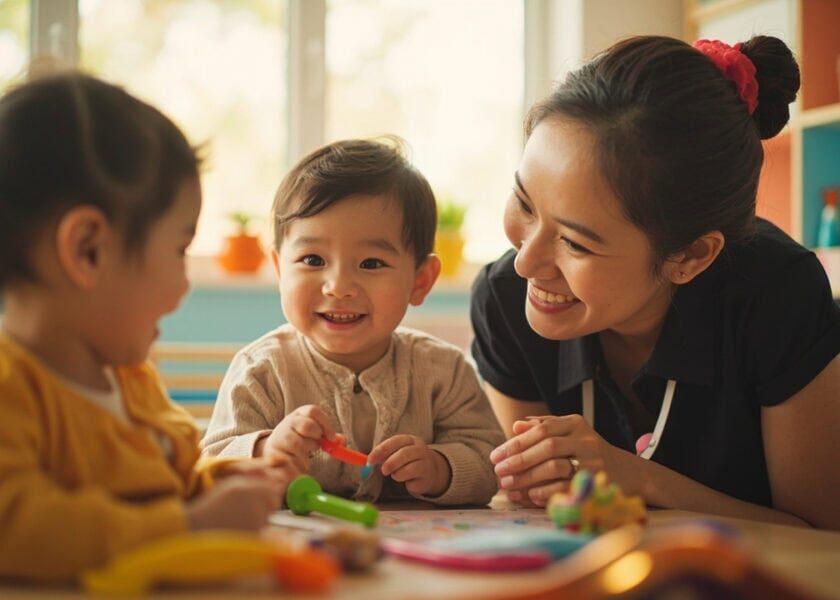
Picture a typical morning in a well-designed childcare space. Children are arriving at different times, in different moods. One child is still crying from the door. Another is already building something with blocks. A third is watching the second child build, curious, drifting slightly closer.
No adult has orchestrated this. No lesson plan dictates it. And yet, something important is happening.
The child who is watching is learning something fundamental: how to observe another person’s focus, how to decide whether to enter that space, how to express interest without intrusion, how to wait for an opening. These are not small skills. These are the skills that will determine whether your child knows how to make a friend in primary school, how to join a group at recess, how to navigate the complex social terrain that will define so much of adult life.
Every shared block, every negotiation over a toy car, every moment of waiting, every small disappointment and small recovery, every time a child says “sorry” and means it — the architecture grows. Brick by brick. Neuron by neuron. Relationship by relationship.
This is what quality childcare is building when it is working at its best. Not just a safe place. Not just a clean place. A social-emotional laboratory where children are discovering, for the first time and in community with other little explorers, what it means to be human together.
The Research Behind What You Suspect
Every longitudinal study that has tracked children into adolescence and adulthood arrives at the same finding. Academic success matters. Physical safety matters. But the single most powerful predictor of long-term wellbeing, of school performance, of relationship quality, of mental health, is something simpler and harder to quantify: the ability to understand your own emotions and manage them well, to read other people’s emotions and respond with empathy, to navigate conflict, to repair what has been broken, to stay present in relationship even when it is hard.
These are the skills that will determine whether your child has friends who are real, who know them, who stay. These are the skills that will determine whether your child grows into an adult who can love well, work well, and recover well.
Here is the extraordinary truth: these skills are not innate. They are not fixed. They are learned. And they are learned in exactly the kind of environment described above — in the moments when a caregiver names a feeling and a child thinks, for the first time, so that is what this is.
The Caregiver as Emotional Translator
None of this happens accidentally. It requires caregivers who are not just warm but deeply trained. It requires ratios that allow for observation and attunement rather than just management. It requires a philosophy that says: our job is not to keep children occupied until you return. Our job is to help them become relationally skilled, emotionally intelligent, socially confident human beings.
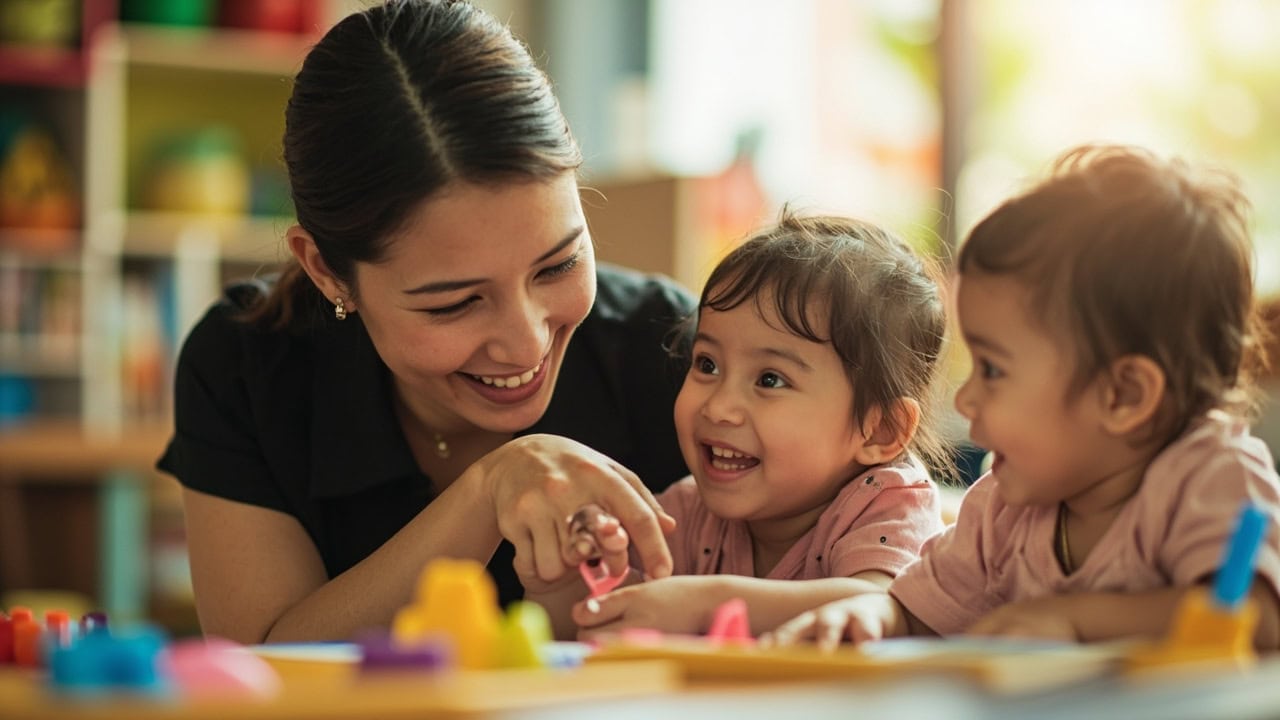
In a high-quality environment, the caregiver becomes something essential — an emotional translator. She is the bridge between your child’s internal experience and the language and understanding that will eventually allow your child to navigate that experience on their own. She tracks not just where the children are physically but how they are feeling, how they are relating, what they are working out, what they need.
This is not scalable in a model that prioritizes throughput over depth. But it is exactly what development requires. Early childhood is not a phase to be gotten through. It is a phase to be inhabited fully, with attention, with intention, with presence.
What Quality Childcare Looks and Sounds Like in Practice
You want to understand what this should actually look and sound like when you pick up your child at the end of the day. Here is what you might observe in a childcare environment that takes the social-emotional curriculum seriously.
Emotional Labeling in Action
You might hear caregivers naming emotions out loud — not just managing behavior but translating feeling into language. “You look so frustrated right now. You really wanted that turn, didn’t you?”
This simple act of emotional labeling does something extraordinary in a child’s brain. It gives them a vocabulary for what they are experiencing. It helps them understand that feeling is not the same as acting, that emotion is information, that the inside of them is something worth understanding and sharing.
Scaffolding Conflict, Not Resolving It
You might observe a caregiver noticing a child in conflict and resisting the urge to resolve it too quickly. Not abandoning the child to figure it out alone, but staying close, staying warm, staying present, while giving the children just enough space to practice the hard work of negotiation. “It looks like you both want to play with the truck. What ideas do you have?”
This is not laissez-faire. This is skilled scaffolding. This is a caregiver who understands that the discomfort of conflict is where some of the most important learning happens — and who stays close enough to ensure that the learning lands safely.
The Language of Genuine Repair
You might notice children being given the language of repair. Not just “say sorry” but “what happened? How did that feel? What might help now?”
Children who learn to apologize with understanding rather than rote compliance grow into adults who can genuinely repair relationships. This capacity — the ability to repair what has been broken — is one of the most powerful predictors of lifelong relational health that researchers have ever identified.
Children Talking About Friends
You might hear children talking about their friends. Not in polished terms, but in the raw, honest language of early childhood. “Maya didn’t want to play with me today.” “We built a really big tower together.” “He said he would share and then he didn’t.”
These stories are not small talk. They are your child’s brain processing and making sense of the social world they are building when you are not in the room. And the way caregivers and parents respond to these stories shapes how your child understands and narrates their own social experience for the rest of their lives.
What to Watch For: A Parent’s Observation Guide
Here is what you might look for when you are evaluating any childcare environment for your child, because arming yourself with this understanding is itself an act of care.
- How caregivers speak to children. Not just whether they are kind, but whether they are curious. Whether they name what they see. Whether they treat children’s feelings as data — worth sitting with rather than rushing past. A caregiver who says “I can see you’re really frustrated” is doing something categorically different from one who says “stop that.”
- How conflict is handled. Conflict is not a sign of failure. How conflict is handled is the sign of quality. Are children given language? Are they given time? Are their feelings treated as reasonable, even when their behavior needs to change? Is repair offered as a gift rather than a punishment?
- How your own child talks about their day. Not just whether they are happy, but what vocabulary they use. Whether they mention friends. Whether they describe their feelings. Whether they come home and replay social moments in their play. These are windows into what is being built.
- The balance of free play. Ask about the ratio of free play to structured activity. Because free play is where the social-emotional curriculum lives most powerfully — in the unscripted moments, the block corners, the pretend games, the small negotiations that no one plans.
Questions Worth Asking
- What do you do when two children want the same thing?
- How do you help a child who is struggling to join a group?
- What does a typical morning look like in terms of free play?
- How do you help a child who is having a hard time regulating their emotions?
- Can you tell me about a moment when you saw two children work something out on their own?
The questions you ask will tell you a great deal about whether the environment you are considering truly understands what we have been discussing today.
Addressing Singapore Parents’ Real Concerns
Trust is not given lightly, and it should not be given lightly. The trust you are being asked to extend — that your child is in hands that understand development, that see your child as a whole person, that are building something precious while you are away — that trust requires substance behind it.
Most of us were not raised with this language. Most of us grew up in environments where emotions were managed rather than explored, where conflict was shut down rather than scaffolded, where apology was a ritual rather than a practice of genuine repair. The idea that a childcare environment is a place for emotional and social development — not just care and supervision — is relatively new thinking. And it requires a different kind of trust from the kind you extend to a babysitter or a school.
Transparency and Partnership
We understand that when you are leaving your child in someone else’s care, in a space you cannot observe throughout the day, uncertainty can feel unbearable. Communication measures built around this reality allow parents to stay connected to their child’s day without intrusion — updates, observations, and moments of discovery shared thoughtfully. Not surveillance, but partnership. Not performance, but trust.
Where observation measures are in place, they are not there to catch anyone doing something wrong. They are there to build a container of trust that protects everyone inside it. When both parents and caregivers know that the space is thoughtfully attended to, something settles. The energy that might otherwise go to anxiety can go to attention. And attention is what children need most.
Affordability and Accessibility
We also want this to be genuinely accessible. The EduNanny approach is part of an ECDA Childminding Pilot, which means it operates within a fee structure designed to make quality care affordable for families. Your Child Development Account can be used. Your Baby Bonus can be applied. Monday through Friday care blocks are structured to meet the realities of working parents in Singapore.
This is not charity. It is the conviction that excellent early childhood care should not be the exclusive privilege of families with significant resources. Every child in Singapore deserves a start that builds their social-emotional architecture well.
Developmental Stages: What Social-Emotional Learning Looks Like from 0 to 6
Understanding that social-emotional development unfolds over time can help you calibrate your expectations and recognize real progress when you see it.
| Age Range | Social-Emotional Skills Emerging | What You Might Notice |
|---|---|---|
| 0–12 months | Attachment, co-regulation, reading caregiver cues | Your baby learns that their feelings are responded to. Separation anxiety signals healthy bonding. |
| 12–24 months | Parallel play, early empathy, emotional labeling begins | Toddlers play alongside each other, notice when another child is upset, and begin learning feeling words. |
| 2–3 years | Negotiation, sharing language, conflict emergence | Real battles over toys begin. With support, children start learning “mine” can coexist with “yours.” |
| 3–5 years | Friendship concepts, repair language, emotional regulation | Children name friends, attempt apology, and begin managing disappointment with caregiver scaffolding. |
| 5–6 years | Group navigation, empathy consolidation, self-regulation | Children join groups, read social cues fluently, and manage frustration without constant adult intervention. |
EduNanny: Built Around the Social-Emotional Foundation
When the EduNanny approach was designed, everything started with a question that was returned to again and again: What would it mean to build a childcare experience that truly understood the social-emotional work happening inside it? Not as an afterthought. Not as a marketing claim. But as the architectural foundation of everything else.
What was discovered is that this requires starting small — not small in ambition, but small in ratios. In the EduNanny pilot programme, there is up to one caregiver for every three infants. At this ratio, the caregiver is not just supervising. She is noticing. She is tracking how each child is feeling, how they are relating, what they are working out, what they need.
The caregiver approach at EduNanny is built around principles that are non-negotiable in how the service operates:
- Emotional labeling is used consistently — caregivers name what they observe in children, building vocabulary and emotional self-awareness from the earliest months
- Conflict is scaffolded rather than resolved — caregivers stay present and warm during peer conflict, offering just enough support for children to practice negotiation
- Repair is taught as a practice, not a ritual — children are guided through understanding what happened, how it felt, and what might help, building genuine relational repair skills
- Free play is protected as the primary arena for social-emotional learning — structured activities complement, but never replace, the unscripted peer interactions where skills are truly built
- Parent partnership is active — regular, thoughtful communication keeps parents informed not as spectators but as partners in their child’s development
When You Drop Your Child at the Door
So when you drop your child at the door in the morning and feel that familiar ache of leaving, I want you to remember this. You are not just leaving them in care. You are leaving them in a place where, if it is the right place, they are building their emotional intelligence. They are learning to feel and to name what they feel. They are learning to read others and to be read. They are learning that relationships are hard and that they are worth it.
That is not small. That is everything.
Every single day your child spends in a quality childcare environment, they are learning something about what it means to be a person in relationship with other people. And the skills they are building there are the ones they will carry forward into every classroom, every friendship, every team, every family they will ever belong to.
If you are looking for a place that understands this — that takes the social-emotional curriculum as seriously as any academic preparation — we would be glad to hear from you. Not just to care for your child, but to partner with you in building the relational foundation that will carry them forward for the rest of their lives.
Learn more about EduNanny and the EduNanny approach to thoughtful, development-oriented childcare in Singapore.