Beyond Supervision: Daily Observation That Transforms How Singapore Parents Understand Their Children
The Morning Goodbye: What Every Singapore Parent Carries
There is a particular silence that follows the morning drop-off. You have kissed your child’s forehead, adjusted the collar of their shirt, handed them their small backpack with its carefully packed milk bottle and spare clothes, and walked out the door.
The car door closes. The engine starts. The Singapore traffic begins its familiar crawl toward the office, and somewhere behind you—in a classroom, in someone’s home, in a space you have trusted with the most important person in your life—your child is beginning their day.
A day you will not see. A day you will not be part of. A day that belongs entirely to them, unfolding in your absence.
This is the unspoken reality of parenting in Singapore. We have built a society where both parents work, where extended family often lives in separate towns or separate countries, where the rhythms of early childhood development happen during the nine or ten hours when most parents are expected to be elsewhere.
We have made peace with this arrangement because we must. We have made peace with it because we trust—we have to trust—that our children are safe, that they are cared for, that they are not suffering in our absence.
But here is what we rarely say aloud, in the quiet moments when we scroll through our phones at lunch or sit in a meeting that seems to stretch forever: we do not just want our children to be safe. We want to know them. We want to witness their growth. We want to feel close to their days even when we could not spend those days with them.
Safety is the floor, not the ceiling. What we truly long for is connection—and connection requires something more than supervision.
What Trained Observation Changes
Consider what a trained educator notices that an untrained eye does not.
A parent dropping their child at a childcare centre might see a happy, active toddler. They see a child who waves goodbye, who seems comfortable, who does not cry at separation. This is meaningful information. It tells you that your child feels secure enough to let you go.
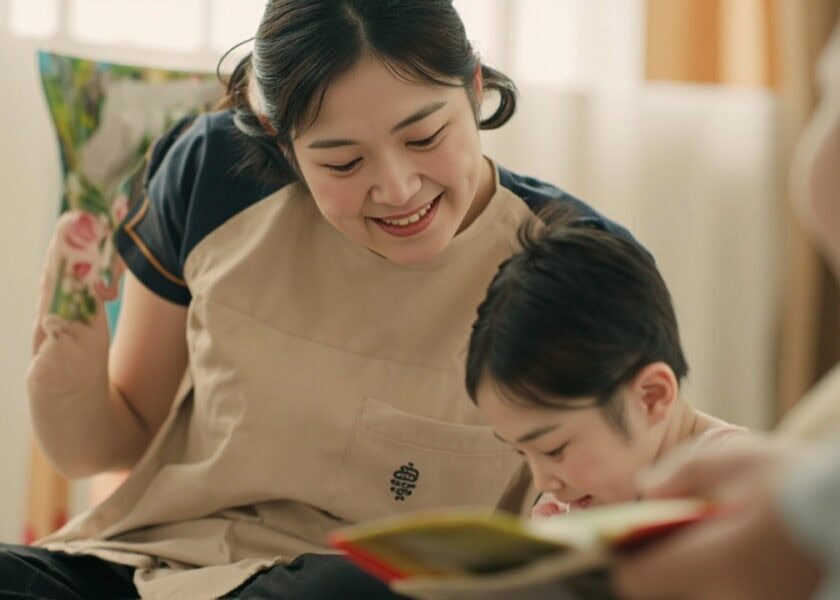
But a trained educator sees more. She sees that this morning, unlike last Tuesday, your child did not immediately join the block corner but stood near the door for almost thirty seconds, scanning the room. She sees that when another child approached with a toy, your child’s hands went up in a gesture she has been making for the past two weeks—not quite reaching, not quite retreating, but hovering in the space of indecision.
She sees that today, something in your child’s inner world is working differently, and she writes it down. She will tell you this evening, not as an observation that your child seemed fine, but as a small data point in the larger picture of your child’s social development—the picture you cannot see because you were not there, but the picture that matters more than you know.
What Development Looks Like When You Know to Watch
A child stacking blocks for the first time looks, to an untrained observer, like a child playing with blocks. To a trained educator, it is a window into fine motor development, cognitive sequencing, persistence, and frustration tolerance.
A child who suddenly refuses a food they previously accepted looks, to an untrained observer, like a child being fussy. To a trained educator, it may be a signal of a developmental leap—children often reject food during cognitive spurts, when their attention is entirely consumed by other growth.
A child who hits another and then looks surprised by their own action looks, to an untrained observer, like a child being aggressive. To a trained educator, it may be a child discovering the power of their own body and lacking the neural pathway yet to inhibit the impulse.
These are not subtle distinctions for the sake of intellectual interest. They are distinctions that change how you understand your child. They are distinctions that transform the question “How was your day?” from a polite exchange to a genuine revelation.
Why These Early Years Matter Most
The first thousand days of your child’s life—from conception to roughly their third birthday—are not a prologue. They are not a warm-up act for the real show. Research in developmental science has established, with growing clarity and consensus, that these earliest years lay the foundation for everything that follows: cognitive capacity, emotional regulation, social ability, physical health, the architecture of the brain itself.
What happens in these years matters more than what happens in any other equivalent period. This is not sentiment. This is science.
Which means that what happens during your child’s hours in childcare is not peripheral to their development. It is central to it. The relationships they form, the stimulation they receive, the observations that are made and acted upon—these are not background details in your child’s story. They are the story itself, at least for the hours when you are apart.
What EduNanny Singapore Offers
The educators at EduNanny are trained in this kind of observation because we believe it is the most important work we do.
Grounded in Standards That Matter
We are part of the ECDA Childminding Pilot, which means our approach is grounded in the standards and intentionality that come with government recognition. Our infant ratios—up to one to three, depending on the setting—are designed not just for safety, but for the attention that meaningful observation requires.
You cannot watch a child with developmental depth if you are responsible for eight infants at once. Attention is a finite resource. We have structured our care to protect it.
Systematic Observation, Daily Communication
Whether we operate in a home-based setting or within our community and centre-based pathways, our educators are trained to observe systematically and report consistently. This is not improvisation. This is methodology.
Every day, multiple times a day, your child’s educator is noticing, recording, and preparing to share. The communication systems we have put in place—including transparency measures such as CCTV where deployed—are not about surveillance. They are about creating the conditions for trust, which is the foundation of everything else we do.
What This Means for Your Evening Collection
Here is what this means for you, practically and emotionally.
It means that when you collect your child at the end of the day—tired, perhaps, after your own demanding hours—you receive more than a summary that they were good, they ate well, they napped on schedule.
You receive insight.
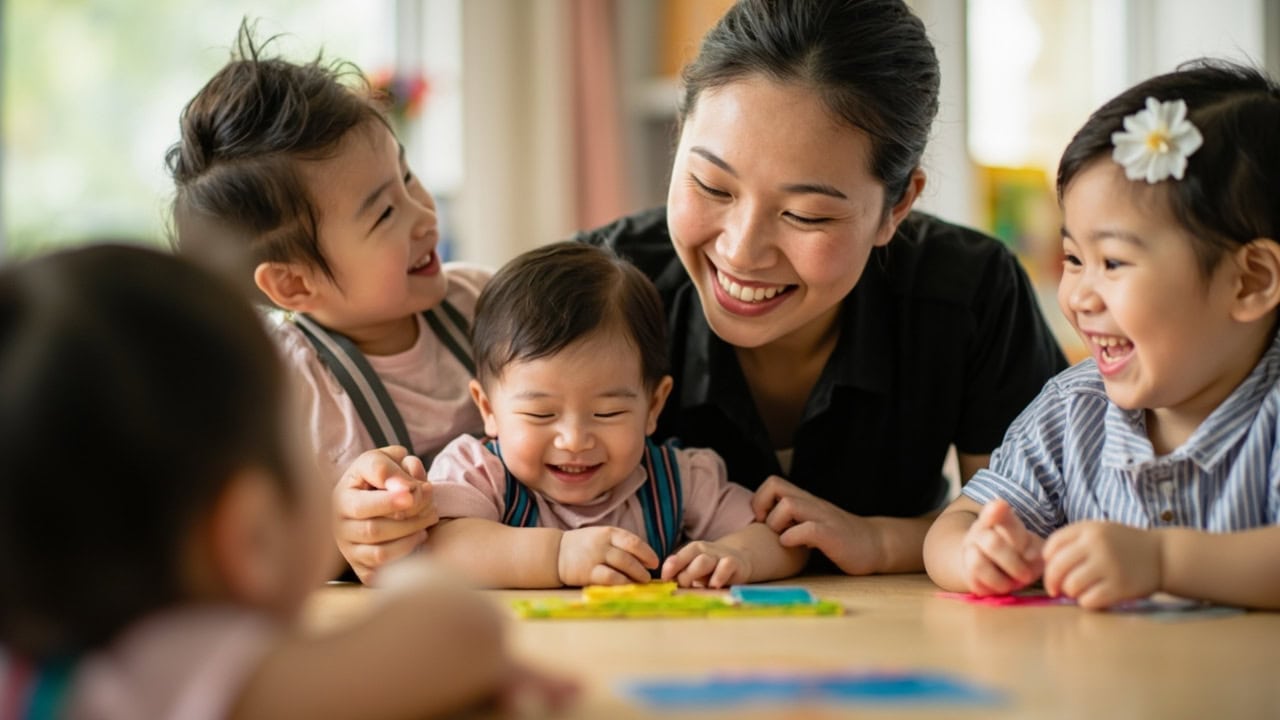
You learn that today, your child discovered how to use a spoon to scoop rather than just bang. You learn that they showed unusual interest in a book about animals and pointed at each one, waiting for the name. You learn that they played next to another child for the first time—not alongside but adjacent, parallel play that is the earliest form of socialization—and that they looked up once, as if checking whether you were there, and seemed satisfied that the familiar adult nearby was watching.
These are not trivia. These are the building blocks of your child’s becoming. And when you receive them—when someone tells you about the day your child had with the precision and care of a trained professional—you feel something shift. You feel closer.
The gap that seemed so large in the morning, the hours that stretched between you and your child’s experience, collapses into something manageable, something bridgeable. You are not shut out of your child’s day. You are being let in through a door you did not know existed.
Supervision vs. Developmental Partnership
Understanding the difference between what childcare can offer and what quality childminding provides is essential for making an informed decision.
| Aspect | Standard Supervision | Developmental Partnership |
|---|---|---|
| Primary Focus | Safety, basic needs met | Safety plus active observation |
| Daily Communication | “They were fine” summary | Specific observations about development |
| Educator’s Role | Caregiver, supervisor | Caregiver, observer, translator |
| Parent Experience | Trusting the day was okay | Feeling connected to child’s growth |
| Reporting Style | Periodic check-ins, incident reports | Daily developmental insights |
| Understanding of Child | General wellbeing indicators | Patterns, progressions, emergence |
Supervision keeps children safe. It ensures they are fed and rested and not in danger. These are non-negotiable. But supervision, alone, leaves you where you started—trusting that the day was fine, hoping it was good, knowing only what you can piece together from your child’s incomplete descriptions or your own anxious imaginings.
Developmental partnership does something more. It translates. It takes the language of your child’s day—the language of movement and expression and discovery—and renders it into terms you can understand, terms that connect to the child you are raising, terms that make you feel like a participant in their growth rather than a distant observer of it.
Evaluating Your Options and Addressing Your Concerns
We believe honesty matters more than persuasion. Here is what EduNanny Singapore is not—and what we are.
What We Are Not Offering
- We are not offering perfection. Children are unpredictable, and even the best observation is an interpretation, not an absolute reading. Our educators are trained professionals, but they are not in possession of some secret knowledge that demystifies childhood. What they offer is disciplined attention—the habit of noticing with purpose, recording with care, and communicating with clarity.
- We are not offering a replacement for your presence. Nothing is. The hours you spend with your child are irreplaceable. What we offer is complement—the filling in of spaces you cannot occupy, the witnessing of moments you would otherwise miss, the professional bridge that connects your awareness to your child’s actual experience.
- We are not offering childcare that is out of reach. We are part of a pilot designed to make quality childminding accessible. Our fee structures are built with affordability in mind. CDA funds and Baby Bonus can be used, and care is available across weekdays in blocks that align with the working day.
- We are not offering a vague promise of quality. Quality, for us, has a definition. It means trained observation. It means low ratios. It means systematic communication. It means transparency measures that allow you to trust what you cannot see.
The Human Work
But the real work is human. It happens in the moments when a child looks up from play and their face changes—a flash of concentration, a spark of recognition, a new expression that has never been there before.
It happens in the careful observation of how children interact with each other, how they negotiate space and toys and attention. It happens in the quiet noticing of a child’s emotional texture—which children they seek out, which activities they return to, which moments make them laugh and which make them retreat.
Our educators are not just caregivers. They are your eyes when you cannot be present. They are trained professionals who have chosen this work because they understand that the early years are not a waiting room before real life begins. The early years are real life. Every moment matters.
Questions to Ask Any Childcare Provider
- What is the educator-to-child ratio? Smaller ratios mean more individual attention and deeper observation.
- How do educators document daily observations? Look for systematic, written approaches—not just verbal summaries.
- What specific information will I receive about my child’s day? Vague reassurances differ fundamentally from developmental insights.
- What training have educators received in child development? Ask about specific coursework, not just years of experience.
- How do you handle communication about developmental concerns? Quality providers have clear protocols for sharing observations that may warrant attention.
- Can I see your transparency measures? CCTV, daily reports, and open communication channels all signal confidence in their practice.
- What does your approach look like during the first thousand days? A provider who understands developmental science will have intentional practices for this critical period.
Signs of Quality Childminding
- Educators can describe your child’s specific patterns, preferences, and progressions
- Daily communication goes beyond “they ate well and napped”
- You feel informed about your child’s development, not just their basic care
- The provider talks about observation as part of their methodology
- You receive specific examples of moments from your child’s day
- Low ratios that allow for meaningful individual attention
- Transparent systems that invite trust rather than requiring blind faith
The Bridge Between Absence and Connection
We live in a city that runs on dual incomes and long hours and the daily negotiation of work and family. We understand that reality because we share it.
The parents who bring their children to us are not negligent. They are not choosing career over children. They are doing what modern Singapore requires, what modern parenting demands, what the economic and social architecture of our city-state has made necessary.
They are doing their best. And their best deserves support that goes beyond the minimum.
EduNanny was built to offer something more—not as a premium indulgence, but as a genuine developmental resource for families who deserve to feel close to their children’s lives even when they could not be present for every moment.
Our approach is thoughtful, our educators are trained, our systems are designed for transparency and trust. We are part of a pilot that is testing new possibilities for childminding in Singapore, and we take that responsibility seriously.
The heart of what we offer is simpler than any system or structure. It is the commitment to notice.
To notice your child with the attention they deserve. To notice the small miracles of their daily development—the new word, the careful stack of blocks, the hand reaching out to another child, the face lighting up at a story.
And then to tell you. To bridge the distance. To make you feel, at the end of every workday, that you know your child a little better than you did that morning.
This is what trained observation makes possible. This is what EduNanny offers. Not just a place where your child is kept, but a place where your child is seen—and where what is seen is shared with you, every day, in the language of love and expertise.
Your child’s days are happening. Even when you are not there to see them. Even when the morning goodbye feels like a small loss. Even when you wonder, in the middle of a long meeting or a difficult commute, what your child is discovering, who they are becoming, what they might show you if they could.
They are discovering. They are becoming. And there is someone there, trained and attentive, watching for the moments that matter.
EduNanny is that someone. EduNanny is the bridge. And we would be honored to be part of your child’s story—and yours.
If this approach to childminding resonates with you—if you are looking for childcare that does more than supervise, that actively observes and daily reports, that treats your child’s development as the serious work it is—we invite you to learn more about EduNanny Singapore and the ECDA Childminding Pilot.
Your child’s daily development is happening whether you can witness it or not. Let us help you feel closer to it.