Beyond Safety: Reading Your Child’s Inner World in Singapore Childcare
That Quiet Moment Every Singapore Parent Knows
There is a moment every Singapore parent knows. It comes during a routine check at the polyclinic, or during a casual conversation at the playground, when another parent mentions their child’s latest milestone and something tightens in your chest. Not from worry, exactly. From the quiet recognition that you have been watching too. That you have been counting and measuring and noticing, sometimes without even realizing you were doing it.
Your child spoke their first word at eleven months. They walked at thirteen. They started pointing at birds and trucks and the red buses that rumble down the road, and somewhere along the way, you became fluent in the language of developmental progress. You know what to look for. You know the milestones, the windows, the sequences. You have become, without anyone formally teaching you, a careful observer of growth.
But here is what no one has told you, and what you have not yet learned to ask: What does your child feel when they are not with you?
Safety Is the Floor. Not the Answer.
This is not the same question as whether your child is safe. You have answers for safety. You have toured the centres, checked the ratios, read the reviews, asked about CCTV systems and emergency protocols. Safety is knowable. It can be inspected and verified and measured against a checklist.
But safety is only the floor. It is the absolute minimum that any parent should expect, and it is not, by itself, the answer to the question your heart is actually asking.
The question your heart is asking sounds like this: When my child is with someone else, does she feel held? Does he feel known? When I drop him off in the morning and he turns to face the day without me, is he at ease, or is he managing?
Thriving and coping look similar from the outside. And learning to tell the difference is one of the most important skills a parent can develop — yet it is a skill that most parenting advice does not teach, and most childcare marketing does not speak to.
The Building Beneath the Scaffolding
When we talk about infant care, we often focus on the physical. The ratios. The hygiene. The nutrition and the sleep schedules and the milestones achieved. These matter. But they are the scaffolding, not the building.
The building is what your child feels inside that scaffolding. The building is whether your child’s inner world — their sense of emotional security and belonging — is being tended to with the same attention you would give to their outer world.
Emotional regulation in a young child is not the absence of big feelings. Children who feel secure feel deeply, because they have learned that big feelings are survivable and that someone will help them come back to center. This capacity develops in relationship — in the small, daily moments of being soothed, of being seen, of having your needs met not just physically but emotionally.
A child’s nervous system learns to regulate through co-regulation — through the slow, patient work of a caregiver who notices their distress and responds with presence. This is the foundation on which everything else is built.
Reading Your Child’s Felt Experience
So how do you know if your child feels secure when you are not in the room? You learn the signs. The same way you learned to read developmental milestones. The same way you learned to notice the precursors to walking, the first signs of language, the subtle shifts that told you your child was becoming someone new. You learn to notice the emotional signs.
Begin with Homecoming
Not the beginning of the day. Not the drop-off that you have learned to manage with practiced efficiency and a brave smile. Begin with homecoming.
Watch your child in the first twenty minutes after you pick them up. Not what they say, though that matters. Not what they do, though that matters too. Watch the quality of their ease.
Notice whether they collapse into your arms with a full-body release, the way a child collapses when they have been holding something together for hours and can finally stop. Or notice whether they are upright and bright and engaged, turning to greet you with real pleasure rather than performance.
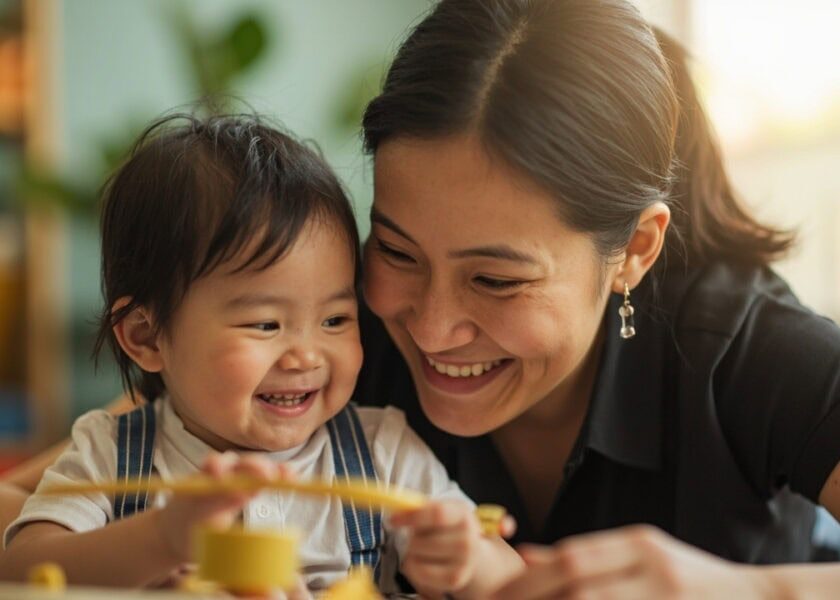
There is a difference between a child who is glad to see you and a child who has been glad to see you all day. A child who feels truly secure in their childcare environment comes home ready to be a child. They are not depleted. They are not tense. They do not need to recover from the day — they need to share the day.
What Bracing Looks Like
Performance and wellbeing look similar from the outside. A child who is managing can follow instructions, share and take turns, use their words. They can smile for photographs and wave goodbye and appear, by every external measure, to be thriving.
But a child who is truly well shows signs that are harder to fake. Watch a secure child, and you will see:
- They initiate play rather than wait to be invited.
- They approach a caregiver with the easy entitlement of someone who belongs there, not the hesitation of someone who is not sure they are welcome.
- They rest in the presence of an adult without needing that adult’s attention — the way a child rests in the presence of a parent.
- They move through the environment with their bodies soft and open, rather than braced.
Bracing is one of the most important signs a parent can learn to read. It is subtle. It lives in the shoulders, the jaw, the way a child holds their arms when they are lifted. A child who is braced is a child who is prepared for something to be wrong. They have learned, often without anyone meaning to teach them, that they must stay alert.
Bracing is not the same as caution. A cautious child explores slowly, but their body is still soft. A braced child is holding themselves together, even in play. Even in comfort. A child who feels truly secure has an ease about them that is not the absence of energy or interest but the presence of trust.
Five Signals of Genuine Emotional Security in Childcare
These are the learnable, readable signs that tell you whether your child is flourishing — not just coping. The more you practice reading them, the more fluent you become in your child’s emotional language.
1. Homecoming ease. The quality of your child’s body when they return to you — not just their words. Look for the full-body release. Listen for the sigh that says everything.
2. Emotional texture in conversation. A child who feels secure will speak about their caregivers with casual intimacy, as if they are talking about family. They will mention moments of connection without being prompted. They will ask, on their own, about their caregiver’s wellbeing, or mention missing them after a day apart. This is not learned politeness. This is the natural language of a child who has formed a genuine attachment.
3. Response to the caregiver’s name. A secure child lights up when their caregiver is mentioned. An ambivalent child may show no response, or a hesitation, a flicker of something difficult to name. Your child’s body knows how they feel before their mind can articulate it.
4. Quality of separation. Not the first week, not the adjustment period, but after — when the routine has settled. Does your child separate easily? Not with relief — that is a different signal — but with the confident ease of someone who knows where they are going and trusts that they will come back? Or does each goodbye carry a weight that does not fade even after months of the same routine?
5. Spontaneous engagement. Watch how your child plays when you are not directing them. A secure child initiates, experiments, explores with their whole body soft. They are curious because they feel safe being curious. They are not performing engagement for an audience.
What Quality Childcare Actually Looks Like
Tending to a child’s inner world requires something that a checklist cannot capture. It requires attunement — a caregiver who is not just present but attuned. Who notices not just what the child is doing but how the child is being. Who tracks not just developmental progress but emotional development.
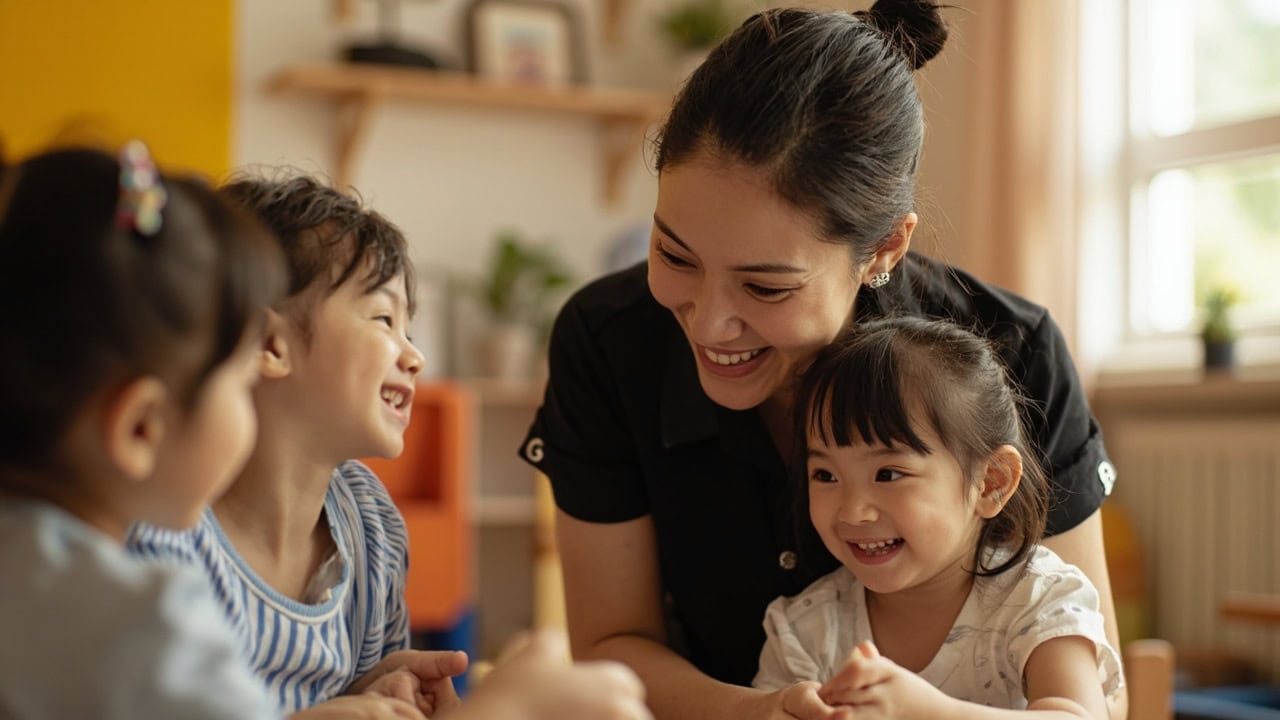
An attuned caregiver knows your child well enough to notice when something is off before it becomes a problem, and responds in a way that communicates, again and again: you are safe here, you are known here, you belong here.
Questions to Ask When Evaluating Care
- Ask about ratios. In infant care, lower ratios mean more individual attention and deeper relationship. Up to one-to-three in home-based settings makes genuine attunement possible.
- Ask how caregivers track emotional development. Not just what they do when a child is upset, but how they notice patterns over time, how they communicate emotional wellbeing to parents.
- Observe the environment. Do the children look soft and open in their bodies, or braced? Do caregivers kneel to a child’s level when they speak? Do children approach caregivers, or do caregivers direct all the interactions?
- Ask about communication. What does a typical update look like? Is it factual — meals, naps, diaper changes — or does it include observations about how your child is being? Their relationships? Their moments of joy?
- Trust your child’s homecoming. No tour or conversation will tell you what your child’s body will tell you after the first few weeks. Watch the quality of their ease. Watch for bracing. Listen to the emotional texture of what they share.
Home-Based vs Centre-Based: Understanding Your Options
| Dimension | Home-Based Childminding | Centre-Based Care |
|---|---|---|
| Infant ratios | Up to 1:3 — space for genuine attunement | Varies by centre; often higher |
| Environment | Domestic, smaller scale, consistent caregiver | Larger group setting, multiple caregivers |
| Emotional tracking | Caregiver has space to know each child deeply | Individual emotional tracking can be harder to sustain |
| Transitions | Often gentler — one caregiver relationship | May involve multiple caregiver relationships |
| Best suited for | Infants, sensitive toddlers, families wanting deeper relationship | Older toddlers who benefit from peer interaction |
Both pathways can offer quality care. Both require the same deeper question: does the caregiver have the space and attention to know my child as an individual?
What EduNanny Singapore Was Built to Honour
EduNanny operates within the ECDA Childminding Pilot, and from the very beginning, our model was designed around a simple conviction: that every child deserves to be known, not just watched. Known in the way that matters most — emotionally, relationally, in the full texture of their inner experience.
Known by caregivers who are attuned enough to notice when something shifts. Who track not just what a child achieves but how a child feels. Who understand that the child’s felt experience of belonging is the foundation on which everything else is built.
Our caregivers maintain up to a one-to-three infant ratio in home-based settings, because attunement requires space. It requires the freedom to notice, to respond, to be present in the way that true care demands. It requires not just supervision but relationship.
We offer both home-based and centre-based pathways, because every family is different, and the right environment for a child depends on the family, the child, the context. What does not change across our pathways is the philosophy: the commitment to knowing each child as an individual, to tracking emotional development alongside physical and cognitive development, to communicating with parents not just about milestones achieved but about the child’s inner life — their moments of joy and difficulty, their relationships, their sense of belonging.
Our communication practices are designed to give parents visibility into their child’s day — not as performance reports but as genuine windows into experience. Where deployed, our CCTV measures reflect our commitment to accountability — not because we have anything to hide, but because we believe parents deserve to know what is happening in the spaces where their children are.
Our pilot fee structures are designed to be affordable, and care blocks are available Monday through Friday. CDA and Baby Bonus funds are usable with us, because accessing quality care should not require financial acrobatics.
These are the practical dimensions of our service. They matter. But they are not why we exist.
We exist because we believe that a child’s first experience of being apart from their parents should be an experience of belonging. Not just safety. Not just supervision. Belonging.
You Already Know More Than You Think
There is a moment that every parent who has learned to read their child’s emotional signals describes. It comes when they first see their child in a new way — not just as a small person to be cared for, but as a whole emotional being whose inner life is rich and legible and worthy of attention.
It comes when they pick up their child from care and notice, for the first time with real clarity, the quality of their child’s ease. The way they collapse into the stroller with a sigh that says everything. The way they chatter on the way home, not because they are supposed to, but because they have so much to share. The way they do not cling at drop-off, not because they do not love you, but because they trust you to come back — and trust the people you have left them with.
It is the moment when childcare stops being a leap of faith and becomes a source of confident peace. Not because the world is risk-free — no parent lives in that world — but because you have learned to read the signs. Because you have become, in your own right, an expert on your child’s emotional experience. Because you know, in your body and your intuition and your carefully developed observation skills, that your child is not just okay.
Your child is flourishing.
This is what we want for every family we serve. Not just safe childcare. Not just quality childcare. Childcare that knows your child. Childcare that sees your child. Childcare that understands, as you understand, that the most important indicator of quality is not what a child can do, but what a child feels.
And it begins with you, learning to read what your child is already telling you.
EduNanny by BUTLER operates within the ECDA Childminding Pilot, offering both home-based and centre-based pathways for families in Singapore. CDA and Baby Bonus funds are accepted. To learn more about our approach to infant care and childminding, we invite you to reach out and begin a conversation.
#SingaporeChildcare #InfantCareSingapore #ChildmindingSG #EmotionalDevelopment #EduNannySingapore