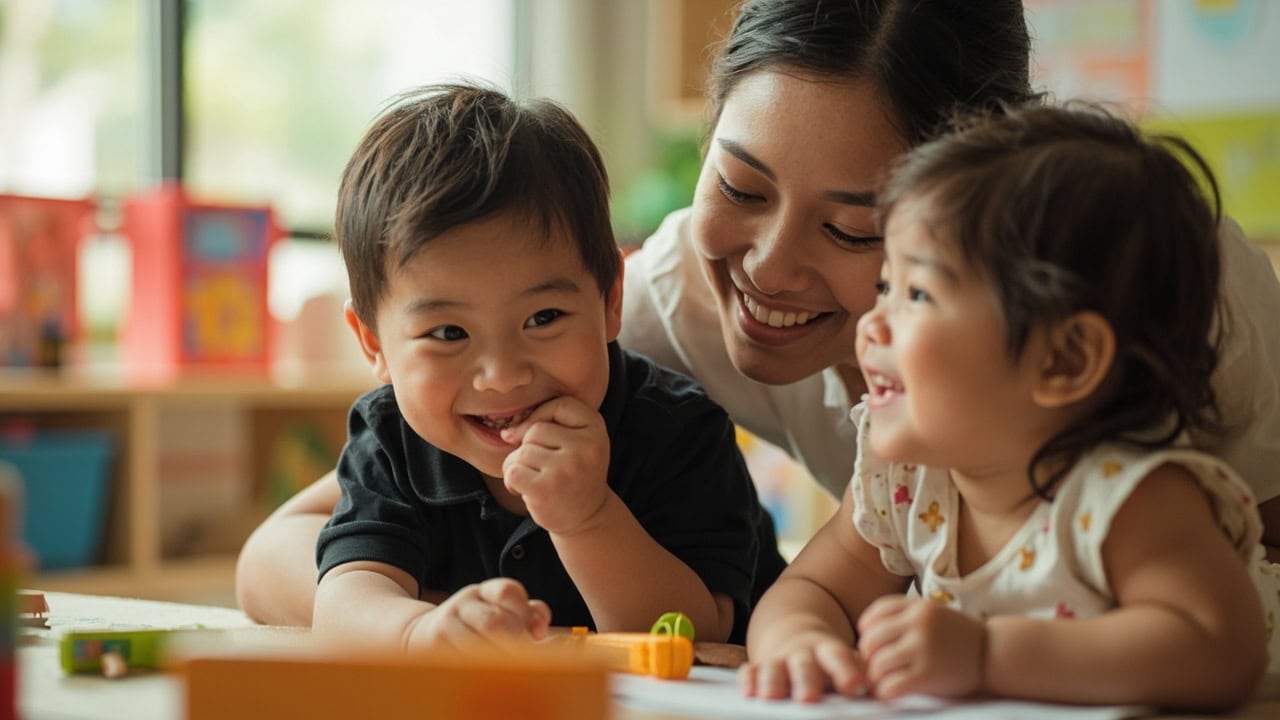
Beyond Identical Treatment: Why Each Sibling Deserves Individual Attention in Childcare
The Sibling Care Question: What Parents in Singapore Really Want to Know
This is not a question about competence or commitment. It lives beneath the logistics of scheduling, the practicality of costs, and the relief of finding care you can trust. It is the question that sits quietly with parents—not because they doubt their caregiver, but because they love their children so much that they cannot bear the possibility of either one being overlooked in the crowd of siblings.
You want your children to share a life together. You want them to build the bonds that siblings build—the private jokes, the fierce loyalties, the knowledge of each other that no one else will ever quite share.
But you also want each of them to be seen. You want your quieter child to be known, not just accommodated. You want your more spirited child to be understood, not just managed. You want the caregiver who holds your family’s daily life in her hands to recognize the difference between what looks like the same behavior and what is actually two completely different children arriving at the same moment from entirely different internal worlds.
This is the tension at the heart of sibling care in Singapore—and it deserves a more honest answer than most parents receive.
Understanding the Fear Behind the Question
When siblings share a caregiver, there is a natural concern that care becomes standardized. That two children receive essentially the same experience wearing different names. That the quieter one learns to wait and the more assertive one learns to take space—not because anyone intended it, but because there are only so many hours and only so much attention to go around.
This is not an unreasonable fear. It is an honest one.
The reason it feels so acute is that you know, with a clarity that no expert can give you, that your children are not the same. Your daughter approaches new situations with caution, processing before she acts, needing time to trust before she can play freely. Your son launches himself into the world as if certainty is something he was born knowing, learning through motion, through repetition, through the sheer force of trying.
The same caregiver greeting them in the morning cannot possibly greet them the same way—or can she?
What Sibling Individuality Actually Means in Practice
The answer is not about whether siblings are in the same room or different rooms. It is not about ratios on paper or the number of children enrolled. It is about whether the caregiver has a system for knowing each child as an individual, not just as a member of a family unit.
Consider what this means in practice. Imagine two siblings, both seemingly “playing” in the same afternoon. One child is deep in parallel play, still learning that others exist alongside her, working on the fundamental discovery that her actions create reactions in the world. The older child has moved beyond this stage. He is watching how other children solve problems, absorbing social cues, beginning to understand himself in relation to peers.
Same room. Same caregiver. Entirely different developmental work happening.
Now imagine a caregiver who notices this distinction. Who recognizes that the younger child needs the freedom to explore without the pressure of social modeling, while the older child genuinely benefits from watching others. This caregiver is not just watching two children. They are holding two developmental trajectories in mind at once—adjusting, responding, recognizing that fairness does not mean identical treatment but means meeting each child where they are.
The sibling bond does not diminish individuality. When both children are truly seen and truly known, they are better able to share themselves with each other. They do not compete for attention because attention is not a finite resource being rationed. They become companions who know each other because each of them has been known.
What Quality Childminding Actually Looks Like
When childcare is designed rather than defaulted, sibling care looks nothing like what most parents fear. It looks like a caregiver who has taken the time to understand not just what your children do, but how they do it.
It is noticing that one child’s frustration manifests in stillness while another’s erupts outward. It is understanding that the same milestone reached at the same age by two siblings can mean entirely different things about readiness and need. It is recognizing when your more demanding child is asking for something deeper than the surface behavior and meeting that need rather than just managing the behavior.
This kind of attention requires conditions that make it possible—a caregiver who is not stretched so thin that observation becomes impossible. It requires time with each child, not just supervision of both. It requires a deliberate approach to tracking development and temperament, not as a bureaucratic checklist, but as a genuine investigation into who each child is becoming.
In practice, individualized sibling care is possible when the conditions are designed for it. Caregivers must be trained in the art of noticing, of holding multiple children in mind, of seeing the sibling unit and the individual child at the same time without confusing the two.
How EduNanny Singapore Approaches Sibling Care
The model behind EduNanny was developed through the ECDA Childminding Pilot, built on a simple premise: individualized sibling care is possible when the conditions are designed for it.
Caregivers in the program are trained in the art of noticing, of holding multiple children in mind, of seeing the sibling unit and the individual child at the same time without confusing the two. They learn to ask questions that most parents have never been asked about their child. They learn to notice patterns that most parents have never had the language to describe. They learn to advocate for a child’s individuality even within a family context where siblings are naturally compared and grouped.
The home-based and community pathways available through the pilot maintain ratios that make this possible. With up to three infants in care, a caregiver has enough space and attention to actually see each child. This is not an accident of logistics. It is a design choice made in recognition of what it actually takes to know two children from the same family well enough to care for them as the distinct individuals they are.
Monday to Friday care blocks create consistency, which is the foundation of trust. Communication protocols, including transparency measures where CCTV is deployed, create partnership, which is the foundation of confidence. CDA and Baby Bonus usability removes unnecessary financial friction from a process that is already emotionally complex.
These are not features listed on a brochure. They are the conditions that make individualized sibling care possible.
Questions to Ask When Choosing Care for Multiple Children
Whether you choose EduNanny or another provider, these questions will help you understand whether sibling care at any given arrangement will truly meet each child where they are:
- How does the caregiver track each child’s development separately? You want to know if there is a system for understanding each child as an individual, not just as part of a sibling pair.
- How does the caregiver handle temperament differences? Ask specifically about what happens when siblings have different needs in the same moment. How is that navigated?
- What does a typical day look like for each child? The answer should not be identical for both children if they have different temperaments and developmental needs.
- How does the caregiver communicate about each child individually? Reports should not blend siblings into one narrative. Each child should have their own story.
- What happens when one child needs something the other doesn’t? Individualized care means that siblings sometimes have different experiences on the same day.
Making the Choice That Feels Right
Even with the right questions answered, the worry that brought you here may not fully disappear. That is okay. It means you care deeply about getting this right.
The honest truth is that no caregiver will love your children the way you do—and no caregiver should try to. What you are looking for is not a replacement for your attention. You are looking for a partner who will extend your care when you are not in the room. Someone who sees your children clearly enough to advocate for them even when they cannot advocate for themselves.
You want someone who will notice when your quieter child is beginning to shrink into the background and deliberately draw them forward. Someone who will recognize when your more demanding child is asking for something deeper than the surface behavior and meet that need.
Here is what the sibling question ultimately comes down to, and it is the question that you already know the answer to, even when you cannot yet articulate it.
You want your children to grow up knowing each other. You want them to have companions in the chaos of their childhood, someone who shares the language of your home, the rhythms of your family, the inside jokes that no one else will ever fully understand.
But you also want each of them to grow up knowing themselves. To know that they are not just someone’s sibling, not just part of a unit, but whole persons with their own temperaments and their own paces and their own gifts and their own struggles. You want each of them to feel, in the deepest part of themselves, that they are seen—not because they are siblings, but because they are themselves.
Your first child taught you what it means to love someone so much that you want to protect them from everything. Your second child, or your third, has taught you something harder and perhaps more important: that love multiplies rather than divides, that your heart does not run out of room, that you can know each of your children as their own person and love them all with the same ferocious completeness.
Choosing care for your children is not just a logistical decision. It is an expression of your values, your hopes for your family, and your understanding of what your children need to flourish.
You already know your children. You know them in ways no one else ever will. The question is whether you can find a caregiver who will come alongside you in that knowing, who will look at your children with the same attention and care that you do.
That is the work. That is the purpose. And that is what every caregiver in this program is trained to honor—for your first child and your second, for the bond they share and the individuals they are, for the life you are building together, one that is messy and beautiful and entirely, irreplaceably yours.
If you are exploring care that takes sibling individuality seriously—care that understands the difference between watching two children and truly knowing each one, care that keeps ratios low enough for genuine witnessing to be possible—EduNanny Singapore was built for families like yours. We welcome the conversation.