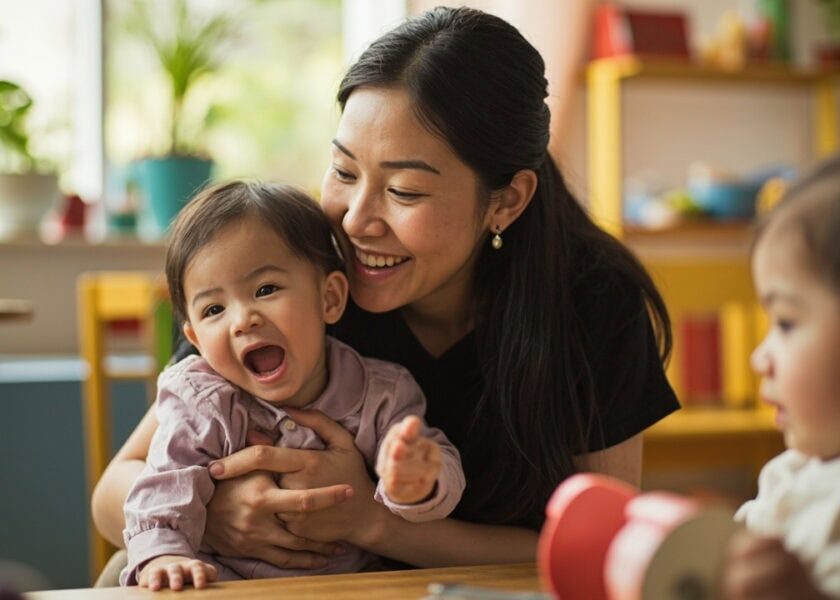
Beyond Fine: The Childcare Update Singapore Parents Actually Need
The Moment Every Singapore Parent Knows
There is a moment at the end of most working days in Singapore that every parent knows. You walk through the door of your child’s childcare arrangement — centre, home-based setting, someone’s living room — and you reach for your child with one arm while your eyes reach for the person who has spent the day with them. You ask, perhaps casually, perhaps with the careful studied indifference of someone trying not to look too anxious, how the day went.
And the answer comes: fine. Or, good. Or, she had a nap and ate well.
You nod. You say thank you. You walk to the car or the bus stop or the MRT station with your child holding your hand, and you think, that is not what I needed to know.
But you do not say it. Because what would you even ask for? And so the silence sits there, quietly, between you and the people you have trusted with the most important hours of your child’s life.
This is not a small thing. The distance between a working parent’s question and their child’s actual day is not inevitable. And the quality of the conversation you have at pickup may be the single most honest measure of whether your childcare is truly working for your family.
The Gap We Have Accepted as Normal
Singapore parents navigate a particular kind of modern tension. We are among the most educated, most ambitious, most pragmatic parents in the world. We plan. We research. We visit multiple centres, ask the right questions, read the reviews, weigh the fees against the curriculum frameworks.
And then — having made what we believe is the best decision we could have made — we hand over our children and spend the next several hours not knowing what on earth is happening. Not in any dramatic sense. Not because we fear something is wrong. But because we are awake and functioning adults who understand, in the abstract, that these early years matter enormously, and yet we have been asked to simply trust that someone else is noticing what our children are noticing. Learning. Feeling. Becoming.
The research on early brain development has been building for decades. The first thousand days — roughly from conception to age three — represent a window of extraordinary neural plasticity. Connections are forming at a rate that will never be repeated. Language pathways are being laid down. Emotional regulation systems are being modelled and practiced. Social cognition — the ability to read faces, to understand cause and effect, to feel the weight of another person’s feelings — is developing at a pace that simply will not be matched later.
Singapore parents, who will spend extraordinary sums on enrichment and tuition and carefully curated extracurricular experiences, know this better than most.
And yet, for all of that awareness, the daily question — how is my child actually developing, right now, today, in the hours I am not there — remains largely unanswered. Not because caregivers do not care. Most caregivers care deeply. But caring and communicating are not the same thing. And communication without structure, without intention, without an explicit institutional commitment to developmental reporting, tends to collapse into the path of least resistance.
Which is: fine. Good. She ate well.
Supervision Is Not Observation
What we are talking about here is not a complaint about individual caregivers. It is a systemic communication failure — a gap between what parents need to know and what the industry has historically considered itself obligated to provide.
The standard response, across most of the sector, is supervision. Not observation. Not developmental tracking. Not a considered exchange about whether a child who has been struggling with sharing toys for the past two weeks showed any flicker of progress on a Tuesday afternoon. Just supervision: the child was safe, the child was fed, the child was alive at the end of the day.
By that measure, yes, the day was fine. But fine is not the same as meaningful. And meaningful is what parents are quietly searching for when they ask how the day went.
What Meaningful Communication Actually Looks Like
A meaningful childcare update is not a running diary. Nobody needs a minute-by-minute chronicle of their child’s day. What parents need — what they are actually reaching for, even when they do not quite know how to articulate it — is a picture of development. A sense that the hours your child spent away from you were hours in which someone was paying attention not just to whether they were safe, but to who they were becoming.
For infants in the first year of life, development is not a linear thing that can be reduced to a checklist. It is a series of simultaneous, overlapping processes. Language development is not just about first words — it is about the entire auditory environment, the number of back-and-forth exchanges an infant has in a day, the range of emotional tones in the voices surrounding them. Motor development is not just about rolling and crawling and walking — it is about the quality of floor time, the opportunities to reach and grasp and explore, the sensory richness of the environment. Social and emotional development at this age is about the quality of the one-on-one relationship, the consistency of responsiveness, the caregiver’s ability to read and respond to an infant’s cues before they become cries.
A caregiver who is genuinely observing rather than merely supervising will notice these things. They will notice that your nine-month-old has begun to use a pincer grip with new confidence and has started transferring objects between hands — a milestone that matters for fine motor development and for cognitive mapping. They will notice that your eleven-month-old has become acutely interested in dropped objects and the concept of permanence, and that this cognitive leap is connected to a new phase of clinginess. They will notice the subtle shift in your fourteen-month-old’s play — from parallel play to a dawning awareness of other children as beings who exist in relation to them.
When a caregiver is genuinely observing your child, they should be able to tell you something meaningful across these interconnected areas:
- Language and communication: The sounds your child is making, their responsiveness to voices, new consonant sounds, attempts at babbling that sounds more deliberate.
- Motor skills: Not just major milestones, but the quality of movement — how your child reaches for objects, how they are progressing in head control, in rolling, in the confidence of their movements.
- Cognitive development: Moments of problem-solving, curiosity, concentration — when your child spent ten minutes investigating how a ball rolls versus when they moved quickly between toys.
- Social-emotional patterns: How your child responded to the caregiver, how they engaged with other children, whether they seemed secure or anxious, moments of genuine laughter or connection.
- Self-regulation: How your child handled transitions, how they responded to frustration, whether they are developing strategies for calming themselves.
This is what parents are asking for when they ask how the day went. They are asking: is someone paying attention to my child in the way that I would pay attention? And if the answer is only ever fine or good or she napped — then the answer is not good enough. Not because the childcare is bad. But because the standard is higher than that, and it should be.
Asking Is Not Distrusting
There is an assumption that demanding more from your childcare provider is somehow disloyal or distrustful. That the parent who asks detailed questions is the anxious parent, the difficult parent, the parent who does not trust the professionals they have chosen.
Asking for meaningful developmental communication is not distrust. It is the opposite. It is the most fundamental expression of trust — the willingness to say, I have entrusted you with the most important thing in my life, and because of that, I need to know what is happening.
The best childcare relationships are not the ones where parents ask nothing and caregivers say nothing. They are the ones where there is a structured, respectful, regular exchange about the child’s development — where both parties understand that their roles are complementary and that the child benefits most when information flows freely.
This is not a radical idea in any other professional domain. You do not take your car to a mechanic and accept vague assurances that it is fine. You do not visit a doctor who tells you that the results came back and you are fine. You expect specificity. You expect observation. You expect that the professional who spent time with your situation noticed things worth telling you.
And yet we have somehow decided that for our children — for these small, rapidly developing, extraordinarily impressionable human beings in their most critical developmental window — vague is acceptable. It is not. And the parents who feel that unease — who drive home from pickup wondering whether that shrug really means everything is okay — are not being neurotic. They are being discerning.
Questions That Change the Conversation
When you pick up your child, there are questions that change the quality of the answer you receive. Not confrontational questions. Not interrogative ones. But questions that signal you are an active participant in your child’s development and you expect your childcare provider to be one too.
- Instead of “how was her day?” Ask: what was the highlight of her day today — what seemed to engage her most? This shifts the response from a general mood report to a specific observation about interest and engagement.
- Ask about a particular domain: Did she seem interested in the picture books this week? Did you notice anything new in how she plays with the blocks?
- Ask about social texture: Who did she spend most of her time near, and how did that seem to feel for her?
- Ask about a developmental thread: We have been working on helping her self-soothe a bit more when she is frustrated — did you notice any moments today when she was able to calm herself?
These questions do two things. They signal to your caregiver that you are paying attention and that you expect them to be paying attention too. And they invite a response that goes beyond fine.
If the response still comes back as fine, then you have your answer about whether observation is happening. That is useful information — not cause for panic, but cause for a different conversation with yourself about whether this arrangement is meeting the standard your child deserves.
The Relief of Being Known and What It Takes to Get There
There is a particular kind of relief that comes from knowing your child was observed. Not just watched. Not just supervised for safety. Observed — in the way a good teacher observes, in the way a perceptive grandparent observes, with attention that is both caring and analytical.
That relief is not trivial. It is not a nice-to-have. It is the difference between spending your working hours wondering and spending your working hours trusting — and there is an enormous difference in the quality of life, and the quality of parenting, that those two states produce.
When you know that someone is noticing your child’s development with intention, you can be present in your own work. You can focus. You can function without that low-grade background hum of anxiety that says, what if something is happening and I am missing it.
But this kind of communication does not happen by accident. It requires a system designed to support it.
What Genuine Developmental Communication Requires
The gap I have been describing is not an accident. It is not the result of lazy or uncaring caregivers. It is the result of a system that has not built communication into its model.
What makes genuine observation possible? Several structural conditions must be in place. The caregiver-to-child ratio must allow for individual attention — not just supervision, but the kind of focused awareness that notices the pincer grip and the stack-sorting and the emerging social awareness. The caregiver must be trained to observe and document development, not just manage safety. And the communication function must be treated as a core part of the service, not a bonus feature that depends on one person’s energy at the end of a long day.
Within the ECDA Childminding Pilot framework, these conditions are built into the model. EduNanny operates within this framework, which means the entire architecture — ratios, training, communication protocols — has been designed to make the kind of observation I have been describing achievable. Caregivers are not just service providers. They are developmental partners, trained to notice and report as an integral part of their role.
The fee structures within the pilot are designed to make this model accessible. Families can use the Child Development Account and Baby Bonus where applicable. Quality care should not be a luxury available only to families with discretionary income. The pilot framework reflects a genuine commitment to making this model workable for the families who need it most.
Finding the Arrangement That Tells You What You Need to Know
No childcare arrangement is perfect. No caregiver will notice everything. No system will eliminate every moment of parental anxiety, because parenting — particularly working parenting in a city as demanding as Singapore — is inherently an act of faith.
You cannot be in two places at once. You cannot witness every milestone in real time. You will miss things. Your child will have moments of frustration or confusion or boredom that you will never know about, because that is the nature of the arrangement.
But the question is not whether the arrangement is perfect. The question is whether the people you have entrusted your child to are paying the kind of attention that matters. Whether they are not just watching but observing. Whether the conversation you have at the end of every day is a reflection of genuine developmental partnership or just the sound of two people being polite to each other while your child’s real life happens in the gap between their words.
The standard is not impossibly high. It does not require hourly reports or wall-to-wall surveillance. It requires intentionality. It requires that communication be built into the model, not left to chance. It requires that a parent at pickup should be able to ask a thoughtful question and receive a thoughtful answer — about brain development and social skills and motor milestones and emotional regulation, about what your child seemed curious about and what seemed to frustrate them and what they achieved today that they could not do yesterday.
If your current arrangement cannot provide that, it is not because your child is not worth it. It is because the arrangement itself was not built to that standard.
EduNanny was built to that standard. And if you are a parent in Singapore reading this — a working parent, a tired parent, a parent who loves your child fiercely and sometimes wonders whether you are doing enough — I want you to know that asking for this is not too much.
Wanting to know what happened in your child’s day is not micromanaging. It is parenting. It is the bare minimum of what you deserve, and what your child deserves, from the hours that matter most.
The conversation you have at pickup can be more than fine. It can be meaningful. It can be a window into your child’s developing world rather than a wall of silence. The childcare relationship in which you are not flying blind — in which the distance between your question and your child’s actual day is not a chasm but a bridge — is available to you.
You have already made the hardest decision: leaving your child in someone else’s care. The next decision is simpler: find the arrangement that will tell you what you need to know. Not because you asked the right questions, but because they were already paying attention.
That is what quality looks like. And that is what you and your child deserve.
At EduNanny, we believe every parent deserves to know what is happening in their child’s day — and every child deserves to be truly seen. Get in touch to learn more about our approach to developmental childminding in Singapore.