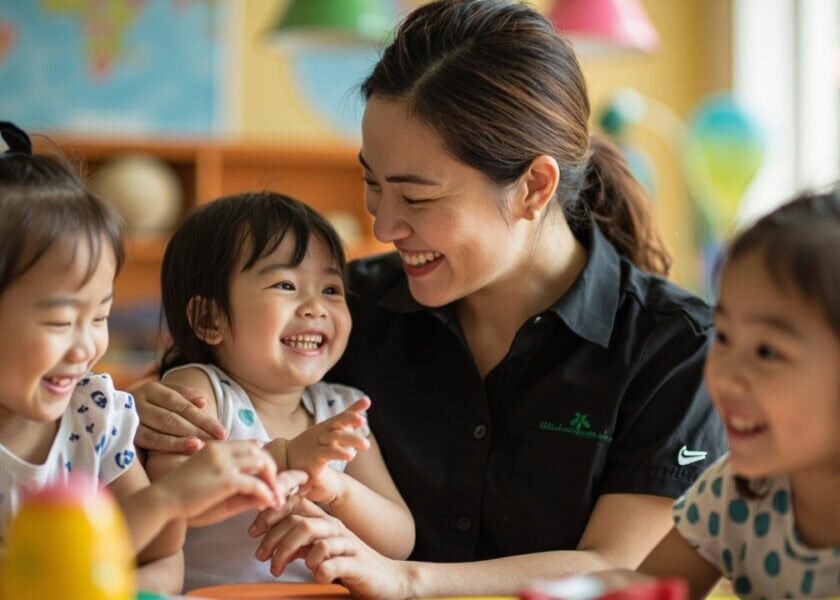
Beyond Childcare: How Singapore Parents and Caregivers Build a Partnership That Serves Your Child
“`html
What You Are Actually Choosing When You Choose Childcare
Singapore parents tell me, when they are being honest, that they feel uncertain. Whether they are communicating enough with their caregiver. Whether they are observing enough at home to bring useful information back. Whether the caregiver truly shares their values and their vision for their child.
This uncertainty is not weakness. It is evidence of care. You feel uncertain because you love your child and because this matters. The parent who feels nothing but confidence is probably not paying attention.
What you are building, whether you planned it or not, is a collaborative understanding of your child’s needs. You are not simply delegating. You are weaving together what you know with what your caregiver observes, and from that weaving emerges something richer than either of you could build alone.
This is the promise of the alliance model. Not that it removes the difficulty of parenting, but that it multiplies your capacity to see and respond to your child.
The First Months: Building a Shared Language for Your Child
The first months are about translation. Not of language, though that matters too, but of the child herself. The parent arrives each morning carrying everything they know about their daughter’s temperament, her rhythms, her particular way of expressing hunger or fatigue or the need for comfort.
They hand this knowledge over—sometimes in words, sometimes in a printed schedule, sometimes simply in the way they hold her before they leave—and they trust that it will be received with care.
What they are doing, whether they name it or not, is building a shared language. A shared language for this specific child. And the caregiver receives that language not as a set of instructions to follow but as an invitation into understanding.
Because here is what the best caregivers know: the parent is the world’s foremost expert on this child. The parent’s observations are not suggestions. They are the foundation upon which everything else is built.
But the best caregivers also know they bring something irreplaceable too. A second set of eyes. A different vantage point. The caregiver will see your child in moments you cannot—tired in a new way, frustrated by a new challenge, showing a spark of independence you haven’t yet noticed at home.
She will hold your daughter when she cries and notice that the cry sounds different when it comes from genuine hurt versus ordinary frustration. She will watch your son take his first unaided steps and feel something genuine shift in her chest. Not because it is her child, but because she has earned the right to care.
That earned quality is what separates a service from an alliance.
What Quality Observation Sharing Looks Like
Let me make this concrete. Imagine a Tuesday afternoon. A mother collects her eighteen-month-old from the caregiver’s home—yes, this happens in Singapore too, and it matters, because home-based care offers something that centre-based care sometimes cannot: the intimacy of a smaller world.
The caregiver hands the child over and says, “He didn’t want to eat the fish today. He kept pushing it away, which he hasn’t done in a while. But he ate every bite of the pasta. I thought you should know because he was exactly the same last week on Wednesday, and I wondered if there was something about fish that he’s working through.”
This is observation sharing. This is the currency of the parent-caregiver partnership.
Notice what it is not: it is not a checkbox on a daily report form. It is not a perfunctory “he ate well, slept well.” It is a genuine piece of intellectual and emotional labor. It is the caregiver thinking about this child, connecting patterns across time, and bringing her observations to the parent not as data but as insight.
The parent receives this differently than she receives a generic daily log. She receives it as evidence that her child’s caregiver knows him. Not knows him statistically. Knows him. And this knowledge—specific, accumulated, shared—is what builds the kind of trust that no background check can manufacture.
Trust, in this context, is not the absence of uncertainty. It is the presence of a relationship that can hold uncertainty together.
How the Alliance Evolves Over Time
The longitudinal dimension matters enormously, and it is almost entirely missing from how we talk about childcare.
Month One: The Formal Phase
In the early weeks, the relationship is formal. Professional. You are still learning each other’s communication styles. The caregiver is still learning your child’s temperament. There is courtesy in the exchanges, and care, but also appropriate distance. You are both being careful.
Month Three: The Shift
By month three, something has shifted. The caregiver knows that your daughter needs a full ten minutes of quiet time before transitions—not five, not seven, but ten. She knows this because she has watched it matter, repeatedly, and because you mentioned it once and she remembered.
Your daughter has started to run to the door when the caregiver arrives. This is the kind of data that no form can capture but that tells you everything about attachment and comfort.
Month Six: The Collaboration Begins
By month six, you are having conversations you never expected. You are asking the caregiver’s opinion on something—not because you must, but because you genuinely value her perspective.
She is telling you about a developmental leap she observed and what she did to support it. The communication has become bidirectional. Generative. You are building something together.
Year One: The Mature Partnership
By year one, your child has a relationship with this caregiver that is genuine and separate from you but not in opposition to you. She talks about “Miss Sarah” or “Auntie Mei” the way she talks about grandparents—not as replacements, but as additional humans who love her.
And you feel, when you drop her off in the morning, not guilt but something closer to peace. Because you know where she is going. You know who will be with her. And you know that you are both working toward the same thing.
This is what the alliance becomes when it is tended. Not a transaction. Not a service delivery. A relationship that serves a child.
Aligned Values and the Anxiety Quality Care Can Address
Not all childcare arrangements are alliances. Many are simply services. The difference is not the setting—home-based or centre-based, both can be either. The difference is the intentionality of the partnership.
Aligned values do not mean the caregiver raises your child exactly as you would. That is neither possible nor desirable. Your child will learn things from her caregiver that she will not learn from you—different songs, different games, different ways of relating to other children. This is not a failure of alignment. This is the richness of a textured early life.
Aligned values means something more fundamental. It means that both parties understand that the child’s wellbeing is the organizing principle. It means that when the caregiver notices something concerning—a developmental delay, a behavioral shift, a sign of distress—she brings it to you without fear and without delay.
It means that when you share something about your child’s needs or your family’s approach, it is received with respect and incorporated thoughtfully. Neither party operates from a place of superiority or suspicion.
Parent and caregiver, both professionals in their own right, both committed to the same child, building the same thing.
What This Means for Parental Anxiety
You can read all the parenting books. You can enroll your child in the most expensive programme in Singapore. You can hire the most qualified caregiver in the database.
And if you do not have this alliance—this daily exchange of observation, this mutual respect, this sense that you are both watching the same child and building toward the same future—you will still feel untethered. You will still lie awake wondering if something is happening at childcare that you don’t know about.
But when the alliance is real, something changes. You feel it in your body. You drop your child off in the morning and you can breathe. You collect her in the afternoon and the caregiver tells you something specific and thoughtful about her day, and you feel less alone.
You start to trust not just the person but the process. You start to trust that your child is being seen, because someone who knows her is paying attention.
This is what the best childcare offers. Not surveillance. Not control. Partnership. And partnership, unlike service, means that both parties are invested in something larger than the transaction. Both parties show up not because they have to but because they want to.
The First Thousand Days: Why Early Alliance Matters More Than You Think
The first thousand days of your child’s life are not just important for brain development, though they are. They are important because this is when your child learns what the world feels like.
Whether it feels safe or unpredictable. Whether the adults around her are reliable and warm. Whether the people who care for her see her as an individual to be known or a task to be managed.
You cannot manufacture this security alone. No parent can. It takes a village—but more specifically, it takes chosen allies. People who choose your child as carefully as you have chosen them. People who bring not just competence but commitment. People who will be, over months and years, the second set of eyes that sees your child clearly.
That is what the quiet alliance offers.
What EduNanny Has Built: The Architecture of Alliance
At EduNanny, the alliance model is not an accident. It is the architecture of the programme.
EduNanny operates within the ECDA Childminding Pilot, and this matters because the pilot is designed with intention. It recognizes that infant care is not assembly-line production. It requires ratios that allow for genuine attention—up to one caregiver to three infants at most, and often better than that.
What the pilot makes possible, practically, is this: consistent, relationship-based care. The same caregiver, over months and years, building the kind of knowledge that only comes from sustained presence. Not a rotating cast of strangers. Not an arrangement where the relationship must restart every few months. The kind of continuity that a child’s brain and heart actually need.
In Singapore, where the cost of living weighs heavily and where the sandwich generation is a reality, this matters. You should not have to choose between quality care and sustainable finances.
What This Means for Your Family
- Monday to Friday care blocks offer the predictability that working parents need
- CCTV measures, where deployed, offer transparency—not because anyone expects something to go wrong, but because visibility builds trust
- Affordable structures designed to make quality care accessible, with CDA and Baby Bonus funds usable
- Training and support for caregivers that develop not just competence but the capacity for genuine partnership
Questions to Ask When Evaluating Childcare Options
If you are researching infant care in Singapore, these are the questions that actually matter:
- Who will be caring for my child? Not just today, but in six months, a year? Will the relationship have room to deepen?
- How does this caregiver communicate? Will I receive observations that help me understand my child’s patterns, or just checkboxes on a form?
- What is the caregiver-to-infant ratio? Is there space for genuine attention, or is care being stretched thin?
- How are concerns raised? If the caregiver notices something about my child’s development or wellbeing, what is the process for sharing that with me?
- What happens if the caregiver is unwell? Is there continuity, or does my child face a revolving door of unfamiliar faces?
- Can I speak with current families? Not just testimonials, but actual families who have been in this arrangement long enough to know whether the alliance model is real or aspirational.
Making the Decision That Serves Your Child
When you choose infant care in Singapore, you are making a decision that will touch your child’s life for years. You are choosing not just a place or a programme but a person, and with that person, a relationship.
That relationship will evolve. It will have awkward early months and deepening middle months and, if it is tended well, a mature phase where you genuinely collaborate on raising this child you both love.
If you are a Singapore parent in the thick of it—drop-offs and pickups and the quiet wondering about whether you are doing this right—know that you are not alone in that wondering. The uncertainty is a form of love. And there is a path forward that is not just endurance but partnership.
What EduNanny offers is not just childcare. It is the scaffolding for a relationship that serves your child. It is the recognition that you, as a parent, are not outsourcing parenting—you are inviting a trusted collaborator into the work of raising your child.
You deserve a partner in that. Not just a service provider. Not just a qualified hand. A partner.
The relationship you are building with your child’s caregiver matters. It is not a logistical footnote in your parenting journey—it is the foundation of how your child experiences the world in these crucial first years. If you are ready to explore what a genuine alliance looks like, EduNanny welcomes the conversation at edunanny.com/contacts, or learn more about EduNanny’s approach to childminding.
“`