Baby Visual Tracking Play: Follow a Moving Toy
EduNanny® by BUTLER · Parent guide
A slow-moving toy can give you and your young baby something to enjoy together. Show one suitable object, wait until your baby notices it, then move it gently while watching their comfort and response.
This guide focuses on a short play opportunity in roughly the first six months. It does not set a target attention span, assess eyesight or promise a route to later reading. Your baby can look, reach, pause or finish in their own way.
Choose a safe starting point
Visual tracking means following movement with the eyes. UNICEF’s guidance for babies aged one to six months suggests helping a baby follow an object by moving it slowly from side to side and up and down, once the baby sees it. This is an invitation to play, rather than a task your baby has to complete.
Choose one clean, intact toy intended for your baby’s age and abilities, and check the manufacturer’s instructions. Keep small or detachable parts away. KK Women’s and Children’s Hospital advises close, undistracted adult supervision and keeping small objects that could cause choking out of children’s reach.
Begin when your baby is awake and comfortable, with you close by and the baby securely supported for their current abilities. There is no need to put a baby into a new sitting or standing position for a looking game. Keep the surrounding space clear and attend to care needs first.
Hold the toy where your baby can comfortably see it. UNICEF’s note about seeing best at 20–30 cm concerns babies aged one to three months; it is not a fixed distance for every infant. Watch whether your own baby notices the toy instead of measuring a universal “right” gap.
Move slowly, then give the moment room
The following is a practical way to apply the slow-movement suggestion. Use whichever steps fit the moment. It is not a clinical exercise or a sequence to repeat until your baby succeeds.
| Part of the moment | What you can do | What guides the next move |
|---|---|---|
| Show | Keep one suitable toy still where your baby can see it. | Give your baby a chance to notice it before moving. |
| Move | When your baby is looking, move it slowly a little from side to side. | Keep the movement comfortable and within view. |
| Pause | Stop the movement and allow a quiet moment. | Notice a look, reach, sound or change of attention. |
| Finish | Put the toy aside when the baby is uncomfortable or ready to move on. | Attend to comfort rather than asking for another attempt. |
You can speak softly or smile during the exchange. Avoid adding rapid movements, several toys or constant questions. If your baby reaches and the toy is suitable to handle, allow safe exploration while you stay close.
A turn away does not require you to move the toy faster or repeatedly bring it back to the baby’s face. Harvard’s serve-and-return guidance describes waiting for a response and noticing when a child is ready to end an activity. A short, comfortable finish is part of responsive play.
Separate looking from a developmental conclusion
Following movement, reaching for a toy and recognising an object are related interests you may notice during play, but one exchange cannot measure all of them. If your baby watches the toy move, you can describe that action without deciding what they understand about the toy.
For the research distinction, see our guide to looking time and object recognition. It explains why a long look during ordinary play does not prove that recognition has been measured.
HealthHub’s Your Growing Baby guide describes development as a guide with variation between babies, and advises discussing concerns with the child’s doctor. A calm-looking moment is not a reason to dismiss a concern, and an unfinished play moment is not a diagnosis.
UNICEF’s four-month guidance specifically advises speaking to a paediatrician if a four-month-old has difficulty moving one or both eyes in any direction. If you are concerned about your baby’s vision or development, ask their doctor for individual advice instead of increasing play repetitions or waiting for a home-game result.
Share what happened with the next caregiver
When another adult cares for your baby, a short description can make the next play opportunity easier to understand. Record the object, the movement offered and the response you actually saw. This can help a parent, relative, nanny or childminder talk about a particular moment.
For example: “I held the rattle still, then moved it slowly to one side. He looked towards it and later turned towards my voice.” This is an illustrative note, not a report from a real child or a developmental score.
Ask the other adult what they noticed and what kept the baby comfortable. Avoid requiring a particular number of minutes of tracking or using one pickup observation to judge the quality of a whole care arrangement.
For the next opportunity, keep one suitable toy ready, show it calmly and follow the baby’s response. The useful outcome is a shared moment that leaves room for comfort, curiosity and an ordinary finish.
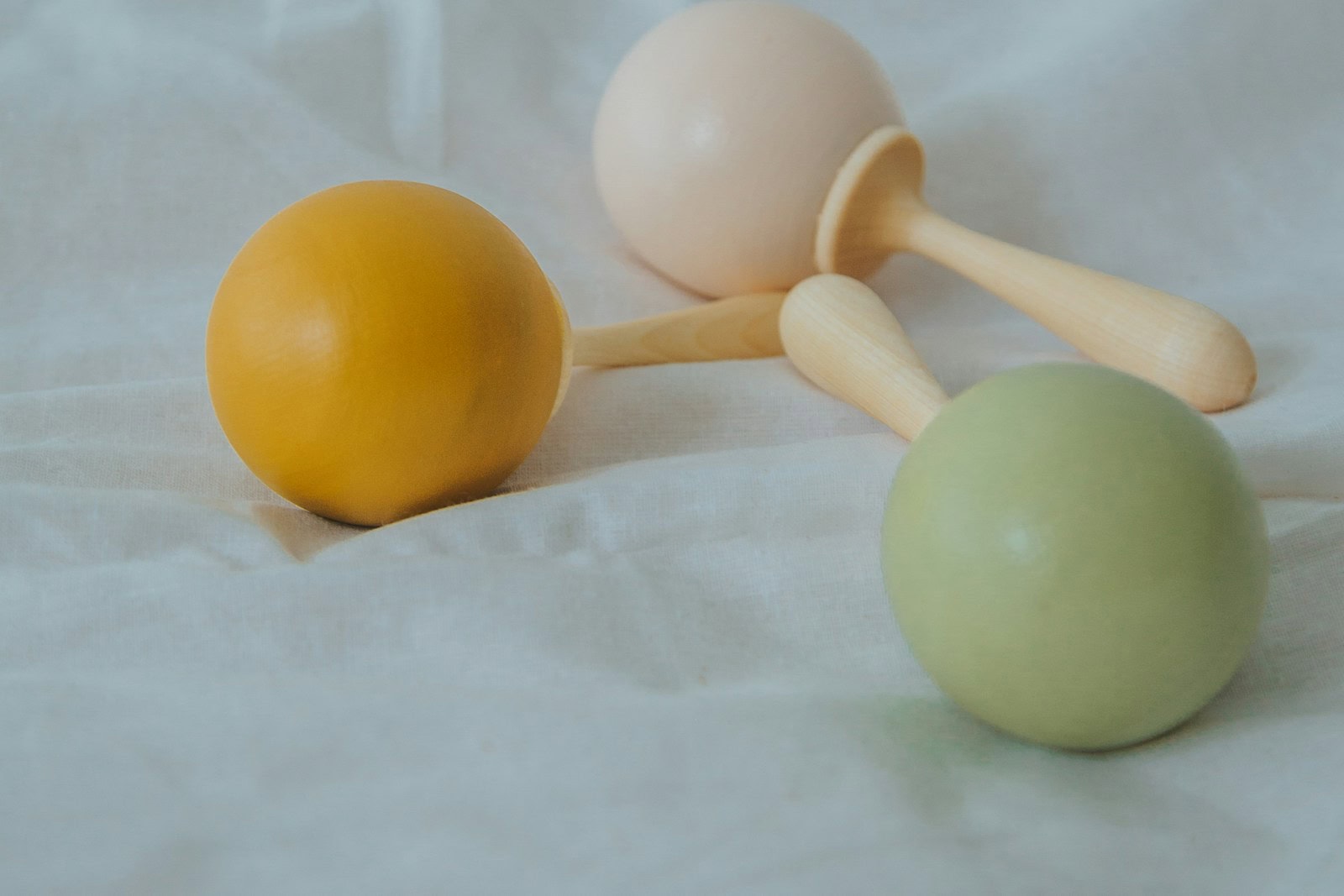
Sources checked 13 October 2026. Featured stock photograph: Marina Abrosimova on Unsplash, used under the Unsplash licence. The photographed rattles illustrate the topic; choose toys for your own baby’s age and abilities. Care for every little chapter.
Sources and further reading
- Parenting tips for the first two years of life · UNICEF
- Your baby’s developmental milestones at four months · UNICEF
- Your Growing Baby · HealthHub
- Childhood Injuries · KK Women’s and Children’s Hospital
- Five steps for serve and return · Harvard Center on the Developing Child