Fraud Blocker edunanny.com
edunanny-0626d428481a2bca306819b926daa104
April 9, 2026

The Professional Infant Care Framework Singapore Families Trust

What Your Child’s Day Actually Looks Like

Before we go further, here is what you will find in this article:

  • Why the first five minutes of each day matter more than you think
  • How sensory experiences in early childhood literally build the brain
  • What trained caregivers actually do — and why it differs from generic childcare
  • Why peer interaction matters even for infants
  • How rest functions as an active part of your child’s development
  • What professional transparency looks like in practice
  • How Singapore’s ECDA Childminding Pilot makes quality care more accessible
  • What questions to ask when evaluating any infant care option

You came here with a question. By the end, you will have something more useful than reassurance — you will have a framework for understanding what quality actually looks like.


The Architecture of a Quality Day

Working alongside Singapore families across the ECDA Childminding Pilot, we discovered something important: the parents who feel most confident about leaving their child in someone else’s care are not the ones who were simply told to trust. They are the ones who began to understand what trust actually looks like when it is built into every hour of the day.

So let us show you. Not philosophy, not promises — but the actual architecture of a day at EduNanny.

Before Your Child Arrives

The day begins before your child arrives.

A trained caregiver — not a casual helper, not someone hired off an advertisement, but a caregiver who has been selected, prepared, and supported — arrives to the space. The environment has already been prepared. Surfaces are clean. Sensory materials are set out. The lighting is thoughtful. The temperature is considered.

Every element of the physical space has been arranged with a purpose that goes beyond cleanliness. This is not decoration. This is preparation — the invisible work that makes the visible experience possible.

The Arrival: A Bridge, Not a Handoff

Then your child arrives.

For a young child, arrival is not a small thing. It is a transition — and transitions are where the architecture of emotional security either holds or fractures.

At EduNanny, this moment is not treated as a handoff. It is treated as a bridge.

The caregiver kneels to the child’s level. The greeting is warm and consistent. The parent is seen, too. There is no rush. Because we know — and the research confirms — that a child who feels held in the first five minutes of the day will navigate the next eight hours very differently from one who is quickly passed off.

This is not instinct alone. This is trained responsiveness. The caregiver has been prepared to read the child’s micro-signals: the way a toddler grips a parent’s leg, the silence of a child who is processing, the searching gaze of an infant whose face is not yet familiar. Each of these states requires a different kind of attunement.

Building the Brain: The Morning Hours

The first two hours of the morning are where much of the neurological scaffolding for the entire day is built — and this is where a professionally designed early care model diverges most sharply from what you might call generic childcare.

Between the ages of zero and three, a child’s brain is building neural connections at an extraordinary rate. This is not a statistic shared to alarm you. It is shared because it tells you something practical: the experiences a child has in these years are not incidental. They are structural. They are literally building the architecture of the mind.

What does this look like in practice?

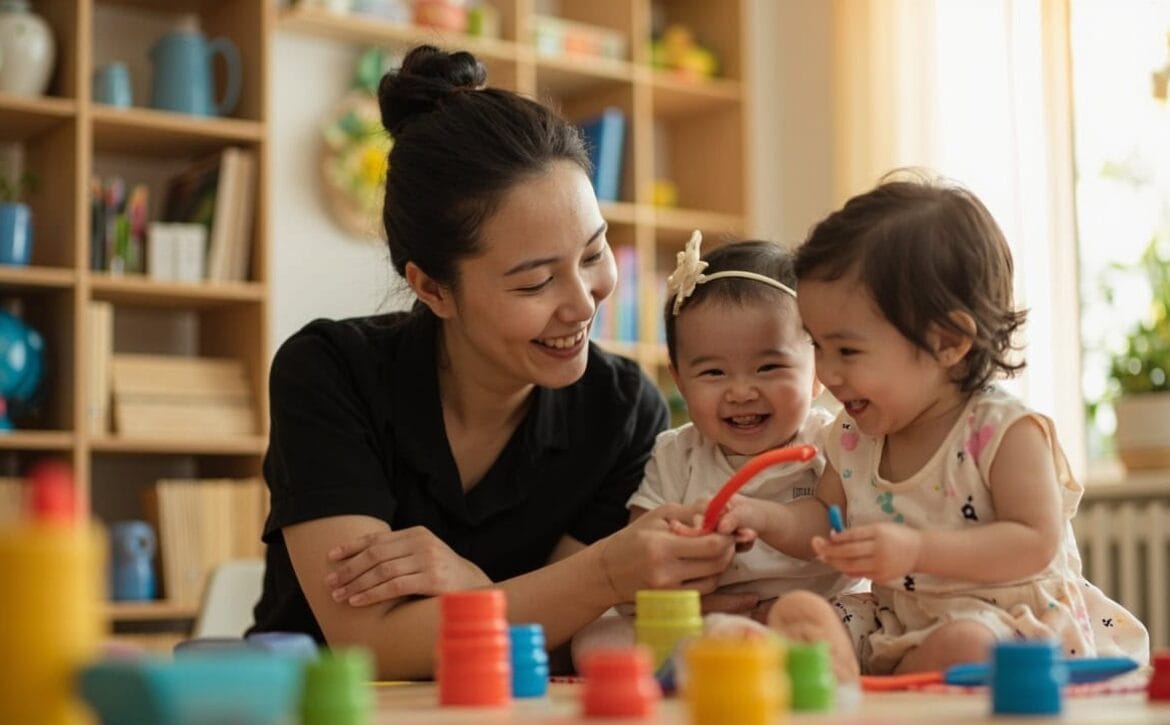
It looks like a ten-month-old reaching for textured objects — building grip strength and spatial awareness at the same moment. It looks like a crawler navigating a low obstacle course — developing the vestibular system, the internal sense of balance and body position, that will later support reading and writing. It looks like a toddler pouring water from one container to another — absorbing early mathematics: volume, cause and effect, full and empty, more and less.

This is sensory motor engagement — the kind of rich, purposeful physical and sensory experience that activates and organizes the developing brain.

The Difference Between a Room and a Curriculum

At EduNanny, the morning environment is carefully considered. It is not a playroom where a child is simply entertained.

The caregiver does not merely supervise this. The caregiver curates it. They observe which activities capture a child’s deepest engagement and adjust accordingly. They introduce the next challenge at the moment of readiness, not before. They sit on the floor, not beside it, because a child’s world is horizontal — and the adult’s position communicates whose world is being prioritized.

This is what separates a professionally designed early care environment from a space where children are simply kept safe and occupied. It is the difference between a room and a curriculum — except the curriculum does not feel like curriculum. It feels like play, because for a child under three, it should be.

Structured Learning Moments

Mid-morning brings something equally important, though it looks quieter from the outside: structured learning moments.

At EduNanny, these are brief, intentional segments where language, cognition, and social development are woven into interactive experience.

A caregiver reads a book — not just any book, but one chosen for developmental relevance — and pauses at key moments to invite response. She names objects, asks simple questions, repeats sounds. She is building vocabulary. But she is also teaching the child that their voice matters in a room, that communication is a two-way exchange, that language is something they participate in, not merely receive.

For infants, this looks like face-to-face interaction. Cooing, mirroring, the caregiver returning a baby’s sound with exaggerated warmth and slight variation — which is precisely how an infant learns the rhythm and melody of conversation before they have words.

For toddlers, it might look like a group activity where sharing is gently scaffolded — where a caregiver narrates what is happening rather than simply instructing:

“I see that Jayden has the red block. I wonder if he might pass it to Aisha when he is ready.”

This is trained facilitation. It is the difference between a caregiver who says “share nicely” and one who builds the emotional and cognitive conditions in which sharing becomes possible.


The Hidden Engines of Early Development

Between learning moments, between physical activities, between the bursts of exploration and the moments of connection, there is something else happening — and this is perhaps the most underappreciated element of quality infant care.

Peer Social Development

Even infants notice each other.

A six-month-old watching another baby reach for a toy is learning something. They are watching intention. They are beginning to understand that another person has wants, that actions have effects on others, that the world contains more than one self.

This is the earliest seed of empathy, and it grows in the presence of skilled facilitation.

At EduNanny, small group ratios — up to one caregiver for three infants in the pilot structure — mean that each child receives meaningful individual attention and the benefit of peer proximity. The group is never so large that a child disappears. It is always large enough that a child begins to understand they are part of something.

You may have heard parents say their child started saying new words, or pointing to things they had not pointed to before, after a few weeks in a quality care setting. This is often attributed to the caregiver alone — and the caregiver matters enormously. But frequently, the catalyst is peer observation: a child learning from watching another child respond to the world.

This is one of the most powerful, and most overlooked, engines of early development. And it only functions well when the environment is small enough, structured enough, and supervised with enough skill that it does not collapse into overwhelm or conflict.

What Rest Actually Looks Like

Then comes something that Singapore parents sometimes underestimate: rest.

Rest is not the absence of activity. Rest is an activity in itself — and in a well-designed childcare day, it is treated with the same intentionality as learning or movement.

A child’s nervous system, still maturing in its first years, does not have the same capacity to self-regulate that yours does. The transition from active engagement to rest requires scaffolding. At EduNanny, this means a consistent, predictable rest routine — dimmed lighting, calm voices, a familiar sequence of events that the child’s body learns to recognize as the signal to slow down.

Sleep in the early years is not passive. It is when the brain consolidates what it has learned during waking hours. It is when neural pathways strengthened during morning play are solidified and organized.

A child who is kept in a high-stimulation environment without adequate rest does not learn more. They learn less — because their system is overwhelmed and unable to integrate new experiences.

The caregiver knows this. They read the child’s cues — the change in energy, the rubbing of eyes, the slight irritability that is not misbehavior but biology. And they respond not with instruction but with care, creating the conditions in which a child can do what their body and mind need to do.

This is one of the quietest, most unglamorous aspects of quality childcare. And it may be one of the most important.


Trust, Transparency, and Affordability

Every parent who walks out the door of EduNanny’s childminding spaces is making themselves vulnerable. They are trusting someone else with the most important thing in their life. And they deserve more than a feeling about that trust. They deserve evidence.

Transparency in Practice

Communication protocols ensure that parents receive regular, substantive updates — not just photographs but meaningful information about their child’s day: what they engaged with, how they slept, what seemed to capture their interest, what they are working toward developmentally. This is not an add-on. It is part of the model’s architecture.

Where deployed, CCTV measures provide an additional layer of transparency — not because we assume anything, but because transparency is the foundation of trust. A service that hides behind closed doors is a service that has not done the work.

EduNanny has done the work. And the work shows in the day.

Affordability Without Compromise

Now let us address something directly, because if you are like many Singapore parents, you may have wondered whether the choice between quality and affordability is simply a fact of life you must accept.

It is not. EduNanny was designed in part to prove that.

The ECDA Childminding Pilot, within which EduNanny operates, has been structured with fee arrangements that make quality infant care more accessible than it has traditionally been in Singapore.

Financial support mechanisms available include:

  • Child Development Account (CDA) — funds can be applied toward EduNanny fees
  • Baby Bonus Cash Gift — contributes to the overall cost picture for eligible families
  • Pilot-specific fee structures designed for broader accessibility

These are not afterthoughts. They are deliberate design choices made because we believe that financial anxiety in parents should not be a barrier to developmental quality in children.

A service that serves only families who can pay premium rates is not a solution to Singapore’s childminding challenge. EduNanny is built for Singapore-wide relevance — for the family in Jurong and the family in Tampines and the family on a single income trying to make a thoughtful decision about who will care for their child while they work.


What to Look For When Choosing Infant Care

If you are evaluating childcare options in Singapore — whether EduNanny or another provider — here are the questions that matter most, based on what developmental research tells us about quality in early care:

The Caregiver

  • How are caregivers selected and trained? What ongoing support do they receive?
  • Can the caregiver explain why they are doing what they are doing, not just what they are doing?
  • How does the caregiver respond to a child who is distressed? Is there a consistent approach?

The Environment

  • Is the space arranged with intention? Can you see evidence of planned materials and activities?
  • What is the caregiver-to-child ratio? Smaller groups mean more individual attention.
  • Is there a balance of active play, quiet time, and rest built into the day?

The Day Structure

  • Does the day have a rhythm that feels predictable? Young children thrive on consistency.
  • What does “learning” actually look like? Is it embedded in play and interaction, or is it a separate, formal activity?
  • How are transitions handled — arrival, meal times, rest times?

Communication and Transparency

  • What will you know about your child’s day? How and when will you receive updates?
  • Can you observe the space? Are there transparency measures in place?
  • How does the service handle concerns or questions from parents?

The Philosophy

  • Does the service have a clear, articulable approach to child development — or does it rely on vague promises of “care” and “learning”?
  • Do they see parents as partners or as customers to be managed?
  • Are they willing to show you what a day actually looks like, not just describe it?

The Real Question: A Different Kind of Confidence

There is a way of thinking about childcare that says it is a necessary compromise — a logistical arrangement that allows parents to work while someone else manages the practical reality of raising a child. If that is how you see it, we understand. That is how many people see it. It is the view that makes childcare feel like a service transaction: you drop off, they babysit, you pick up.

But there is another way of understanding what happens in those hours, and it changes everything.

The hours your child spends in a professionally designed early care environment are not hours subtracted from their development. They are hours added to it.

The sensory experiences, the language-rich interactions, the peer learning, the responsive caregiving — these are not substitutes for what you provide at home. They are companions to it. They extend the developmental environment your child lives in, and they do so with intention and skill.

When your child comes home from a quality care setting and shows you something new — a word, a gesture, a way of playing that was not there before — it is not a coincidence. It is the visible result of a day that was built, hour by hour, to help them grow.

You now know that when your child spends a day in a professionally designed childminding environment, they are not being watched. They are being held — physically, emotionally, and developmentally.

They are not in a space designed to keep them safe and busy until you return. They are in a professionally designed environment that has been built around the specific neurological, emotional, and social needs of a child in their first thousand days.

The caregiver is not a bystander. They are a trained professional who has learned to read your child’s signals, respond to their individual rhythms, and create conditions in which development happens naturally — through play, through connection, through the simple and profound act of being truly attended to.

The day is not a sequence of activities. It is a thoughtfully structured progression — arrival, sensory engagement, learning, peer interaction, rest — each phase building on the last, each one preparing the ground for what comes next.

It is the kind of design that you, as a parent, would build yourself if you had the training, the time, and the support. And the reason you do not have to build it yourself is that EduNanny has built it for you.

Ready to Learn More?

You chose to care deeply. You chose to ask the hard questions. You chose to be here, reading, because you refused to settle for less than your child deserves.

That instinct — the one that kept you searching, the one that brought you here — is exactly the instinct EduNanny was built around. Because we believe that parents who ask these questions deserve answers. Real ones. Specific ones. The kind that come from opening the door and showing you what is inside.

The anxiety you carry is not something to outgrow. It is something to channel — into better questions, into higher standards, into a choice made with clarity instead of guesswork.

EduNanny was built for exactly that kind of parent.

And we would be honored to walk this road alongside you.

If you are interested in understanding how EduNanny’s childminding approach might work for your family, we invite you to reach out. We are happy to answer your questions, walk you through the model, and help you think through whether this is the right fit — no pressure, no obligation.

You can begin your search for quality infant care with confidence. The questions you are asking are the right ones. And the answers exist.

Learn more about EduNanny’s approach to early childhood care, or connect with our team to explore whether our childminding model is the right fit for your family.


edunanny-0626d01e680a95ee7aac1174d2d48b03
April 9, 2026

What Singapore Parents Learn When They Stop Checking

There Is a Silence in That Car

There is a particular silence that fills the car on the way to childcare. Not the peaceful kind. The kind that holds everything you want to say but cannot find the words for.

Your child is in the backseat, still warm from home, still yours in the way that mornings allow. And you are driving toward a choice you made months or years ago, carrying a question that never quite goes away — no matter how many times you have made this drive before.

The question is not whether you chose well. You have answered that question a thousand times in a thousand ways. It is something deeper. Something that lives in the space between the morning handoff and the afternoon pickup:

Are we still a family when we are apart?

This is the question that almost no one talks about. Not because it is shameful, but because it is tender. We speak easily about choosing childcare — about visiting centres, meeting caregivers, and making that first decision with its weight of consequence. That part of the journey has been written about, discussed, worried over, and eventually resolved.

But what happens after? What happens in the months and years that follow, when the decision is behind you and the relationship is still very much alive?

This is where most stories about childcare end. But this is where EduNanny Singapore begins.


The Transformation No One Warns You About

There is a transformation that happens to parents in the weeks after enrollment. It is subtle and rarely acknowledged, but if you have lived it, you will recognize it immediately.

In the beginning, you are a monitoring parent. Not because you are anxious by nature, but because you have been given something irreplaceable and you do not yet know who else to trust with it. So you watch. You notice the way your child responds at pickup. You study the photos sent during the day. You ask questions that feel necessary even when they feel endless.

You are not doubting your choice. You are simply not yet finished with the process of making it.

This phase is honest and important. It is how trust is built — not through announcements, but through evidence gathered over time. A monitoring parent is not a bad parent. A monitoring parent is a parent who cares deeply and is still learning the shape of this new arrangement.

But here is what the existing conversation misses: this phase passes. Not because parents stop caring, but because something else grows in its place.

The First Time You Stop Checking

The first time you realize you have stopped checking is a small revolution.

You arrive at pickup and your child runs to you with the easy joy of someone who has had a good day. And for a moment — just a moment — you feel the old reflex rise. You want to scan the room, check the notes, ask about the morning. But then something else happens. You look at your child’s face and you see it there.

The evidence you no longer need to request. The story that has already been told.

This is the shift from observation to knowing. It does not happen overnight. It happens in increments, measured in routines that become familiar, in caregivers who remember the small things, in a communication rhythm that begins to feel less like reporting and more like sharing.

EduNanny understands this evolution. Their approach is built not for the moment of enrollment but for the months and years that follow. When a family joins the ECDA Childminding Pilot with EduNanny by BUTLER, they are not simply accessing childcare. They are entering into a partnership designed to deepen over time. The caregiver is not a service provider rotating on a schedule. She is a consistent presence who learns your child’s rhythms, your family’s language, the small preferences and larger patterns that make your child uniquely themselves.

This is the difference between transaction and relationship. And it matters more than we often admit.


What Partnership Actually Means

There is a word that parents rarely use when they first enroll their child — partner. They use words like caregiver, provider, centre, option. These are reasonable words. They describe the decision-making phase accurately. But they do not describe what happens next.

What happens next is that the relationship becomes something more than contractual. Your child’s caregiver becomes someone who knows things about your child that even you are still discovering. She knows that your daughter needs a few minutes of quiet transition after nap time. She knows that your son communicates frustration differently than other children his age, and she knows exactly how to respond.

She notices the things you would notice if you were there, and she tells you about them in ways that help you understand rather than worry.

What Changes for Parents

When parents arrive at this understanding, something shifts. The daily anxiety of separation does not disappear entirely — parenthood does not allow for that kind of certainty — but it transforms. It becomes a background hum instead of a foreground roar. You can think about your work because you know your child is known. You can breathe during the commute because you trust the people on the other end of the journey.

Through this sustained partnership, parents discover two quiet transformations:

  • They learn to read their child differently. Not with the anxious vigilance of the early months, but with the calm attunement that comes from having another trusted adult confirm what they are seeing. When the caregiver tells you that your child has been working on something — a skill, a social moment, a language breakthrough — and you come home to see it for yourself, something deepens. Your understanding of your child expands. You begin to see them not just as your child, but as a person with a life that includes more than you.
  • They learn to see themselves differently. There is a quiet pride that grows when you realize you have successfully navigated one of the hardest transitions of modern parenthood — the return to work, the letting go, the daily reconciliation of professional identity and parental love. You did not just survive it. You built something through it. A relationship with a caregiver who has become a trusted colleague in the work of raising your child. A confidence that did not exist two years ago.

This is the identity change that the existing childcare conversation does not capture. It is not just your child who grows through the childcare years. It is you.


What Quality Childminding Actually Looks Like

Now let us speak plainly about what this looks like in practice, because philosophy without structure is just sentiment.

EduNanny by BUTLER operates within the ECDA Childminding Pilot, which means families access a regulated, supported model of home-based and community-based care. The pilot was designed with specific structural commitments that allow partnership — not just supervision — to develop over time.

The Framework That Holds the Relationship

  • Small ratios. In infant care settings, ratios are kept to one caregiver for every three infants. Love at scale requires intention, and that intention is built into the structure of the service.
  • Consistent hours. Care blocks run Monday through Friday, aligned with the rhythms of working family life. Reliability is not a bonus — it is the foundation on which trust grows.
  • Transparent communication. Where deployed, transparency measures including communication updates and CCTV access provide families with the visibility that sustained trust requires. These are not surveillance tools — they are reassurance tools, and there is a meaningful difference.
  • Affordable access. Fees within the pilot structure are designed to be accessible, and payment mechanisms include CDA and Baby Bonus usability. Financial logistics should not add unnecessary weight to an already demanding season.

These are not glamorous details. They are the scaffolding that allows partnership to exist. Without consistent hours, without reliable ratios, without communication that feels like sharing rather than surveillance, the emotional evolution we have been describing cannot take place. Trust requires structure. Co-parenting requires schedule. The relationship between a family and their caregiver requires the kind of dependable framework that lets intimacy grow.


Common Questions About Sustained Childminding

“What if the relationship doesn’t develop the way it should?”

Not every family arrives at partnership easily. Some parents carry doubts that linger longer than they expect. Some children take longer to settle. Some seasons of family life bring stress that spills into the childcare relationship. This is normal. It is human.

And it is precisely why the sustained nature of the EduNanny approach matters.

A relationship built for the long term does not end at the first difficulty. It deepens through it. When a caregiver has been with your family for eighteen months or two years, she knows the difference between a temporary phase and a genuine concern. She can speak with calm authority when you arrive at pickup worried, because she has seen your child through enough variation to know what is typical and what requires attention.

This is what no amount of daily reassessment can provide. Daily reassessment is the posture of a new relationship. What you need, eventually, is the posture of an established one — the posture of people who know each other, who have history, who trust that the relationship itself will carry them through the uncertain moments because it has done so before.

“How do I know if this is the right choice?”

The right choice is not the choice without doubt. The right choice is the one you are willing to keep making — not out of stubbornness, but out of the growing evidence that it is working.

The question to ask is not “Will this be perfect?” but “Is this relationship designed to last? Is the caregiver consistent? Is the communication honest? Is there room for this to grow into something real?”

These are the questions that EduNanny is built to answer over time, not on the day of enrollment.


The Question You Carry — and the Answer You Will Find

If you are a parent who has already chosen EduNanny, I want to speak directly to you for a moment.

You may still be in the monitoring phase. You may still feel the reflexive urge to check, to question, to hold the relationship at a distance until it proves itself. This is not wrong. It is the beginning of something.

But I want you to know what is available to you on the other side of that caution.

There is a version of this relationship where you arrive at pickup and feel not relief but genuine delight — delight at seeing your child’s day reflected in their face, delight at the small update from someone who knows them well, delight at the simple fact of a day that has gone well in the ordinary, unremarkable way that good days do.

There is a version where you can think about your work without guilt because you know your child is not just cared for but cherished. Where the caregiver who spends forty hours a week with your child feels less like a service provider and more like a person whose judgment you trust, whose observations you value, whose presence in your family’s life feels like a gift rather than a compromise.

Are we still a family when we are apart?

The answer, offered by every parent who has walked this path before you, is yes. Not despite the separation, but through it. You remain a family because the love does not pause when you leave. It continues in the hands of people you have come to trust. It grows in the spaces where your child is known and held and nurtured in your absence.

It returns to you at the end of the day, transformed by the day itself, and you meet it with the fullness of a parent who has learned to let go without letting go.

This is what EduNanny Singapore offers. Not just childcare. Not just a service or a solution or a convenient arrangement for working families. They offer the sustained, intentional, human relationship that makes modern parenthood not just bearable but meaningful. That transforms the question from who will care for my child to who will grow alongside us.

The caregivers who walk this path with families are not invisible. They are not interchangeable. They are the consistent presence that makes trust possible. They are, in every meaningful sense, partners.

And the parents who learn to lean into this partnership — who stop managing and start co-parenting, who stop questioning and start trusting, who stop monitoring and start knowing — these parents discover something that no decision-making guide can prepare them for.

They discover that they were never meant to do this alone. That the village has a name now. That it operates Monday through Friday, in homes and communities across Singapore, within a framework built for the long term.

Welcome to the relationship. It only gets deeper from here.


If you are considering what sustained, development-oriented childminding could look like for your family, connect with EduNanny Singapore to learn about availability, the ECDA Childminding Pilot, and how their caregiver families are matched with your family’s rhythms and needs.

edunanny-0626cd2b7499d39afb6d1a404f372278
April 9, 2026

Reading the Evening: What Your Child’s Behavior Tells You About Their Day

The Invisible Hours: Why What You Cannot See Matters Most

EduNanny exists in that space—in the hours you are not there.

Let me paint something for you. A picture that most parents never see but every parent should understand.

A child wakes at seven. There is breakfast, not rushed but paced—the child learning the rhythm of hunger and fullness, the pleasure of a banana cut just right, the security of a predictable sequence. Then the diaper change, which is also a conversation, a moment of eye contact, a gentle narration of what is happening to their body.

Then the arrival at the caregiver’s home or centre, where the door opens and a familiar voice says good morning, and there is a ritual—a song, a wave to a particular picture on the wall, a transition object that says to the child: we know you, you are expected here, this is a place that belongs to you.

What happens in the hours that follow? A midmorning activity where your child reaches for a block and a caregiver says, not automatically, but intentionally, “The blue one. You want the blue one. It’s heavier than the yellow.”

That sentence, spoken to a child who cannot yet form complete sentences of their own, is not small talk. It is language mapping. It is the caregiver building the architecture of thought inside your child’s mind, one observation at a time.

And then there is the pacing. The movement between active play and quiet moments. The way lunch is served—not rushed, not forced, but offered with patience while a child learns that eating is something they do, not something done to them.

The way nap time arrives not as a scheduled demand but as a gentle invitation, with consistent cues that tell a child’s body: it is safe to rest now, we will watch over you.

These are the invisible hours. And the difference between adequate childcare and exceptional childcare lives almost entirely in these hours. It lives in the seventeen seconds between when a toddler stumbles and when a caregiver responds. It lives in whether a child’s frustration is acknowledged and soothed or quietly ignored. It lives in whether the environment is designed for development or merely for management.


What to Watch For: Reading Your Child’s Day

You cannot see these invisible hours. But you can learn to read them. The transitions at the edges of the day—the moments you are present—tell you everything about what happened in between.

The Morning Goodbye

The morning transition at EduNanny is engineered to ease separation rather than rush it. You arrive. You are met. The caregiver gives you a moment to say goodbye in your own way, without pressure.

A child who is rushed through goodbye carries that rush inside them. A child who is given a proper farewell—a moment of eye contact, a clear “I love you, I will come back,” a wave from the window—carries something different. They carry the knowledge that departures have a shape, that they can be trusted, that the person left behind is not abandoning them but making a promise they intend to keep.

This is not sentimental thinking. This is developmental science. The way a child experiences separation in the first years shapes their internal model of trust for the rest of their lives. The morning goodbye is not a logistics problem. It is a foundation moment.

Midmorning and the Environment

By midmorning, your child is in an environment designed for engagement. That means the caregiver is not simply watching but responding.

When your child reaches for a toy, the caregiver notices. When your child drops something and looks up to see if anyone noticed, the caregiver noticed. When your child shows interest in a texture, a sound, a movement, the caregiver builds on that interest rather than redirecting to something more convenient.

In infant care settings at EduNanny, ratios of up to one caregiver to three infants mean that these moments of responsiveness are actually possible. A caregiver managing six infants cannot respond with the same attunement as one managing two. The math matters.

Mealtimes and Rest

Lunch is not a break in the developmental program. It is one of the most significant teaching moments of the day.

A one-year-old at lunch is learning self-regulation. They are learning the difference between hungry and full, the pleasure of eating and the frustration when food spills. They are learning whether the experience of food is warm or stressful, whether they will be rushed or allowed to explore their plate at their own pace.

Nap time follows the same principle. Sleep is not a switch to be flipped. It is a biological process that requires readiness, environment, and emotional safety.

A child who is gently guided into sleep—through consistent cues, through a familiar sound, through the presence of a hand on their back—learns that sleep is a gift, that their body is trustworthy, that the world will wait for them.

The Pickup Window

Here is what most parents do not realize: the pickup is not just a logistics moment. It is an information moment. What does your child look like when they see you?

A child who has spent their day in quality care will often emerge calm, curious about what you have to tell them, perhaps flushed from play, carrying some small object they want to show you. They may or may not be eager to leave immediately—and this matters.

A child who does not want to leave a caregiver’s environment is not rejecting you. They are telling you something important: that they were engaged, that the environment felt like theirs, that the hours mattered.

Ask your child specific questions. Not “Did you have fun?”—fun is an adult word, and children under three often cannot answer it. Ask instead: “What did you do this morning?” “Who did you play with?” “What was your favorite part?”

Notice the caregiver too. How do they communicate with you at pickup? Do they offer a brief, genuine account of your child’s day? Do they mention something specific—a mood, a discovery, a moment of triumph or frustration? The quality of the handoff communication tells you a great deal about the quality of the hours inside.

The Evening Reunion

This is the moment that reveals everything.

A child who comes home from a day of quality care arrives ready to be themselves. They are not depleted by overstimulation, not withdrawn by under-engagement, not carrying the residue of stress or unmet need. They are available. Available to play. Available to connect. Available to show you the dent in their clay shape, to tell you about the song they learned, to ask for the same story they asked for yesterday and will ask for again tomorrow.

For you, as a parent, the evening reunion becomes a mirror. Watch your child. Listen to them.

If they come home rigid, overwhelmed, shut down, something in the day was wrong. If they come home open, curious, ready to engage with you, the day was right.

You are not helpless in reading your child. You have the information you need. You just need to know how to look.


Evaluating Quality: What to Look For

Understanding quality means knowing what to observe. Here is how you can evaluate any childcare environment against what developmental science tells us matters most:

What to Observe What Quality Looks Like What Inadequate Care Looks Like
Morning goodbye Space for a proper farewell; caregiver at child’s level Rushed transitions; pressure to leave quickly
Caregiver responsiveness Caregiver notices and responds to child’s signals Caregiver’s attention is scattered or device-distracted
Language environment Full sentences spoken to children; narration of activities Minimal verbal interaction; commands without explanation
Mealtimes Child guided, not rushed; mess tolerated; child’s pace respected Forced feeding or rushed meals; frustration with mess
Nap time Consistent cues; gentle guidance; child’s readiness honored Cry-it-out methods; rigid schedules without individual adaptation
Pickup handoff Specific, genuine updates about the child’s day Generic pleasantries; no meaningful information shared

EduNanny’s Approach: Designed Rhythms for the Hours You Cannot See

This is why EduNanny exists.

EduNanny was built on the understanding that the ordinary hours of a child’s day are not ordinary at all. They are the hours that shape everything. From the moment your child wakes to the moment they fall asleep tonight, every transition, every interaction, every rhythm is either building them or failing to build them. There is no neutral ground.

EduNanny offers pathways that meet families where they are. Whether through home-based care, where a trained caregiver becomes a trusted extension of your family, or through community and centre-based environments designed for the same intentional development, EduNanny operates within the ECDA Childminding Pilot framework to make quality care accessible across Singapore.

Pilot fee structures are designed with affordability in mind, and payments through CDA and Baby Bonus are supported, removing unnecessary barriers between families and quality care. Monday through Friday care blocks provide the consistency that young children need for true security and development.

Where deployed, transparency measures including communication protocols and, in applicable settings, CCTV provisions, offer additional reassurance—not as surveillance, but as partnership. Because EduNanny believes that parents who understand what quality looks like become better partners in their child’s development. The more you know, the more you can trust. And the more you trust, the better the relationship becomes—for you, for your caregiver, and most importantly, for your child.


Common Questions from Parents

Choosing childcare raises real concerns. Here are the questions EduNanny hears most often, answered honestly.

How can I trust someone I cannot see?

This is the central tension of modern parenting, and EduNanny does not pretend it away. Trust must be built, not assumed. That is why EduNanny invests in transparency measures—structured communication at pickup, regular updates, and where applicable, CCTV provisions—not because cameras create trust, but because understanding what quality looks like allows you to trust what you cannot directly observe.

When you know what to look for, the invisible hours become legible. You can read your child’s evening behavior. You can ask the right questions. You can evaluate the handoff communication. Trust is not blind faith. It is informed confidence.

Is home-based or centre-based better for my child?

Both can be excellent. What matters is not the setting but the intentionality within it. Home-based care offers a smaller, family-like environment with consistent caregivers. Centre-based care offers structured programs and peer interaction. EduNanny supports both pathways, understanding that different families have different needs—and that quality is not determined by walls but by the design of the day within them.

My child cries every morning. Is this normal?

Morning separation anxiety is developmentally normal and often peaks between eight and fourteen months. What matters is how the caregiver responds to that anxiety. A child who is acknowledged, held briefly if needed, and given a proper farewell will typically settle more quickly than a child who is rushed through the moment. Watch how the caregiver handles the goodbye, not just whether your child cries.

How do I know if the caregiver is truly engaging my child or just managing them?

Ask yourself: When my child reaches for something, does the caregiver notice? When my child looks up after dropping something, has the caregiver noticed? When my child shows interest in something unexpected, does the caregiver build on it or redirect?

Responsiveness is visible if you know what to look for. It shows up in eye contact, in verbal narration, in the way a caregiver’s attention follows a child’s interest rather than imposing their own agenda.


Coming Home Whole

I want to come back to where we started. The morning goodbye.

This morning, somewhere in Singapore, a parent knelt down to say goodbye to their child. They may not have known it, but they were making a deposit in their child’s emotional bank account. The way they said goodbye—their presence, their acknowledgment of what this moment means—was not small. It was everything.

And then they left. Into the invisible hours.

Those hours were not invisible to the caregiver who held your child, who spoke to them in full sentences, who noticed when they reached for the red block instead of the blue, who narrated their world back to them and in doing so taught them that their experiences matter.

Those hours were not invisible to the environment that held them—the rhythm of the day that told their body when to eat, when to rest, when to move, when to be still. Those hours were not invisible to the children beside them, learning the first grammar of friendship, of sharing, of the word “mine” and the discovery that it can be followed by “yours.”

Those hours were invisible to you. But they were not empty.

Quality childcare is not a compromise for busy parents. It is a designed environment where development continues, where security deepens, where curiosity is fed. The architecture of your child’s day matters. It is not background. It is foundation.

EduNanny exists so that those invisible hours can be worthy of your trust. Not because we replace you—nothing can—but because we understand that children need more than one environment, more than one relationship, more than one set of rhythms to develop into the people they are meant to become.

EduNanny is here to build it with you—not just for today, but for every day your family needs us. One morning goodbye at a time. One afternoon discovery. One evening reunion that tells you everything you need to know about the day that mattered.

This is the work we have chosen. And this is the trust we are honored to carry.


EduNanny is a Singapore-based childcare and childminding service committed to quality care and developmental support for families. To learn more about our approach, read about our team or speak with us directly about your family’s needs.

edunanny-0626c976246346852de6ce4c92e686c0
April 9, 2026

What Primary One Teachers Actually Look For in New Students

The Hidden Readiness Gap Singapore Parents Face

Here is what most parents are not told. Primary One teachers will tell you, if you ask them honestly, that the children who arrive most ready are not always the ones who came with the most vocabulary or the earliest numeracy skills.

The children who adapt most confidently are the ones who can sit upright at a desk without fidgeting compulsively. Who can sustain attention through a forty-minute lesson. Who can regulate their emotional responses when frustration arrives. Who can hold a pencil with control and move through a doorway without colliding with it.

These capacities — the ones that actually determine whether a child will thrive in that first year of formal schooling — are not built in enrichment centres. They are built in the first five years of life, in the body, through movement, through play, through the quiet sensory experiences that accumulate invisibly over thousands of hours.

This is the gap that most school readiness conversations never name. We talk about literacy and numeracy because they are visible, measurable, and easy to market. But beneath those academic skills lies a whole layer of development that is invisible, foundational, and absolutely essential.

It is the layer that schools depend on but cannot create. And it is the layer that quality childcare — the right kind of childcare — is uniquely positioned to build.


What Schools Actually Need: Foundations Before Worksheets

Consider what writing actually requires. When a child learns to write, the act seems simple from the outside. A hand moves across paper, and a letter appears. But what makes that possible is an extraordinary symphony of sensory and motor coordination that took years to develop.

The child needed a body that understood its own boundaries — where the hand ends and the pencil begins. They needed proprioception: the sense that tells the brain where the limbs are in space without looking at them. They needed visual-motor integration — the ability to translate what the eyes see into what the hand does.

They also needed core strength and shoulder stability to hold the arm steady against gravity, and the postural control to sit upright and attend. All of this happened before the first letter was ever attempted, and almost none of it happened because someone taught it.

It happened because the child moved, crawled, climbed, carried, poured, squished, balanced, and explored. It happened in a body that was given the time, the space, and the opportunity to learn through sensory experience. This is what developmental readiness actually looks like — not a set of facts memorized or skills rehearsed, but an invisible architecture of sensory-motor integration that makes everything else possible.


The Invisible Curriculum of Quality Childcare

When a child in quality childcare spends their morning climbing a low structure, navigating uneven surfaces, manipulating objects of different textures and weights, their brain is building exactly the neural pathways that will later enable them to sit still, attend, and write.

When a child is allowed to experience just enough frustration in a safe environment — when the block tower falls and they have to rebuild, when the sandcastle collapses and they start again — they are building emotional regulation skills that have nothing to do with academics and everything to do with classroom success.

When a child in a quality programme spends time in different sensory environments, with varied physical challenges, with caregivers who understand how to support rather than redirect away from productive struggle, they are accumulating the very foundations that Primary One will demand.

This invisible curriculum does not show up on a progress report. It does not produce immediate, measurable results that you can show at a family gathering. But it is there, invisibly compounding, building the child that will walk into Primary One with a body that is ready, an attention span that can sustain, and an emotional resilience that will serve them through every challenge that school brings.


What to Look For: Evaluating Childcare for School Readiness

How do you know if the childcare you are considering is actually building these foundations? The difference between a programme that provides supervision and a programme that provides developmental care is enormous.

When you visit a potential childcare setting, look past the colourful walls and the display of artwork. Look at what the children are doing with their bodies.

Movement and Physical Engagement

  • Are the children moving? Climbing, jumping, carrying, balancing?
  • Movement is not a distraction from learning. Movement is the medium through which the body builds the readiness that learning requires.
  • A programme that keeps children seated for extended periods, that prioritizes structured academic activities over free movement and play, is not building school readiness. It is performing it.

The Sensory Environment

  • Are children given opportunities to engage with different textures, temperatures, weights, and spatial configurations?
  • Sand, water, playdough, climbing frames, tunnels, obstacles — these are not just fun. They are the raw materials of sensory-motor development.
  • A quality programme understands that sensory experience is not a luxury but a necessity for development.

The Caregivers

  • Watch not just their warmth, though that matters enormously, but their understanding.
  • Do they allow children to experience manageable challenges, or do they step in to solve every problem immediately?
  • Do they observe what a child is working through physically and developmentally, or are they simply managing behaviour?
  • Do they understand the connection between physical development and later academic readiness?

The caregivers in a quality programme are not babysitters. They are developmental partners who understand what they are building in every child in their care.

Ask specifically about sensory-motor development. Ask how the programme incorporates movement and physical challenge into the daily schedule. Ask what the ratio of children to caregivers is — because this matters enormously in infant care. When ratios are too high, individual children do not receive the observation and responsive interaction they need.

Ask how they support children who struggle with attention or emotional regulation. Ask what they believe school readiness actually means. The answers you receive will tell you whether you are speaking with a programme that understands the invisible foundations, or one that is simply following a curriculum.


EduNanny Singapore: Built on Developmental Understanding

EduNanny by BUTLER is built on a fundamentally different understanding of what children need. As part of the ECDA Childminding Pilot, EduNanny offers a pathway specifically designed to provide the kind of developmental care that builds these invisible foundations. Whether through home-based care or community and centre-based settings, the approach is consistent: intentional, observation-driven, and developmentally informed.

What This Means in Practice

In infant care, ratios are kept low — up to one to three for infants — so that every child is truly seen, responded to, and supported. Care is not about filling time. It is about creating the conditions for development to unfold naturally, through guided but unhurried engagement with the physical and sensory world.

The caregivers at EduNanny understand the significance of what they are doing. They are not simply minded. They are developing.

Accessibility for Singapore Families

Pilot fee structures are designed to be affordable, and payments can be made using the Child Development Account and Baby Bonus, making quality developmental care a realistic option for more Singapore families. Care is available across Monday to Friday blocks, supporting parents who need reliable, consistent arrangements rather than fragmented solutions.

Transparency and Trust

For parents who want to stay close to their child’s development, EduNanny provides the transparency and communication that builds trust. Where deployed, CCTV measures allow parents to observe their child’s environment with confidence. Daily updates, regular developmental tracking, and open channels of communication mean that you are never guessing about what your child is experiencing.

Addressing Common Concerns

Is this really different from other childcare?

Most childcare programmes operate on a supervision model — keeping children safe, fed, and occupied. EduNanny operates on a developmental model — understanding that every activity, every interaction, every moment of guided play is building something specific in the child’s architecture. The caregiver is not a guardian. They are a developmental partner with intention.

Can my child catch up if they are already older?

The foundations of sensory-motor development are most efficiently built in the early years, but they continue to develop throughout childhood. The key is ensuring that whatever care arrangement you choose prioritizes these foundations over premature academic exposure. A quality programme meets your child where they are and builds from there.

How do I know it is working?

You will not see worksheets or progress graphs. What you will see is a child who moves through the world with growing confidence. Who sits at the dining table without fidgeting. Who handles disappointment without falling apart. Who approaches new challenges with curiosity rather than fear. These are the indicators that the invisible architecture is being built.


The Years Before School Are Not a Waiting Room

They are not a period to be endured until the real learning begins. They are the years in which the architecture of learning itself is constructed — brick by brick, through movement and sensation and emotional experience and the patient, intentional support of adults who understand what they are building.

As a parent, you cannot do this alone, and you should not be expected to. The complexity of modern Singapore life means that many families rely on childcare, and that reliance is not a compromise. When you choose wisely — when you choose a programme that understands what children actually need — it becomes an advantage.

It becomes a gift you are giving your child that they will not be able to name for years, but that will carry them through every challenge that school and life bring.

EduNanny exists because we believe that every Singapore child deserves this kind of care. Not just supervision. Not just safety. But the developmental partnership that builds the invisible foundations for everything that comes after.

Your child’s Primary One teacher will not know what was built in these early years. But your child will know. Their body will know.

And on the first day of school, when they walk into that classroom with a spine that holds them upright, an attention that sustains, an emotional resilience that holds, and a brain that is ready to learn — you will know too.

That is the readiness that matters. That is what quality childcare builds. And that is what EduNanny is here to give.


Ready to learn how EduNanny can support your child’s foundational development?

Explore our infant care and childminding options, or speak with our team about finding the right developmental partnership for your family. You can also learn more about EduNanny and our approach to quality childcare in Singapore.

edunanny-0626c5c37e0fc6ee44be33636b5236cc
April 9, 2026

The Guilt You Carry Is Real and It Means You Care

The Guilt You Carry Is Real — And It Says Something Important About You

Let me say what you may have never heard said plainly: the guilt you carry is real. It arrived before you ever made a decision about childcare. It was already there, woven into the air you breathe as a Singapore parent, circulating through family group chats and coffee mornings and the quiet sighs of elders who remember different ways.

Somewhere between the expectations placed on you and the life you are actually living, a story took hold — the story that says a good parent should be the one who is there, only there, always there. That to choose anything else is to choose wrongly. That to hand your child to someone else, even for a few hours, even to someone trained and trusted and warm, is to fail at the one thing that is supposed to define you.

I want to pause here, because this moment matters. I am not going to tell you that guilt is irrational. I am not going to wave it away with cheerful reassurances that everything will be fine. You are not irrational. You are a parent who loves your child with a ferocity that is entirely reasonable.

The guilt you feel is the shadow cast by that love. It is proof of how much you care, not evidence of your inadequacy.

But here is what I also know, from speaking with parents in Singapore who have stood in that car park and walked through those gates: the story you are telling yourself about what it means to be devoted is not the whole story.

It is a story shaped by a particular cultural moment, by the particular pressures of raising children in one of the world’s most demanding cities, by a social landscape that often confuses sacrifice with love and presence with devotion.

And it is a story that, if left unexamined, will cost you something precious. Not just your peace of mind. Your child.

A parent who is diminishing under the weight of guilt and self-denial does not give their child a better version of themselves. They give them a tired version, an anxious version, a version running on obligation rather than on genuine, joyful presence.

Children are extraordinarily perceptive. They feel the difference. Not because you failed them, but because you were honest about what you needed and chose something different. Or because you were not, and the tension lived in your body every time you sat with them.


Freedom Is a Parenting Value

Here is where I want to introduce an idea that sounds simple but is, I think, quietly revolutionary: freedom is a parenting value.

Not the careless kind. Not the kind that means absence or indifference. The kind that means giving yourself — and therefore your child — the space to grow into more than one fixed shape.

Consider what freedom looks like in real terms:

  • The freedom to return to work and find yourself again in the conversation, the challenge, the identity that existed before parenthood reshaped you
  • The freedom to be a whole person, because a whole person makes a far better parent than a hollowed-out martyr ever could
  • The freedom to come home at the end of the day not as a weary servant but as someone with something genuine to give

This is what quality childcare gives back to you. Not as a convenience, not as a stopgap, but as a genuine gift — to you, to your partnership if there is one, to your extended family, and yes, to your child. Not in spite of your love for your child, but because of it.

Consider what happens in a household where a parent chooses quality care and chooses it confidently. The morning drop-off is warm, not fraught. The caregiver is known, trained, trusted. There is a system in place — communication that keeps you informed, transparency that keeps you close even when you are apart.

The child, sensing the calm certainty of the parent rather than the conflicted guilt, settles. Plays. Learns. Grows secure.

And the parent — this is the part that so few people talk about honestly — walks out into the morning with their shoulders looser, their mind clearer. They carry purpose. The knowledge that they made a deliberate, wise choice that serves their whole family.

Children who feel genuinely secure do something extraordinary for their parents. They give them permission. Not with words, because they are too young for words, but with their whole way of being in the world — the ease in their bodies, the trust in their eyes, the way they reach for you not in desperation but in joy.

They give you permission to be a full, growing, changing person.


What Developmental Science Actually Tells Us

There is a developmental truth here that I want to name plainly, because it is important and because Singapore parents deserve to know it: children do not develop best in isolation. They develop best when they are held by a secure base — which can be, and in a healthy family often is, more than one person — and given the space to explore, to relate, to learn trust beyond the binary of one caregiver.

Secure attachment does not require one person and one person alone. It requires consistency, warmth, attunement, and reliability. When those qualities are present in the home and in a quality care setting, they do not weaken each other. They reinforce each other.

Your child learns that the world is safe, that adults can be trusted, that love is not possessive but expansive. And that lesson will serve them for the rest of their lives.

The trained caregiver is not a replacement for you. No one can replace you. Your child knows your voice, your smell, the particular way you hold them. That bond is not fragile. It is not under threat from a few hours of quality care.

What the trained caregiver does is something different and deeply complementary. They give you perspective. Peace of mind. The ability to leave the room — literally, metaphorically, emotionally — and know that your child is in hands that are as attentive as your own.


What Quality Childminding Actually Looks Like in Singapore

If you are researching infant care options in Singapore, you deserve clarity about what good care actually means — not in abstract terms, but in the concrete details of daily life.

Signs of Quality Infant Care

  • Caregiver training: When your child cries, it is met with understanding, not confusion or impatience. Caregivers are trained to read the language of infants — the cry that means hunger, the cry that means fatigue, the cry that means simply: I need to know you are here.
  • Developmental observation: Your child’s milestones are not left to chance. They are observed, noted, and communicated back to you honestly and regularly.
  • Transparent communication: When you pick your child up at the end of the day and ask what happened, there is something real to tell you — because the caregiver has been paying attention not just to supervision but to understanding.
  • Intentionally small ratios: Attention is not an abstract idea. It is a concrete, countable thing, and it matters in the most tangible ways at the most critical stages of your child’s development.
  • Consistent routine: Structure that works with the rhythms of working family life, not against them.

The Question of Trust

For Singapore parents, trust is not an abstract concept. It is the wall you hit every time you consider leaving your child with someone else. You want to know: Who is with my child? How do I know they are safe? How do I know they are being seen?

These are not weaknesses to be overcome. They are the instincts of a good parent. Quality care acknowledges this directly — through trained caregivers, honest communication, transparent systems, and the kind of partnership that means you are never wondering in isolation.


What EduNanny by BUTLER Understands

There is something I want to say about Singapore parents specifically, because you carry something that is unique to this place. You are raising children in a society where the conversation about education begins earlier and louder than almost anywhere else. Where the question of which school, which class, which enrichment starts before your child can string a sentence together.

And in that environment, the pressure to be the perfect parent — the parent who does everything, knows everything, provides everything — is not just a personal feeling. It is a social atmosphere. You breathe it in without choosing to.

EduNanny understands this at its core. It is why they exist, and it is why they do what they do with such seriousness of purpose.

EduNanny is part of the ECDA Childminding Pilot — a programme designed not as an afterthought but as a considered, structured response to the real needs of Singapore families. They offer both home-based care and community or centre-based pathways, because families are not all the same and should not be forced into a single shape.

What EduNanny Offers

Feature What It Means For You
Caregiver-to-infant ratio of up to 1:3 Your child receives genuine, individualised attention
Trained caregivers Professionals who read infant cues and communicate honestly
Monday to Friday care blocks Structure aligned with working family life
CDA and Baby Bonus access Financial accessibility so the decision does not feel like a wall
ECDA Pilot participation Structured, accountable, government-recognised programme

What I want you to feel in those details is not just logistics. I want you to feel the intention behind them. EduNanny did not build a service and then figure out who it was for. They looked at Singapore parents — at the dual-income households navigating two careers and a commute and the particular pressure of raising children in one of the most academically competitive cultures in the world — and they built something that meets you where you are. Not where someone thinks you should be. Where you are.


Addressing Your Real Concerns

“Am I abandoning my child?”

You are not abandoning your child. You are making a deliberate choice to meet your child’s needs — including the need for a secure, growing, emotionally available parent — by building a team around them. The parent who returns home from work present and whole is giving their child something. The parent who stays home out of guilt and resentment is also giving their child something. Neither is neutral. Choose which gift you want to give.

“Will my child feel insecure?”

Children feel insecure when care is inconsistent, unresponsive, or cold. They do not feel insecure when multiple warm, attuned adults share in their care — especially when those adults communicate with each other and with you. Secure attachment is built through reliability and warmth, and those qualities can exist in more than one relationship.

“What will people think?”

This concern is real, and I will not dismiss it. But I will say this: the story that says you must do everything alone is a story that serves no one — not you, not your child, not your family. The parents who thrive in Singapore are not the ones who did it all alone. They are the ones who knew when to reach for support, and had the wisdom to trust it when they did.

“Is it worth the cost?”

EduNanny’s fees are designed to be accessible within the framework of working family life. You can use your Child Development Account and your Baby Bonus. The financial side of this decision does not have to feel like a wall. It is there, it is real, and it is workable. When you weigh this against what you gain — your own clarity, your presence at home, your capacity to be the parent you want to be — the calculation shifts.


Choosing Well and Taking the Next Step

If you are beginning to explore your options, here is what matters most:

  • Visit before you decide. Trust the feeling in your gut when you walk through the door. Are you welcomed? Is the environment calm? Do the caregivers interact with children in ways that feel warm and intentional?
  • Ask about communication systems. How will you know what happened during the day? What is their approach to sharing developmental observations?
  • Understand the ratios. Smaller ratios mean more individualised attention. This matters most in the earliest months.
  • Look for trained caregivers, not just supervision. There is a significant difference between someone watching your child and someone who understands infant development and responds to it.
  • Consider your whole family. The best care for your child is care that also works for you — that leaves you able to be present when you are home, and at peace when you are not.

EduNanny is that trusted partner. Not the substitute. The partner. The organisation that stands beside you in the car park at 7:45 in the morning and says: we have your child, and you can walk through that gate knowing that what you are doing is right.

Not because it is easy, but because it is wise. Because you have chosen something deliberate. Because you have chosen growth.

If you are still reading this, I want to speak to you directly — as one person who understands the weight of this decision to another. Whatever brought you here — the return-to-work letter sitting unopened on your desk, the conversation with your partner that keeps circling back to the same question, the morning drop-off that has become harder rather than easier with time — I want you to know that the act of considering quality childcare with care and honesty is itself an act of love.

Not a retreat from devotion. An expansion of it.

You are not failing. You are reaching for something more than the story that told you one person had to be everything.

Singapore is a demanding place. It asks more of parents — not just in time and energy, but in the harder work of questioning old stories and choosing new ones. The parents who thrive here are not the ones who did it all alone. They are the ones who knew when to reach for support, and had the wisdom to trust it when they did.

Your child is ready to grow. And so, I believe, are you.

Your child does not need you to be everything. They need you to be present, and present requires you to be whole. EduNanny is ready to help you get there.

Begin the conversation today.


At EduNanny, we believe thoughtful, development-oriented childcare begins with listening. If you are looking for a trusted partner who understands the weight of this decision and the importance of your child’s early years, we welcome the opportunity to start a conversation with you.

edunanny-0626c246db2b7dd639711e46716ec19e
April 9, 2026

What Quality Childcare Really Returns for Singapore Families

The Quiet Costs You Are Already Paying

Let us start with something most providers will not say plainly. There is a difference between care that supervises and care that invests. Supervision keeps a child safe and occupied. Investment returns something compounding—in your child’s confidence, in your own clarity as a parent, in the structural strength of your family.

Consider what you may already be paying for without the return:

  • The email you open with a queasy stomach because something felt off last week
  • The bedtime that has become difficult, and you cannot quite name why
  • The caregiver who is kind but who, despite best intentions, cannot give your infant the sustained, responsive attention that developmental science has shown us shapes the architecture of the early brain

These are not dramatic failures. They are quiet ones. And quiet failures carry quiet costs—in your worry, in your fatigue, in the erosion of the confidence you deserve to feel as a parent. That cost is real. It accumulates. And it rarely shows up on a balance sheet.


Quality Childcare as a Family Investment

Singapore parents already understand investment. You understand compound interest, property appreciation, the long game of education. You make extraordinary sacrifices for your children’s future—the best primary schools, the most enriching activities, the tutored edge in a competitive system.

What you have not always been given is permission to apply that same thinking to childcare. To look at the monthly fee and see not a drain, but a deposit—one that, when placed in the right hands, grows in ways that matter most.

All of that future investment begins—or does not begin—in the first thousand days. In the quality of the voice speaking to your infant eleven hours a day. In the richness of the environment where your toddler spends more waking hours than you do. The investment you make now in the quality of your child’s daily care is the foundation on which every future investment either stands or stumbles.


What Genuine Developmental Care Looks Like

What does quality actually look like when you strip away the marketing language?

It looks like ratios that allow real attention—the kind where your infant is not one of six or seven, but one of three at most. It looks like caregivers who are not just trained but reflective, who understand infant communication before language exists and respond to it with intention.

It looks like a family that is genuinely included—not just updated, but partnered with, because no one knows your child the way you do, and the best care knows how to listen to that knowledge. It looks like transparency that does not require you to take anything on faith—open communication, honest reporting, and where deployed, systems that give you real visibility into your child’s day.

For your infant specifically, genuine developmental care means caregivers who understand that every interaction is language, that responsiveness is not indulgence but the fundamental medium through which trust is built. Who read the difference between exploratory pushing and genuine distress. Who knows that the child who throws the block is not a problem child but a child testing gravity, cause, and consequence.

These are not luxuries. For a parent navigating the demands of work, family, and modern Singapore life, these are the conditions that make it possible to trust and to let go without those two things feeling like a contradiction.


The Compounding Returns for Your Family

Now consider what changes when care is genuinely developmental. When the family receives not just a daily report but genuine insight—a conversation that helps you understand your child more deeply than you did yesterday.

What changes is not just your child’s day. What changes is your relationship with your child. Your understanding of who they are becoming. Your capacity to show up as the parent you intend to be when you are together.

There is a phrase sometimes used in parenting circles: good childcare makes parents better parents. It sounds counterintuitive. It should not.

A parent who is not running on guilt and doubt, who trusts the person caring for their child, who receives honest and thoughtful communication about their child’s day—that parent walks through the door at the end of the workday with something different to give. Not less love. More presence. Not less investment. More intentionality.

Quality childcare does not replace the parent’s role. It restores the parent’s capacity to fulfill it.

The question is not whether Singapore families can afford to invest in quality childcare. The question is whether they can afford not to.


What Singapore Parents Really Worry About

Singapore parents often worry that choosing quality childcare means they are outsourcing their parenting. This concern deserves an honest answer.

Choosing quality childcare is not outsourcing parenting. It is building a support system that allows you to parent better—not instead of you parenting, but alongside you. The hours your child spends in quality care are not lost hours. They are hours of developmental richness that complement the time you share together.

Strong families and quality care reinforce each other. Research consistently shows this. When you choose a caregiver who genuinely invests in your child, you are not replacing your role. You are creating conditions where your role can flourish.

You will know because your relationship with your child will strengthen, not weaken. You will know because the worry will quiet down, replaced by genuine curiosity about your child’s day. You will know because bedtime will stop feeling fraught and start feeling connected. These are not intangible outcomes. They are the measurable returns of choosing care that genuinely invests in your child.

The cost of quality is real. Let us not pretend otherwise. But so is the cost of settling. The doubt, the distance, the days that feel like they are slipping by without the kind of connection and development you want for your child—that cost is also real, and it is ongoing, and it compounds in ways that are harder to measure but no less significant.


EduNanny Singapore: A Thoughtful Response

This is where EduNanny Singapore enters the picture—not as another provider, but as a deliberate response to a very specific gap. The gap between what Singapore parents need and what the current landscape mostly offers.

Developed by BUTLER and operating within the ECDA Childminding Pilot, EduNanny’s model has been shaped with regulatory recognition and developmental intent.

It means families can access care through pathways that include both home-based and centre-based options—because the right setting matters, but the right people matter more. It means ratios designed around genuine attention, not optics. It means affordability built into the pilot structure—not as a compromise on quality, but as a commitment to making quality accessible to families who understand its value. Families in the pilot can access CDA and Baby Bonus schemes, because the financial architecture of quality care should not be a barrier to entry.

Beyond the structure, there is a philosophy running through everything EduNanny does. It begins with the conviction that every infant deserves responsive, intentional care—care that sees the child, not just the task of childcare. It holds that the family is not a problem to be managed but a partnership to be honored. It believes that when a caregiver is well-supported, well-trained, and genuinely valued, that quality flows naturally to the child. And it recognizes that modern parents need more than a drop-off point—they need a resource, a partner, a system that works as hard as they do.

That is why EduNanny has developed Thomas, an AI-powered chatbot designed to support parents throughout the childminding journey. Thomas does not replace the judgment of a caregiver or the instinct of a parent. But it sits in the background of your parenting life—available at odd hours, patient with repeated questions, grounded in real guidance—so that the small uncertainties that used to erode your confidence can be addressed before they accumulate.

It is one part of a broader commitment to making quality childcare feel not like a luxury aspiration but like a realistic, manageable, deeply worthwhile choice for Singapore families.


A Framework for Choosing with Confidence

If you are beginning to think about childcare options for your infant in Singapore, here is a framework that may help:

Questions to Ask Any Provider

  1. What are your caregiver-to-infant ratios during both structured and unstructured time?
  2. How do your caregivers understand and respond to infant communication before language develops?
  3. What does a typical day look like from your infant’s perspective?
  4. How are families included in the care partnership beyond daily updates?
  5. What training do your caregivers receive, and how is it ongoing?
  6. What does your communication with families look like—not just reports, but genuine insight?

Signs of Quality

  • Caregivers who can describe your child’s unique patterns and preferences
  • Communication that helps you understand your child better
  • A sense that the caregiver sees your child as an individual, not a task
  • Ratios that allow for genuine responsiveness
  • A partnership approach where your knowledge of your child is valued and incorporated

Red Flags to Notice

  • Vague answers about daily activities and infant interaction
  • Ratios that seem designed for compliance rather than care
  • Communication that updates without insight
  • A sense that your family’s role is peripheral to the care process

Permission to Choose Differently

Choosing quality childcare is not a compromise. It is not a concession you make because you have no other choice. It is a deliberate, intelligent decision to invest in the conditions your child needs to thrive—and in the conditions your family needs to be strong.

The cost of quality is real. But so is the cost of settling. And when you choose with that clarity—when you approach the decision as a parent who understands what is actually at stake—you do not just find a solution. You find a foundation. One that your child stands on for everything that comes next.

EduNanny Singapore exists for families who are ready to choose that way. Not out of guilt. Not out of desperation. Out of the same deliberate care and long-term thinking you bring to every other important decision in your family’s life.

That is the choice worth making. And it is one you are already capable of making—you simply needed permission to recognize it as what it truly is.


Whether you are exploring options for the first time or looking for a change, EduNanny welcomes conversations with families who want to understand what thoughtful, development-oriented care can look like. Learn more about who we are or explore the EduNanny approach.

edunanny-0626bef09ec924d078c15a459abab1e6
April 9, 2026

What Your Child Really Brings Home After Childcare

The Evening Homecoming: What Your Child Really Brings Home

There is a particular silence that fills a home in the late afternoon, just before the key turns in the lock. A stillness that carries the weight of hours spent elsewhere — in classrooms, in childcare centres, in the care of others. And then the door opens, and everything changes.

You know this moment. You have lived it hundreds of times, perhaps thousands. The small figure at the gate. The face turned toward the car. The instant when your child spots you and something shifts — not just in their expression, but in the entire atmosphere of the household.

In that breath, a question forms that you may not even say aloud: What was today? How are you? How do I begin to know the hours I missed?

This is the evening homecoming. And it is one of the most emotionally significant moments in the life of a working family — and yet, until now, it has remained largely unwitnessed by those who might help us understand it.

What Your Child Actually Brings Home

A day in quality childcare is not a blank space in your child’s life. It is a full and textured experience, rich with learning, social discovery, sensory exploration, and emotional navigation. Children do not simply wait for their parents to return. They live entire days — days that leave marks on them, residue on them, shaping their inner worlds in ways we are only beginning to appreciate.

When you pick up your child at the end of a day, what you are receiving is not just a physical body. You are receiving the emotional and social content of those hours. Consider the difference between two children at the same pickup window:

  • The child who runs to you with open arms, laughing, and launches into a story — that child is bringing you the texture of a secure, engaged, enriching day.
  • The child who clings quietly, who seems distracted or subdued — that child is also communicating something. Not that something is wrong, necessarily. But that something happened. That the day had content, and that content is now in the room with you.

For a long time, parents were told that the hours apart were best left unspoken — that asking too many questions would make children anxious. But this advice missed something essential. Children do not want us to pretend the day didn’t happen. They want us to receive it. They are, in their own ways, trying to share it with us — through their play, through their behaviour, through the way they move through the home in those first crucial minutes after arrival.


The Science Behind the Homecoming

Here is what happens, neurologically and emotionally, in the hour after a child returns home. Understanding this changes everything about how we approach the evening hours.

The Secure Base at Work

When a child has spent the day in a secure, quality care environment, they have been building. Building their sense of safety, their confidence in exploration, their capacity for social engagement. They have used their caregivers as what developmental psychologists call a secure base — a foundation from which to venture out and to which they can return.

This is how children learn. This is how the brain develops. The secure base is not a soft concept; it is a fundamental architecture of early childhood development.

When the day ends and the child is reunited with a parent, something remarkable occurs. The secure base shifts. The parent becomes the new secure base. And the child, now in the presence of their primary attachment figure, begins what is called attachment behaviour — they seek proximity, comfort, reconnection. They may do this through physical closeness, through storytelling, through play, or through a period of quiet settling. Each child does it differently, and each evening may look different from the last.

This is not a problem to be solved. It is a process to be understood.

Reading Different Evening States

The child who asks for “uppies” the moment you walk through the door is not being clingy. They are recalibrating. They are transferring their sense of safety from one trusted figure to another.

The child who walks straight to a toy and plays intently for twenty minutes without looking at you is not being independent; they are processing. They are integrating the experiences of the day and returning to their secure base not through physical contact, but through the knowledge that you are present — that the home is a safe container in which they can do this important work.

When we rush — when we shush the child who wants to be held because dinner is almost ready, when we interrupt the play that seems purposeless because we need to get through the evening routine, when we treat the handover hour as a logistical obstacle rather than an emotional opportunity — we are not just speeding up a process. We are potentially interrupting it. We are telling the child, perhaps without meaning to, that their need to process does not have space here.

The guilt of limited hours, the pressure of the evening meal, the fatigue of a full workday — these are real. They are the daily conditions of Singapore family life, and no amount of awareness erases them entirely. But awareness does something else. It allows us to build habits that honour both realities — the child’s need for reconnection and the parent’s need for grace.


How to Receive Your Child Well

There is a kind of evening presence that does not require perfection. It does not require parents to put down every device and give undivided attention from the moment of arrival until bedtime. It is simpler and more sustainable than that. It begins with a single quality: receiving.

The Art of Noticing

When you greet your child at the door, meet their eyes. Not just the surface of their face, but their inner state. Ask yourself:

  • What is this child bringing to me right now?
  • What do I see in them?
  • Is there ease in their body? Tension? Quietness? Overexcitement?

You are not diagnosing; you are noticing. And this noticing — this simple act of paying attention — is the foundation of the evening you build from there.

Two Common Evening States, Two Different Responses

If your child comes home energetic and eager to share: Give them a few minutes of that. You do not have to cook dinner in silence while they talk. You can let dinner wait. You can kneel down and listen. You can say, “Tell me one thing that happened today that made you happy.” Just one thing. The specificity of the question invites a response; the openness of the invitation does not pressure.

If your child comes home quiet, subdued, clinging: Offer physical presence without words. A slow walk around the block. A few minutes on the couch with a book. The absence of demand. The presence of a warm body. Children who have had a hard day — and some days are hard even in the best childcare environments — often need to be received differently. They need silence, or near-silence. They need space. And they need to know that you see them, even when they cannot tell you what they feel.

The Architecture of Evening Rituals

Human beings are ritual-making creatures. We orient ourselves through repeated acts of meaning. For children, who are still learning to trust that the world is consistent, that their needs will be met, that they are safe — rituals are not luxuries. They are architecture. They are the structure through which meaning is built.

The evening routine creates a container — a consistent shape that the evening takes, night after night, so that children know what to expect and can relax into it. This does not mean the same rigid sequence must unfold identically every day. It means that the broad contours are recognisable:

  • The greeting happens, and it looks a certain way
  • There is a period of decompression, of play, of connection, before the structured demands of dinner and bedtime
  • Bedtime is not a sudden plunge into darkness but a gradual winding down — a story, a song, a moment of quiet conversation, a kiss, a reassurance that tomorrow will come

Within this ritual container, there is room for the child to process the day. There is room for parents to observe, to receive, to be present. There is room for the secure base to do its work.


What Quality Childminding Actually Looks Like

Understanding the evening homecoming is not just a parenting skill — it is a care philosophy. And the best childcare arrangements extend this understanding into the hours before you ever arrive at the door.

Quality childminding is not about mere supervision. It is a developmental relationship, not just a logistical arrangement. And it is most powerful when it extends beyond the childcare hours and into the home.

The Handover as a Bridge

When a parent receives a handover update — whether through conversation, through written notes, through the transparency of a care relationship built on trust — they are receiving a key. A key to understanding what their child may be carrying home, what their evening behaviour might mean, how they might best receive this particular child on this particular day.

Consider the difference between two handover experiences:

  • Caregiver A hands over your child with a smile and a wave. You have no real insight into what the day held.
  • Caregiver B shares that your child spent the morning deeply engaged in building with blocks, seemed frustrated during circle time but recovered well, and particularly enjoyed the outdoor play. She suggests your child might enjoy telling you about the “tower that fell down.”

The second handover does not add to your guilt about being away. It gives you something: information, context, a doorway into your child’s day that makes the evening connection easier.

Extending the Circle of Care

Quality care arrangements understand that the handover is not an ending — it is a bridge. When caregivers and parents are aligned in their approach, working toward the same goals of security, development, and emotional wellbeing, the child moves between these two worlds without friction. The secure base established in care extends naturally into the home, and the homecoming becomes what it should be: a smooth, reassuring transition that honours what the day has built.

At EduNanny, this philosophy shapes everything. Operating within the ECDA Childminding Pilot, EduNanny represents a supported, structured pathway for families who want home-based and community-based care rooted in developmental trust. With infant ratios of up to one-to-three, every child is seen, known, and responded to as an individual — not a number in a room.

Trained, vetted, and supported caregivers build relationships with families that extend through honest communication — not just at handover, but throughout the care journey. Parents receive insight into their child’s day not as surveillance, but as partnership. Not as proof of supervision, but as evidence of genuine engagement with their child’s development.

Addressing What Singapore Parents Actually Worry About

“Is quality care affordable?”
The pilot fee structures are designed to make quality care accessible to families across Singapore. CDA and Baby Bonus funds can be used, which means the financial planning you have already done for your child can be directed toward their care.

“Will I know what my child is doing during the day?”
Where communication protocols and transparency measures are in place, they are not surveillance — they are confidence. They signal that the care arrangement has nothing to hide and everything to share.

“Can I trust the people caring for my child?”
EduNanny childminders are trained, vetted, and supported. They are not just employees; they are partners in your child’s development. They send you home each evening not just with a child, but with insight. With understanding. With the information you need to receive your child well.

“Does this mean I’m replacing my role as a parent?”
This is not about replacing the parent. It is about extending the circle of care — so that when the handover happens, both you and your childminder have been working toward the same goal: a secure, smooth transition that honours what the day has built and prepares the child for a restful, connected evening at home.


5 Evening Rituals for Singapore Families

Whether your child is in formal childcare or with a childminder, these evening rituals can help bridge the day. They are not about perfection — they are about presence.

  1. The Doorway Hello: Kneel or crouch to your child’s level. Make eye contact. Let them initiate the first physical contact. This signals that the reunion is theirs to lead.
  2. The Walk Home: If possible, walk home together rather than driving. The movement, fresh air, and unstructured conversation create a natural decompression period.
  3. The One-Thing Question: Ask one specific question about the day — not “How was your day?” but “What made you laugh today?” or “What was the hardest part?”
  4. The Play Witness: Let your child show you something — a toy, a drawing, a game. Your attention on their play is not idle; it is active receiving.
  5. The Winding Story: At bedtime, let your child tell you something that happened, real or imagined. The stories children choose to tell at the end of the day often reveal what they are processing.

Choosing Infant Care in Singapore: What to Look For

If you are currently researching childcare options, here are the questions that matter most — questions that reveal whether a care arrangement understands the evening homecoming as a developmental window, not just a logistical moment.

  • How does the caregiver handle the handover? Do they share genuine observations about your child’s day, or simply wave goodbye?
  • What is the child-to-caregiver ratio? Is your child seen as an individual or a number in a room?
  • How do they support the evening transition? Do they prepare children — and parents — for the homecoming? Do they offer insight, not just supervision?
  • Is there communication infrastructure? Written updates, photos, a daily log — these are not luxuries, they are transparency.
  • Are they honest about the full day? Do they share the moments that were challenging, not just the highlights? Are they building trust, or managing appearances?

These are not luxuries. They are the markers of care that understands what your child brings home — and wants to help you receive it well.


A Plain Truth for Working Parents

There is something I want to say plainly, because it matters and because parents rarely hear it said clearly.

The evening homecoming is not a problem to be solved. It is a relationship to be tended.

Every evening, you have an opportunity. Not a perfect opportunity — not one where you will always be rested, always be patient, always be fully present in the way you wish. But an opportunity nonetheless. To see your child. To be seen by them. To build, brick by brick, the secure base that will carry them through their years of growing.

What children learn in those first hours home stays with them. The child who knows that their arrival is met with joy, that their stories are welcomed, that their need for comfort is received without impatience — that child is building something inside themselves. A sense of worth. A capacity for intimacy. A trust that the world will hold them.

We do not need to be perfect parents. We need to be awake parents — awake to what our children are showing us, awake to the significance of moments we might otherwise let slip past.

EduNanny is here to walk this path with you. Not to replace you. Not to judge you. But to stand beside you in the daily, quiet, profound work of raising the next generation.

Because the evening homecoming is not just a transition.

It is where love meets the day, and both are changed by the meeting.

That is what we understand. That is what we protect. And that is why we are here.

Curious about what quality childminding looks like for your family? Explore EduNanny’s ECDA Childminding Pilot, infant care ratios, and how CDA and Baby Bonus funds can support your journey. Or connect with our team to learn more.


EveningHomecoming #SingaporeChildminding #QualityInfantCare #WorkingParentsSingapore #ChildDevelopment #SecureBase #ECDAChildmindingPilot #EduNannySingapore

edunanny-0626bb0d8ad0a1f7276428af6e4d16d5
April 9, 2026

Beyond Being Watched: How Children Build Identity in Quality Childcare

The First Architecture of Who They Are

Here is what we know about the early years. In the first thousand days of life, and through the years that follow, children are not simply growing in size or learning to walk and talk. They are doing something deeper. They are building the first architecture of who they are.

They are discovering what they like and what they dislike. They are learning that they have preferences, opinions, ways of being in the world that are uniquely theirs. They are, in the truest sense, becoming a person.

And here is what many parents do not realise: this identity work does not only happen in their presence. In fact, some of the most important moments of self-discovery happen precisely when parents are not there to guide or influence the outcome. When a child is in an environment that is safe, attentive, and responsive — an environment designed to notice and nurture their emerging self — they have the freedom to try things, choose things, fail at things, and succeed at things on their own terms.

That freedom is not a compromise. It is a gift.


What This Looks Like in Practice

Think for a moment about what this actually looks like on an ordinary day.

A child at a quality childcare setting wakes up from a nap and walks — deliberately, with the unmistakable intention of a two-year-old — toward the art corner. She picks up a paintbrush. Not because anyone told her to. Not because it was time for art. She chose it. And in that small, unremarkable moment, something significant is happening. She is learning that she has preferences. That her choices matter. That she is a person who can reach out and shape her world.

Multiply that moment across hundreds of moments in a day, a week, a month:

  • The child who chooses the red truck over the blue one and is met with warm acknowledgment: “I see you really love the trucks today.”
  • The child who finally finds the words to tell a classmate that he does not like his block tower being touched — and is met with respect and help, not dismissal.
  • The child who hesitates at the edge of the sandpit for three days in a row, watching, until finally she steps in — and a caregiver is there to notice and celebrate that quiet courage.

These moments are not incidental. They are the raw material of identity. They are how children learn who they are.


Being Known, Not Just Supervised

This is the distinction that separates being supervised from being truly known. Supervision is passive. It asks only: is the child safe? Is the child fed? Is the child entertained?

But a quality developmental environment asks something richer:

  • Who is this child?
  • What makes them light up?
  • Where do they need support, and where do they need space?
  • What is this child quietly becoming, and how can we help them become it more fully?

When trained caregivers observe a child with developmental intent — when they are educated in how identity forms, how preferences emerge, how confidence is built — they become something more than supervisors. They become witnesses to a child’s becoming.

They are the ones who notice that one child is deeply methodical in how she approaches new toys while another is bold and reckless in the best way, trying everything with joyful abandon. They understand that a child’s reluctance to join circle time may not be shyness but a temperament that needs a different path to social connection.

And in these conditions, children build something real:

  • Self-assurance — not the inflated kind that needs constant validation, but the deep, quiet kind that comes from knowing, in your bones, that you are a person who can make choices and solve problems.
  • Emotional regulation — the ability to name what they feel, to seek comfort when they need it, to recover from disappointment.
  • Social confidence — the willingness to approach another child, to share, to collaborate, to resolve conflict with words rather than tears.

There is something else that happens in these environments that may surprise you. Children in quality care often develop a stronger sense of self precisely because they have the experience of being an individual apart from their parents. They learn that they can exist in the world, form relationships, make choices, and be valued for who they are — not just as someone’s son or daughter, but as themselves.

This is not a diminishment of the parent-child bond. It is an enrichment of it. A child who knows themselves well, who has been seen and celebrated in their individuality, brings that selfhood home. They are more fully themselves with you, not less.


EduNanny by BUTLER: A Partnership in Your Child’s Becoming

EduNanny was built on a conviction that every child deserves to be known — not just watched, not just managed, but truly known. And every parent deserves to trust that the hours of care are hours of meaningful growth, not merely hours of safe occupation.

Individualised Attention Through Thoughtful Ratios

At EduNanny, care is designed around small ratios — up to one caregiver for every three infants in infant care settings. This is not a convenience. It is a philosophy made visible.

When ratios are this thoughtful, caregivers can attune to each child as an individual. They can notice the subtle shifts in mood, the emerging interests, the moments of breakthrough and the moments of need. They can remember, from one day to the next, that this child loves stories about animals but is cautious around loud sounds, and that this other child is a physical learner who needs to touch and move to understand.

Communication as Partnership

Parents at EduNanny receive regular, thoughtful updates about their child’s day — not just that they ate and slept, but what they explored, what they enjoyed, how they interacted with others. Documented observations and updates give parents a window into their child’s world that goes beyond the surface.

This is not about surveillance. It is about partnership. It is about ensuring that parents remain connected to their child’s developmental journey, even across the hours of separation.

The Singapore Context

Singapore families are fortunate to have a childcare sector that is growing, maturing, and increasingly serious about quality. The Early Childhood Development Agency (ECDA) has established frameworks that reflect Singapore’s commitment to professional, accessible care.

EduNanny participates in the ECDA Childminding Pilot, a government-recognised initiative that opens accessible, structured care pathways to families across Singapore. CDA and Baby Bonus funds are usable, and the care blocks — Monday through Friday, designed around the rhythms of working family life — provide the consistency that children need to thrive.


What to Look for in Quality Infant Care

If you are evaluating childcare options in Singapore, here are the questions worth asking — not just on a tour, but in conversation with yourself:

  • Do the caregivers observe with intent? Can they tell you something specific and individual about your child — not just that they are sweet or active, but something that reveals who they are?
  • Do children have real freedom to choose? Is the day structured enough for safety and routine, but open enough for a child to reach for the paintbrush or walk toward the trucks on their own terms?
  • Are individual temperaments respected? Is there more than one way for a child to participate? More than one path to social connection?
  • How does the programme communicate with parents? Do updates go beyond meals and naps to describe your child’s emerging interests, friendships, and moments of growth?
  • Is the caregiver-to-child ratio small enough for genuine attunement? In infant care especially, this is not a detail. It is the condition that makes everything else possible.

Your Child Is Becoming Themselves

There is a moment every parent in Singapore knows. It happens somewhere on the MRT ride to work, or in the quiet of your office car park, or in that first hour at your desk before the emails begin. It is the moment you realise your child is somewhere else right now — and you are here.

And the question that rises, unbidden and honest, is this: what are they doing? What are they feeling? What is this day going to mean for them?

Here is the reassurance that transforms that anxiety into something quieter and more grounded: you are not leaving your child in a void. You are entrusting them to an environment that is actively, intentionally, professionally invested in who they are becoming.

The hours apart from your child are not lost hours. They are not hours of mere supervision. They are hours of identity formation. Hours in which your child is discovering preferences, building confidence, learning to be a social being, and becoming more deeply themselves.

With EduNanny, the answer to your question is clear: your child is becoming themselves. Fully, confidently, beautifully themselves. They are being seen — their unique temperament, their emerging interests, their particular way of moving through the world — and that seeing is reflected back to them through warm attention, intentional activity design, and the genuine delight of caregivers who have made it their work to understand children.

Because every child deserves more than supervision. Every child deserves to be known.


If this understanding of childcare resonates with you, we would be glad to hear from you. Learn more about EduNanny and what thoughtful, development-oriented childminding looks like for families in Singapore.

edunanny-0626b775b64365510f85394c9a947e48
April 9, 2026

Beyond the Hand-Off Singapore Parents Discover Childcare Partnership

The Guarded Beginning

In the beginning, there is often guardedness. It is entirely natural. You are entrusting the most vulnerable, precious part of your life to someone outside your family, and every parental instinct says: protect, scrutinise, remain in control.

You observe the caregiver with a sharpness that is partly protective and partly self-protective. You wonder whether you are doing the right thing. You wonder whether others are judging you. You wonder whether choosing professional care means you are somehow less committed to this role you have taken on — this role that has already changed you in ways you did not anticipate.

This tension is real. It lives in the quiet moments:

  • The hand-off at the door when your child reaches for you and you have to keep walking toward the MRT station
  • The first time your little one comes home humming a song you do not recognise
  • The afternoon you read a message from a caregiver describing something your child did that you did not witness

These moments carry an ache. But here is what many parents discover: that ache is not a sign you chose wrong. It is a sign you care deeply. And it is often the beginning of a transformation that you could not have planned for.


The Shift: When Caregiving Becomes Partnership

The first time a caregiver sits with you and says something like, “I noticed today that he gets very focused when we read books with animals — have you seen that at home?” — something shifts. You realise you are being seen as a partner, not as a client. You are being invited into a conversation about your child that is richer and more textured than anything you could observe alone.

A skilled caregiver does not just care for your child. They give you a new lens. They reflect your child back to you in ways that reveal what you might have missed in the daily immersion of being a parent.

They notice patterns in your child’s behaviour that you, being so close, may not have named yet. And in doing so, they sharpen your own intuition.

This is the paradox that most parents stumble into and then wonder why no one prepared them for it. The right childcare partnership does not replace your parenting. It deepens it. It creates a small space — sometimes just a few conversations, sometimes a longer journey of shared observation — where you begin to trust yourself more, not less.

Where you start to think: perhaps I am actually good at this. Perhaps I have been paying attention all along, and I just needed someone to confirm that the things I was noticing were real.


What Quality Childcare Looks Like in Practice

In Singapore, where the landscape of infant care and childminding can feel overwhelming, understanding what “quality” actually means in practice matters. It is not a buzzword. It is a collection of choices, relationships, and structures that add up to something real for your family.

Singapore family life is demanding. The logistics alone — the dual-income household, the commute, the cost of living, the early morning routines that feel like military operations — are exhausting in ways that are not always acknowledged.

Parents need support that is reliable, affordable, and worthy of their trust. The weight of wondering whether your child is safe and well while you are at work is heavy enough without adding the burden of uncertainty about the quality of care.

The hallmarks of genuine quality care

  • Attentive observation: Caregivers who notice not just what your child does, but how and why — the way they approach new situations, the rhythms of their day, the small breakthroughs that happen between milestones
  • Honest communication: Updates that are specific and textured, not generic (“had a good day” but rather “loved splashing in the water tray today, especially after we read the boat book”)
  • Transparent practice: Where available, accessible systems like CCTV that bring parents peace of mind rather than surveillance anxiety
  • Respectful ratios: Small groups or home-based settings where your child is known as an individual, not just one among many
  • Trained and supported caregivers: Because the quality of that human connection determines everything else

Quality care is not about finding someone who will love your child exactly as you do. It is about finding people who will love your child in their own way — in a way that enriches, rather than replaces, what you bring as a parent.


The Parent’s Role: Trust, Partnership, and Growth

There is a moment — and most parents will recognise it — when your child does something, perhaps at the dining table or in play, and you think: where did that come from?

And then you remember. You remember a conversation with your child’s caregiver about how she has been practising stacking blocks, about how he loves to mimic the sounds of vehicles, about the book they have been reading every afternoon that features a little girl who wears red shoes.

You see the connections. You understand the influences. And what opens up in that moment is a sense of awe at the texture of your child’s inner life — a texture that you could not have woven alone, because no parent can provide every experience, every voice, every way of being in the world that a child needs to become themselves.

Let us be clear about something, because the fear is real and worth addressing directly. Choosing professional care is not outsourcing. Outsourcing implies detachment. What we are describing is something entirely different.

It is the recognition that a child who is known by trusted, skilled caregivers — caregivers who communicate with you, who respect the bond you have with your child, who see themselves as part of a village rather than a replacement for a family — that child is not losing anything. That child is gaining perspective, enrichment, and the gift of knowing that the world contains reliable, loving adults beyond their parents.

And the parent? The parent is gaining what we have come to think of as a mirror. A skilled caregiver reflects your child back to you with clarity and compassion, and in that reflection, you begin to see your own parenting more clearly too.


EduNanny: Built Around Partnership

This is what we have built at EduNanny, and this is why the work matters beyond the immediate service it provides. We are not simply matching families with caregivers. We are creating the conditions for a relationship that elevates the entire family.

As a participant in the ECDA Childminding Pilot, EduNanny has built our approach around a simple conviction: when caregivers and parents are genuine partners, the child thrives in a way that neither could produce alone.

That partnership means honest communication. It means transparency about what happens during the day — and where we operate with measures like CCTV, it means parents can access a window into their child’s world that brings peace of mind, not surveillance anxiety. It means caregivers who are trained to notice, to document, and to share what they see in a way that enriches your understanding of your own child.

It means practical structures designed for the reality of Singapore family life:

  • Weekday care blocks that align with how Singapore’s working week actually functions
  • Thoughtful fee structures designed to be accessible for families navigating real costs
  • Government contribution support — because quality care should not require a financial trade-off that creates its own anxiety

These are not peripheral details. They are the conditions that allow a parent to breathe. And in that breath, in that quiet reduction of worry, something becomes possible: you can be present when you are with your child.


What to Look for When Choosing Infant Care in Singapore

If you are researching your options, here are some questions worth sitting with as you evaluate what is right for your family:

  • Do I feel heard in my conversations with this provider, or do I feel like a transaction?
  • Can they describe my child as an individual, or do they speak in generalities?
  • How do they communicate observations — and how often?
  • What does training and ongoing support look like for their caregivers?
  • How do they handle the transition period for new families?
  • What practical elements align with Singapore’s working week — ratios, hours, fee structures?

The right choice will not answer every question perfectly — no arrangement does. But it should leave you feeling more curious about your child, not less. More connected, not more anxious. More like a parent who is growing, not one who is delegating.


You Are Already Doing This

If you are reading this and you are somewhere in the middle of that journey — perhaps still deciding, perhaps already enrolled and navigating the early weeks, perhaps further along and recognising every word — we want you to know something.

You are doing something remarkable.

The fact that you are thoughtful enough to be here, to be asking these questions, to be willing to examine your own experience as a parent alongside the experience of your child, is itself a form of love. It is a form of care. And it is exactly the kind of attunement that quality childcare partnerships are designed to honour and to grow.

You are not the parent you were before. You are more observant. More honest. More certain of some things and less certain of others.

And that is not a failure. That is growth.

We invite you to come and see what EduNanny looks like in practice. Not as a tour obligation, not as a checklist item, but as a genuine conversation about what you are hoping for, what you are worried about, and what you have already noticed about your child that deserves to be understood more deeply.

Our team is ready to listen. Our commitment is simple: we want to be the kind of partner who makes you a more confident, more joyful, more attuned parent. Not because we replace anything you do, but because everything we do is in service of the relationship between you and your child.

This is the parent you are becoming. The one who chose with wisdom, who partnered with care, who allowed the village to form — and who discovered, somewhere along the way, that the village made you not less of a parent, but more.

More present. More patient. More willing to grow alongside your child rather than simply ahead of them.

That is the transformation we have seen in families across Singapore, and it is the one we hope to walk beside you in.


#SingaporeChildcare #InfantCareSG #ChildmindingSingapore #QualityChildcare #ParentingInSingapore

edunanny-0626b458c26cbe7471a483c54869a2f6
April 9, 2026

Beyond Identical Treatment: Why Each Sibling Deserves Individual Attention in Childcare

The Sibling Care Question: What Parents in Singapore Really Want to Know

This is not a question about competence or commitment. It lives beneath the logistics of scheduling, the practicality of costs, and the relief of finding care you can trust. It is the question that sits quietly with parents—not because they doubt their caregiver, but because they love their children so much that they cannot bear the possibility of either one being overlooked in the crowd of siblings.

You want your children to share a life together. You want them to build the bonds that siblings build—the private jokes, the fierce loyalties, the knowledge of each other that no one else will ever quite share.

But you also want each of them to be seen. You want your quieter child to be known, not just accommodated. You want your more spirited child to be understood, not just managed. You want the caregiver who holds your family’s daily life in her hands to recognize the difference between what looks like the same behavior and what is actually two completely different children arriving at the same moment from entirely different internal worlds.

This is the tension at the heart of sibling care in Singapore—and it deserves a more honest answer than most parents receive.


Understanding the Fear Behind the Question

When siblings share a caregiver, there is a natural concern that care becomes standardized. That two children receive essentially the same experience wearing different names. That the quieter one learns to wait and the more assertive one learns to take space—not because anyone intended it, but because there are only so many hours and only so much attention to go around.

This is not an unreasonable fear. It is an honest one.

The reason it feels so acute is that you know, with a clarity that no expert can give you, that your children are not the same. Your daughter approaches new situations with caution, processing before she acts, needing time to trust before she can play freely. Your son launches himself into the world as if certainty is something he was born knowing, learning through motion, through repetition, through the sheer force of trying.

The same caregiver greeting them in the morning cannot possibly greet them the same way—or can she?

What Sibling Individuality Actually Means in Practice

The answer is not about whether siblings are in the same room or different rooms. It is not about ratios on paper or the number of children enrolled. It is about whether the caregiver has a system for knowing each child as an individual, not just as a member of a family unit.

Consider what this means in practice. Imagine two siblings, both seemingly “playing” in the same afternoon. One child is deep in parallel play, still learning that others exist alongside her, working on the fundamental discovery that her actions create reactions in the world. The older child has moved beyond this stage. He is watching how other children solve problems, absorbing social cues, beginning to understand himself in relation to peers.

Same room. Same caregiver. Entirely different developmental work happening.

Now imagine a caregiver who notices this distinction. Who recognizes that the younger child needs the freedom to explore without the pressure of social modeling, while the older child genuinely benefits from watching others. This caregiver is not just watching two children. They are holding two developmental trajectories in mind at once—adjusting, responding, recognizing that fairness does not mean identical treatment but means meeting each child where they are.

The sibling bond does not diminish individuality. When both children are truly seen and truly known, they are better able to share themselves with each other. They do not compete for attention because attention is not a finite resource being rationed. They become companions who know each other because each of them has been known.


What Quality Childminding Actually Looks Like

When childcare is designed rather than defaulted, sibling care looks nothing like what most parents fear. It looks like a caregiver who has taken the time to understand not just what your children do, but how they do it.

It is noticing that one child’s frustration manifests in stillness while another’s erupts outward. It is understanding that the same milestone reached at the same age by two siblings can mean entirely different things about readiness and need. It is recognizing when your more demanding child is asking for something deeper than the surface behavior and meeting that need rather than just managing the behavior.

This kind of attention requires conditions that make it possible—a caregiver who is not stretched so thin that observation becomes impossible. It requires time with each child, not just supervision of both. It requires a deliberate approach to tracking development and temperament, not as a bureaucratic checklist, but as a genuine investigation into who each child is becoming.

In practice, individualized sibling care is possible when the conditions are designed for it. Caregivers must be trained in the art of noticing, of holding multiple children in mind, of seeing the sibling unit and the individual child at the same time without confusing the two.


How EduNanny Singapore Approaches Sibling Care

The model behind EduNanny was developed through the ECDA Childminding Pilot, built on a simple premise: individualized sibling care is possible when the conditions are designed for it.

Caregivers in the program are trained in the art of noticing, of holding multiple children in mind, of seeing the sibling unit and the individual child at the same time without confusing the two. They learn to ask questions that most parents have never been asked about their child. They learn to notice patterns that most parents have never had the language to describe. They learn to advocate for a child’s individuality even within a family context where siblings are naturally compared and grouped.

The home-based and community pathways available through the pilot maintain ratios that make this possible. With up to three infants in care, a caregiver has enough space and attention to actually see each child. This is not an accident of logistics. It is a design choice made in recognition of what it actually takes to know two children from the same family well enough to care for them as the distinct individuals they are.

Monday to Friday care blocks create consistency, which is the foundation of trust. Communication protocols, including transparency measures where CCTV is deployed, create partnership, which is the foundation of confidence. CDA and Baby Bonus usability removes unnecessary financial friction from a process that is already emotionally complex.

These are not features listed on a brochure. They are the conditions that make individualized sibling care possible.


Questions to Ask When Choosing Care for Multiple Children

Whether you choose EduNanny or another provider, these questions will help you understand whether sibling care at any given arrangement will truly meet each child where they are:

  1. How does the caregiver track each child’s development separately? You want to know if there is a system for understanding each child as an individual, not just as part of a sibling pair.
  2. How does the caregiver handle temperament differences? Ask specifically about what happens when siblings have different needs in the same moment. How is that navigated?
  3. What does a typical day look like for each child? The answer should not be identical for both children if they have different temperaments and developmental needs.
  4. How does the caregiver communicate about each child individually? Reports should not blend siblings into one narrative. Each child should have their own story.
  5. What happens when one child needs something the other doesn’t? Individualized care means that siblings sometimes have different experiences on the same day.

Making the Choice That Feels Right

Even with the right questions answered, the worry that brought you here may not fully disappear. That is okay. It means you care deeply about getting this right.

The honest truth is that no caregiver will love your children the way you do—and no caregiver should try to. What you are looking for is not a replacement for your attention. You are looking for a partner who will extend your care when you are not in the room. Someone who sees your children clearly enough to advocate for them even when they cannot advocate for themselves.

You want someone who will notice when your quieter child is beginning to shrink into the background and deliberately draw them forward. Someone who will recognize when your more demanding child is asking for something deeper than the surface behavior and meet that need.

Here is what the sibling question ultimately comes down to, and it is the question that you already know the answer to, even when you cannot yet articulate it.

You want your children to grow up knowing each other. You want them to have companions in the chaos of their childhood, someone who shares the language of your home, the rhythms of your family, the inside jokes that no one else will ever fully understand.

But you also want each of them to grow up knowing themselves. To know that they are not just someone’s sibling, not just part of a unit, but whole persons with their own temperaments and their own paces and their own gifts and their own struggles. You want each of them to feel, in the deepest part of themselves, that they are seen—not because they are siblings, but because they are themselves.

Your first child taught you what it means to love someone so much that you want to protect them from everything. Your second child, or your third, has taught you something harder and perhaps more important: that love multiplies rather than divides, that your heart does not run out of room, that you can know each of your children as their own person and love them all with the same ferocious completeness.

Choosing care for your children is not just a logistical decision. It is an expression of your values, your hopes for your family, and your understanding of what your children need to flourish.

You already know your children. You know them in ways no one else ever will. The question is whether you can find a caregiver who will come alongside you in that knowing, who will look at your children with the same attention and care that you do.

That is the work. That is the purpose. And that is what every caregiver in this program is trained to honor—for your first child and your second, for the bond they share and the individuals they are, for the life you are building together, one that is messy and beautiful and entirely, irreplaceably yours.


If you are exploring care that takes sibling individuality seriously—care that understands the difference between watching two children and truly knowing each one, care that keeps ratios low enough for genuine witnessing to be possible—EduNanny Singapore was built for families like yours. We welcome the conversation.