
Attunement as Infrastructure How EduNanny Redefines Early Care Across Singapore First Thousand Days

Introduction: What is EduNanny, really?
EduNanny is a living synthesis of early-childhood wisdom translated into Singapore’s homes, HDB void decks, community spaces, and modern centres. Drawing from Montessori’s respect for independence, Pikler’s reverence for respectful caregiving, Bowlby’s secure attachment, Vygotsky’s social learning, and Erikson’s psychosocial stages, EduNanny blends evidence, design, and culture to meet families where they are. This article deepens the original vision with practical guidance, actionable steps, and real insights for parents navigating the first thousand days of life.
- What it is in practice: A near‑home childminding model led by trained childminders, caring for a maximum of three infants at a time (1:3 ratio) to protect attention, attunement, and safety.
- Your options: Centre‑Based pods, Home‑Based micro‑pods, and Distance support for coaching and guidance, all designed to be affordable, transparent, and high‑trust.
- Why it matters: Infants learn through relationships and environment. EduNanny brings centre‑quality standards into the heart of communities, reducing transit stress for families and elevating care as a public good.

Five pillars of practice
1) The Attunement Pedagogy: Observe, Invite, Extend
Infants learn first through relationships. Our practice is simple and rigorous:
- Observe: Read cues—gaze, reach, coos, fluctuations in breath. Treat these as data about the infant’s needs and interests. Examples: pausing to mirror a facial expression, noticing when a hand moves toward a toy, or tracking sustained eye contact during caregiver talk.
- Invite: Offer just‑right challenges inspired by Montessori—soft ramps for gross motor exploration, treasure baskets with natural materials for sensory play, mirrored panels for body self‑awareness, and gentle turn‑taking for proto‑language.
- Extend: Follow the child’s lead with language, gesture, and presence. Use Vygotsky‑style scaffolding: label ideas, narrate actions, and gradually shift responsibility to the child as competence grows.
- Environment as the third teacher: Calm, beautiful, purposeful spaces with low shelves, natural materials, and floor‑level movement zones. Routine remains predictable, unhurried, and respectful to cultivate a sense of safety and coherence.
Home application: Create a daily rhythm at home that mirrors the Attunement Pedagogy. For example, schedule a morning “undisturbed exploration” block, followed by a caregiver‑led but infant‑driven activity, and end with a predictable nap routine. Keep the play spaces tidy and inviting to encourage independent exploration.
2) Safety by Design: A seven‑layer architecture
Safety is a system, not a checklist. We translate theory into practice with layered safeguards:
- Ratio you can feel: 1 childminder to 3 infants, enabling close attention and rapid response.
- Transparent care: Live accountability through innovation CCTV with clear privacy protections and periodic reviews.
- Sleep safety: Firm, flat surfaces; back‑to‑sleep; no loose items; room‑temperature monitoring; individual sleep profiles documented for each infant.
- Health and hygiene: Hand‑wash rituals, bottle labeling and sterilisation, food safety logs, single‑surface diapering per child, and daily sanitisation of high‑touch zones.
- Movement safety: Floor maps with soft boundaries, low furnishings, clear lines of sight, and clutter‑free movement spaces.
- Handover integrity: Two‑point ID checks at pick‑up/drop‑off, shared wellness notes, and real‑time updates via parent app.
- Preparedness: Emergency drills, staff first aid certification, choking response training, and escalation pathways to healthcare partners.
Practical tip for parents: Ask to review the safety matrix of any pod. Request a recent safety drill summary, see how sleep logs are kept, and understand how incidents are escalated and communicated to families.
3) The Developmental Pathway: Four rivers of growth
We align daily practice with the science of the first thousand days. The curriculum flows through four rivers, each with practical milestones:
- Attachment and regulation: Predictable caregiving, warm tone, regulated co‑regulation strategies. Milestones: consistent soothing cues, use of gentle rhythm to calm, and early self‑soothing behaviors observed and supported.
- Movement and body sense: Floor time, rolling, crawling, pull‑to‑stand, cruising. Milestones: infant‑led pacing, avoidance of devices that overly restrict movement, and safe exploration of space.
- Language and social mind: Narrated care, songs, simple signs (Makaton), and eye‑level interactions. Milestones: responsive vocal games, turn‑taking routines, and increasing intentional communication even before verbal speech.
- Curiosity and problem‑solving: Open‑ended materials and cause‑and‑effect play. Milestones: playful experimentation, early sequencing, and small decisions that build agency.
Individual care maps: Every infant has a micro‑milestone plan. When variations arise, we adjust and coach families with timely referrals if needed—no labels, no panic—just informed support.
4) Joy as a Metric: Because a happy infant learns more
Secure attachment unlocks exploration. Joy is developmental fuel measured in practical ways:
- Daily joy markers: giggles, relaxed shoulders, sustained gaze, eager reach.
- Rituals that matter: hello songs, finger plays, sensory calm‑downs, outdoor light exposure, and predictable nap routines.
- Parent partnership: Two‑way diaries, short video snippets, and weekly reflections so families feel connected even when apart.
Implementation tip: Create a simple “joy diary” template at home: each evening, note one moment of joy, one moment of challenge, and one small adjustment you’ll try tomorrow to sustain a calm, engaged day.
5) The Purpose and Profession of Childminders
Childminders are nation‑builders at the human scale. EduNanny invests in their art and craft:
- Professional pathway: Training in infant development, respectful care, safety, and reflective practice; ongoing coaching; and community of practice circles.
- Maximum Employment Mandate: Roles designed to formalise community care as dignified work, offering near‑home, flexible, and meaningful employment.
- Culture of dignity: Fair scheduling, supportive supervision, and clear career progression—because quality care grows from the caregiver’s daily experience.
For families: When you invest in caregivers’ professional growth, you invest in consistent, high‑quality care for your child. Look for alignment with ongoing training opportunities, reflective practice sessions, and a supportive team culture.

How the model fits Singapore
- Tri‑venue model: Centre‑Based pods, Home‑Based micro‑pods, and Distance coaching ensure care reaches diverse families across the island.
- Location strategy: Pods near MRTs, estates, and everyday community hubs reduce commute stress and support neighbourhood bonding.
- Hours that respect working life: 7am–7pm Monday–Friday to reflect long but common workdays, with calmer transitions at start and end of day.
- Affordability and accessibility: Competitive pricing starting at $33/day and alignment with ECDA’s Childminding Pilot to support eligible families.
- Transparency and trust: Clear policies, live updates, and a safety‑first culture designed to build long‑term trust between families, caregivers, and the community.
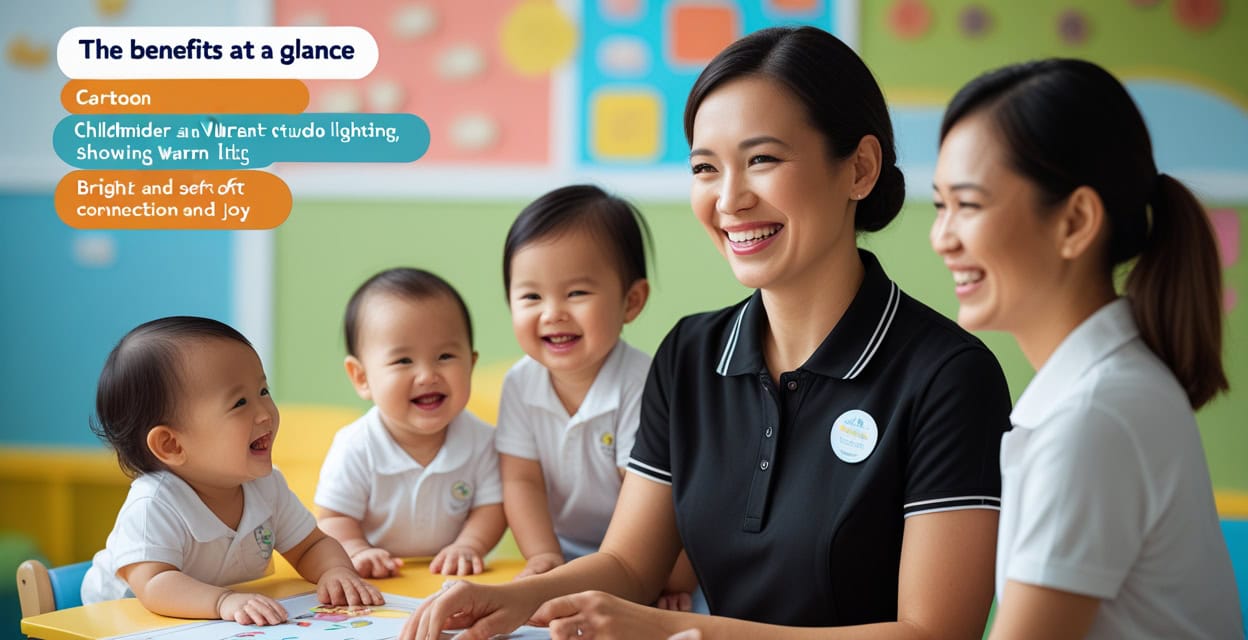
The benefits at a glance
- Excellence and Quality embedded in daily practice, not slogans
- Centre‑Based, Home‑Based, and Distance options
- Convenience: 7am–7pm, across neighbourhoods islandwide
- Affordability from $33/day
- ECDA Childminding Pilot alignment (Dec 2024–Dec 2027), subject to eligibility
- 1:3 infant ratio for true attunement
- Innovation CCTV with safety‑led layouts
- A National Social Initiative with a Maximum Employment Mandate
- Fees payable by CDA/Baby Bonus where eligible
- Learn more at EduNanny.com and Childminding.EduNanny.com

A day in the life of an EduNanny infant
Sample daily rhythm that reflects unhurried care and purposeful learning:
- 7:00–7:30 Arrival and a calm welcome. Caregiver meets the infant eye‑to‑eye, checks wellness notes, and adjusts the day’s plan to the infant’s pace.
- 7:30–9:00 Feed and floor time. Gentle tummy time, supported rolling, and a treasure basket with natural textures.
- 9:00–10:30 Short outdoor or courtyard exploration if weather allows; sensory play with safe, natural materials.
- 10:30–12:00 Nap preparation and rest period with individual sleep profiles; caregivers log sleep quality and duration.
- 12:00–14:00 Lunch and a quiet story routine; language exposure through narration and turn‑taking games.
- 14:00–16:00 Afternoon activities: supervised exploration, social interactions with peers, cause‑and‑effect play, and early problem‑solving tasks.
- 16:00–18:00 Calm down routine, reflective care notes for families, and a brief family‑facing update with a photo or short video.
- 18:00–19:00 Departure and farewell routine with a trusted goodbye ritual to foster security and predictability.
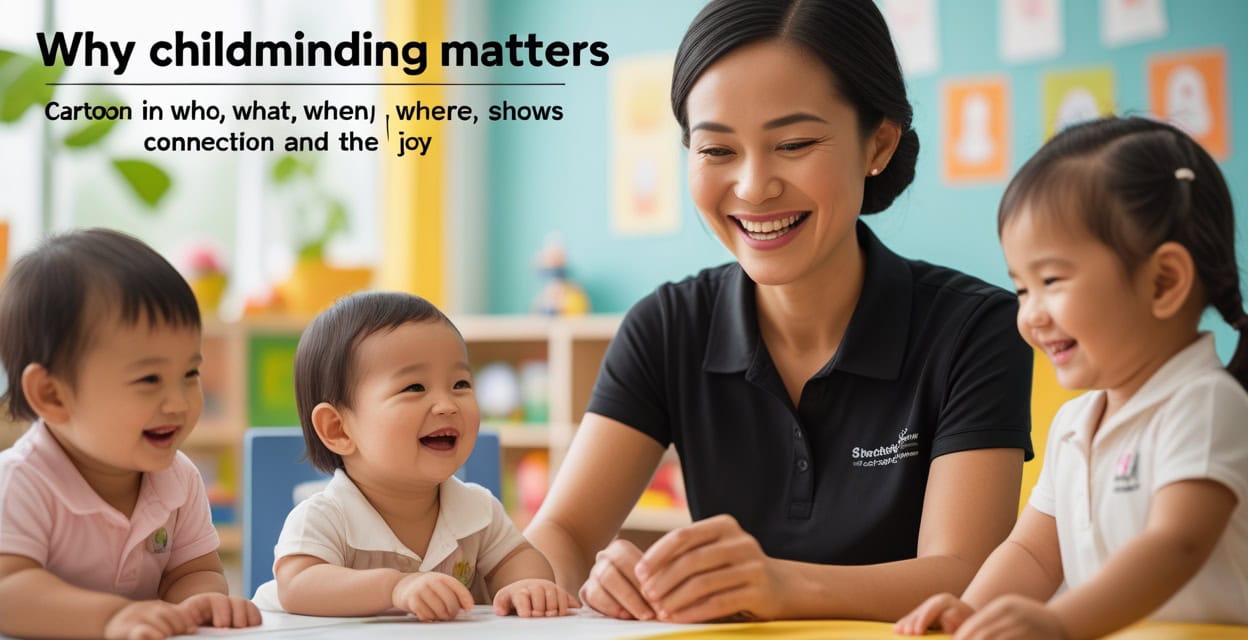
Why childminding matters—who, what, when, where, how
- Who: Infants who benefit from constancy; parents who need reliable partnership; childminders who deserve dignified work; communities that gain from near‑home care.
- What: Relationship‑first, safety‑led childminding with a 1:3 ratio that blends science with heart.
- When: The first thousand days—the window is brief but powerful for shaping neural architecture and lifelong patterns.
- Where: In centres and homes across Singapore—near workplaces, estates, and everyday life.
- How: Through trained caregivers, micro‑pods, transparent systems, innovation CCTV, rigorous safety protocols, and a curriculum that embodies attunement.
The philosophy and purpose of EduNanny Childminding
Care is curriculum. Every diaper change, bottle, and nap is an opportunity to teach trust, autonomy, and joy. Safety is love made visible, and when families can choose warmth without sacrificing reliability, Singapore becomes kinder, smarter, and more cohesive.
We build infrastructure at the human scale: tiny circles of three, multiplied island‑wide, each a seedbed of empathy, curiosity, and resilience. This is how a nation grows from the inside out.

Closing
To every parent who wonders if today can be gentle enough for your baby—yes, it can be. To every caregiver who wants your work to matter—yes, it does. To policymakers and partners imagining a fairer, more supportive Singapore—yes, it is within reach. Join us in making EduNanny a trusted everyday solution for families across the island. Visit EduNanny.com or Childminding.EduNanny.com. Speak with our team, tour a pod, ask hard questions, and bring your hopes. The future arrives small and swaddled; our task is to hold it safely, teach it kindly, and return it each evening a little more confident than before.
Thank you.
[#EduNanny, #SingaporeInfantCare, #First1000Days, #Childminding, #EarlyChildhoodDevelopment]