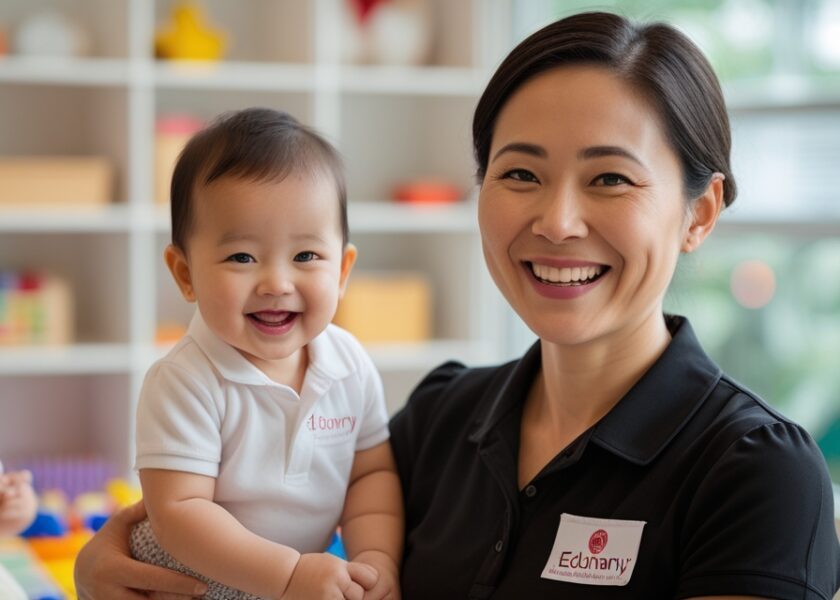
Ask This Before Your Child’s Caregiver Leaves
The Moment Everything Changes
Let’s start with what is actually happening inside a young child when the person they have bonded with prepares to leave.
We talk a great deal about attachment in the early years, and rightly so. The first thousand days of a child’s life are not just a phrase researchers use to sound impressive. They represent a period of neural architecture-building that happens at no other time in the human lifespan. A child’s brain is forming more than one million new neural connections every second during the first three years. The quality of the relationships that surround that formation matters in ways that are not metaphorical. They are structural. They are biological.
When a child forms a secure attachment to a primary caregiver — someone who is consistent, who responds reliably, who is present in the small moments as well as the significant ones — that child is building something inside themselves that will serve as a template for every future relationship. It is the internal working model from which they will eventually navigate friendships, partnerships, professional relationships, and their own eventual parenting. This is not sentiment. This is developmental science, and it has been replicated across decades of research in early childhood development the world over.
Now consider what happens when that caregiver leaves — not gradually, not with preparation, not with a process designed around the child’s understanding — but abruptly, mid-bond. The child has built an internal map of the world in which this person is a fixed point. That fixed point moves. And the child, who has no adult framework for understanding why, experiences something that is genuinely close to grief.
It may look like regression — a child who was toilet-trained suddenly having accidents again, a child who was sleeping through the night suddenly unable to settle. It may look like withdrawal. It may look like rage. In older toddlers, it can look like a strange, precocious understanding that is somehow worse than not understanding at all.
These are not behavioural problems. These are children communicating distress through the only language they have.
The research on caregiver turnover in early childhood settings consistently points to what parents already intuitively know: transitions that are sudden, unexplained, or not handled with the child’s developmental understanding in mind carry real costs. They can set back language development. They can disrupt sleep and feeding routines that took months to establish. They can fracture the sense of safety that a child had begun to trust.
And they can leave parents feeling as though they have failed their child in a way that is profoundly disorienting — because they did not fail. They were simply not warned, and they were not given the tools to ask the right questions before choosing a care arrangement that was built to withstand the ordinary turbulence of human life.
The Questions No One Tells You to Ask
Which brings me to something I think we owe every parent in Singapore: most childcare conversations begin with the wrong questions.
When families begin looking for infant care or a childminder, the questions they ask are usually the right ones by conventional standards. What is the curriculum? What are the qualifications of the caregivers? What does the environment look like? Is it clean, is it safe, is it stimulating?
These are good questions. They matter. But they are incomplete in a way that no one tells you about until the day you get that phone call.
The question that matters just as much — perhaps more — is one that almost no parent thinks to ask at the point of enrollment:
What happens when a caregiver leaves?
Not if. When. Because in the real world, caregivers are human. They get sick. They have families of their own. They relocate. They change careers. They age out of the physical demands of infant care. Life happens to the people who care for your children, just as life happens to you.
The question is not whether transitions will ever occur. The question is whether the system around you has been designed to handle them in a way that does not treat your child as collateral damage.
These are not rude questions. They are not aggressive questions. They are the questions of a parent who understands that the childcare relationship is one of the most important relationships your child will form in the early years, and that you have every right to treat it with the seriousness it deserves.
Before you sign any enrollment agreement, ask:
- What is the staff turnover rate? Not in general terms — specifically. How long have the current caregivers been in their roles?
- What happened the last time a caregiver left? What was the transition process?
- Does the provider have a documented transition protocol?
- Who will tell you, and how, if a caregiver needs to leave?
- Will you be given time to prepare your child?
- Will the handover be graduated rather than immediate?
- Will you be consulted on how your child is told?
If a provider cannot answer these questions clearly, that is information. It is not necessarily a reason to walk away — but it is a reason to understand exactly what you are choosing before you choose it.
A Departure vs. A Handover
Let me paint a picture that I think every parent in Singapore will recognise as the difference between a departure and a handover — because that difference is everything.
A Departure
This is what most families experience. The caregiver gives notice. The family is informed. A date is set. And then, on that date, the caregiver leaves, and a new person arrives, and everyone is expected to adjust. The child cries. The new caregiver tries their best. The parent feels guilty for not having prepared their child more, or for not having done more interviews, or for not having seen the signs.
This is the standard experience, and it is not anyone’s deliberate cruelty. It is simply the absence of a design principle that puts the child first.
A Handover
By contrast, a handover is a process. It is a graduated transition in which the departing caregiver is involved — not indefinitely, not in a way that creates dependence, but long enough for the child to begin building a relationship with the new caregiver while the familiar presence is still there.
It is age-appropriate communication — not lying to a toddler that the caregiver will “come back tomorrow” when she will not, but honestly acknowledging what is happening in a language the child can metabolise.
It is relationship documentation, where the departing caregiver shares the small things that matter — how the child likes to be held, what settles them, what they are afraid of, what makes them laugh — not as administrative data but as a transfer of intimate knowledge that says: your care mattered, and what I know about your child will not disappear with me.
These are not complicated ideas. They are not revolutionary. What is revolutionary is treating them as a standard rather than a luxury.
If You Are Living Through a Transition Right Now
Perhaps you are reading this while navigating a change that happened recently in your family — a caregiver who left, a child who is struggling to settle, a household that feels like it is holding its breath.
I want to say something clearly: this is not your fault. The grief you may see in your child is not a reflection of your parenting. The disruption you are managing is not evidence that you chose the wrong care arrangement. You made the best decisions you could with the information you had, and the love you have for your child is visible in the very fact that this pain exists for you at all.
But I also want to be practical, because sentiment without direction is not kindness — it is just noise.
If you are navigating a transition that has already happened, the single most important thing you can do is give your child what every child who has experienced a loss needs: consistency, presence, and honest acknowledgment of what has changed.
- Consistency in the routines that still exist.
- Presence — your presence, especially — in the days and weeks immediately following a departure, if that is possible for your work and life situation.
- Honest, age-appropriate communication. Tell your child what happened in simple, true terms. Use the departing caregiver’s name. Acknowledge that the child loved her, and that it is sad that she is not here anymore, and that it is okay to feel sad about it.
Children who are given language for their grief grieve more quickly than children whose grief is met with silence or deflection.
And be patient with yourself. Rebuilding trust in care — your child’s trust, and perhaps your own — takes time. It is not a failure if your child resists a new caregiver for weeks. It is not a failure if they cry at drop-off, or if they test limits in ways they did not before. This is a child who experienced an involuntary loss, and loss, in the early years, does not resolve on anyone’s schedule but the child’s.
What Intentional Care Looks Like
Too many care arrangements in Singapore are built around the assumption that continuity is an ideal rather than a design principle. Parents are expected to trust. Providers are expected to retain good staff. But there is rarely a transparent, structured protocol for what happens when the ideal meets reality — and when it does, parents are left scrambling, children are left grieving, and the caregivers who are leaving are often left without guidance on how to exit a relationship they, too, have come to care about.
The care you deserve is care that acknowledges this reality out loud, in the open, and builds systems around it.
When evaluating any care arrangement in Singapore, look for these indicators that continuity is treated as a foundational commitment rather than a hope:
- A provider who can clearly articulate their transition protocol, not just their curriculum.
- Evidence that relationship documentation is part of how care is delivered — that the small knowledge about your child (sleep patterns, comfort preferences, fears, joys) is treated as important, not incidental.
- Communication practices that keep you informed not just about what your child ate and how they slept, but about the quality of the relational environment your child is inhabiting.
- Graduated handover processes when changes must occur, with your child’s developmental needs at the centre of how the transition is handled.
- Staff retention rates that suggest the provider has figured out how to build an environment where good caregivers stay.
These are not luxuries. They are quality indicators — and they are ones you are entitled to evaluate before you make the most important entrustment of your life.
How EduNanny Approaches Continuity
EduNanny operates within the ECDA Childminding Pilot, and that is not simply a regulatory category. It is a framework designed around a specific recognition: that home-based and community-based care pathways offer something that centre-based care, for all its strengths, often cannot replicate. The ratios are different. The environment is different. The relationship structure is different.
For many Singapore families — particularly those navigating infant care, where the developmental stakes are highest — that difference is not a compromise. It is exactly what they need.
EduNanny’s approach understands something that most care models treat as incidental: that the relationship between a caregiver and a child is not a service delivery mechanism. It is a living, evolving bond that has developmental consequences in both directions.
When that bond is disrupted abruptly, it is not just the child who is affected. The family reorganisation, the parental guilt, the practical chaos of finding replacement care mid-bond — these are real, measurable costs that extend far beyond the child in question.
That is why continuity is not an afterthought at EduNanny. It is woven into the design of the service from the beginning — through careful caregiver matching, through structured transition protocols, through graduated handovers when changes do occur.
Where deployed, transparency measures including communication tools and monitoring options give parents insight into the daily experience of care — not as surveillance, but as the natural right of any parent who has entrusted something as precious as their child’s early relational world to someone else.
The pilot fee structures are designed to make this quality of care accessible, not just available to families with the means to pursue premium options. CDA and Baby Bonus usability are part of the architecture that makes continuity feasible for Singapore families across income levels.
And the Monday to Friday care blocks reflect a reality that working parents in Singapore understand viscerally: childcare is not a nine-to-five need, and reliable, structured care windows are the difference between a family that is managing and a family that is thriving.
Building Trust in Care
Singapore is not a place that lacks for ambition. We plan our pregnancies, our finances, our housing, our careers. We are extraordinarily good at designing for futures.
But in the one area where design may matter most — the relational architecture of our children’s earliest years — we have too often been content to hope. To assume. To trust that good intentions will carry the weight that structure should carry.
I am asking you, today, to stop hoping. Not to stop believing in the goodness of caregivers — that belief is well-founded, and the caregivers I have worked with in Singapore are among the most dedicated, self-giving professionals I know.
I am asking you to stop hoping and start asking. Ask about retention. Ask about transitions. Ask what the protocol is when the person your child has bonded with prepares to leave.
Ask because you have the right to know. Ask because your child’s sense of safety is not a commodity. Ask because continuity is not a luxury. It is a quality metric, and it is one you are entitled to evaluate before you make the most important entrustment of your life.
And if you find a provider who answers those questions with honesty, with structure, with a genuine commitment to walking families through transitions rather than simply managing them — hold onto them. They are rare. They are valuable. And they are doing something that matters more than any curriculum framework or sensory environment ever could: they are treating your child’s emotional world as worthy of design.
The Care Your Child Deserves
Every parent has at some point experienced the particular vulnerability of leaving your child with someone else. That moment — when you hand your infant to another person and walk away, trusting that the world will be kind to them in your absence — is one of the bravest acts of parenting.
It requires a faith that is not naive, because you have thought carefully about who you are trusting and why. But it is still faith. And the faith is this: that the person holding your child will hold them well. That they will love them. That they will keep them safe. That they will notice the small things — the way your child’s brow furrows before a meltdown, the song that always works, the comfort object that must not be forgotten — and that this knowledge will accumulate into a relationship that your child will carry with them as a source of security, not anxiety.
That faith is not irrational. But it does require something from the other side. It requires that the people who hold our children take continuity not as a nice-to-have, but as a covenant.
That is what EduNanny is here to do. Not to promise that nothing will ever change. But to promise that when change comes — because it will, because it always does, because we are human and humans move and grow and sometimes must leave — it will be handled with your child’s heart at the centre of the process.
That is the care that Singapore families deserve. And that is the care we are committed to building, one transition, one handover, one child at a time.
If you are researching infant care or childminding options in Singapore and want to understand how continuity is designed into care — not hoped for — I encourage you to learn more about EduNanny’s approach within the ECDA Childminding Pilot. Ask the questions in this article. Evaluate the answers. And choose care that treats your child’s emotional world with the seriousness it deserves.