Making Room to Respond in Small-Group Infant Care
A calm room is not proved by how many toys it holds. Materials, visual focus, adult position and pauses offer a practical lens for small-group care—without turning room design into a developmental promise.
A calm room can still ask the wrong question. Materials may sit within reach, an adult may be nearby and the floor may look open, but a parent wants to know whether the setting can help an infant signal, be answered and have room to respond.
That interaction—not the décor—is the evidence-backed core of responsive care. The Center on the Developing Child at Harvard University describes serve and return as responsive, back-and-forth exchanges between a young child and caring adult. The materials, visual field, adult position and pauses discussed below form a practical way to observe an infant-care setting. They are not a validated checklist, and none should be read as proof that room design causes developmental progress.
Responsiveness begins with the exchange
Responsiveness depends on sequence. An adult notices a signal and returns it, but that return is not the whole exchange: the child still needs a chance to contribute again. An impressive toy or lesson cannot substitute for that sequence.
Consider a hypothetical exchange. A childminder brings a stable cloth object into view and waits. The infant looks, reaches or vocalises; the childminder follows that action with a gesture, sound or movement of the object. The next prompt grows from the infant’s contribution rather than from a fixed script. This illustrates responsiveness, but it does not prove that cloth objects are better than other materials.
A 2022 scholarly article on responsive caregiving and early learning reports that one study linked responsive caregiving with a positive effect on healthy growth trajectories. That offers context for the significance of caregiving interactions. It does not test a particular shelf layout, degree of visual stimulation, adult posture or group arrangement, so it cannot support a claim that any of those features produces a developmental outcome.
Treat materials as access, not display
A practical materials audit begins with visibility and reach. What is in the infant’s field of view? Which objects can be presented in a way suited to the infant’s stage and the setting’s safety requirements? Can the adult introduce an item, change the selection or put it away without turning the moment into a fixed lesson? These are observational prompts, not research-derived rules.
In a hypothetical example, two stable, washable cloth pieces sit within reach while the rest of the materials are stored. The childminder presents one, watches for an observed signal and then keeps it still, changes its position or removes it. The point is not that two is the right number. It is to make a small adjustment based on what the infant does.
Observation should also avoid assigning more ability than an action shows. Looking towards a colour is not the same as naming it. Looking at or matching a picture is not reading. Following a familiar melody is not the same as singing words. Accurate description keeps observation useful and avoids turning an ordinary moment into a developmental claim.
No cited source establishes that a particular number of objects, a densely arranged display or a visually sparse room improves attention. A larger display may offer more choices, but it does not by itself demonstrate responsiveness. A simpler arrangement is likewise an editorial choice, not a proven intervention or proof that visual clutter caused a difficulty.
Position the adult around the exchange
Adult positioning is another variable to observe, not a posture to prescribe. Sitting, kneeling or standing may suit different moments, depending on the infant, the activity and the supervision demands of the setting. The cited research does not identify an ideal eye level, distance or position that reliably produces a developmental benefit.
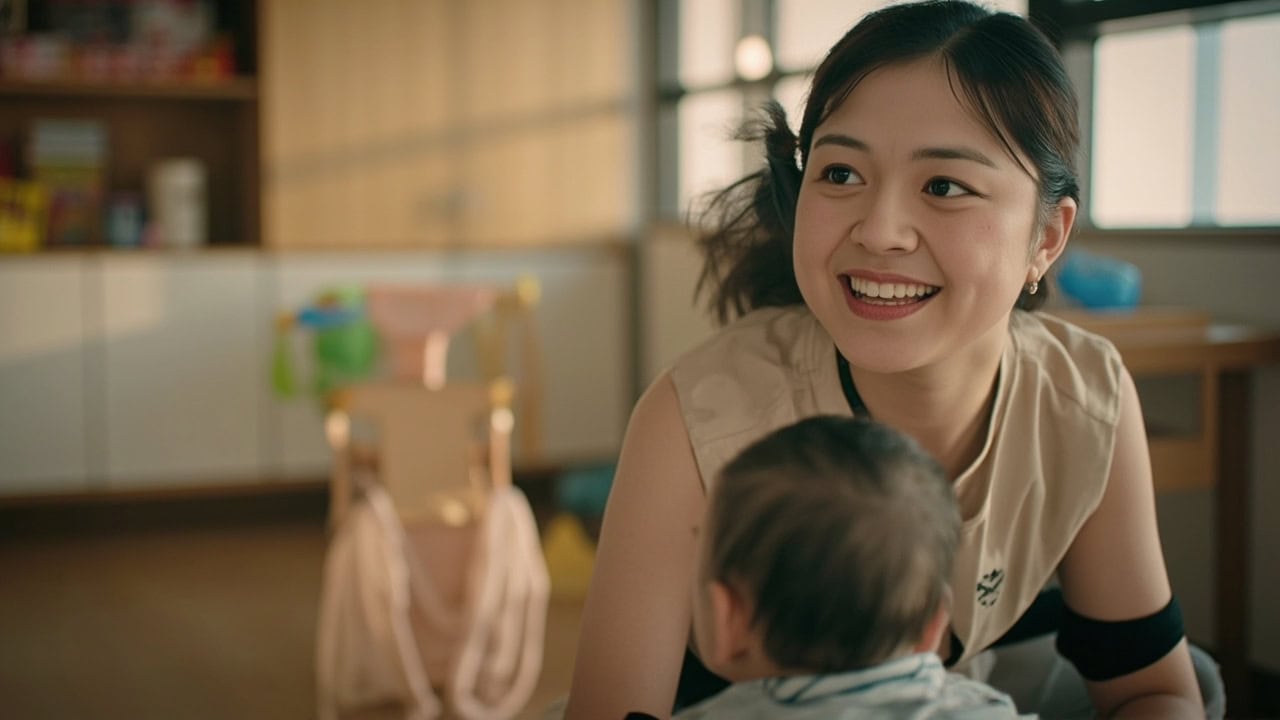
In another hypothetical moment, an adult kneels and brings a face, gesture or voice into the infant’s immediate field, then shifts position as the infant moves. The adult follows a change in gaze or sound instead of forcing the original activity to continue. This illustrates flexibility; it does not show that floor-level care performs better than standing care.
Positioning is about access, not performance. An adult can be physically present and still miss an infant’s signal. In a group, the adult must also manage changing demands beyond the immediate exchange. The useful question is whether the arrangement supports engagement while preserving supervision. The cited evidence does not show that any room arrangement removes the wider demands of group care.
Make the pause part of responsiveness
The most concrete evidence-backed instruction in this area is also the simplest. Harvard’s five-step guide to serve and return says to give a child a chance to respond whenever a serve is returned and notes that back-and-forth turns can be quick. A pause is therefore part of the exchange, not empty time inserted to meet a target.
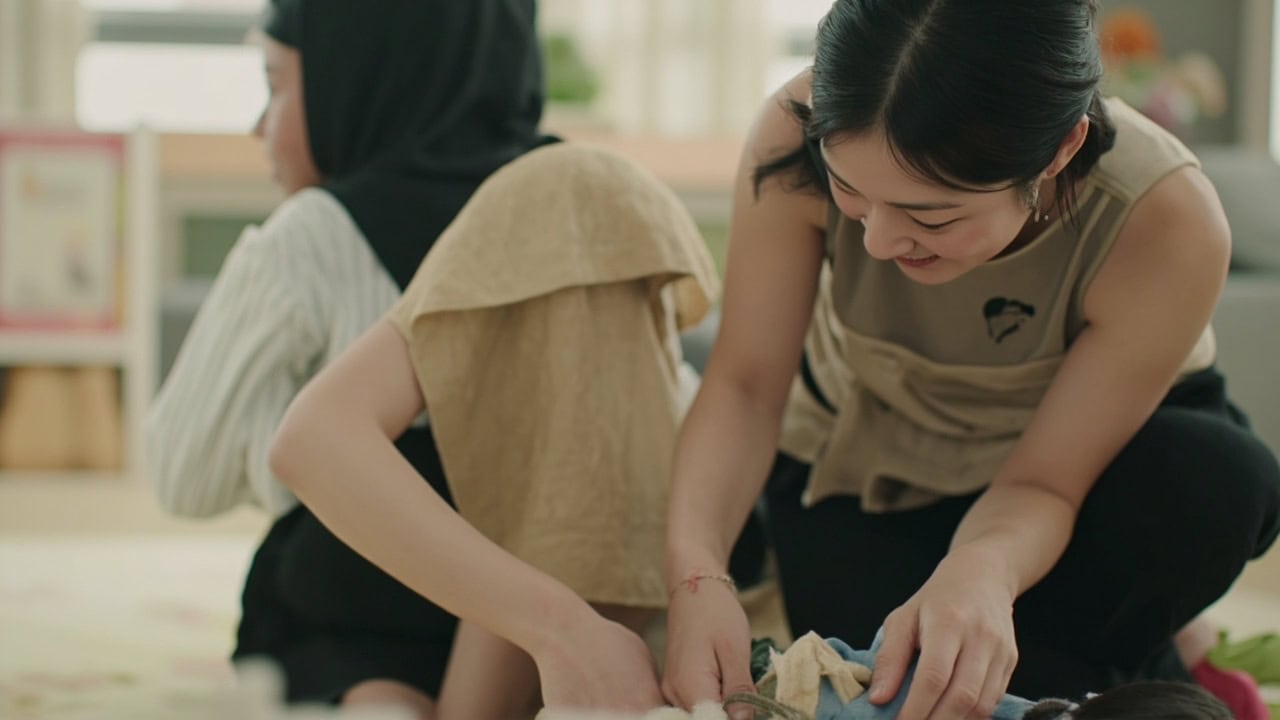
Imagine a childminder returning a reach with a cloth square. If the infant looks back, vocalises or reaches again, the adult can answer. If attention moves elsewhere, the adult can let the exchange close. This example shows a response followed by space for another signal; it does not establish that a particular length of waiting improves attention or development.
There is no evidence-based stopwatch in the sources used here. The pause should not become a prescribed number of seconds, and it should not be used to postpone an infant’s needs or reduce supervision. The childminder still has to notice changing signals and act on them. The aim is responsiveness, not a performance of stillness.
What small-group care can—and cannot—promise
EduNanny’s ECDA Childminding Pilot page describes its approach as small-group, safe and responsive infant care, with time and attention used to create opportunities for exploration and interaction. That is the provider’s own description of its service. It is useful implementation context, but it is not independent evidence that a group arrangement causes stronger development.
A small-group arrangement may alter the practical opportunity to notice cues and tailor an interaction, but opportunity is not an outcome. It does not guarantee uninterrupted individual attention, a particular response from every infant or faster progress. The cited sources do not establish that a small-group description or staffing arrangement causes more infant initiation, earlier milestones, accelerated development or higher intelligence.
For parents weighing premium care, the observable practice matters more than a label. Is the adult responding to this infant? Is the infant given room to answer? Are materials, position and pacing adapted without claims attached to a colour, object or count? The setting may make an interaction easier; the interaction itself is what the evidence highlights.
It helps to separate capacity, conduct and developmental claims. Capacity is what a service is designed to make possible. Conduct is what an adult actually does. A developmental claim requires evidence about what changed for children. A staffing description cannot establish all three.
Read one exchange, not a room score
A visit can be more informative when a parent watches one complete sequence rather than assigning points to colour, furniture or object quantity. Notice whether the childminder picks up an infant’s signal, returns it in a way suited to the moment and allows a response. Then notice whether the next step changes when the infant’s attention changes. These are conversation prompts, not a validated inspection scorecard.
Appearance can shape expectations, but evidence does not turn a colourful room into responsive care or a sparse room into a problem. The adult’s attention is what a parent can observe in the moment: Is the adult following the child’s contribution, making space for another turn and still managing the wider setting? A well-presented room cannot demonstrate any of that by itself.
Making room to respond means keeping safety and access in view, then noticing when an infant contributes something small. The adult returns it, leaves an opening and respects a change of direction. This is not a promise that a particular room or group size accelerates development. It is a disciplined way to keep the child’s signal at the centre of the interaction.
A responsive care environment is ultimately not a decoration style. It is a practical question about whether the people and setting can support an attentive exchange—without claiming that the environment did the developmental work alone.
Sources and further reading
- Serve and Return: Back-and-forth exchanges · Center on the Developing Child at Harvard University
- 5 Steps for Brain-Building Serve and Return · Center on the Developing Child at Harvard University
- Responsive Caregiving and Opportunities for Early Learning · PubMed Central
- EduNanny ECDA Childminding Pilot · EduNanny
The images in this article were generated with AI for illustration. They do not show actual EduNanny staff, children or facilities.
Every family has different care needs. Speak with EduNanny to discuss care that is right for your child.