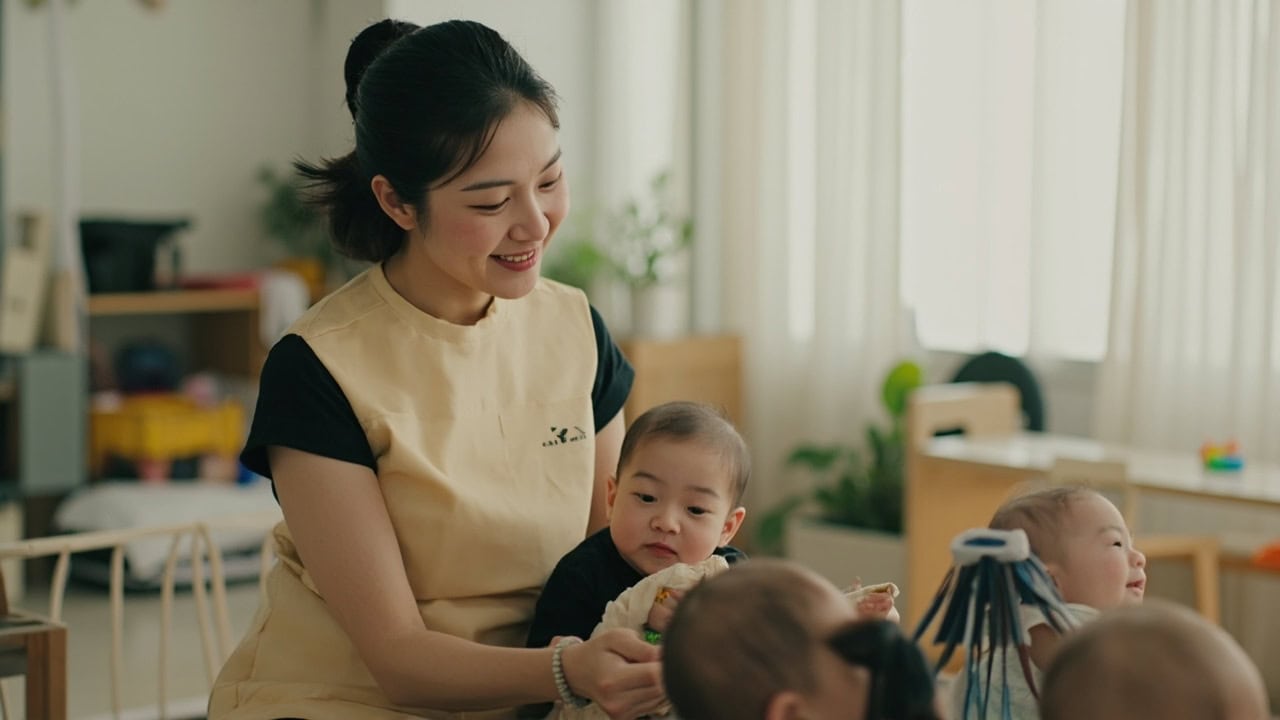
Consistency Is a Pattern of Response, Not a Repeated Activity
Reliable infant care is not a fixed sequence of toys, songs and mealtimes. It is a dependable pattern of noticing signals, responding with care and leaving room for the infant to answer.
In a hypothetical morning, a parent might take comfort from familiar signs: the same warm song before rest, a book returned to its basket, or a childminder noticing that a baby reaches for a cup. Those repetitions can feel reassuring. Dependable care must also work when the toy is refused, the song is ignored and a new gesture takes over.
That distinction matters when considering responsive care consistency. It means a dependable pattern of noticing an infant’s signals and choosing a suitable response across play, language and daily care, even when activities, timing and interests change. Consistency is reliable attention, not a frozen timetable.
Consistency That Changes With the Infant
The Center on the Developing Child at Harvard University describes serve-and-return interactions as responsive, back-and-forth exchanges between a young child and a caring adult. It says these interactions play a key role in shaping brain architecture. For infant care, the useful idea is the exchange: an adult notices a signal, makes a responsive contribution and allows the child to answer. The evidence does not justify treating any particular toy, song or schedule as a guaranteed developmental result.
The Center’s five-step parent and caregiver guide recommends returning a child’s serve by supporting and encouraging, and says to give the child a chance to respond. It also notes that turns can be quick. That is practical guidance, not an instruction to impose a fixed number of seconds; an exchange can be brief without being made into a timed test.
In a hypothetical play session, an infant may ignore one open material and attend to a cloth book. The childminder can follow that interest, look at a picture, then return the book to the basket when attention shifts. Another day, a different material may be welcomed. The materials have changed, but the adult still notices, responds and makes room for the infant’s next contribution.
A timetable can organise transitions, but it cannot know in advance which toy will hold attention or whether a familiar song will invite a response. The dependable element is the adult’s willingness to observe, adjust and keep the child’s next contribution in view.
The Exchange Behind Everyday Care
Responsive care is not the same as turning every minute into an activity. A hungry, uncomfortable or tired infant may need practical care rather than play. The adult may support a meal, change a position, lower the pace or create more space. The aim is not to extend every exchange; it is to fit the response to the infant’s needs and signals.
Consistency can also be seen in what happens after a first attempt does not work. In a hypothetical song time, an adult begins with a familiar phrase, notices that the infant turns away and settles the pace instead of repeating it more loudly. In a later moment, the same song may be welcome. Changing the response is not inconsistency; it is the pattern being applied to what is happening now.
Play, Books and Song Follow the Lead
During hypothetical floor play, an adult can put one safe material within reach, watch what the infant does and adjust rather than prescribe the next move. If interest fades, the adult may simplify, change or end the activity. The infant’s response guides the next step; whether the exchange produces a particular developmental result is not established by the responsiveness itself.
Shared books work similarly. An adult can look at a picture, point, then give the infant a chance to look or reach. Looking at or pointing to a picture is shared attention, not independent reading. A look back or vocalisation may be treated as a contribution to the exchange, but it should not be described as singing lyrics or intelligible speech.
Language can be invited without being tested. If an infant watches a red cup, an adult may say red cup once and return attention to the child. Visual attention is not evidence that the infant can name the colour. Labels can invite noticing and communication; they are not scores to be won.
What Low-Ratio Care Can—and Cannot—Promise
For parents, premium care is more usefully assessed through quality of attention than through décor, luxury or constant stimulation. Practical signs include close observation, age-appropriate choices, safety and an adult’s ability to adapt while maintaining clear boundaries.
A low childminder-to-infant ratio may make it more practical to notice a subtle gesture, wait for a response or adjust an activity. The cited Harvard material explains serve and return; it does not provide evidence that a particular staffing ratio causes faster development, earlier milestones or another defined outcome.
EduNanny’s first-party ECDA Childminding Pilot Programme page states that its small-group care has a maximum of three infants per childminder. That exact figure is a programme fact, not independent outcome evidence. A maximum of three also should not be read as a promise of continuous one-to-one attention: shared supervision, transitions and the needs of several infants still require judgement within the group.
Consistency Through Ordinary Care
The same pattern appears during ordinary transitions. In a hypothetical clean-up, an adult might offer a safe cloth, notice that the infant drops it and continue the task without fuss. At a meal, the adult can follow the routine already in place, notice what attracts attention and add a brief comment without turning food into a quiz.
In another hypothetical sequence, a baby who turns away from a lively song may be met with a calmer voice or more space; a baby focused on movement may need an adult nearby without another object being placed within reach. Clear boundaries are also responsive: an adult can acknowledge a child’s interest while stopping an unsafe action and offering an acceptable alternative. Safety and comfort come before prolonging an exchange.
How Parents Can Assess Consistency
Parents comparing infant childminding can move beyond “Which activities are provided?” A more revealing question is: “What does the childminder do when an infant looks away, loses interest or needs a different pace?” The answer should show observation, judgement and flexibility—not a claim that the same material works for every child.
Updates are most useful when they separate observation from interpretation. “Looked back during the song” or “reached towards the picture” records what happened. “Understood the song” or “showed advanced language” claims more than the observation supports. A useful account also says how the adult responded, without presenting one repeated activity as a developmental guarantee.
A busy day may move from floor play to a book, a meal, a change and an unplanned pause. A low ratio may provide useful context, but the more revealing test is what the adult can notice and do within the setting. Beneath the changing sequence, consistency remains recognisable: notice the infant, choose a fitting response and make room for what comes next.
Sources and further reading
- Serve and Return: Back-and-forth exchanges · Center on the Developing Child at Harvard University
- 5 Steps for Brain-Building Serve and Return · Center on the Developing Child at Harvard University
- EduNanny® ECDA Childminding Pilot Programme · EduNanny
The images in this article were generated with AI for illustration. They do not show actual EduNanny staff, children or facilities.
Every family has different care needs. Speak with EduNanny to discuss care that is right for your child.