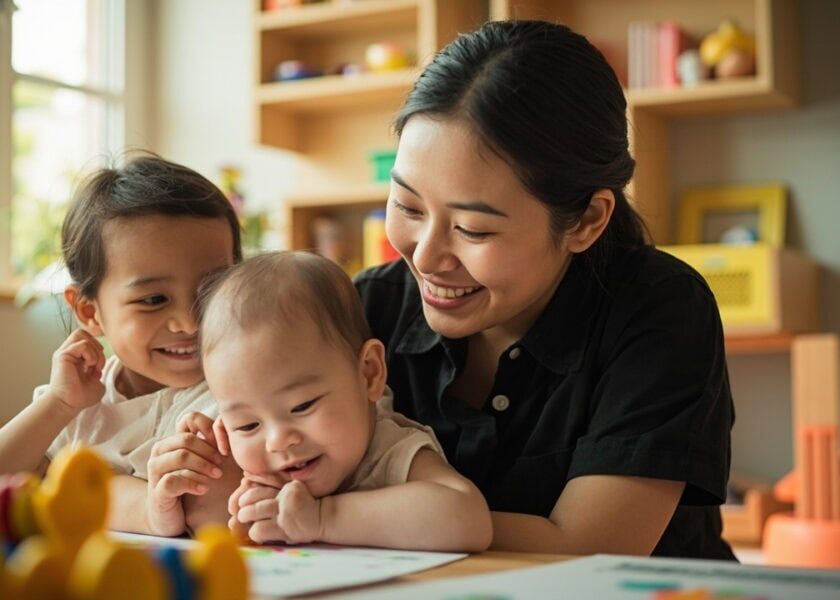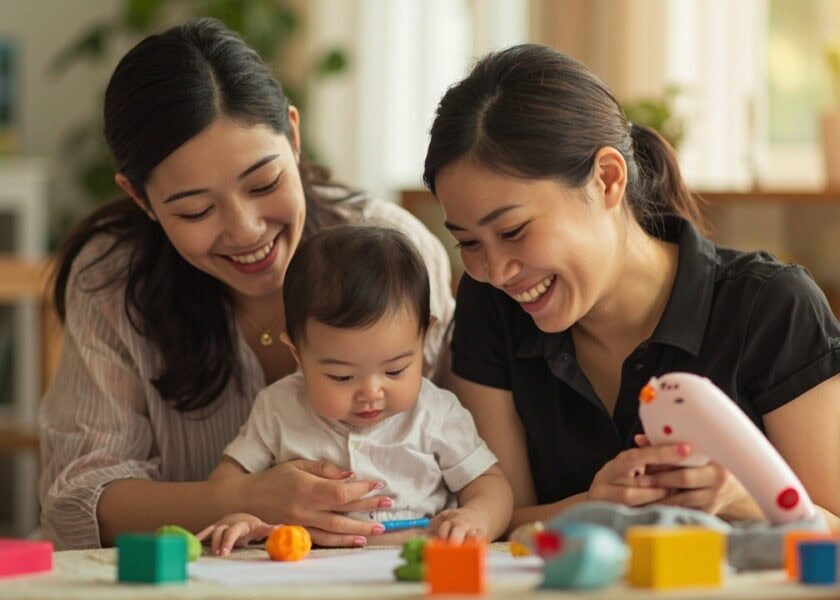
Why Choosing Quality Childcare Is Choosing Your Child
The Moment Every Singapore Parent Knows
There is a moment — quiet, unannounced — when a Singapore parent realizes that loving their child and leaving their child are no longer things they can keep separate. It arrives not as a single dramatic decision but as a slow accumulation of small, exhausting truths. The mortgage that doesn’t pause for maternity leave. The career that waits for no one. The alarm clock that still rings at six even though you were awake since three, watching your baby breathe, wondering whether you are doing this right.
And somewhere in the space between all of that, the question no one prints in parenting books and no one says out loud at playgroup:
What if my child forgets me?
It sounds absurd when you say it plainly. You know it sounds absurd. But you have thought it anyway, haven’t you? In that half-awake hour before dawn. In the car before you’ve pulled out of the driveway. In the quiet of your office when you should be answering emails but instead you’re staring at a photo of your child’s face and wondering if they are crying. If they are looking for you. If they are wondering why you left.
If this is where you are tonight, you are not alone. You are, in fact, exactly where most parents who choose quality childcare have been. And that place is not weakness. It is the beginning of something important — a conversation you deserve to have, honestly and without shame.
Give the Fear a Name
Before we go further, let’s name what you are experiencing — because named things lose some of their power.
What you are feeling is not merely separation anxiety, though that is the phrase people reach for. And it is certainly not guilt, though guilt is what everyone wants to talk about, as though the solution to your pain is simply convincing you to stop feeling it.
No. What you are experiencing is something far more primal. You are experiencing the terror of being replaceable to the one person in the world you cannot bear to be replaceable to. You are afraid that your child will bond with someone else so completely that the bond you grew inside your body — the one that cost you blood and stitches and months of sleeplessness and every ounce of your emotional reserves — will somehow become less real. Less primary. Less yours.
Psychologists don’t always say this plainly, but what you are feeling is the fear of no longer being necessary. And in a culture like Singapore’s, where the pressure to be the perfect parent is amplified by comparison, by competition, by the relentless messaging that the first thousand days of your child’s life are everything and you are running out of them — this fear doesn’t stay quiet. It shouts. It wakes you up at three in the morning. It makes you cry in the bathroom at work. It makes you Google “signs my child prefers their caregiver” at midnight.
Here is what we want you to know, and we want you to hear it slowly: the fact that you are afraid is not evidence that you are failing. It is evidence that you love your child with a ferocity that has no off switch.
That fear is not weakness. It is the deepest, most honest thing about you as a parent. And it deserves more than to be dismissed.
What Research Tells Us About Security and What Your Child Actually Needs
There is a concept in developmental psychology that has been studied for more than fifty years and remains one of the most robust findings in all of child development. It is called attachment theory, and at its centre is a deceptively simple idea: children develop security not from the sheer quantity of time they spend with a caregiver, but from the quality of responsiveness they experience.
Consider this. A child who has one caregiver who is warm, consistent, and emotionally attuned will almost always develop more secure attachment than a child who has two caregivers, both of whom are warm, but one of whom is inconsistent, distracted, or emotionally unavailable — not because they don’t care, but because life is hard and parents are human and sometimes a parent who is exhausted, overwhelmed, or running on empty cannot be emotionally present no matter how much they want to be.
This is not a judgment on imperfect parents. It is a recognition of a biological fact: a child’s sense of safety in the world depends on having at least one reliably responsive attachment figure. Just one. But that one must be reliable.
Here is where Singapore parents need to hear this clearly: if the choice you are making is between a parent who is physically present but emotionally exhausted, distracted, and running on empty — and a qualified, consistent, warmly responsive caregiver in a quality childminding setting — the attachment science does not automatically favour the parent. This is not an easy thing to hear. But it is an important one, and you deserve to hear it from someone who respects you enough not to soften it into something less true.
What children genuinely need
What children need — what decades of research tell us they genuinely need — is not maximal parental presence. They need a secure base.
A place they can trust completely. A foundation from which they feel safe enough to explore the world, and to which they can always, always return. That is the whole of it. Not a single human being who is never absent. A secure base that is consistently warm, consistently responsive, and consistently present.
When your child is in quality care, they are not choosing between you and their caregiver. They are building something more nuanced and more beautiful than that. They are learning that the world contains people who can be trusted. They are learning that safety is not located in one person alone but in a pattern of care that repeats, that holds, that does not abandon.
Children who attend high-quality early care settings do not show weaker attachment to their parents. Research consistently shows they display stronger exploratory behaviour — one of the most reliable markers of secure attachment. They are more confident in the world because they are more certain, at a level deeper than language, that someone will catch them if they fall.
This means the childcare setting stops being a compromise and starts being something else entirely: a secondary secure base. One that extends the reach of your child’s sense of safety rather than replacing it. One that works with the attachment you have built, not against it.
What Quality Childminding Looks Like in Practice
We have to be careful here, because the word quality is doing enormous work in that last section, and not every childcare arrangement is equal to this task. So let us talk about what quality care does — and does not — look like.
Quality care is not:
- A pristine facility with colourful walls and a laminated schedule on the door
- A teacher-to-child ratio that looks good on paper but doesn’t translate to real attention
- A caregiver who is technically qualified but emotionally distant
Quality care is:
Responsiveness. The ability of the caregiver to notice your child’s cues, to interpret them accurately, and to respond in a way that is warm, timely, and consistent.
- A caregiver who notices when your baby is about to get fussy and intervenes gently before the crying starts
- A caregiver who mirrors your toddler’s frustration with calm rather than matching it with control
- A caregiver who can read the difference between a child who needs comfort and a child who needs space, and who knows how to tell the difference in the span of a single breath
Because responsiveness is not a box you check. It is a discipline you practice. It requires training, yes. It requires systems, yes. But above all, it requires caregivers who have been selected not just for their qualifications but for their orientation — the way they instinctively hold a child, the patience they bring to repetition, the warmth that cannot be taught but can be recognized and cultivated.
The Singapore Context: Why This Decision Feels Different Here
Singapore parents carry a specific and particular weight that parents in other contexts sometimes do not. The competitive culture here — the relentless comparison, the endless chatter about giving children the best start, the way your child’s development can become a measure of your worth as a parent — none of this exists in a vacuum. It is woven into the fabric of daily life in a way that is almost impossible to escape.
You open your phone and someone else’s three-year-old is doing Montessori activities in a perfectly curated playroom. You go to a parenting forum and someone is asking whether their child should already be reading at eighteen months. Your mother-in-law asks when your child will be toilet trained, and the subtext is clear: isn’t it time you got your life back?
And in the middle of all of this, you are trying to make a decision about childcare, and every option feels like a referendum on your parenting, on your priorities, on your love.
Singapore parents are not making childcare decisions from a place of ease. They are making them from a place of genuine, often exhausting, sometimes desperate care. And that deserves a response that is equal to that seriousness — not a checklist, not a sales pitch, but a genuine answer to the question: How can this be worthy of what I am trusting you with?
Evaluating Your Options: A Practical Guide for Singapore Parents
Before you begin evaluating providers, ask yourself a few honest questions:
- What kind of caregiver do I want my child to come home talking about?
- What would make me feel safe enough to set this fear down at the door each morning?
- Am I choosing based on what looks good, or based on what actually feels right for my child and my family?
When you visit a potential childcare setting, look and ask for:
- Responsiveness in action: Watch how caregivers interact with the children. Do they notice before children escalate? Do they kneel to a child’s level? Do they respond to crying with warmth rather than routine?
- Consistent faces: Will your child see the same caregivers most days, or does turnover feel high? Consistency is not a nice-to-have — it is foundational to attachment.
- Transparent communication: How will the caregiver share information with you about your child’s day? Is it specific, honest, and regular — or generic and rare?
- Trained caregivers: What training do the caregivers have? Are they supported by a structured programme, or working from instinct alone?
- Respect for your role: Does the setting seem to see itself as a partner with you, or as a replacement for you? The best childcare arrangements feel collaborative.
Red flags to notice:
- Caregivers who seem distracted, rushed, or emotionally flat
- A facility that looks impressive but where you don’t sense warmth in the interactions
- Resistance to your questions, or answers that feel scripted rather than genuine
- An approach that promises to make your child “independent” by minimizing comfort and response
Your common concerns, answered honestly
Will my child forget me?
Your child cannot love anyone else in the way they love you. That bond is not transferable. It is not fragile. It does not erode every time someone else changes your child’s diaper or sings them a lullaby. What you share with your child is encoded in their nervous system, in the texture of your voice, in the particular rhythm of your breathing, in the ten thousand hours of attuned interaction that began the moment they were born and have never stopped since. No caregiver, no matter how wonderful, can replicate that. And more importantly — no caregiver worth your trust would want to.
What if my child cries every time I leave?
Some crying at separation is normal and does not indicate a problem. What matters is what happens afterward. In quality care, a responsive caregiver will soothe your child and help them settle. Over time, as your child learns that you always return and that the caregiver is a safe person to be with, the crying typically decreases. If it does not, that is a conversation worth having — and a sign that the arrangement may need adjusting.
Is a childcare centre really better than me being there?
This depends entirely on the quality of what is available to you. Attachment science tells us that a warm, consistent, responsive caregiver can provide the conditions for secure attachment. If the choice you are making is between yourself at your most exhausted and a caregiver who is genuinely warm and attentive, the attachment benefits may well favour the latter. This is not a failure on your part. It is a recognition that you are human, and that humans — even parents who love their children completely — have limits.
Aren’t there better options — a grandparent, a stay-at-home arrangement?
Every family is different, and every arrangement has its own strengths and challenges. Grandparents can offer wonderful care, and some families find that arrangement works beautifully. What EduNanny offers is a specific kind of care: professional, trained, structured, and designed to meet Singapore’s early childhood standards. For parents who don’t have family nearby, or whose family situation makes this impractical, or who want a different kind of support altogether, quality childminding fills a real need.
What EduNanny Singapore Was Built For
EduNanny Singapore, a service under the banner of BUTLER, operates within the ECDA Childminding Pilot — a framework designed by Singapore’s own early childhood development authority. This is not an imported model or a one-size-fits-all solution. It is a programme shaped by people who understand what it means to raise a child in a one-room flat in Toa Payoh or a five-room flat in Jurong West, who know that Singapore children grow up in air-conditioned rooms and playground sand and hawker centre mornings, and that all of this is part of what quality care must hold space for.
What this means in practice:
- Trained and supported caregivers selected not just for qualifications but for their orientation toward children — their warmth, their patience, their instinct to notice before they respond
- Attentive ratios designed so that every child can be known — not processed, not managed, but known by someone who sees them as an individual, not a slot in a schedule
- Honest, consistent communication — not generic updates or photos that could have been taken at any point in the day, but real information: what did my child eat, how did they sleep, did they seem happy, what are they curious about right now?
- Your place in your child’s life is not diminished. The caregiver you choose understands that they are an extension of your child’s world, not a replacement for it. They honour the bond your child has with you by reinforcing it — by keeping the connection between you and your child alive even in the hours you are apart.
When a parent receives honest, consistent information about their child’s day, something shifts. The fear doesn’t vanish — the love that drives it doesn’t vanish either, and you wouldn’t want it to. But the fear becomes manageable. It stops being the kind of fear that makes you call four times before noon. It becomes the kind of fear you can set down at the door, knowing that the person on the other side of it is holding your child with the same attention you would give them yourself.
The Reframed Decision: An Invitation
Here is what we want you to take away from everything above:
The choice to seek quality childcare is not the end of your parenting. It is a continuation of it — an expansion of it.
It is you, the parent, saying: My child deserves more than what I alone can provide, and I will find the people who will provide it with excellence. It is the architect’s decision, not the victim’s surrender.
Every parent who makes this choice — every parent who has lain awake with this question, who has Googled at midnight, who has cried in the office bathroom, who has felt the weight of Singapore’s expectations pressing down on shoulders already carrying a toddler — every one of you has already shown the most important thing: the courage to choose your child over your pride.
Because here is the truth that sits at the centre of all of this: leaving your child and loving your child are not in opposition. Sometimes the most loving thing you can do is trust someone else to hold your child the way you would hold them yourself.
You are not abandoning your child. You are choosing your child — choosing a future for your family that is sustainable, that is supported, that is rooted in the reality that one person, even one person who loves their child completely, cannot be everything all the time without erosion.
You are building a village. You are widening the circle of trust in which your child lives. You are giving your child a second anchor, and that second anchor does not pull against the first. It holds when you cannot.
And one morning — if you have chosen well — you will drop your child off and the caregiver will bend down to your child’s level and say, “Hello, we missed you,” and your child will light up and reach for them. Not instead of reaching for you. But also.
That moment — small, ordinary, extraordinary — is the answer to the question you have been carrying. It is proof that quality care does not replace you. It extends you. It amplifies the safety you have built. It gives your child more room to grow because it gives them more trust in the world.
EduNanny Singapore was built on a single belief: every child deserves a second secure base, and every parent deserves to leave their child with someone worthy of the trust it takes to do so.
We are here for the parents who understand this. Who are brave enough to examine their fear honestly and strong enough to act on what that examination reveals. Who know that the quality of care they choose is not a reflection of their failure as a parent but a reflection of their commitment to getting it right.
If you are sitting with this fear tonight — the one that lives in your chest like a stone, the one that tells you that leaving your child means leaving them behind — we want you to hear this, and we want you to hear it slowly:
You are not leaving your child. You are choosing your child. And you are choosing a future for your family that is worthy of the love you carry.
EduNanny Singapore offers infant care and childminding under the ECDA Childminding Pilot, with trained caregivers, attentive ratios, and a commitment to honest, consistent communication with parents. If you are exploring childcare options and want to speak with someone who understands the weight of this decision, we welcome the conversation.
Ready to learn more? Visit edunanny.com or speak with our team to arrange a visit and see what quality childminding looks like in practice.