What Your Child Learns in the Hours You’re Not There
The Hours You Are Not There: What Your Child Is Really Learning in Quality Childcare
There is a moment that probably sounds familiar to you. It is late afternoon. You walk through the door of your child’s childcare space, and your little one looks up — not with distress, but with a kind of quiet recognition. Something has happened today that you were not part of. You can see it in the way they move, the way they look at the other children, the way they reach for your hand and then let go again, testing what it means to be back.
And you find yourself wondering — not with anxiety, but with a deep, quiet curiosity — what exactly went on in the hours you were not there.
That question is one of the most honest things a parent can ask. And it is also one of the most underserved questions in the way we talk about childcare in Singapore.
Most of the conversation assumes that what parents need is reassurance. Reassurance that their child is safe. Reassurance that they made the right choice. Reassurance that the separation is manageable and temporary. And all of that matters — of course it does. But it leaves a quieter, more profound question unasked.
The question is not whether your child is okay. The question is what they are becoming.
In quality childcare, at its best, your child is building the foundational architecture of who they will be — not as a student, not yet as a learner in the formal sense, but as a human being navigating emotions, relationships, curiosity, and the slow, astonishing work of figuring out how to be in the world. Here is what that actually looks like:
- Emotional regulation — learning to name and manage feelings with support from responsive caregivers
- Social confidence — discovering that other children are interesting, not threatening
- Self-concept — quietly understanding “I am a person who can do things, who matters”
- Cognitive growth through play — absorbing skills naturally, the way they absorb language
- Independence — building the courage to explore a world larger than home
Keep reading to understand what these competencies look like in practice — and how to recognize them in your own child.
What It Actually Takes to Belong
Consider, for a moment, what it actually takes for a young child to walk into a room full of other children and feel, even vaguely, that they belong there.
It is not instinct. It is learned. It is built — brick by tiny brick — through dozens of small experiences that you will never witness:
- The moment another child shares a toy and your child takes it, and nothing terrible happens
- The moment a caregiver names an emotion — “You look frustrated right now” — and your child realizes that what is happening inside them has a word, and therefore a shape, and therefore a way through it
- The moment they reach for a caregiver’s hand not because they are afraid, but because they have learned that this hand is a safe place to return to, and that reaching does not mean the world will stop letting them go
These are not trivial things. These are the earliest lessons in emotional regulation, in social trust, in the understanding that other people have feelings too, and that relationships are something you can navigate rather than simply survive.
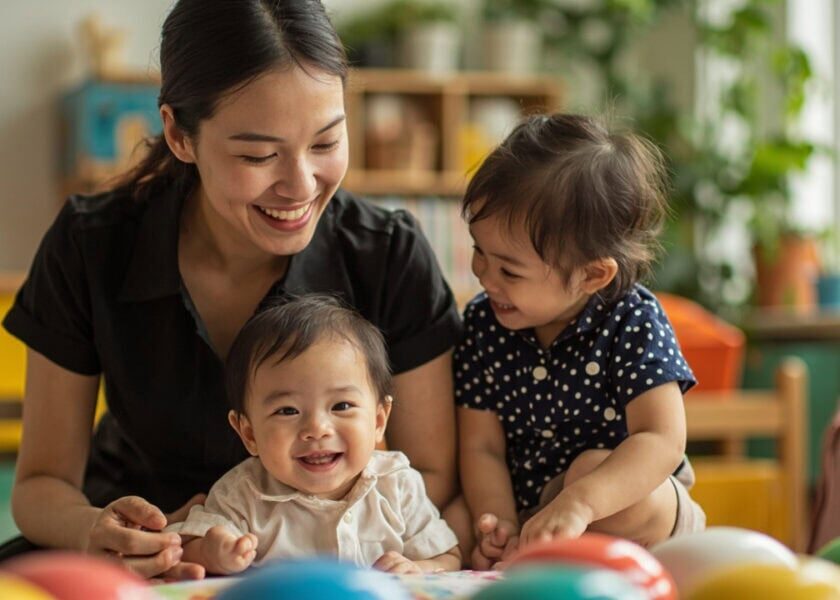
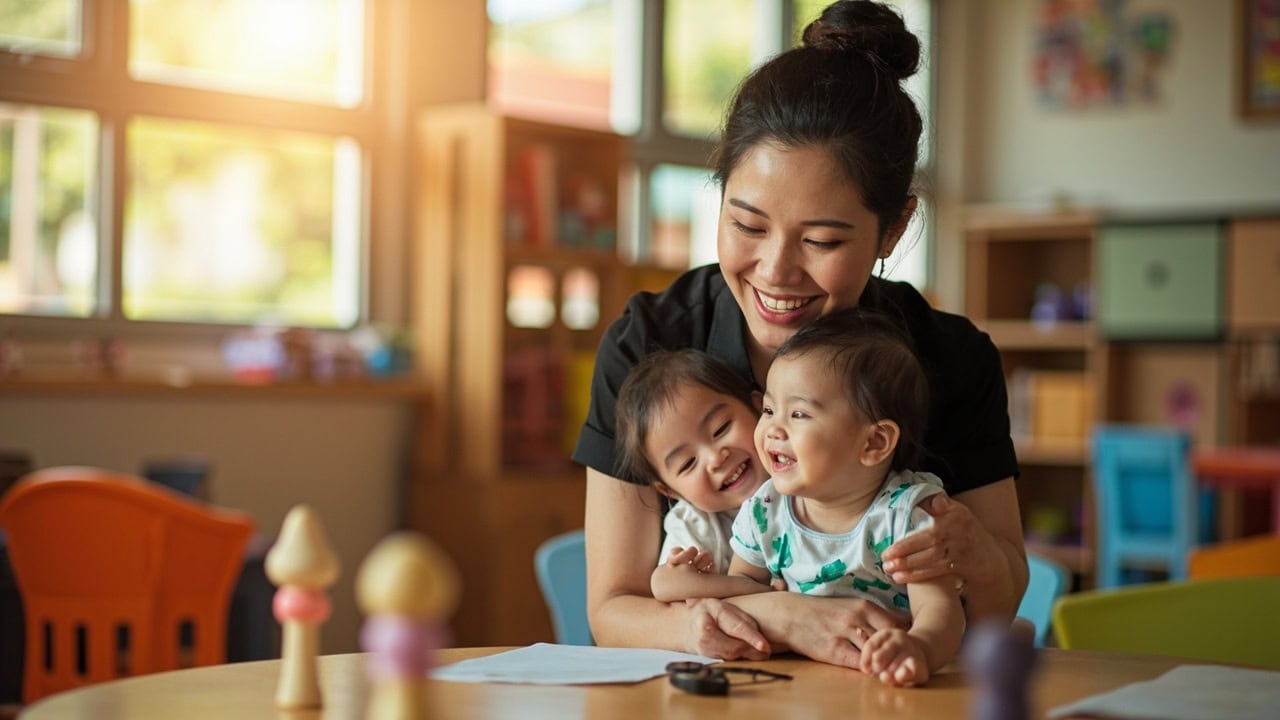
In quality childcare settings, your child is not merely being supervised. Your child is being socialized into humanity. And this happens not through worksheets or instruction but through play, through repetition, through the thousand small negotiations of a morning spent among other children.
The Sandbox as Classroom
They learn to wait. They learn to take turns — not because they have been told to, but because they have felt what it is like when someone waited for them.
They learn to assert themselves — “That is my block” — and they learn that asserting yourself does not end the world, but it does require words, and words require a kind of courage that a two-year-old is only just discovering they possess.
This is what researchers mean when they talk about social-emotional development in the early years. But the research language flattens something that is, in reality, vivid and tender and deeply specific to your child. What it really means is this: your child is learning, in those hours away from you, how to be a person among other people.
And that is not a small thing. That is the hardest thing.
The Imitation Machine: Invisible Cognitive Growth
Children are extraordinary imitators, and they are always imitating the best version of what they see. In a quality childcare environment, they are surrounded by other children who are further along in skills they are just beginning to discover — language, motor coordination, problem-solving, emotional expression.
They watch an older toddler ask for help and receive it, and something downloads. They watch a caregiver kneel down to eye level and say, “You worked so hard on that. You must feel proud,” and they file that away in a part of their brain that does not yet have language for pride but is already building the scaffolding for it.
This is cognitive growth happening invisibly, beneath the surface of play. And it is happening not because someone is teaching it, but because the environment is alive with learning opportunities that children absorb the way they absorb language — naturally, constantly, and without apparent effort.
When your child comes home at the end of the day, you are often watching the afterglow of something that happened hours earlier: a word they have never said before, a song they hum without knowing the words, the way they arrange their toys in a line and call it a train — a concept they did not have this morning. Parents often underestimate this. Not because they are inattentive — in fact, it is precisely because they are so attuned to their child that they attribute everything to what they themselves have taught.
But the truth is that your child is learning things you did not teach them, from environments you did not create, in ways you will never fully trace. And that is not a failure of your influence. It is the magnificence of a young mind that is wired, beautifully and relentlessly, to grow.
Recognizing Growth at Home: Milestones You May Have Missed
The most powerful way to understand what your child is building in quality childcare is to look at the moments that show up at home — the moments you may have noticed and then quietly set aside, not realizing they were milestones.
Signs Your Child Is Building Self-Concept
Look for these evidence-based indicators that your child is developing a quiet, foundational understanding of themselves:
- Words before grabbing. The first time your child uses words to solve a problem with a sibling instead of reaching for what they want.
- Confident goodbyes. The morning they wave goodbye to you with a casual, confident “Bye, Mama!” when six months ago that same goodbye was a negotiation.
- New competencies. The evening they ask to set the table, because someone at childcare showed them it could be done, and now they want to do it too.
- Gentle corrections. The way they correct you — with the patience of someone who has practiced patience — when you have done something in what they have decided is the wrong order.
These are not coincidences. They are evidence of a child who is building self-concept — the quiet, foundational understanding of “I am a person who can do things, who has opinions, who matters to other people.”
Being Seen as This Child
In quality childcare, your child is seen. Not in the abstract — not as a group of children who need supervising — but as this child, this specific person with this specific temperament, these specific joys and fears and small obsessions.
A skilled caregiver notices that your child loves things in order and responds by giving them the first turn in a sequence of activities. A caregiver notices that your child hesitates at the threshold of the sandbox and offers a hand, not a push.
These micro-responses, repeated over months, compose something that has a name in developmental science — secure attachment, emotional regulation, executive function — but has a much more human meaning: your child is learning that the world is a place where they can show up fully and be met.
What Quality Childcare Actually Looks Like
So what does quality actually mean — not in the abstract, but in the specific?
Ratio and Attention
When we speak about the kind of childcare that is worthy of your child’s earliest hours, we are talking about environments where the ratios allow for genuine attention. Where one caregiver is not managing six infants but is present with two or three — close enough to notice the flicker of frustration before it becomes a meltdown, close enough to narrate what is happening in a way that builds language in real time, close enough to remember that your child slept better after lunch on Tuesday and woke up hungry earlier on Thursday.
This is not a luxury. This is the actual condition under which human beings, at their smallest and most impressionable, can feel safe enough to explore.
Trained, Not Just Certified
We are talking about caregivers who have been trained not just in safety protocols — though those matter, profoundly — but in the understanding of child development itself:
- Who know that a child who bites is not a bad child but a child who has not yet found the words for a feeling
- Who know that parallel play, where two toddlers sit side by side with the same toy and do not acknowledge each other, is not a failure of social development but a critical precursor to it
- Who know that the most important thing they can do on a Tuesday afternoon when a child is tired and irritable is not to distract them but to sit beside them in that tiredness and help them name it
Honest Communication
We are talking about environments where you, as a parent, are not shut out of your child’s day but kept close to it — through honest, daily communication about what happened, how your child slept, what they discovered, what challenged them.
Where transparency is not a policy but a practice. Where cameras, where deployed, are not there to surveil but to bridge — so that you can see, in a small frame on your phone during your lunch break, your child building a tower with a concentration that looks almost like a frown, and feel that pull of recognition, that quiet pride that says: my child is somewhere good.
The Honest Truth About Childcare and Modern Parenting
I want to pause here, because I think it would be dishonest not to acknowledge something that many parents feel but rarely hear spoken aloud in this conversation.
The decision to place your child in someone else’s care is not a simple one. In Singapore, where the rhythms of family life are shaped by dual-income pressures, long working hours, and the particular intensity of raising young children in a fast-moving city, many parents do not feel they have a choice. They feel they have been pushed into it.
And that feeling — that sense of being without an alternative — can cast a shadow over what might otherwise be a perfectly good childcare arrangement.
A Reframe Worth Holding Onto
So let me say this plainly: The hours your child spends in quality care are not stolen hours. They are not a gap to be endured until school starts. They are hours in which your child is growing in ways that complement, not replace, what you give them.
The research on this — and the observation of every skilled early childhood educator — is consistent: children who experience quality group care alongside strong parental attachment develop social skills and emotional resilience at rates that often outpace those of children who have not. Not because the childcare is better than what parents provide, but because it is different, and different is exactly what a growing human mind needs.
Your child is not learning despite your absence. In a very real sense, your child’s time in quality care is one of the first experiences they have of the world being larger than home — and of that largeness being survivable, interesting, and full of people who are glad to know them.
That is not a consolation. That is a fact. And it is one of the most important things we can hold onto when the logistics of modern life make childcare feel like a compromise rather than a choice.
How to Choose Quality Childcare in Singapore
If you are researching infant care and childminding options in Singapore, here are the questions worth asking — beyond safety certifications and proximity to your home or workplace.
Questions to Ask Any Childcare Provider
- What is the caregiver-to-child ratio? Smaller numbers mean more individual attention and responsiveness.
- How do caregivers respond to emotional moments? Look for answers that reference understanding behavior as communication, not punishment.
- What does daily communication look like? Is it a perfunctory log, or does it reflect genuine observation of your child’s day?
- How do caregivers describe their training? Look for understanding of child development, not just certifications.
- How are parents included? Is there transparency, open dialogue, and a sense that you are partners in your child’s care?
Signs of Quality to Look For
- Caregivers kneel to eye level when speaking to children
- Children are engaged in meaningful play, not just occupied
- The environment feels warm, not institutional
- Staff can tell you something specific about your child — their preferences, their patterns, their small victories
- You feel welcomed, not like a visitor in your child’s life
EduNanny by BUTLER: A Pathway Within the Childminding Pilot
EduNanny is part of the ECDA Childminding Pilot, which means our approach is grounded not in guesswork but in a framework that has been thoughtfully designed to meet the real needs of Singapore’s youngest children and their families.
Pathways That Fit Your Family
We offer home-based care, community-based care, and centre-based options — because the right environment should fit the family’s life, not the other way around. Our ratios are structured to ensure that the attention your child receives is the kind that shapes rather than merely supervises.
Our care runs Monday through Friday, in blocks that reflect the rhythms of working family life, and our fee structures are designed to be accessible within the pilot framework — because the children who benefit most from quality childcare should not be only those whose parents can afford premium pricing.
Communication as Commitment
We understand that parents carry questions, and we believe those questions deserve more than a photo update and a daily log. So we built communication into the fabric of what we do — not as a feature, but as a commitment.
You should know what your child is doing, how they are growing, and what you might be noticing at home that connects to what happened during the day. And where transparency tools like CCTV are deployed, they are there because we believe that trust is built through openness, not reassurance.
Support When You Need It
We also know that modern parenting comes with a particular kind of cognitive load — the logistics, the decisions, the constant small questions that arise between one hour and the next. That is why we offer the Thomas AI Chatbot, a practical resource designed to support you in navigating the everyday questions of infant care and childminding. Not as a replacement for human guidance, but as a bridge between the moments when you need answers and the moments when a caregiver is available to give them.
What We Believe
EduNanny is not just a service. It is an understanding — that the hours your child spends in our care are hours of consequence, hours of growth, hours during which your child is becoming someone more capable, more confident, and more fully themselves.
We do not take that responsibility lightly. We take it as the most important thing we do.
The Invisible Curriculum, Made Visible
There is a phrase that early childhood educators sometimes use — “the invisible curriculum.” It refers to all the learning that happens not through instruction but through environment, through relationship, through the unstated messages a child absorbs about how the world works and where they fit inside it.
Quality childcare is rich with this invisible curriculum. In the hours you are not there, your child is learning:
- That people can be trusted
- That mistakes are survivable
- That trying again is not failure but its own kind of success
- That other children are interesting, not threatening
- That feelings come and go and there are words for the ones that stay
- That they are competent
- That they matter
- That the world, which once seemed so small and centered entirely on home, is actually very large — and they are beginning to find their place inside it
What This Means for School and Beyond
These are not skills that appear on a report card. They will not be tested in Primary One. But they are the skills on which every other learning will be built — the curiosity that drives academic achievement, the emotional resilience that carries a child through disappointment, the social confidence to speak up in class and belong.
Everything starts here. In the sandbox, at the craft table, on the mat where a caregiver reads the same book for the fourth time because your child has decided this is the book and this is the week to fall in love with it. In the small, unrepeatable, extraordinary hours of early childhood.
When You Pick Up Your Child Tomorrow
So the next time you pick up your child and see something in their face that you did not put there — a confidence, a curiosity, a small new way of relating to the world — I want you to know what you are looking at.
You are looking at the evidence of hours well spent. Of a child who was in a place that understood that their work — which looks like play, which sounds like noise, which sometimes looks like nothing at all — is actually the most important work of their young lives.
You are looking at the invisible curriculum, made visible.
And you are looking at your child, practicing being human — not later, not when school begins, not when they are ready.
Right now. In the hours you are not there. Becoming exactly who they are meant to be.
Ready to Learn More?
If you are researching childcare options in Singapore and would like to understand how EduNanny approaches infant care and childminding, we welcome the conversation. No pressure, no obligation — just an honest discussion about whether we might be the right fit for your family.
Speak with Our Team | Learn About Our Programmes