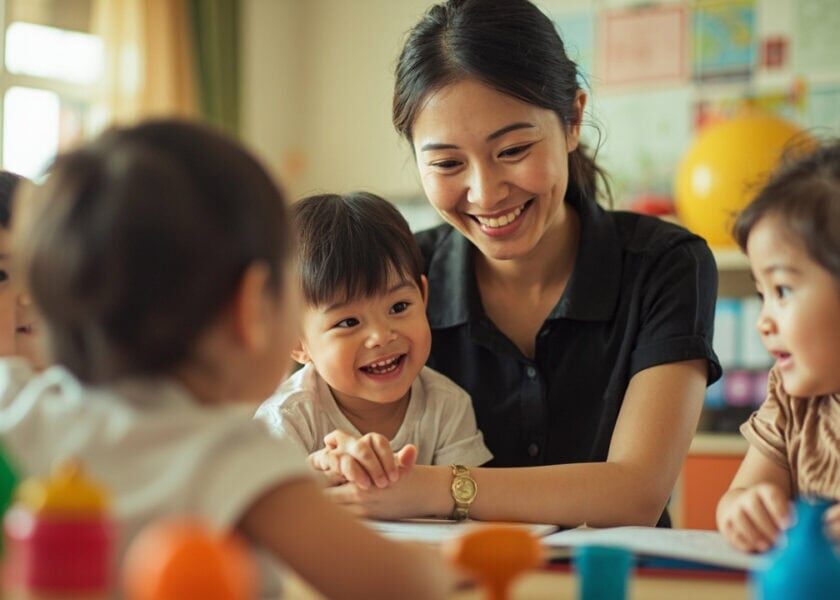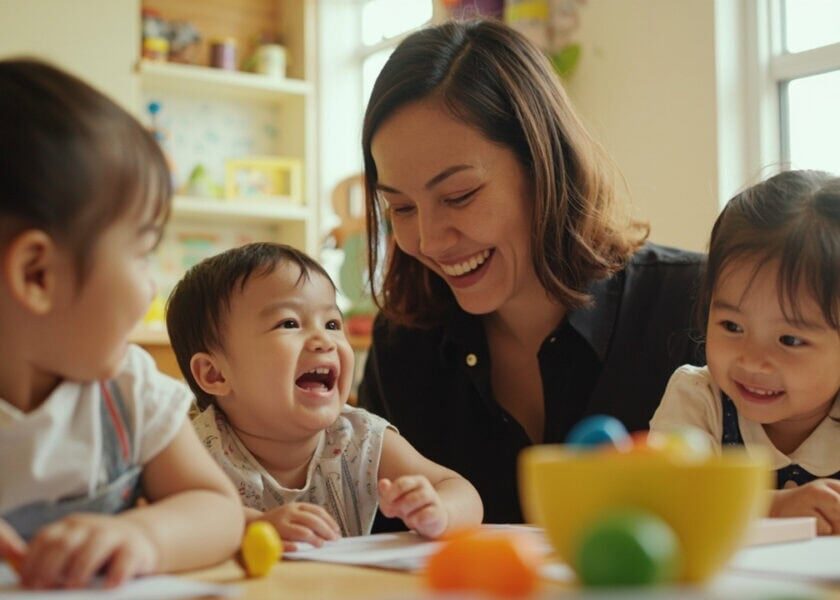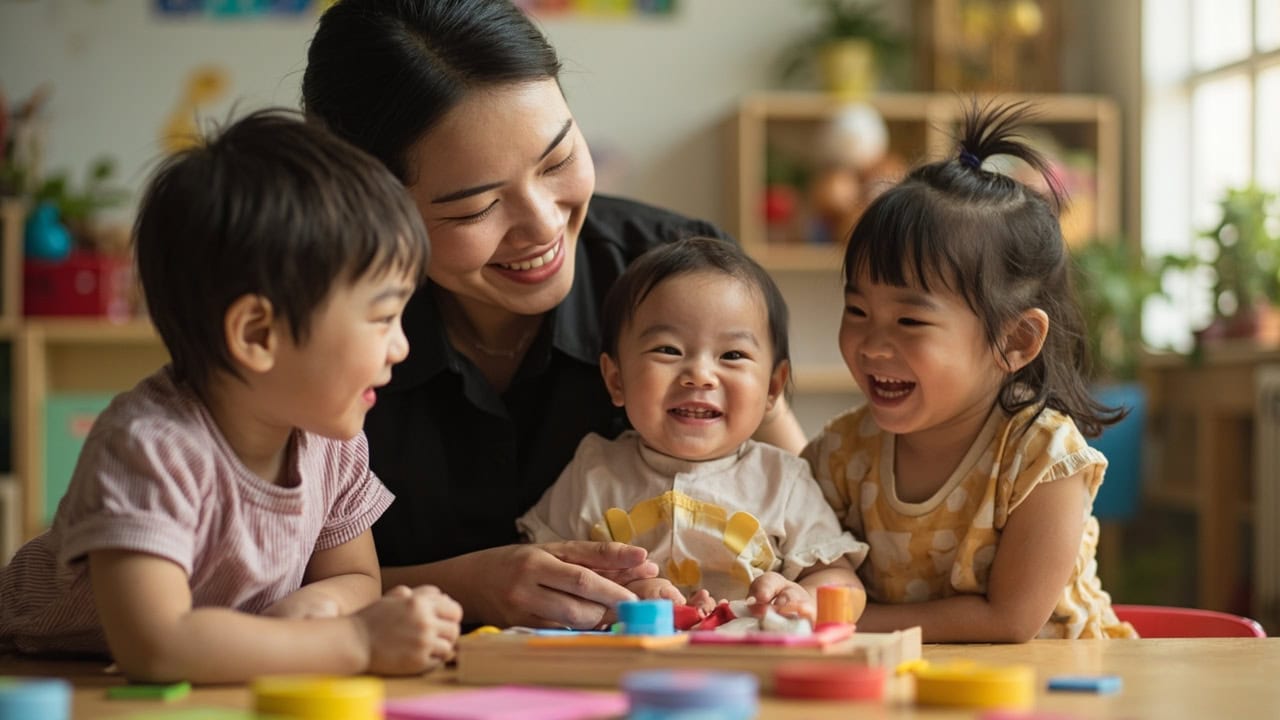
Your Child Comes Home Changed: Evidence of Quality Childcare
Signs Your Child Is Thriving, Not Just Being Minded
The Difference Between Occupied and Engaged
There is a profound difference between a child who is occupied and a child who is engaged. Occupied means the hours passed. Engaged means something happened—somewhere between arrival and homecoming, your child’s mind reached for something, stretched toward someone, tried something new, and came away changed by it.
That change does not disappear when your child walks through your front door. It lives in their body, their language, their way of being in the world for the hours that follow. And that, if you know how to look, is one of the most honest quality indicators available.
Four Developmental Signals to Watch For
1. Language Growth
Not the milestones on a checklist, but the small linguistic leaps that reveal a mind that has been spoken to, sung to, read to, and listened to throughout the day.
- A two-year-old who comes home using a new word they did not leave with that morning
- A three-year-old who narrates a game in surprisingly full sentences
- The child who responds to a question about their day with a name—a friend, a teacher, a moment—instead of a shrug
Language that has grown in the care of attentive adults does not stay at childcare. It travels. It shows up at the dinner table, in the bath, on the drive home.
In Singapore, where many children are raised in multilingual environments, you might also notice your child picking up phrases in English or Mandarin that reflect the language exposure they received during care. If you are hearing new words, new phrases, new ways of expressing wants and wonder—those are not accidents. They are the residue of a day filled with responsive human interaction, and you are hearing them at home because your child was paying attention to someone who was paying attention to them.
2. Emotional Resilience
Not whether your child is happy all the time—that is not the goal, and it is not realistic. But consider the texture of their emotional resilience across the day.
Does your child seem to carry a baseline sense of security into new situations? When something frustrates them, do they have some repertoire—not a perfect one, but some beginning—for managing that feeling?
A child in genuinely quality care develops what researchers sometimes call emotional regulation, but what it looks like in real life is simpler than that term suggests. It looks like a child who, after a hard moment, can come back. Who can be comforted. Who does not stay stuck in distress because they have learned, across hundreds of small interactions, that difficult feelings pass and that adults help.
You cannot see the caregiver who taught your child to take a breath. But you can see the child who knows how to take one.
3. Curiosity
A child who is genuinely engaged in quality care develops a hunger for the world that makes them ask questions, reach for new experiences, and show interest in things they have not encountered before. Not because they are being drilled or tested, but because they have been in an environment where their natural desire to learn was treated as something worth following.
Watch your child in the evening. Do they point at things and ask about them? Do they want to try new activities? Are they still interested?
A child who is merely attended to will often arrive home flat, depleted, as if the day has drained something out of them. A child who is genuinely engaged in meaningful care often arrives home buzzing—not because they are overstimulated, but because something inside them has been activated.
4. Connection
The capacity to form relationships, to show affection, to care about other people.
A child in quality care develops social muscles—not by being placed in a group and told to figure it out, but by being in a setting where social experiences are scaffolded, guided, and made safe.
Watch how your child plays with other children now. Watch how they talk about their friends. Watch whether they show signs of caring—sharing, noticing when someone is upset, wanting to include others.
These social capacities do not appear suddenly. They are built slowly, in an environment where your child has had enough individual attention to feel secure, and enough group experience to practice being with others.
Reading the Whole Picture: Before and After
The signals do not only appear in isolation. Look at the trajectory—the difference between how your child leaves in the morning and how they arrive home.
A child who is growing will often grow visibly. A child who is merely being minded may arrive home quiet, listless, as if they have been holding themselves together in an environment that was not quite for them. A child who is thriving will bring something back:
- A new song or expression you have not heard before
- A story about someone who matters to them
- A confidence in their body
- An aliveness that tells you something real happened today
These are not guarantees—children have difficult days. But the overall trajectory, the general direction your child is moving, tells you something you are entitled to trust.
Why These Signs Appear: The Conditions That Make Them Possible
You have more ability to evaluate your child’s care than you might think. The signals described above do not appear by accident. They are products of specific conditions—and understanding those conditions helps you know what to look for when choosing infant care in Singapore.
Care Ratios
When a child is in a setting with genuinely low ratios—one caregiver for every one, two, or three infants—you are not just looking at a number. You are looking at the condition that makes everything else possible.
At these ratios, your child is not one face in a crowd. They are someone whose name is known, whose rhythms are understood, whose distress is noticed and responded to quickly.
When the numbers are small enough, group care can offer something genuinely close to the attentiveness of one-to-one care. Your child is not lost. They are held within a small, consistent group of children and a consistent caregiver who knows them. The same adult sees them arrive each morning, learns their cues, their preferences, their quirks. That knowledge compounds over time—and it produces a child who arrives home changed.
Consistency and Relationship
Beyond ratios, consistency matters. A rotating cast of caregivers means your child is constantly adapting, never quite settling into the security of being truly known. The developmental signals you observe at home—the language growth, the emotional resilience, the social ease—are products of accumulated relationship. They require time and continuity to form.
When evaluating childcare options, ask not just about the curriculum or the facilities, but about the team structure. Who will be with your child? How often? How does the programme handle staff changes or transitions?
The Role of Communication
The best programmes understand that you are not a passive observer waiting to be reassured. You are an active reader of your child’s experience, and the programme should give you the tools to read more accurately—not surveillance, but genuine communication.
Regular updates, documented observations, and transparent sharing about your child’s day help you connect what happens inside the setting to what you observe at home. When your child uses a word they learned at childcare, it helps to know the context. When they come home energized about something, it helps to know what triggered it. Communication closes the loop between the setting and your family.
How to Evaluate Childcare Quality in Singapore
Use your child’s behavior as the ultimate quality feedback. Here is a simple framework for evaluating infant care:
| What to Observe | What It Suggests |
|---|---|
| New language at home | Responsive interaction during care hours |
| Emotional recovery after distress | Secure attachment, scaffolded support |
| Curiosity and energy at pickup | Genuine engagement, not depletion |
| Warmth about friends and teachers | Safe social environment, relationship building |
| Overall developmental trajectory | Accumulated quality of care over time |
Ask yourself: does this programme produce children who come home changed in these ways? If yes, you are looking at quality. If not, no amount of marketing or reassuring conversation should satisfy you.
You cannot be inside the setting, but that does not mean you are blind. Look at the evidence that comes home. Look at your child’s developmental trajectory over weeks and months. Look at the communication the programme provides. These three together give you a far clearer picture than any tour or conversation alone.
Remember that “fine” and “thriving” are not the same thing. A child who is merely attended to may be calm, may even seem happy in a surface way. But you will not see the language leaps, the curiosity spikes, the social confidence building. The developmental signals described above are not optional extras—they are the evidence that your child’s mind is being engaged, not just their body being supervised.
What Quality Care Makes Possible
Children who are changed by their days in small, meaningful ways. Children who arrive home with more language, more confidence, more curiosity, more connection than they left with. Children who are being formed by an environment that takes their potential seriously.
This is what you deserve as a parent: not just a service, but a partnership in your child’s development. Not just a place that promises to care for your child, but a place that produces the kind of observable growth you can recognize, celebrate, and trust.
Programmes designed around these conditions—including those operating under the ECDA Childminding Pilot framework—structure their approach around the ratios and relationship continuity that allow for the individual attention your child needs. The communication measures these programmes offer give you meaningful windows into your child’s day, helping you understand what they are experiencing so that you can connect it to what you observe at home.
When your child talks about a friend or a teacher with warmth, when they navigate a social situation with something approaching ease, when they show curiosity that is alive rather than performative—these are not random. They are the output of hundreds of hours of attentive, responsive, developmentally serious care.
And you are entitled to read them as evidence that your child is not just attended to. They are growing.
Your Child Is Telling You Something
You are already reading your child beautifully. Your observations matter. Your child’s behavior is meaningful data. The evidence of quality care is not locked inside the setting—it walks through your front door every afternoon.
Watch for it. Trust it. And know that when you choose a setting designed to produce exactly what you are observing, you are not hoping. You are seeing.
If you are exploring childcare options in Singapore and would like to understand how a thoughtfully structured programme can support your child’s development, we welcome you to get in touch or learn more about our approach.