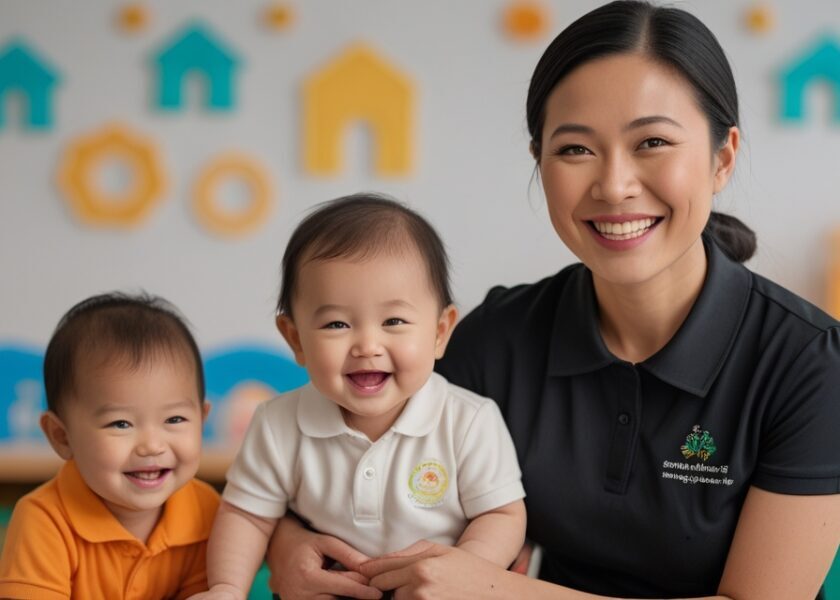
How Singapore Parents Practice Active Partnership After Childcare Enrollment
The Relationship Begins After Enrollment
Understanding this shift — from choosing to engaging — is perhaps the most important thing to grasp about the childcare journey. It is a shift that Singapore parents navigating infant care for the first time often feel but rarely find guidance for.
Here is what observation across many families reveals: the parents who feel most confident and most connected are not the ones who hover or check in constantly. They are not the ones who send messages every hour or request photo updates every afternoon. They are the ones who have learned what it means to be actively present in a partnership without needing to control it.
That distinction — between staying involved and micromanaging — is one of the most important skills you will develop in these years. It is also one of the least discussed.
What Active Partnership Looks Like in Practice
There is a mother who enrolled her daughter in home-based infant care when her daughter was eight months old. In the first few weeks, she felt the familiar pull of anxiety. Her daughter would cry at drop-off. She would lie awake wondering if she had made the right call.
But instead of pulling back or pushing forward, she did something simple and deliberate. She asked her caregiver, every pickup, one open question. Not “was she good?” but “what did she enjoy today? Was there a moment when she seemed particularly engaged or particularly frustrated?”
That one question — asked consistently, without agenda — transformed her relationship with the caregiver. It communicated respect. It invited partnership rather than performance.
Within a month, the caregiver began proactively sharing observations. A new sound her daughter made. A texture she had touched and rejected. A brief moment of contentment during a book that the caregiver had noticed and remembered. These small exchanges built something. Not just trust, but a shared understanding of who this child is.
This is what the relationship is: not abstract, but living in the daily exchange. In the consistency of your attention. In your willingness to ask real questions and receive real answers.
The Questions That Open Conversation
When you pick up your child, consider asking questions that invite depth:
- “What was the highlight of her day?”
- “Did she seem particularly interested in anything today?”
- “How did she sleep or eat compared to usual?”
- “Was there a moment that seemed challenging for her?”
Questions like “was she good?” or “did she behave?” invite performance and shut down conversation rather than opening it.
The Seasonal Signals: How Quality Reveals Itself Over Time
The childcare relationship is not static. It evolves. Your child evolves. And what you should be observing and expecting from the partnership changes too.
The First Season: Months 1–3
In the first few months after enrollment, you are building the foundation. You are establishing communication habits. You are learning your caregiver’s style. You are watching how your child responds to the new environment.
The signals here are relatively simple:
- Does my child seem familiar with the space?
- Does she show signs of recognition — comfort when entering, familiarity with routines?
- Does the caregiver greet you both warmly and with genuine attention?
- Does communication feel natural and consistent?
By the Sixth Month
You should be noticing deeper signs of partnership quality:
- Is my child developing in ways that feel consistent with what I observe at home?
- Is the caregiver sharing meaningful observations — not just “she ate well” but “she has been really focused on fitting objects into containers, she spends long stretches on that”?
- Is there a rhythm to the communication that feels natural rather than forced?
- Does the caregiver remember details from previous conversations?
By the First Year
Your child has grown. She has changed. The developmental needs are different. And the quality of the partnership should be visible in how well the caregiver has adapted:
- Have they updated their approach as your child has grown?
- Are they bringing new ideas, new activities, new ways of engaging?
- Is the environment still safe and stimulating — appropriate for where your child is now, not where she was a year ago?
- Do developmental conversations feel richer and more detailed than before?
These seasonal check-ins are not formal reviews. They are quiet observations you make as a parent. And they are one of the most reliable ways to know whether the partnership is still thriving.
Addressing Concerns Without Overstepping
There is a particular anxiety that Singapore parents feel deeply but rarely speak about openly: the question of whether your involvement will be perceived as interference.
You chose this caregiver or this arrangement because you trusted them. But now you are paying them. Now you are relying on them. And the fear of overstepping, of being seen as difficult, of damaging the very relationship you need — this fear is real and it is valid.
Asking thoughtful questions about your child’s day is not micromanagement. Expressing interest in what your child is learning or how she is developing is not distrust. Requesting a conversation when something feels off is not disloyalty to your caregiver.
These are the actions of an engaged parent. And the right caregiver — the one who was worth trusting in the first place — will receive them as such.
When concerns arise, approach the conversation with specific observations, not general worries. Frame it as a shared question: “I noticed she seems more tired than usual — have you observed the same?” Allow space for the caregiver’s perspective before drawing conclusions. A good caregiver welcomes this kind of engagement. The conversation happens in a context of established respect — and that context matters more than most parents realize until they need it.
Re-Enrollment: A Trust Milestone, Not Just a Logistics Step
The re-enrollment conversation is so often treated as a logistical step when it is actually one of the most significant trust gestures a parent can make.
Re-enrollment is not simply confirming that you need care for another term. It is a decision. It carries weight. And in that moment, you are answering a question you have been quietly asking yourself all along: do I still trust this arrangement? Is this still the right place for my child?
Parents who have been actively engaged in the partnership — who have built the communication habits, raised concerns when needed and seen them addressed, who have watched their child grow in a space they feel genuinely connected to — these parents do not experience re-enrollment as a source of anxiety. They experience it as a confirmation. A milestone that feels earned.
This is precisely why the months of engagement matter. They are not just about keeping a relationship healthy in the present. They are about building the foundation of trust that makes every future decision easier.
What Sustainable Parental Involvement Looks Like
Sustainable involvement is not about presence at every pickup or messages at every hour. It is about the quality of attention you bring to the moments that matter.
It looks like this:
- You have established rhythms of communication that feel natural, not performative
- You attend the moments that matter — not every pickup, but the ones where your presence signals something to your child
- You read the reports or daily updates and respond with genuine interest, not just acknowledgment
- You know your caregiver’s name and you use it
- You ask about their day sometimes, not just about your child’s
- You remember that this is a person who has chosen to dedicate their working hours to the care of small humans, and that deserves respect
Sustainable involvement also means knowing when to step back:
- When your child has had a difficult morning and the caregiver is soothing her, you trust that process and do not linger unnecessarily
- When the caregiver shares an observation that differs from what you see at home, you receive it with curiosity rather than defensiveness
- You recognize that your child behaves differently in different contexts — and that this is not a threat to your understanding of her. It is an expansion of it.
This kind of involvement requires emotional maturity: the ability to hold trust and accountability simultaneously. To believe in your caregiver and still ask questions. To respect their expertise and trust your own observations. These are not contradictions. They are the components of a mature relationship.
How EduNanny Supports the Ongoing Partnership
The ECDA Childminding Pilot represents something genuinely thoughtful in Singapore’s childcare landscape. It offers families a pathway that sits between centre-based care and fully domestic arrangements — warm, regulated home environments with small ratios where the caregiver’s attention is not divided across a large group.
Beyond the logistics, EduNanny has been designed around a question that matters most after the decision is made: how will I stay close to my child’s experience even while she is away from me?
The communication channels, the transparency measures, the regular touchpoints — these are not bureaucratic additions. They are the architecture of the partnership itself. In a small-ratio environment, the caregiver knows your child. Not as one of many, but as an individual whose rhythms and preferences and small quirks have been observed and remembered. When you ask a question, the answer is not generic. It is specific. It is real.
For families navigating CDA and Baby Bonus funding, fee structures within the pilot have been designed with affordability in mind. Care is structured around the realities of working parents, available across Monday to Friday blocks.
The re-enrollment conversation at EduNanny reflects this understanding. It is not a transaction to be processed. It is a continuation of something that has been built over time. For families in the ECDA Childminding Pilot, there is something meaningful in knowing that the structure you have come to rely on — the small ratios, the home-based warmth, the caregiver who knows your child’s name and her rhythms — has been designed not just for enrollment but for the long arc of your child’s early years.
Wherever You Are in This Journey
If you are in the season of choosing: the research you are doing matters. The tours matter. The questions you are asking matter. But they are not the end of your work. They are the beginning of a relationship that will require your attention and intention over months and years.
If you are in the season of doubt: your child has been in care for a few months and something feels uncertain. I want you to know that uncertainty is not failure. It is information. And the right response to information is not panic. It is conversation. Ask the question. Make the call. Trust the process of communication even when it feels uncomfortable.
If you are in the season of confidence: things are going well and your child is thriving and you feel good about your choice. I want to encourage you to deepen what is already working. Do not assume that quality will sustain itself without your presence. Be the parent who shows up, who asks good questions, who builds the relationship not because it is broken but because it is worth investing in.
And if you are in the season of re-enrollment: you are making this decision again, with all that you now know. Recognize the significance of what you are doing. You are choosing to continue. You are choosing to trust. And that choice, made with awareness and intention, is one of the most powerful things you can offer your child.
Childminding, when it is done well, is not a service transaction. It is not a convenience for working parents or a placeholder until children are old enough for school. It is a contribution to a child’s inner life at a time when the foundations of who they will become are being quietly, persistently laid.
The caregiver who holds your infant — who soothes her when she wakes from a nap confused, who names the world to her as she points at things, who sits with her in the quiet of an afternoon and lets her explore the texture of something ordinary — this person is doing something profound. And so are you.
You are the parent who chose. Who stays involved. Who asks the questions. Who trusts but verifies. Who shows up not because you must but because you understand that presence is not just physical. It is the thread that runs through every season of your child’s early years.
EduNanny Singapore exists in the space between your home and theirs — your child’s second home. They have built their model around a truth that more childcare providers should embrace: that parents and caregivers are not opposite ends of a relationship. They are its two essential poles. And the child thrives when both are strong.
That is why this matters. That is why the work of staying close — of staying involved, of staying communicative, of staying present — is not extra. It is the work itself.
It always has been.
Ready to explore a childcare model built for the long-term? Learn more about EduNanny Singapore’s home-based infant care under the ECDA Childminding Pilot and discover how they support the ongoing parent-caregiver partnership from enrollment through every season of your child’s early years.
Explore more: About EduNanny Singapore · Get in touch