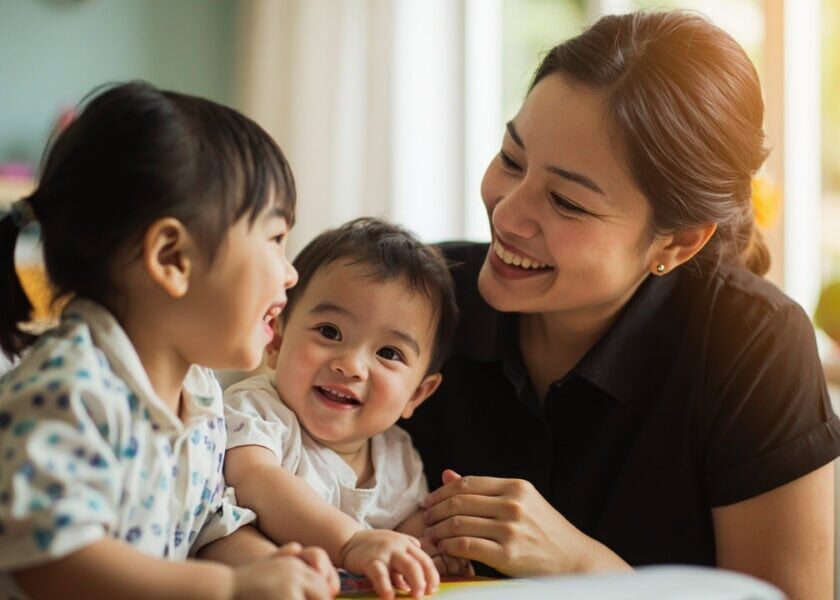
Signs Your Child Is Thriving Not Just Surviving in Childcare
The Moment at the Gate: What Your Child Is Really Becoming
There is a moment, familiar to every parent who has left their child in the care of another, that happens just before the gate closes. You look back. Your child is there, and for a breath, you hold two things at once: the certainty that you are leaving them in safe hands, and the hope that something good is happening in your absence.
Something that is building. Not just managing your child’s day, but shaping it.
That hope is not small. It is, in many ways, the most important question a parent carries.
You already know your child is safe. What you want to know — what you really want to know — is whether they are thriving. Whether the environment you chose is doing something meaningful with the hours your child spends there. Whether, when you pick them up, you will see more than a child who was fine. You want to see a child who is becoming.
This article is about that hope. It is about what transformation actually looks like when care is right — the specific, recognizable changes you can see in your child over weeks and months. It is about how to recognize quality when you are choosing infant care in Singapore, and why the decision you make now shapes not just who your child is at three, but who they are at thirteen, at thirty, at fifty.
What This Article Covers
- What developmental transformation looks like in the first year
- The difference between supervision and active developmental support
- How EduNanny Singapore approaches infant care and childminding
- Practical guidance for choosing quality care in Singapore
- What to look for when you pick your child up each day
What Transformation Looks Like: The Signs Parents Actually See
When care is transformative, it shows in ways that are specific and recognizable. Not mysterious. Not hidden. You can see it in your child’s language — how they begin to string words together not just to ask for things but to describe what they see, to narrate their own small world, to remember details from a morning that you did not witness.
You can see it in how they play. Not randomly, but with purposeful curiosity — testing how things fit, how they work, what happens when this is combined with that. You can see it in their social ease: the child who once hung back at a playground now walks toward other children with quiet confidence, understanding that they belong there.
You can see it in the way they begin to manage small frustrations, to recover from disappointment, to signal what they need not with a scream but with a word. These are not minor things. These are the early architectures of a person.
Language Development
Language growth in quality care goes beyond new vocabulary. You will notice your child using words to express ideas, not just request items. They may start naming emotions — “I am sad” or “I am excited” — because someone in their care helped them learn those words. They begin to engage in back-and-forth conversation, asking questions that reveal genuine curiosity about the world around them.
Play and Exploration
Watch how your child plays after a day in quality care. Do they initiate play? Do they experiment — stacking blocks only to knock them down and rebuild, mixing colours, testing boundaries? Purposeful play is your child doing the work of a scientist: forming hypotheses, testing them, and learning from results. This is not aimless activity. It is learning in action.
Social Confidence
A child who is thriving in quality care begins to show comfort with other children and adults. They may wave goodbye without hesitation. They may approach a new caregiver with recognition rather than fear. They share, they take turns, they show the early signs of understanding that other people have feelings too — and that those feelings matter.
Emotional Regulation
Perhaps the most telling sign of quality care is how your child handles frustration over time. A child in responsive care learns that big feelings pass. They learn that when they are upset, someone will help them calm down. They learn words for their feelings and strategies for managing them.
And here is what matters most: you do not have to wait years to see this. Three months. Six months. The difference between a child who has been in responsive, developmentally supportive care and a child who has simply been supervised is visible in the span of a single season. When you see it, something in you shifts. The anxiety softens. The guilt dissolves. What replaces it is something much more sustaining — the quiet pride of watching your child become themselves, and knowing that the environment you chose for them had something to do with it.
The Critical Distinction: Supervision Versus Development
Not all childcare is the same. This is not a criticism — it is a reality that every parent deserves to understand clearly.
Supervision means your child is fed, changed, kept safe, and entertained. This is not nothing. It matters. But it is passive. Your child is kept occupied, but not necessarily challenged. They are safe, but not necessarily growing.
Active developmental support means your child is in an environment designed to help them learn, explore, and develop at their own pace. It means caregivers who are trained to observe, respond, and extend your child’s learning in everyday moments. It means a setting where every interaction is an opportunity — a conversation over lunch, a game of pretend at the water table, a moment of comfort after a tumble.
The difference is not always visible from the outside. That is why the changes you see in your child become your most reliable evidence. A child who is simply supervised may come home tired, passive, and watching screens. A child who is in developmentally rich care often comes home animated, talkative, eager to show you something new they learned.
This is the question worth asking when you evaluate any infant care option in Singapore: not just “will my child be safe?” but “will my child be challenged, supported, and growing?”
EduNanny Singapore: A Thoughtful Approach to Early Care
EduNanny by BUTLER was built to answer that question honestly and practically. It is not simply a childcare service. It is an approach to infant care and childminding that takes seriously the extraordinary responsibility of being part of a child’s earliest years.
As part of the ECDA Childminding Pilot, EduNanny brings structure and intention to an option that has long been trusted by families across Singapore — home-based and community-based childminding — elevating it with standards, oversight, and developmental frameworks that parents can rely on.
What does that mean in practice? It means that the care your child receives is guided by principles of early childhood development, not just by routine. With ratios of up to one caregiver to three infants, your child is not one of many — they are known, noticed, and responded to. Caregivers are trained, supported, and treated as the professionals they are, because the quality of your child’s early experiences depends fundamentally on the quality of the person caring for them.
What EduNanny Prioritises
- Intentional developmental frameworks — not just routine, but purpose in every interaction
- Small caregiver ratios — your child is known, not just looked after
- Trained and supported caregivers — treated as professionals who shape early lives
- Consistent standards across settings — whether home-based or centre-based
- Transparent communication — so you are connected to your child’s day
Accessibility and Trust
One of the things that sets EduNanny apart is its commitment to accessibility. The pilot fee structure is designed with affordability in mind. CDA and Baby Bonus funds can be used, which means that for many families in Singapore, quality infant care is not a distant aspiration but a practical, achievable choice.
Early childhood development is not a luxury. It is a foundation. And foundations should be available to every child, not just a privileged few.
For parents navigating infant care for the first time — or for the first time in years — trust is not automatic. It is built. Where deployed, measures such as CCTV and regular updates give parents a window into their child’s day — not to surveil, but to connect. Imagine receiving a message from your child’s caregiver that tells you not just that they ate and slept well, but that they tried something new today. That they showed patience with a peer. That they laughed at a story. These are the moments that matter.
EduNanny also uses technology in service of parents, not instead of them. The Thomas AI Chatbot, available to families, offers a way to get answers, guidance, and support between visits — not as a replacement for human connection, but as a resource that makes navigating your child’s early development a little less isolating. Early parenthood is full of questions that arrive at inconvenient hours. Thomas is there for those moments, with reliable information grounded in evidence.
Choosing Infant Care in Singapore: A Practical Guide
If you are evaluating infant care options right now, here is what to look for — beyond the brochure, beyond the tour, beyond the brand.
- Observe the caregivers. Do they get down to your child’s level? Do they respond promptly and warmly? Do they talk to your child — not just at them, but with them? The quality of caregiver interaction is the single most important predictor of quality care.
- Watch the other children. Are they engaged? Are they comfortable? Do they move freely and explore? A room full of children who look fearful or checked out is a warning sign. A room full of children who are curious and at ease is a good sign.
- Ask about ratios. How many infants per caregiver? The fewer the better, especially for infants under 18 months. Small ratios mean your child is noticed, not just watched.
- Ask about the day. What does a typical day look like? Is there time for free play? For outdoor activities? For caregiver-child conversation? A day that is mostly structured activity or screen time is not the same as a day of developmentally supportive care.
- Ask how they communicate with parents. Will you receive regular updates? Photos? Notes about your child’s day? Open, consistent communication is a sign of a provider that values your role as a parent.
- Notice how you feel. During the tour, during the first weeks — notice your own emotional response. You know your child best. If something feels off, trust that instinct. If something feels warm, responsive, and alive, trust that too.
Common Parent Concerns, Answered
“Will my child adjust?” Most children adjust to quality care within a few weeks, especially when the environment is warm, consistent, and responsive. Look for signs of increasing comfort over time — not immediate ease, but gradual warmth toward caregivers and the environment. Some children need more time. A good caregiver will work with you through it.
“How will I know if it’s working?” You will see it. Not in dramatic leaps, but in small, accumulating shifts. Your child uses more words. They engage in more complex play. They handle minor frustrations with increasing grace. These are the signs that care is not just managing your child’s day — it is shaping it.
“Is it worth the cost?” Think about what you are investing in: not just childcare, but the architecture of your child’s brain. The social confidence that becomes the ability to collaborate. The curiosity that becomes persistence. The emotional regulation that becomes resilience. These are not intangible benefits. They are real, compounding, and lasting. When you see your child thriving, the answer to this question becomes clear.
“What if something goes wrong?” Ask any infant care provider in Singapore about their protocols for illness, emergencies, and communication. A quality provider will have clear, written policies and will welcome your questions. At EduNanny, oversight and standards are built into the pilot framework specifically to address this — so that parents can feel confident that something going wrong is not just possible but responded to quickly and appropriately.
Why This Matters for Life
The curiosity sparked in a two-year-old becomes the persistence of a six-year-old. The social confidence learned in a small group becomes the ability to collaborate, to lead, to empathise — skills that no curriculum teaches, but that early environments cultivate.
The emotional regulation practiced in a safe, responsive setting becomes the resilience a child draws on when school gets hard, when relationships get complicated, when life does what life does and requires something of them.
These are not abstractions. They are compounding effects — small moments of growth that build on each other over time, creating a trajectory that is hard to see day to day but impossible to miss year over year.
The first thousand days of your child’s life are not an abstraction. They are countable. They are here. They are now. And what we do in them — what environments we place our children in, what care we choose for them, what people we trust to be part of their earliest formation — shapes not just who they are at three, but who they are at thirteen, at thirty, at fifty.
The Gate Opens Again: What You Will See
The next time you pick your child up — whether it is at a home-based setting, a community space, or a centre — I want you to look at them with the attention they deserve. Watch them. Notice them. See what they are becoming.
You will see confidence in the morning, when they do not cling but walk toward the caregiver with recognition. You will see it in the afternoon, when they come home and immediately recreate something they learned. You will see it in the evening, when they use a word or a gesture that surprises you with its precision.
You will see it in the way they look at new situations — not with fear, but with the particular brightness of a child who has learned that the world is interesting and that they are capable of meeting it.
If you see confidence, curiosity, connection, growth — if your child is not just fine but flourishing — then you will know. You chose well. You invested not in risk management, but in your child’s future. And the people who cared for them today were not just doing a job. They were doing something important and worthy and life-changing.
That is what EduNanny Singapore stands for. That is the purpose served every day, in every home and centre where a caregiver meets a child with intention, warmth, and genuine investment in who they are becoming.
Your child is watching the world and learning how to be in it.
Let us help them become who they are meant to be.
Ready to explore what thoughtful, development-focused care looks like for your family? Connect with our team to learn more about our infant care and childminding options, pilot eligibility, and how we support families across Singapore.