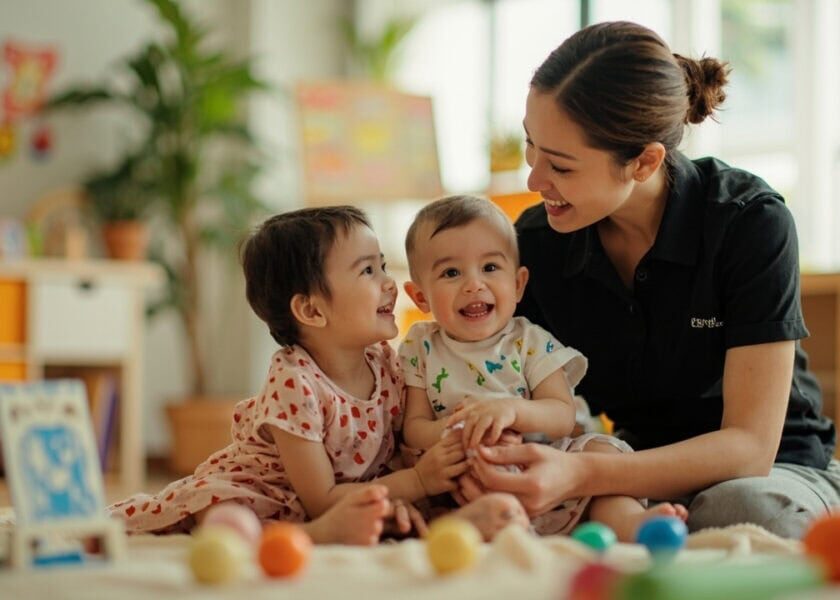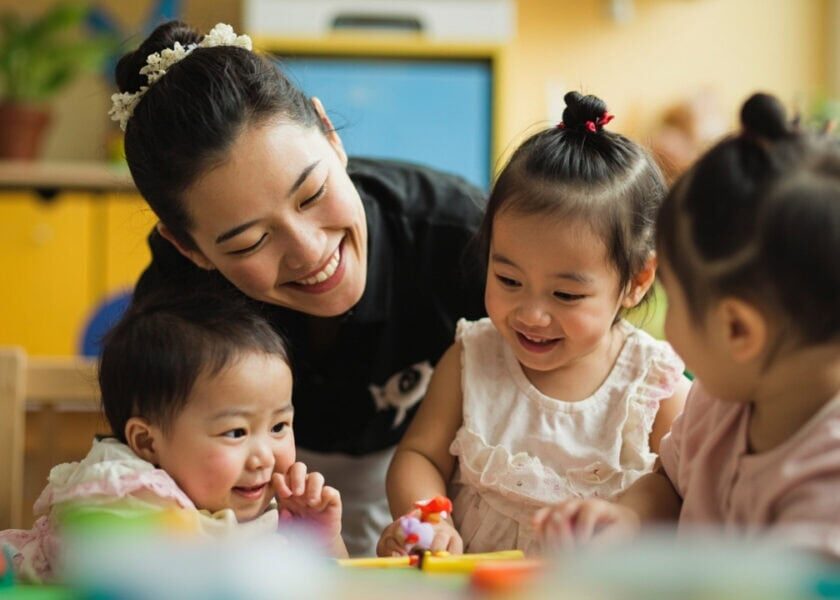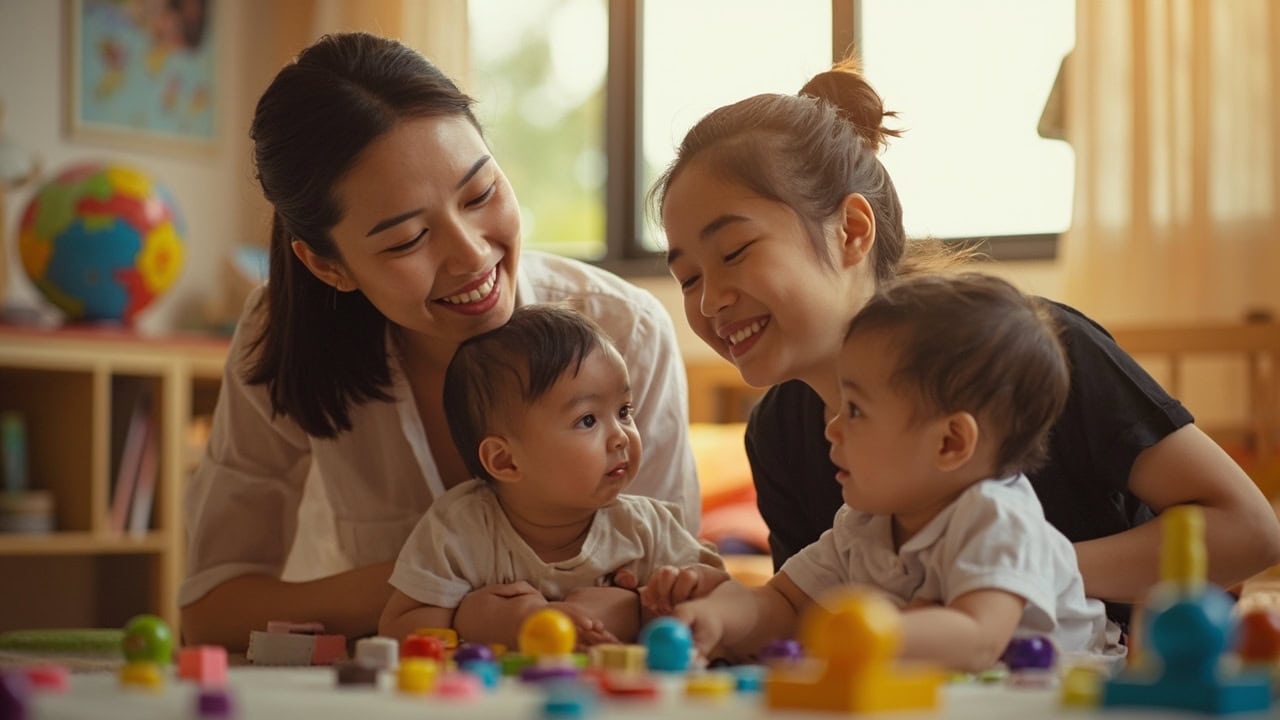
What to Look for in Childcare That Actually Builds Your Child
Your Child’s Brain in the First Five Years
Let us start with what is actually happening inside your child’s head — because what happens there in these years is extraordinary, and understanding it changes how you see every decision you make about care.
In the first five years of life, a child undergoes development at a speed and complexity that will never be matched again. Not in primary school. Not in secondary school. Not ever. By the time a child turns five, their brain has formed the vast majority of its neural connections — more than one million new synapses per second in the earliest months.
The circuits being laid down right now, in your child’s brain, are the circuits that will govern how they think, how they learn, how they regulate emotion, how they form relationships, and how they understand themselves in relation to the world.
This is not metaphor. This is neuroscience. The architecture of the mind is being built, and the materials being used are the interactions, the experiences, and the quality of care that surrounds a child in these years.
Critical Windows That Cannot Be Reopened
Developmental scientists use a term called critical periods — windows of time when certain types of development are especially receptive to the right kinds of input. Language development has its critical period. Emotional regulation has its critical period. The development of secure attachment — the internal working model of safety and trust that a child carries into every future relationship — has its critical period.
These windows do not stay open indefinitely. They are shaped by the early environment. Which means that the choices parents make about care in these years are not just logistical decisions. They are developmental decisions. They are, in a very real sense, decisions about what kind of human being you are helping your child to become.
This is not meant to induce anxiety. It is meant to illuminate. Because once we understand what is actually happening in a child’s developing brain, body, and emotional architecture, we can make choices with confidence rather than guesswork.
The Five Domains of Early Childhood Development
A child’s development in the early years happens across several interconnected domains. Understanding these domains helps you see what quality care should actually be building.
1. Cognitive Development
The growth of thinking, problem-solving, memory, and the ability to make sense of the world. When a toddler figures out how to open a container, when a preschooler asks “why” for the hundredth time, when a child sorts objects by colour or size — these are cognitive achievements being laid down.
2. Language Development
Not just the acquisition of words, but the deeper capacity to communicate, to understand others, to listen, to express. Language grows fastest when a child feels emotionally safe. It grows through responsive conversation — real back-and-forth dialogue, not just hearing words on a screen.
3. Motor Development
Both gross motor skills like running and climbing, and fine motor skills like the precise movements of the hands that later enable writing, drawing, and self-care. Motor confidence supports social confidence. The toddler who climbs confidently is also building the foundation for so much more.
4. Social-Emotional Development
The ability to recognise and manage emotions, to form healthy attachments, to empathise, to cooperate, to feel secure in relationships. This is the domain most shaped by the quality of caregiving — and the domain that most determines a child’s sense of self.
The Connections Between Domains
These domains do not develop in isolation. They are deeply interconnected. Cognitive exploration flourishes when a child has secure attachment. Every domain reinforces the others.
This is why quality care is never just about one thing — it is about creating an environment where all of these domains can grow together, in sync, supported by responsive human relationships.
Quality Care vs. Supervisory Care
Here is something that often causes confusion for Singapore parents. There is a difference between childcare that supervises and childcare that intentionally expands a child’s capabilities. Both environments may look similar on the surface. Both may have clean, safe spaces. Both may have caring-looking adults. But the developmental quality of the experience is profoundly different.
| Supervisory Care | Developmental Care |
|---|---|
| Primary goal is safety and basic care | Every aspect shaped by understanding of child development |
| Children are fed, changed, kept from harm, perhaps entertained | Daily activities are purposeful learning experiences |
| Caregiver interactions may be efficient but not necessarily attuned | Caregiver interactions are responsive and relationship-focused |
| Schedule is functional | Schedule balances stimulation with rest, group with individual |
| Space is safe and clean | Space is intentionally designed to invite exploration |
Supervisory care is not without value — it is important work, and it provides real relief to families. But it is not the same as what your child actually needs in these foundational years.
The Power of Caregiver Ratios and Consistency
This is why the ratio of caregivers to infants matters so profoundly. When one caregiver is responsible for three infants rather than six or eight, every feeding, every diaper change, every moment of fussiness becomes an opportunity for responsive interaction. The caregiver can attune. They can notice the subtle shift in a baby’s cry that indicates hunger versus discomfort versus a need for stimulation.
They can respond with consistency — the same warm voice, the same gentle physical closeness, the same predictable care routines that teach an infant that the world is reliable, that needs are met, that people can be trusted.
When a caregiver consistently responds to a baby’s distress with comfort and presence, that infant is learning something fundamental: I am seen. My needs matter. The world responds to me.
That knowledge becomes the foundation for all future trust — in teachers, in peers, in partners, in themselves. This consistency is not sentimental. It is structural. It is building the neural pathways that will later enable a child to self-regulate, to manage their own emotions, to delay gratification, to form secure relationships.
Scaffolding: How Children Learn to Grow
In an intentional developmental environment, caregivers engage in what researchers call scaffolding — the careful, responsive support that helps a child reach just beyond what they could do alone, building competence incrementally.
When a toddler is building a tower and it falls, a developmentally attuned caregiver does not simply rebuild it for them. They might narrate what happened, offer encouragement, ask a question that extends the child’s thinking. This builds problem-solving, persistence, and confidence — skills that transfer far beyond the block corner.
Play Is Not a Break From Learning
For young children, play is learning. And the role of the caregiver is to create the conditions for rich, meaningful play — not to fill time with activities, but to build environments and relationships where deep learning through play becomes possible.
When a toddler pours water from one container to another, they are not just playing. They are developing spatial reasoning, understanding concepts like volume and gravity, building fine motor control, exercising concentration, and often working through emotional frustration when the water spills.
When a group of preschoolers engages in pretend play — taking on roles, negotiating rules, managing conflict — they are building social cognition, language skills, emotional intelligence, and executive function. This is serious developmental work happening through the natural language of childhood.
What to Look For: Evaluating Any Care Environment
So what should Singapore parents look for? How do you evaluate whether a care environment is genuinely developmental, or whether it simply has the appearance of activity without the substance of learning?
1. Listen to How Caregivers Speak to Children
In a quality environment, you will hear real conversation — not just directives or corrections, but back-and-forth dialogue, questions, responses that extend a child’s thinking. You will hear caregivers naming emotions, narrating actions, describing what is happening. This constant, responsive language input is one of the most powerful engines of language development in the early years.
2. Observe the Children’s Behaviour and Affect
Are the children engaged, absorbed in what they are doing? Are they exploring, creating, problem-solving? Or are they mostly waiting — waiting for instructions, waiting for the next scheduled activity, waiting for something to happen to them? A high-quality environment looks alive. Children are active participants in their own learning, not passive recipients of entertainment.
3. Notice the Emotional Climate
Is there warmth in the room? Do caregivers seem genuinely connected to the children, not just dutiful? When a child is upset, how is it handled? Is the response swift, calm, and comforting? The way a caregiver handles distress is one of the clearest indicators of the quality of the attachment relationship they are building with your child.
4. Look at the Environment Itself
Is it designed for children — at their height, with their interests and capabilities in mind? Or does it feel like a space that has been adapted for children from a space originally designed for adults? Quality environments are thoughtfully prepared, with materials that are accessible, inviting, and appropriate for the developmental stage of the children present.
5. Ask About Caregiver Consistency
This is enormously important and often overlooked. Children do not form deep attachment bonds with revolving door caregivers. They need consistent, familiar faces who know them, who understand their rhythms, their preferences, their particular needs. Ask how long caregivers have been in their roles. Ask about turnover. Ask whether your child will have a primary caregiver who is with them most days.
These are not peripheral questions. Consistency is one of the foundational elements of secure attachment, and secure attachment is the foundation of everything else.
Signs of Healthy Development Across Age Groups
Trust your own observations. After a period of time in quality care, you should begin to notice signs of healthy development across all domains.
In Infants (0–12 months)
- Responds to familiar voices and faces with recognition and calm
- Shows interest in the environment, tracks movement, explores with eyes and hands
- Begins to babble and respond to conversation
- Settles when comforted, showing growing trust in caregivers
In Toddlers (1–3 years)
- Becoming more curious, more communicative, more confident in exploring new things
- Developing the ability to manage small frustrations without complete collapse
- Showing interest in other children, beginning to engage in parallel play
- Using more words, combining phrases, understanding simple instructions
- Moving with increasing coordination and confidence
In Preschoolers (3–5 years)
- Engaging in more cooperative play with peers
- Showing emerging empathy — noticing when others are upset
- Asking questions constantly, showing genuine curiosity about how things work
- Developing early self-regulation — waiting, sharing, negotiating
- Showing pride in accomplishments and resilience after setbacks
If you are seeing these signs, your child is not just being kept. They are being built. If you are not seeing them — if your child seems to be regressing, or persistently distressed, or showing signs of developmental stagnation — that is information too. You know your child best. Your observational vigilance is an essential part of the equation.
Addressing the Real Concerns Singapore Parents Carry
Before choosing any care arrangement, it is worth addressing the questions that sit beneath the practical decisions — the ones that carry real emotional weight.
Is Choosing Childcare an Admission of Parental Insufficiency?
No. The belief that only parents can raise children is a cultural idea, not a developmental fact. In every human society across history, children have been raised by extended networks of caregivers — grandparents, older siblings, community members, trusted others.
The village raising the child is not a nostalgic fantasy. It is the natural human condition. What modern Singapore has done is formalise that village into a professional structure. And when that professional structure is excellent — when caregivers are trained, supported, consistent, and developmentally attuned — children do not lose anything. They gain additional eyes that watch them with care, additional hands that comfort them, additional voices that speak to them with warmth and intention.
A child in excellent quality care is not being raised instead of by family. They are being raised alongside family, enriched by it, expanded by it.
What About the Cost?
Singapore is an expensive city, and childcare costs are a real pressure for many families. The Baby Bonus CDA funds can be used to offset some of these costs. Supported programmes and pilot fee structures are designed to make quality care more accessible. These are meaningful reliefs, and they reflect an understanding that every family deserves access to care that actually builds their child, not just watches them.
Within the real constraints of cost and logistics, there is room to choose differently than you might have assumed. The choice between a care arrangement that simply manages logistics and a care arrangement that actively builds your child is available to you. It may require a little more searching, a little more intentionality, but it is available.
Why Does This Choice Matter for the Long Term?
The developmental foundations laid in the first five years have long-term consequences. Children who develop secure attachments, strong language foundations, healthy emotional regulation, and confident self-concept in the early years enter primary school with advantages that compound over time.
They are more ready to learn. They are more resilient in the face of academic and social challenges. They have a deeper well of confidence to draw from. The early investment is not just for now. It is for the next twenty years and beyond.
How EduNanny Singapore Approaches Early Childhood Care
EduNanny Singapore was built on a clear, evidence-based understanding: that every infant and young child deserves care that is not just safe and clean and convenient, but that is genuinely developmental — care that actively builds the brain, the body, and the emotional architecture of the child in their charge.
This is not an abstract commitment. It is operationalised in specific, measurable ways:
- In the ratios of caregivers to children, which allow for genuine attunement rather than just supervision
- In the training and ongoing support provided to caregivers
- In the careful design of the physical and relational environment
- In consistent communication with families about what is happening with their child
- In caregiver consistency — the same familiar faces who know your child, their rhythms, their needs
Parents can see what is happening with their children through transparency measures and regular updates — because trust is built on visibility, not promises.
For families navigating the choice between different types of care, EduNanny Singapore offers a model grounded in developmental science and relational warmth. Whether through centre-based programmes or home-based approaches, the question is always the same: Is this environment actively building my child, or simply keeping them?
Your Next Steps
If you are researching infant care or childminding in Singapore, here is what you can do with what you now know:
- Visit potential care environments and observe using the markers in this article. Listen. Watch. Notice.
- Ask the questions that matter — about caregiver ratios, turnover, consistency, and how they handle emotional moments.
- Trust your observations of your child over time. Healthy development across domains is the ultimate indicator.
- Remember that cost is not the only indicator of quality, but neither is it irrelevant. The quality of relationships and intentionality of the environment matters most.
- Choose with confidence, knowing that your question — Is this actually good for my child? — is the right question to be asking.
You came to this article with that question. You now have enough to answer it — not just with your intuition, but with your understanding. You know what to look for. You know what to ask. You know what to observe in your own child. You know that the answer is not determined by the cost of the programme or the prestige of the brand. It is determined by the quality of the relationships, the intentionality of the environment, the consistency and attunement of the caregivers, the genuine understanding of child development that shapes every decision in the day.
You are now equipped to make that evaluation. And making it — making it with clarity and confidence — is one of the most consequential acts of parenting you will undertake.
Because the child being built in those early years is the person who will one day navigate the world on their own. And the foundations you help to lay now — in trust, in curiosity, in emotional resilience, in the love of learning, in the quiet confidence that comes from being truly seen — those foundations are theirs forever.
That is what quality childcare builds. Not just a child who is supervised. A child who is becoming.
Ready to explore what quality developmental care looks like in Singapore? Connect with EduNanny Singapore to learn more about our approach to infant care and childminding — and to find care that builds.