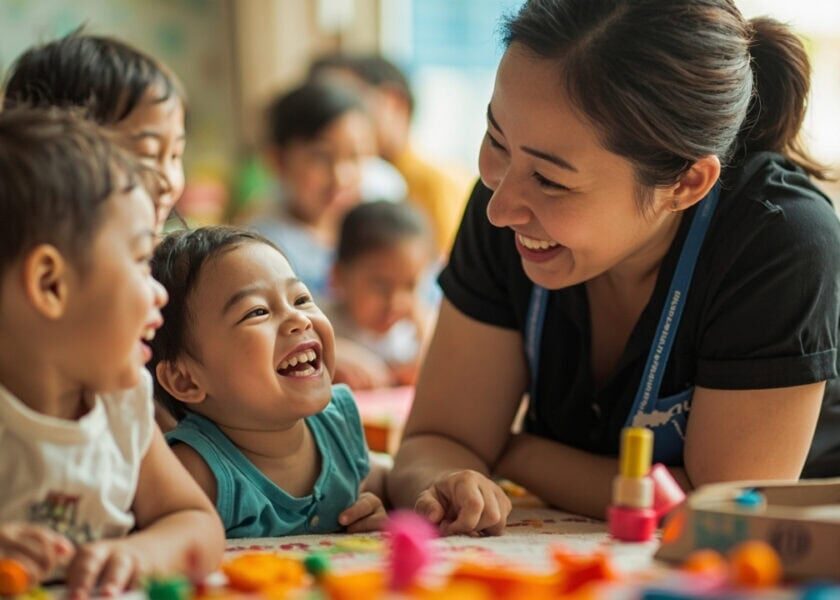
The Moment Your Childcare Arrangement Reveals What It Was Really Built For
The Sibling Threshold: How Singapore Families Discover That Childcare Needs Transform When a Second Child Arrives
There is a moment in every family — quiet, unannounced, rarely discussed — when something shifts. It is not the birth itself. That moment arrives a few weeks or months later, when the reality of two settles in, when the rhythm you built for one child suddenly feels like a song played in the wrong key.
The logistics compound. The guilt divides. And in that moment, a question surfaces that most childcare conversations never dare to ask: Was this arrangement ever really built for a family, or just for a single child?
That question is the beginning of everything EduNanny Singapore was designed to answer.
What the Sibling Threshold Actually Reveals
If you have navigated the early years with one child, you know the weight of that experience. The research. The nursery setup. The careful selection of care. You made decisions with a clarity that felt almost singular — as if the entire architecture of your child’s early development rested on one right choice.
And perhaps it did. For one child. One arrangement. One set of needs.
But families are not singular. And the moment a second child arrives, the architecture you so carefully built begins to show its seams.
It is not a crisis. It is a revelation.
Most parents do not experience the arrival of a second child as a catastrophe. They experience it as a slow, accumulating pressure — one that reveals something honest about what their childcare arrangement was actually designed to do.
The Questions Change Shape
When you have one child, the questions are manageable:
- Is this caregiver attentive?
- Does my child seem happy?
- Is the environment safe?
But with two children — especially two with different ages, different temperaments, different rhythms of hunger and sleep and curiosity — the questions change shape entirely:
- Can one caregiver hold the developmental needs of an infant and a toddler simultaneously?
- Can a single arrangement flex across two children who are learning to be siblings while also learning to be themselves?
- Can this family give both children what each of them deserves, without dissolving in the process?
These are not logistical questions. They are questions about care. And they are the questions that the sibling threshold forces into the light.
Why Arrangements Show Their Limits
What makes this moment so significant — and so often unspoken — is that it exposes the limits of arrangements that were never stress-tested for complexity.
A caregiver or a centre that excelled with one child may find that excellence does not scale easily when the family doubles. Ratio matters here in ways that feel personal.
A one-to-three infant ratio is not an abstract policy metric. It is the difference between a caregiver who can notice the subtle shift in a six-month-old’s engagement and one who is already occupied managing the older child’s need for independence while the infant waits.
It is the difference between a care environment that adapts and one that simply absorbs.
And when you have two children at different stages of development, you feel this in your bones. You feel it in the evenings when your toddler is pushing boundaries and your infant is fighting sleep and the day has asked more of you than one person could reasonably give.
The Singapore Reality
Singapore parents know this pressure intimately. The cost of living. The demands of dual-income households. The aspiration to give each child not just adequate care but genuine developmental attention — these realities do not diminish the joy of a growing family, but they do raise the stakes of every care decision.
The question is no longer simply about finding quality. It is about finding care that can grow with you — care that can hold the complexity of a real family rather than a theoretical one.
Care That Adapts vs. Care That Was Built for a Moment
Most childcare conversations frame the decision around quality versus convenience, or instinct versus necessity. But the sibling threshold reveals something more precise: the difference between care that is designed around a child and care that is designed around a system.
A system works well until the system is challenged. When the family changes, when the needs multiply, when the temperaments collide — a system shows you its edges.
But care that is built around the child — around the specific, evolving, irreducibly individual child — does not have edges. It flexes. It listens. It adjusts.
That is what EduNanny Singapore offers. Not a different way to do the same thing, but a different foundation entirely.
What Quality Childminding Actually Looks Like
When families are evaluating care at the sibling threshold, certain details stop being checkboxes and start being the architecture of their daily peace:
- Safe ratios: Up to one-to-three infant ratios mean that each child is genuinely seen, not managed
- Consistent schedules: Monday to Friday care blocks mean that the family rhythm is supported, not disrupted by arbitrary limitations
- Financial clarity: Within the ECDA Childminding Pilot fee structures, supported by CDA and Baby Bonus usability where applicable, this standard of care becomes accessible rather than aspirational
- Communication standards: Knowing what your children’s day looked like — how they slept, what made them laugh, whether the older one struggled with sharing and how it was handled
The sibling threshold is hard enough without adding financial uncertainty to the equation.
What Families Actually Need at This Moment
Beyond the structural elements, what families describe when they find the right arrangement is not relief about ratios or fee structures. It is something deeper.
It is the feeling of a care environment that can hold both children — their different needs, their different tempos, their different ways of being in the world — without forcing one to wait while the other is attended to.
- A toddler who is learning to assert her independence does not need to be managed differently because a new baby has arrived
- An infant who is building the foundations of trust and attachment does not need to be squeezed into a schedule designed for an older child
- Each child deserves care that meets them where they are
- A family deserves an arrangement that does not require them to choose between the two
This is what adaptability means in practice. It is not a feature or a promise. It is a daily, human response to the real complexity of raising more than one child.
The Emotional Dimension Nobody Talks About
The sibling threshold does not just test your childcare arrangement. It tests your sense of yourself.
When you had one child, there was a version of you that felt capable — stretched, certainly, but capable. With two, many parents experience a different kind of reckoning.
The hidden fear beneath the logistics is not “will my children be okay.” It is “will I be enough.”
Will I be enough for two children, for a partner, for my career, for the version of myself I thought I was becoming?
And the honest answer is that no parent is enough for all of that alone. That is not a failure. That is the reality that the sibling threshold makes impossible to ignore.
What you need is not more of yourself. You need a care arrangement that extends your capacity rather than substituting for it — that works with your family rather than around it.
EduNanny Singapore: Built Around This Moment
EduNanny by BUTLER operates within the ECDA Childminding Pilot. That is not simply a regulatory designation. It represents a model of care that has been shaped by a serious understanding of what infants and young children actually need.
What EduNanny offers is home-based care in the truest sense — because it does not require your family to fit into it. It fits into your family. It works within the ECDA Childminding Pilot to offer structure without rigidity, professionalism without impersonality, and the kind of personalised attention that makes the sibling threshold not a crisis to weather but a threshold to cross with confidence.
Why Transparency Matters
When you are re-evaluating care with two children, you are not just looking for a caregiver. You are looking for a partner in your family’s rhythm.
Communication from your caregiver or care provider should not be a courtesy. It should be a standard. When EduNanny operates with clear communication protocols, with visibility measures in place where deployed, you are not receiving a service feature. You are receiving the thing that allows you to trust.
Trust at the sibling threshold is not built on faith. It is built on knowledge.
The Dignity of Care Work
There is also a dimension of this moment that we do not talk about enough: the role and the dignity of the childminder herself.
When care is stretched thin — when one caregiver is managing two, three, sometimes more children in an environment not designed for that complexity — it is not just the children who feel it. The caregiver feels it.
The quality of attention. The patience. The ability to respond with warmth rather than efficiency. These diminish not because the caregiver lacks commitment, but because human care has real limits.
A model that respects the caregiver-to-child ratio is, in a quiet and practical way, a model that respects the dignity of care work itself. EduNanny’s approach does not ask one person to do the work of two. It creates the conditions in which the caregiver can bring her full attention, her full warmth, her full professional capability to each child in her care.
That is not a small thing. That is everything.
Common Questions at the Sibling Threshold
Is home-based childminding as reliable as a centre?
The ECDA Childminding Pilot provides the framework that ensures quality standards, consistent ratios, and professional oversight. What families gain is the adaptability of home-based care without sacrificing the structure that keeps children safe and supported.
Can one caregiver really give both children enough attention?
This is exactly the right question to ask — and it is why ratios matter so deeply. When infant-to-caregiver ratios are respected, one attentive caregiver can offer genuinely personalised attention to each child. When ratios are stretched, neither child receives what they need. The sibling threshold exposes this distinction in ways that single-child care never could.
Is this affordable for our family?
The pilot fee structures, supported by CDA and Baby Bonus usability where applicable, are designed to make quality care accessible rather than aspirational. The sibling threshold is hard enough without adding financial uncertainty. Understanding what support is available is part of making a confident decision.
What Changes When the Arrangement Fits
And when those conditions are right — when the ratio is safe, when the communication is clear, when the arrangement is built around the child rather than around administrative convenience — something shifts in the family.
It is not dramatic. It is not a headline. But parents describe it in similar ways:
- The feeling of leaving for work in the morning and not carrying a low-grade anxiety about whether both children are okay
- The feeling of coming home and finding both children settled, engaged, secure
- The feeling of realising that the arrangement is not just managing your family but fitting alongside it, growing with it, flexing with it the way a healthy ecosystem flexes rather than the way a rigid structure breaks
A Framework for Your Decision
If you are re-evaluating care at the sibling threshold, here are the questions that matter most:
- Ratio clarity: Can this arrangement genuinely support the developmental needs of both my children simultaneously, or will one child always be waiting?
- Adaptability evidence: Has this model shown it can flex across different ages, temperaments, and developmental stages, or was it designed for a single moment?
- Communication standards: Will I know what my children’s days look like, or will I be guessing?
- Family fit: Does this arrangement require my family to constrain itself, or can it grow with us?
- Caregiver sustainability: Are the conditions here ones where a caregiver can bring her full attention and warmth, or is she being asked to do more than is humanly possible?
For Families at This Threshold
The sibling threshold is not a problem to be solved. It is a truth to be understood.
The question was never “is this good quality care.” The question was “is this care built to evolve with us.”
Most arrangements were not designed with that question in mind. They were designed for a moment — a first child, a first home, a first set of needs. And they served that moment well.
But a family is not a moment. A family is a living, changing, increasingly complex architecture of people who need different things at different times, who grow in directions you cannot always predict, who will surprise you every single day.
EduNanny Singapore does not promise to predict that future. No one can. But it offers something more grounded: a model of care that is built to flex, to adapt, to meet each child where they are — and to grow with your family when the family itself grows.
If you are standing at that threshold — if you are a parent with two children, or approaching that moment, or simply beginning to suspect that your current arrangement was designed for one child and not for the life you are actually living — know this:
The recognition itself is a form of clarity. You are not failing. You are seeing more clearly.
And the choice that follows that clarity is not about finding the most expensive or the most praised option. It is about finding the arrangement that can hold your whole family — both children, their different ages, their different needs, their sibling bond that is just beginning to form — with the attention and the warmth and the professional care that each of them deserves.
That is not a luxury. In Singapore, with the cost of living what it is, with the demands of modern parenthood what they are, with the dreams you hold for both your children — that is a necessity. And it is available.
EduNanny Singapore is built for this moment. For your family. For your children. For the life that is growing and changing and becoming more than it was.
And that is exactly what it was always meant to do.
If you are exploring care options for your growing family, we would be glad to hear from you. Learn more about who we are or explore how EduNanny Singapore supports families at every stage.