Redefining Parental Presence for Singapore’s Working Families
The Question Every Working Parent in Singapore Carries
There is a moment, somewhere between the nursery door and the office lift, that every working parent in Singapore knows. It is the moment when you have just handed your child to someone else and you are walking away.
In that moment, a question surfaces—not loud, not dramatic, but persistent. It lives beneath every decision you have made about returning to work, about childcare, about the life you are building for your family.
Am I still present in my child’s life if I am not there?
You are not alone in asking it. You are not weak for asking it. But I want to suggest to you today that it is the wrong question—and that once we learn to ask the right one, everything changes.
The Fear Is Real. And It Is a Misunderstanding.
The fear is visceral. It lives in your chest when your child cries at drop-off and you wonder if that cry means something has broken. It surfaces in the quiet of your commute when you calculate how many hours remain before you will see their face again. It arrives uninvited at 11 p.m. when you slide into bed exhausted, knowing you have tomorrow’s meeting at dawn and tonight’s bedtime story was the first real pause in your day.
You wonder: Are they forming attachments without me? Will they know it was me who held them? Am I becoming a visitor in my own child’s life?
These fears are real. They are not irrational. They are the honest cost of a life where you have chosen—as most Singapore parents do—to build a career and a home simultaneously.
But here is what needs to be said clearly: the fear is real, and it is also a misunderstanding. Not of your love. Not of your commitment. A misunderstanding of what presence actually is.
We have been taught, by culture and instinct and half-remembered parenting philosophy, that presence is a function of time. That to be present means to be physically there, to occupy the same space, to accumulate hours. We have internalised a kind of invisible arithmetic: hours with my child equals presence. Absence equals loss.
But presence has never been about hours. It has always been about quality.
Consider this. You can sit in a room with your child for an hour while your mind is on your presentation, your phone, your anxiety. You can be physically there and emotionally absent. And a child knows the difference. They feel it in your touch, in the pace of your voice, in whether your attention is truly with them or merely hovering nearby.
Now consider another scenario. You have had a day where work went well, where you felt capable and focused. You come home to your child without the weight of guilt, without the defensive need to prove something. You kneel down. You look into their eyes. You are not thinking about what you missed. You are only thinking about them.
That moment of eye contact, of genuine engagement, of your child feeling seen—that is presence. That is the thing that builds attachment.
What Child Development Actually Tells Us
Here is what we know from the psychology of parenting and child development: children do not need their parents to be their only caregivers. They do not need their parents to be their only teachers, playmates, or sources of stimulation.
What children need—what actually builds secure attachment and healthy development—is emotional attunement. It is responsiveness. It is the experience of being seen and known by adults who are attuned to their signals.
A parent who comes home depleted, distracted, and fighting internal guilt is not able to provide this attunement at the level their child needs. Exhaustion is not neutral. When you are running on empty, your patience thins. Your responses become mechanical. The warmth in your voice becomes effortful rather than natural.
Your child registers this. They do not judge it, but they feel it. It is not a crisis. It is simply a dimming.
Now consider the parent who has been able to work, to feel productive and purposeful. This parent comes home not depleted, but recharged. Not guilty, but grateful. And in that space of emotional availability, something extraordinary becomes possible: true connection.
The difference between these two scenarios is not the number of hours. The difference is your capacity to be emotionally available.
Quality Childminding Builds the Foundation for Your Presence
Professional, quality childcare does not diminish your parental presence. It creates the foundation for your presence to be deeper, more available, and more fully given.
Here is what to look for when evaluating care options in Singapore:
- Small caregiver ratios: Fewer children per caregiver means more individual attention, more responsiveness, more consistent attunement to your child’s signals.
- Consistent caregivers: Your child thrives on predictability. Consistent faces build security, not confusion.
- Structured environments: Good care is not passive. It actively supports language development, motor skills, and social exploration.
- Expanding your child’s world safely: Quality care introduces your child to capable, caring adults who model warmth and responsiveness. This builds resilience, not replacement.
- Transparent communication: You deserve to feel connected to your child’s day—not because you doubt the care they are receiving, but because connection is human.
The hours your child spends in quality care are not hours lost. They are hours in which your child’s social world expands, in which their language is modelled by other attentive adults, in which they learn that the world is safe and populated by capable, caring people.
And critically, those hours are hours in which you are not held to a standard no human being can sustain. You are allowed to rest. You are allowed to work. You are allowed to be the adult you need to be so that when you return to your child, you can be the parent you want to be.
The better the care, the more your child is held in a warm, responsive, stimulating environment during the day, the more your child is primed for connection when you walk through the door. They are ready—ready for your voice, your touch, your full attention. Ready to experience the sweetness of reunion that is one of parenthood’s most underrated gifts.
EduNanny: Parental Infrastructure, Not Childcare Substitution
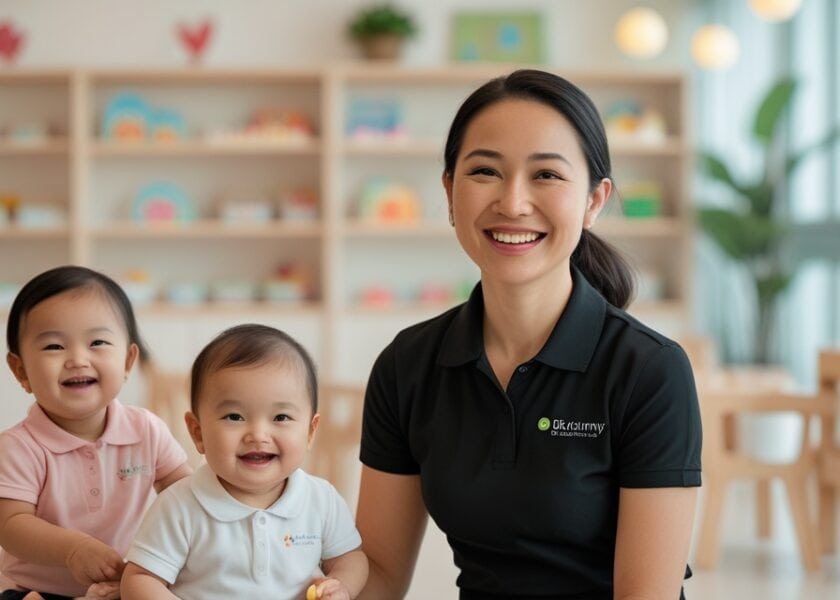
It is here, at this intersection of philosophy and practical reality, that EduNanny enters your life—not as a replacement for what you provide, but as infrastructure for what you provide.
EduNanny is part of the ECDA Childminding Pilot, and I want to be clear about what that means, because it matters. This is not a standard childcare centre making broad promises. The Childminding Pilot is a government-recognised framework specifically designed to address the realities of Singapore’s working families.
What the Childminding Pilot Offers
- Infant ratios of up to one to three: This is not a marketing feature. It is a commitment to attention quality. In an environment where one caregiver is present for three infants, your child is not one face in a crowd. They are seen. They are known. They are responded to.
- Monday to Friday care blocks: Because Singapore’s working parents work Monday to Friday. This is not a limitation—it is a design. It means your child’s routine has continuity, that the care environment and the home environment complement each other.
- Accessible fee structures: The CDA and Baby Bonus schemes are usable here, because this is infrastructure for families, not a premium service for those who can outspend others.
- Transparent communication systems: Systems that allow you to feel connected to your child’s day—not because you doubt, but because you want to be part of their story even when you are apart.
The Philosophy Behind the Care
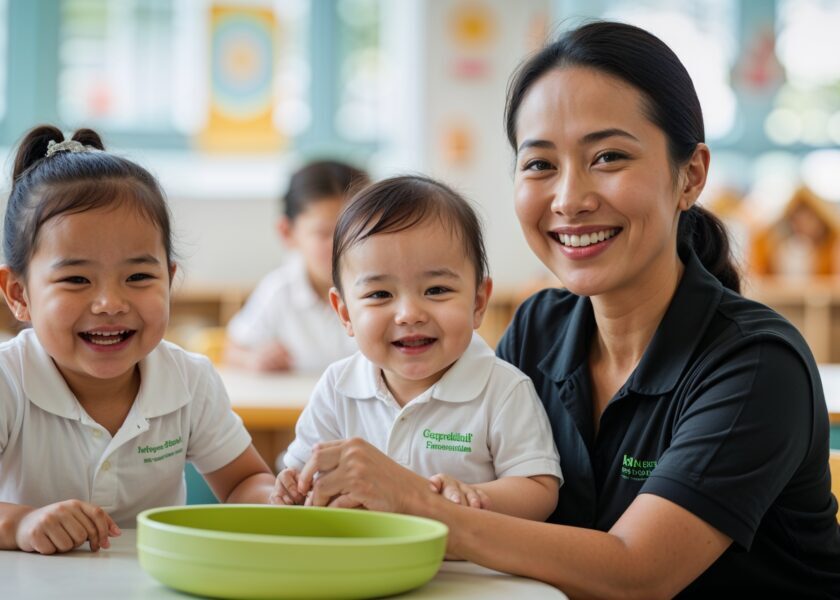
The philosophy is this: the role of a childminder is not to do what a parent does. It is to create conditions in which the parent-child relationship can deepen. The caregiver is not a substitute. The caregiver is a collaborator.
They hold space so that you can come home and fill that space with something no caregiver ever can—your unique, irreplaceable love for your child.
There is a dignity in this that we do not always name. The childminder who arrives each morning and greets your child with genuine warmth is not taking your place. They are holding your child in trust. They are nurturing a human being in your stead, for a few hours, with skill and intention.
When your child learns to trust other capable adults, when your child builds a secondary attachment that expands their sense of safety in the world, they are not turning away from you. They are building resilience that will serve them their entire life.
This is not a loss. This is growth.
Addressing the Identity Transition Every Working Parent Faces
When you become a parent, something shifts. The person you were before—your ambitions, your rhythms, your self-concepts—does not disappear, but they are joined by another identity. You become a parent. And if you return to work, you become a working parent. Not a lesser version of a parent. A different kind of parent.
The tension is not just logistical. It is existential. Who am I now? What do I owe my child? What do I owe myself? Can I be both the parent I want to be and the professional I worked to become?
The answer is yes. But it requires infrastructure. It requires support systems that do not judge you, do not pity you, do not treat your choices as compromise. You need a childcare framework that sees you as a full person making full decisions—not as a guilty parent requiring absolution.
When you drop your child at a place that treats your choice as noble rather than compromised, you feel something different. You do not carry the weight of apology into your day. You carry the weight of purpose.
Purpose is the enemy of guilt.
When you know why you are doing what you are doing—when you understand that your work is not an absence from your child but a contribution to the life your child will inherit—the guilt loosens its grip. Not immediately. Not completely. But enough. Enough to breathe. Enough to be present.
Practical Guidance: Choosing Infant Care in Singapore
If you are researching infant care or childminding options in Singapore, here is what to look for and what to ask:
- Ask about caregiver ratios: For infants, lower is better. Up to 1:3 is a standard that prioritises your child’s individual needs.
- Ask about consistency: Will your child have a primary caregiver, or will faces rotate frequently? Consistency builds security.
- Ask about the environment: Is it stimulating, safe, and age-appropriate? Does it complement, not replace, the attachment you are building?
- Ask about communication: How will you know what your child is doing during the day? What systems are in place for transparency?
- Ask about fees and subsidies: Are CDA and Baby Bonus schemes usable? Are there accessible payment structures?
- Ask about philosophy: Does the care framework see itself as a collaborator with you, or as a replacement? The right answer matters.
Your Next Step
Quality childminding does not eliminate the working parent tension. It transforms it. You will still feel the pinch of the morning goodbye. But underneath that moment, there will be a foundation of clarity. You will know, with increasing conviction, that your child is safe, is held, is loved in your absence.
And you will know that when you return, you have something real to offer.
You are not choosing between your child and your career. You are building a family in a modern world, and that requires modern solutions. It requires people who see you clearly, who understand the tension you live in, who can hold your child with skill and warmth while you do the work only you can do.
When you kneel down and your child runs to you with that face—that face that is happy to see you, that trusts you completely, that has been secure all day and is now ready to be secure in your arms—you will know something that many parents never learn.
Presence was never about the hours you spent. It was always about the love you carried.
EduNanny is here to help you carry it well—not just childcare, but parental infrastructure. Not just care, but presence support. If you are a parent in Singapore navigating this decision, we would be glad to hear from you.
EduNanny is part of Singapore’s ECDA Childminding Pilot, offering quality infant care designed around the needs of working families. Connect with our team to learn how we can support your family, or read more about our approach.