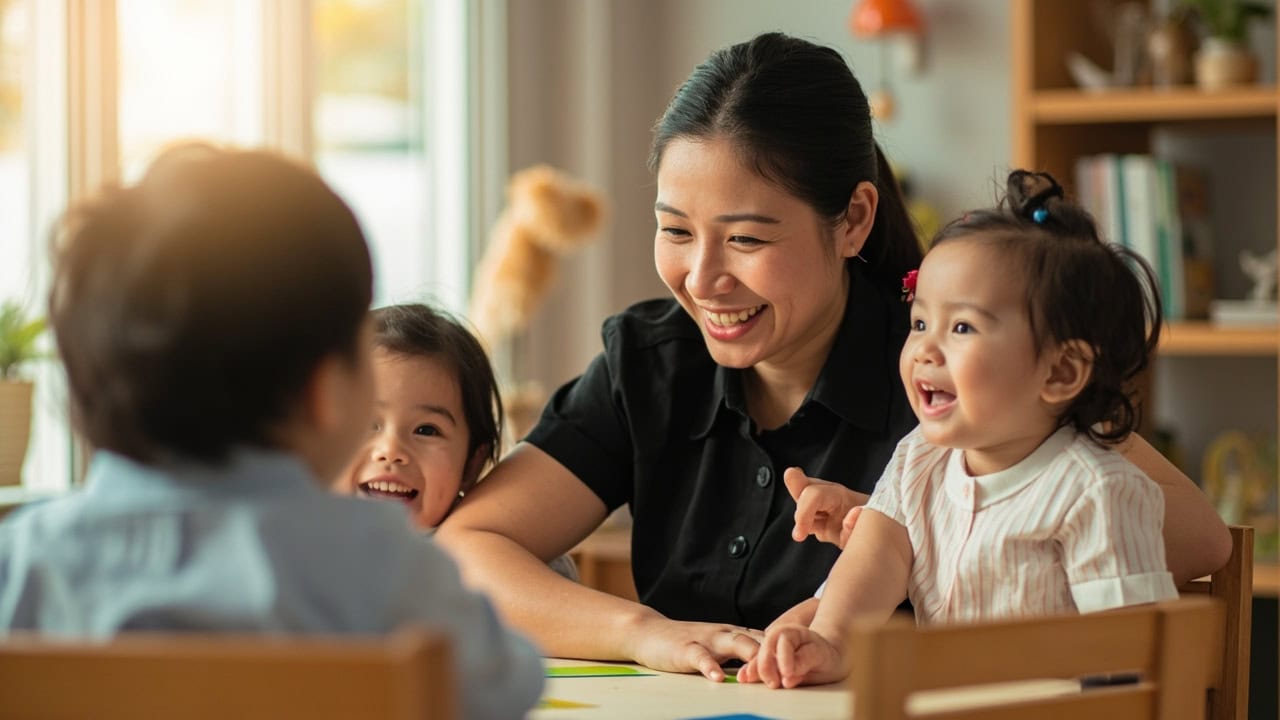
Building Lasting Partnership With Your Child’s Caregiver
Understanding True Partnership With Your Child’s Caregiver
Let us start by clearing something up, because the anxiety around “doing it right” can distort the very relationship you are trying to build.
Partnership is not hovering. It is not checking your phone every hour for updates, quizzing your caregiver about every diaper change, or interpreting a slightly lower appetite at lunch as evidence that something is wrong. These impulses come from love—but love expressed this way can undermine the very trust you are trying to build.
Partnership is also not checked-out detachment. It is not handing over complete responsibility and pretending your role as a parent pauses at the childcare gate each morning. Sometimes distance comes from exhaustion. Sometimes it comes from a cultural expectation that trusting childcare means stepping back entirely. But this, too, serves no one—not you, not your caregiver, and certainly not your child.
The partnership we are talking about sits somewhere in the middle. It is the willingness to communicate clearly, to show up consistently, and to build something over time that neither of you could create alone.
When you chose your child’s caregiver, you did not hire a service provider in the transactional sense. You entered into a relationship with another human being who will spend more waking hours with your child than almost anyone else in their early years. That relationship deserves the same care you would offer any meaningful partnership in your life. It is not about perfection. It is about presence.
What Partnership Looks Like in Daily Life
Here is what partnership looks like on a Tuesday afternoon in February, six months after enrollment.
You arrive for pickup. Your toddler runs toward you with that particular shriek of delight, then immediately turns back to show their caregiver something on the shelf. The caregiver catches your eye and says, “She has been so proud of her tower all afternoon—twelve blocks, all by herself.”
You feel a small swell of something—pride, gratitude, the quiet relief of being known. This is partnership. Not a formal meeting, not a written report, but a small exchange that tells you something meaningful about your child’s day.
Communication in quality childcare is not only the scheduled conversations or parent-teacher meetings. It is these micro-interactions, accumulated over weeks and months, that build a shared understanding no app can replace.
Transparency in childcare is not surveillance for its own sake. It is the kind of openness that allows both parents and caregivers to see the whole child—across home and childcare, in all their complexity. When communication structures are genuinely in place—regular touchpoints, thoughtful updates, a clear system for questions and concerns—you have the foundation for partnership.
In quality home-based arrangements, caregiver ratios that allow for genuine attention make this kind of communication possible. When an infant programme maintains up to a one-to-three ratio, caregivers have the capacity to observe carefully, notice small developments, and share them in ways that feel meaningful rather than transactional.
Watching Your Child Grow With Curiosity, Not Anxiety
Singapore parents carry unique pressures. The cost of living. The expectations of academic achievement that loom even before preschool. The difficulty of balancing career advancement with the demands of early parenthood. These pressures can distort how we see our children’s development.
We start measuring progress against milestones, against other children, against an internalized standard of what our child should be doing by a certain age. Developmental awareness matters—understanding the broad strokes of how children grow, the progression from infant to toddler to preschooler. These are genuinely useful. But milestone-watching becomes problematic when it turns into milestone-anxiety, when every small variation is interpreted as a warning sign, when the joy of watching your child discover the world is overshadowed by fear.
A good partnership with your caregiver can help you hold this balance. When your caregiver notices that your infant is reaching for objects more purposefully, or that your toddler is beginning to engage in parallel play with another child, they are offering you information—not a diagnosis, not a performance review, but a window into your child’s experience.
The key is to approach this exchange with curiosity rather than anxiety. With a desire to understand rather than to judge.
Supporting Growing Independence
There is another dimension to partnership that often goes unacknowledged: the way your child’s relationship with their caregiver evolves over time, and your role in supporting that evolution.
In the early weeks and months, your infant’s attachment to their caregiver is built on consistency, warmth, and responsiveness. The caregiver becomes a secure base—a person your child trusts to meet their needs, to provide comfort, to be present. This is healthy and important.
But as your child grows, something shifts. They begin to develop their own sense of agency, their own relationships, their own identity separate from you. The toddler who runs into childcare each morning, barely pausing to say goodbye, who turns immediately to their friends and their activities—this is not rejection. This is development. This is your child growing.
Supporting this growth means being willing to let go in small ways. It means resisting the urge to rescue your child from every minor frustration, to hover at the gate, to pull them back into the dependent infant relationship that, while precious, cannot last forever.
It also means staying attuned to your own feelings as a parent—recognizing that your child’s growing independence can evoke complex emotions. It is okay to feel a twinge of sadness even as you celebrate their confidence.
Navigating Transitions as Your Child Grows
A practical question many parents ask: how do I navigate transitions as my child moves from infant to toddler to preschooler, especially if I am staying within the same childcare arrangement?
Transitions within a consistent care setting can be surprisingly smooth, precisely because the relationships are stable. The caregiver who has known your child since infancy understands their temperament, their preferences, their fears and joys. When the curriculum shifts, when the daily rhythm changes to accommodate an older child’s developmental needs, there is continuity in the human relationship even as the programme evolves.
But transitions also require intentional communication. As your child’s needs change, the information you share with your caregiver should evolve. The concerns of a parent with an infant—feeding schedules, sleep patterns, health considerations—differ from the concerns of a parent with a toddler or preschooler—social dynamics, emerging language skills, the growing complexity of play.
The Seasons of Partnership
Partnership develops over time, and different seasons call for different approaches.
In the earliest days, the priority is consistency and communication. You are learning your caregiver’s style; your caregiver is learning your child’s cues. Expect some adjustment—this is normal. Share generously: sleep patterns, feeding preferences, comfort strategies that work at home. Ask questions without judgment. This is the season for establishing the communication patterns that will serve you for years.
By three months, you and your caregiver have developed a rhythm. The updates become richer, the exchanges more natural. You start to notice patterns together—how your child responds to different activities, what soothes them when they are upset, who they gravitate toward in group settings. This is when partnership begins to feel reciprocal rather than transactional.
As your child approaches their first birthday, you will likely notice a shift in your own relationship with the arrangement. The anxiety of the early weeks has settled into quieter confidence. You trust your caregiver. You trust the process. You are beginning to see your child as a whole person—one who is known and loved across two worlds, home and childcare, and who benefits from the collaboration between them.
Your Real Worries, Addressed
There is something many parents feel but rarely articulate: the worry that they are not doing enough.
This worry is so common among Singapore parents that it has almost become invisible—a background hum of anxiety that accompanies the already difficult work of raising young children in a demanding city. These questions do not have single answers because the right answer is always contextual. But here is a gentler truth: showing up consistently, communicating openly, and maintaining a posture of genuine collaboration is, in most cases, enough.
“Am I checking in too much?”
The urge to check in constantly comes from love, not distrust. But constant checking can undermine the very trust you are trying to build—with your caregiver and with yourself. A better approach: establish clear communication rhythms that work for both of you, and trust that significant concerns will be raised by either party.
“What if something happens and I don’t know about it?”
Quality childcare arrangements build transparency into their structure—not as surveillance, but as openness. Ask your programme about their communication approach. What updates can you expect, and how often? What is the process for urgent concerns? The answers to these questions will tell you a great deal about whether the arrangement prioritizes genuine partnership.
“How do I know if my child is actually thriving?”
You know your child is thriving when you see signs of security, curiosity, and growing confidence—not when you see them hitting every milestone on schedule. A good caregiver will help you see these signs by sharing observations that go beyond the transactional: how your child interacts with peers, how they handle transitions, what makes them light up during the day.
“What if my child seems to prefer their caregiver to me?”
This is more common than you might think, and it is almost never what it seems. Your child’s comfort with their caregiver is a sign of secure attachment—not a replacement for you, but an expansion of their world. The toddler who runs to their caregiver in the morning is not rejecting you; they are showing you that they have developed a second secure base. This is healthy. It means the arrangement is working.
Building a Partnership That Grows With Your Family
There is something worth pausing on here. In the earliest years of life, children are extraordinarily receptive. Their brains are developing at a pace they will never match again. The relationships they form, the experiences they have, the security they feel—all of these become part of the foundation on which their future selves will be built.
When parents and caregivers work together in genuine partnership, they are not just managing logistics. They are participating in something significant: the creation of a human being.
The science of early childhood development tells us that the first years matter enormously—not in the guilt-inducing way that popular parenting culture sometimes implies, but in the honest recognition that early experience shapes brain architecture, influences stress responses, and sets patterns that can persist for decades. When we take childcare seriously—as a society, as parents, as caregivers—we are acknowledging this truth.
The question becomes not just whether you have chosen well, but whether you are cultivating that choice over time. Whether you are investing in the relationship. Whether you are showing up, day after day, with the intention to partner rather than to supervise.
Consistent, quality childminding—offered by trained and registered caregivers in home-based settings—provides the continuity and personalized attention that children need to thrive. The ECDA Childminding Pilot is built on this understanding: that regular care rhythms, familiar faces, and predictable daily structures create the conditions for trust to develop over time.
A Partnership Available to You
Imagine your child, five years from now. Walking into a classroom with confidence. Turning back to wave at you with joy rather than anxiety. Building friendships, asking questions, exploring the world with curiosity.
Now trace backward through the years that made that child possible—the daily rhythms of infant care, the growing autonomy of toddlerhood, the emerging social world of the preschool years. Each of those moments, each of those days at childcare, was shaped not just by the programme itself but by the quality of the partnership that surrounded it. By the communication between you and your caregiver. By the trust you built incrementally through small, intentional acts.
That partnership is available to you. It begins with the decision you make today and deepens with every day you choose to invest in it.
EduNanny is here to support that journey—not as a service you purchase and forget, but as a partner who walks alongside you as your child grows. We know that Singapore parents carry heavy burdens. The cost of raising children in this city, the pressure of work-life balance, the competing demands on your time and attention. We do not pretend that childcare alone can solve these challenges. But we do believe that quality childcare, entered into with the right partnership mindset, can make them more manageable. Can give you greater confidence in your daily choices. Can create a space where your child thrives while you have the peace of mind to pursue your own work and well-being.
The decision is yours. The partnership is yours to build.
If you are researching infant care or childminding options in Singapore and want to learn more about arrangements that support genuine parent-caregiver partnership, we invite you to explore what EduNanny offers. Our team is available to answer your questions and help you find a pathway that fits your family’s needs.